Production Debugging And Error Handling
Asked of: Software Engineer
Last updated
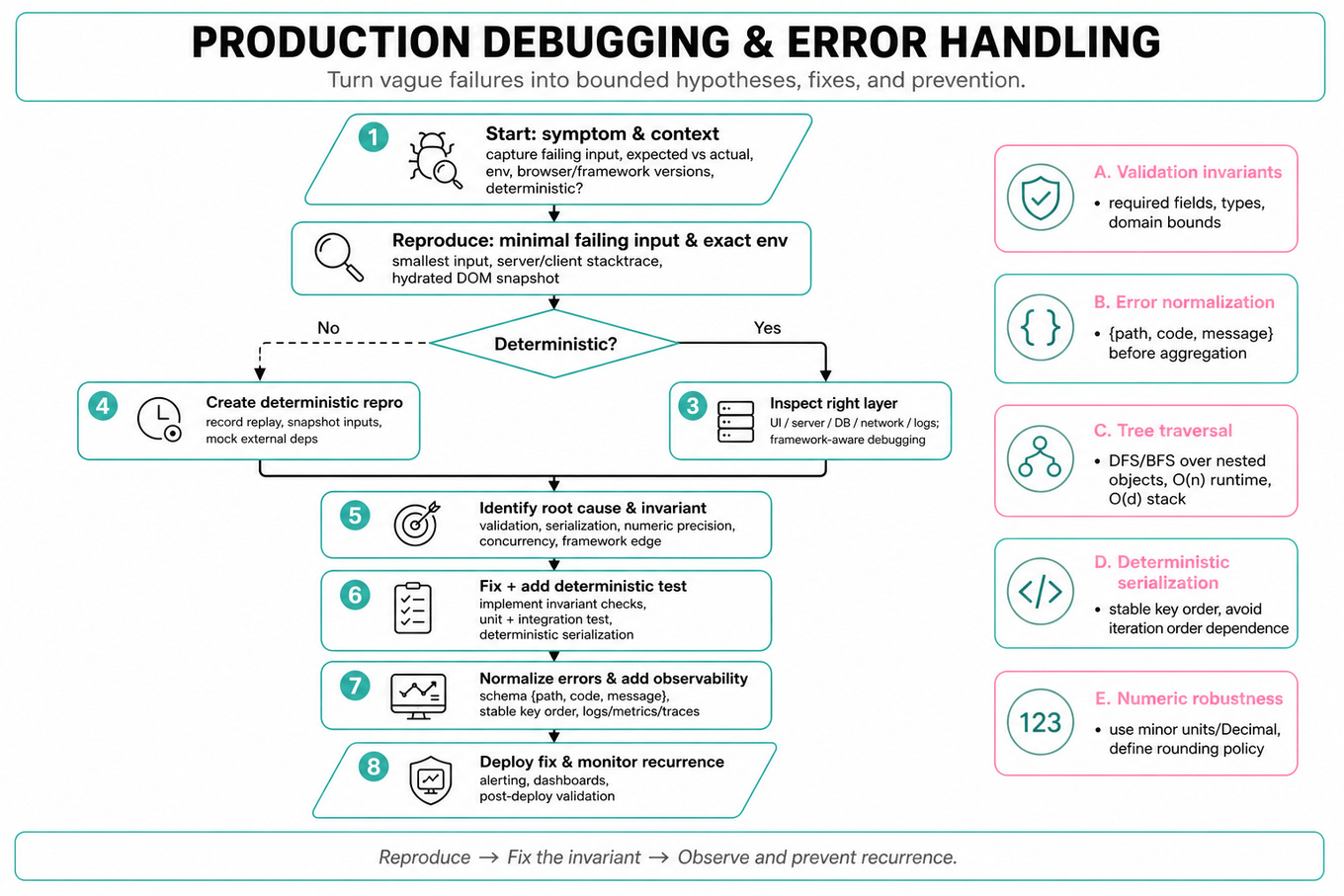
What's being tested
Interviewers are probing production-minded debugging: can you turn a vague failure into a bounded hypothesis, inspect the right layer, fix the root cause, and prevent recurrence? The recurring skills are input validation, error normalization, deterministic behavior, and framework-aware debugging across backend-style data transformations and frontend DOM behavior. Stripe cares because seemingly small validation bugs can create incorrect charges, confusing merchant integrations, broken compliance flows, or support-heavy edge cases. A strong Software Engineer answer shows not only “here is the bug,” but also “here is the invariant, the test that catches it, the observability I would add, and the failure mode I am intentionally handling.”
Core knowledge
-
Reproduction first beats speculative fixing. Start with the smallest failing input, expected output, actual output, environment details, and whether the issue is deterministic. For UI bugs, capture browser, framework version, server-rendered HTML, hydrated DOM, and user interaction path.
-
Validation invariants should be explicit and testable: required fields are present, types are correct, values are within domain bounds, and output shape is stable. For cost computation, examples include
quantity >= 0,unit_priceis finite, and totals avoidNaN/Infinity. -
Error normalization converts heterogeneous failures into a consistent schema, such as
{ path, code, message }. Nested validators often emit arrays, maps, exceptions, or nullable messages; normalize before aggregation so rendering, logging, and tests do not depend on library internals. -
Tree traversal is the common algorithm behind nested validation aggregation. Use DFS or BFS over objects/arrays, carry the current
path, and filter invalid leaves. Runtime should be over validation nodes, with stack space for depthdin recursive implementations. -
Deterministic serialization matters for tests, logs, and client-visible errors. Sort by stable keys such as
path,field_order, or insertion index; avoid depending on unspecified object iteration across runtimes. Determinism turns flaky failures into reproducible failures. -
Numeric robustness is part of error handling, not a polish detail. For money-like computations, avoid binary floating point where precision matters; use integer minor units or
Decimal. Check rounding policy, negative values, overflow, missing discounts, and stable sorting tie-breakers. -
Client-side validation improves UX but is not authoritative. A passport form can validate date format, required fields, pattern constraints, and accessibility state in the browser, but server-side validation must enforce the same security and business rules before persistence or payment.
-
DOM attributes vs properties are a common frontend debugging trap. In
React,classNamemaps to theclassattribute, boolean attributes may reflect differently, andvalueas a property can diverge fromgetAttribute("value"). Inspect both rendered HTML and live DOM state. -
SSR/hydration mismatches require layer-by-layer isolation. Compare server output, client bundle behavior, framework compile output, and post-hydration DOM. A bug may come from template compilation, prop casing, build transforms, browser normalization, or code that mutates DOM after render.
-
Observability should be proportional and privacy-aware. Log validation error codes, field paths, request IDs, version/build SHA, and counts, not raw passport numbers or sensitive user data. Use metrics like validation failure rate, top error code, and frontend exception count.
-
Testing strategy should include unit, property, integration, and regression tests. Unit tests cover edge cases; property tests generate malformed inputs; integration tests verify schema-to-UI behavior; regression tests lock the exact bug so the fix cannot silently revert.
Worked example
For Debug Validation Error Aggregation, a strong candidate would first clarify the expected output contract: should empty strings be included, how should nested paths be represented, and must ordering be stable across runs? They would ask for one failing input and actual output, then declare assumptions such as “I will treat null, undefined, and whitespace-only messages as non-errors unless the product contract says otherwise.” The answer should be organized around four pillars: reproduce with a minimal nested validation object, inspect the aggregator’s traversal logic, normalize/filter messages consistently, and add deterministic serialization plus regression tests.
The likely implementation shape is a recursive or stack-based traversal that carries path, recognizes arrays and objects, and emits only valid error leaves. The candidate should call out that filtering before flattening can be wrong if a parent object has no message but contains children with messages. A specific tradeoff is recursion simplicity versus stack safety: recursion is readable for typical form schemas, but an iterative stack is safer if untrusted or deeply nested schemas can exceed call-stack limits. They should also mention stable ordering: preserve schema order if user-facing, or sort by canonical path if test/log stability matters more. They would close with prevention: add unit cases for null, empty arrays, duplicate paths, mixed nested arrays/objects, and whitespace-only messages, then instrument aggregate error counts by code without logging sensitive field values. If more time remained, they could add property-based tests to generate arbitrary nested error shapes and assert no empty messages appear in output.
A second angle
For Debug wrong DOM attributes in unknown framework, the same debugging discipline applies, but the failure boundary shifts from data structure traversal to rendering layers. A strong candidate would not immediately blame the browser or framework; they would compare source component code, compiled output, server-rendered markup, hydrated DOM, and live properties inspected via element.getAttribute(...) and element.propertyName. The key invariant becomes “the semantic state represented by the component is reflected correctly in the accessible DOM,” not just “the string in HTML looks right.” The tradeoff is whether to use the framework’s idiomatic prop API or force raw attributes; idiomatic props are usually safer, but custom elements and accessibility attributes like aria-* may require exact attribute behavior. The prevention pattern is similar: create a minimal reproduction, add framework-specific regression tests, and verify behavior in the browser rather than relying only on snapshot strings.
Common pitfalls
Pitfall: Treating validation as a set of
ifstatements instead of a contract.
The tempting answer is “just skip null messages” or “just add another regex.” That misses the deeper issue: define the accepted input domain, normalized error schema, ordering guarantee, and ownership between client and server validation.
Pitfall: Debugging from the middle of the stack.
A weak communication pattern is jumping straight into code changes without saying how you would reproduce and isolate the failure. A better answer narrates the layers: input, transformation, framework/library behavior, output, logs/tests, then the smallest fix that restores the invariant.
Pitfall: Ignoring user-facing and operational consequences.
For Stripe-style systems, “the code passes the sample” is not enough. Mention how bad errors surface to users, whether sensitive data could leak in logs, how you would monitor the fix, and which regression tests would prevent recurrence.
Connections
Interviewers may pivot from this topic into API design, especially how to return stable error codes and field paths to clients. They may also ask about idempotency, observability, frontend accessibility, or distributed debugging using request IDs and structured logs. For coding-heavy variants, expect edge cases around sorting stability, precision, malformed input, and time/space complexity.
Further reading
-
Google SRE Book, “Monitoring Distributed Systems” — useful framing for symptoms, signals, and production debugging discipline.
-
MDN: HTML attribute reference — grounding for how browser attributes behave versus framework abstractions.
-
React DOM Elements — concrete examples of prop/attribute naming, boolean attributes, and hydration-related behavior.
Featured in interview prep guides
Practice questions
- Debug Validation Error AggregationStripe · Software Engineer · Onsite · hard
- Debug wrong DOM attributes in unknown frameworkStripe · Software Engineer · Technical Screen · medium
- Compute costs with validation and sorting in PythonStripe · Software Engineer · Technical Screen · medium
- Build and Validate Passport Form UIStripe · Software Engineer · Technical Screen · medium
Related concepts
- Debugging, Observability, And Production OperationsSoftware Engineering Fundamentals
- Product Debugging And Funnel AnalysisProduct / Decision Making
- Production Hardening and TestingSoftware Engineering Fundamentals
- Product Diagnostics And Root Cause Analysis
- Transformer Training Pipeline DebuggingMachine Learning
- Clean Coding, Requirements, and Edge CasesCoding & Algorithms