Recommender Systems Ranking And CTR
Asked of: Machine Learning Engineer
Last updated
What's being tested
This topic tests whether you can build and operate a learning-to-rank system whose predictions remain useful under real serving constraints. The interviewer is probing your understanding of CTR modeling, biased feedback data, offline-to-online evaluation, feature freshness, latency, and deployment safety. Microsoft cares because ranking models directly influence high-volume user experiences, and a small modeling or serving regression can affect both relevance and system cost at large scale.
Core knowledge
-
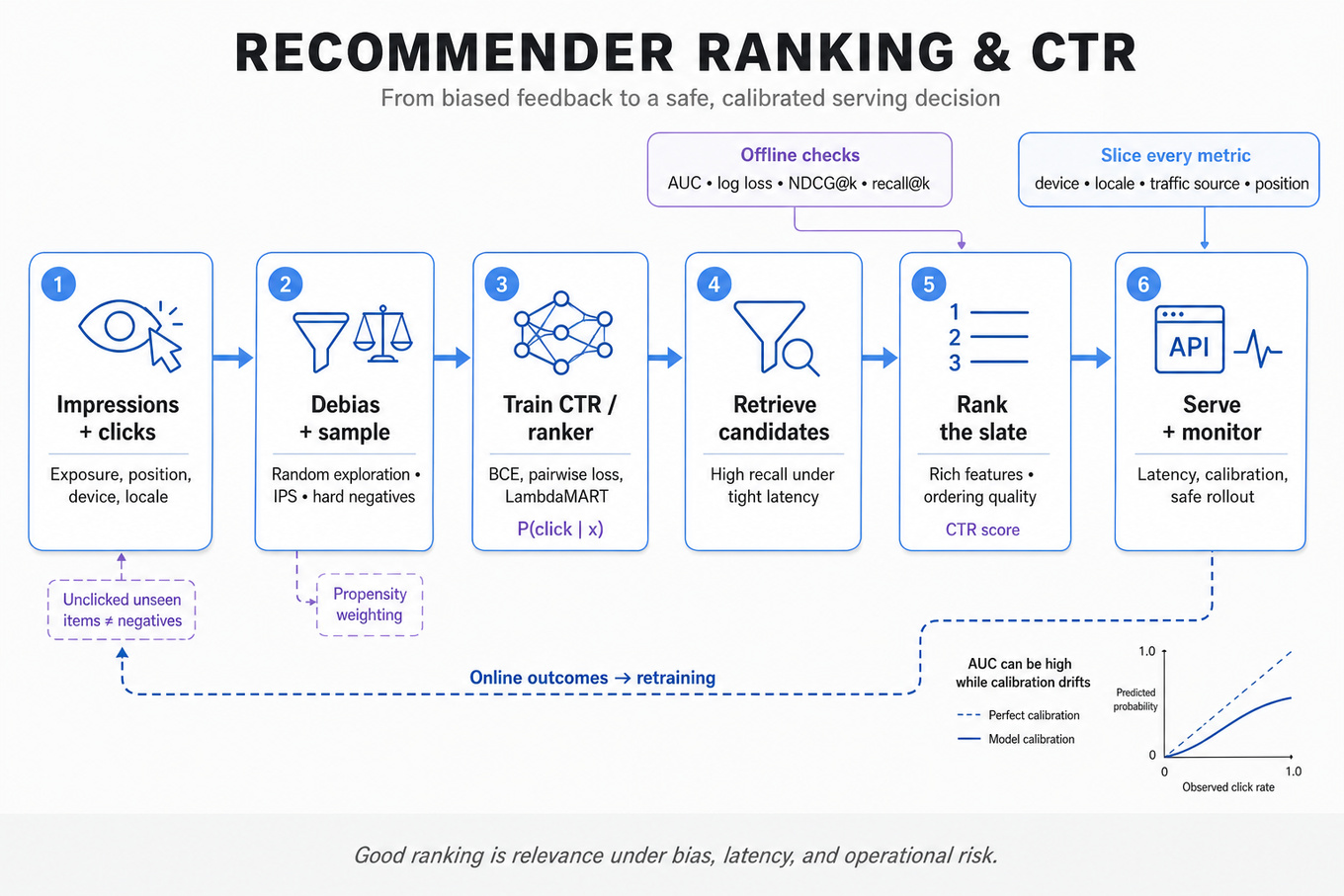
Ranking architecture usually has multiple stages: candidate retrieval, lightweight filtering, and a more expensive ranker. Retrieval optimizes recall under tight latency; ranking optimizes ordering quality using features unavailable or too costly for millions of candidates.
-
CTR prediction estimates , commonly with logistic regression,
LightGBM,XGBoost, deep cross networks, or transformer-based models. Binary cross-entropy is typical:
-
Pairwise and listwise ranking losses optimize ordering rather than isolated probabilities.
LambdaMARTapproximates changes inNDCG; pairwise losses such as Bayesian Personalized Ranking train , while listwise objectives model the entire displayed slate. -
Offline metrics must match the production objective and data structure. Use
AUCfor discrimination,log lossand calibration curves for probability quality,NDCG@korMRR@kfor ordering, and recall@k for retrieval; report slices, not only global averages. -
Calibration matters when scores drive downstream decisions, budgets, or blended ranking. A model can have excellent AUC but systematically overpredict clicks; use Platt scaling, isotonic regression, or calibrated loss, and validate calibration by device, locale, traffic source, and position.
-
Implicit feedback is biased: clicks reflect both relevance and exposure. Position, visibility, device, and prior rank affect observed labels. Counteract this with randomized exploration, propensity weighting such as inverse propensity scoring, or click models; never treat unclicked unseen items as ordinary negatives.
-
Negative sampling changes the training distribution. Random negatives are cheap but often too easy; in-batch, impression-based, or hard negatives better reflect serving candidates. Track the sampling ratio and correct or calibrate probabilities if the sampled distribution differs from production.
-
Feature parity means training and serving compute the same feature semantics, transformations, and time cutoffs. A feature store can help enforce this, but point-in-time joins are essential: features must only use information available before the impression to prevent leakage.
-
Freshness and latency are competing constraints. Precompute stable user/item embeddings, cache hot features, and compute request-time context selectively. Define budgets such as end-to-end
p99latency, model inference time, memory, and candidate count; measure them under realistic load rather than average latency. -
Delayed and contaminated labels require explicit windows. A click may be immediate, while conversion or dwell labels arrive later; use label maturity windows, avoid training on incomplete examples, and prevent post-impression events from entering features.
-
Online evaluation should include controlled A/B tests with guardrails: CTR, qualified engagement, latency, error rate, diversity, and negative feedback. Randomize at an appropriate user or session level, monitor novelty and interference, and use confidence intervals or sequential-testing controls rather than reacting to noisy early movement.
-
Drift monitoring covers input, prediction, and outcome distributions. Track feature missingness, category churn, score histograms, calibration, CTR by slice, and delayed-label performance. A model can have stable inputs but degraded quality when user intent or inventory changes.
-
Deployment safety requires versioned artifacts, reproducible training data, shadow or canary serving, rollback, and model/data compatibility checks. Compare the new model against the incumbent on both offline replay and live guardrails before increasing traffic.
Worked example — Design a CTR-ranking recommender
No titled interview question was supplied, so use this representative prompt: “Design a CTR-ranking recommender for a high-traffic feed.” In the first 30 seconds, clarify the object being ranked, the candidate volume, latency and freshness budgets, the definition of a click, and whether the goal is pure CTR or a broader utility metric. State assumptions such as a two-stage retrieve-and-rank pipeline, impression-level logging, and a delayed-label policy. Organize the answer around candidate generation, feature and label construction, model choice, offline/online evaluation, and deployment monitoring. Explicitly call out that logged clicks are position-biased, so impression exposure and randomized data or propensity correction are needed. A practical design might use a retrieval model for recall, a gradient-boosted or deep ranker for CTR, and calibrated scores combined with business or safety constraints only after relevance scoring. The key tradeoff is model complexity versus p99 latency and feature freshness: a larger model may improve offline NDCG, but stale or expensive features can reduce online quality. Close by saying that, with more time, you would quantify slice-level fairness, design exploration, test label maturity, and validate offline-to-online correlation.
A second angle
A different framing is an existing ranker whose online CTR dropped after deployment despite unchanged offline AUC. Investigate feature skew, missing or stale serving features, candidate-distribution changes, position shifts, calibration drift, and logging differences before replacing the model. Replay the exact production candidate sets, compare score distributions and per-position metrics, and inspect slices by client, geography, and traffic source. The response should emphasize diagnosis and rollback safety rather than proposing a new architecture immediately.
Common pitfalls
Pitfall: Treating every impression without a click as a true negative ignores unobserved exposure and position bias. Explain impression-based labels, randomized exploration, propensity weighting, or a click model instead.
A tempting answer reports only offline AUC and declares the model better. A stronger answer distinguishes discrimination, calibration, ranking at top-, slice performance, and online guardrails, then explains why offline gains may not translate to production.
A shallow response names a model such as XGBoost or a transformer without discussing feature availability, label delay, serving latency, rollback, or drift. Explain the operational contract: point-in-time training, online/offline parity, artifact versioning, canarying, and monitoring.
Connections
The interviewer may pivot to candidate retrieval, feature-store point-in-time correctness, counterfactual evaluation, A/B testing, or model drift and rollback. Be prepared to connect ranking quality to calibration, exploration, latency, and multi-objective constraints without turning the answer into a data-pipeline design.
Further reading
-
Learning to Rank for Information Retrieval — comprehensive treatment of pointwise, pairwise, and listwise ranking.
-
Deep Neural Networks for YouTube Recommendations — canonical large-scale candidate-generation and ranking architecture.
-
Practical Lessons from Predicting Clicks on Ads at Facebook — useful discussion of CTR modeling, calibration, and production constraints.