Reddit Semantic Search And ANN Retrieval
Asked of: Machine Learning Engineer
Last updated
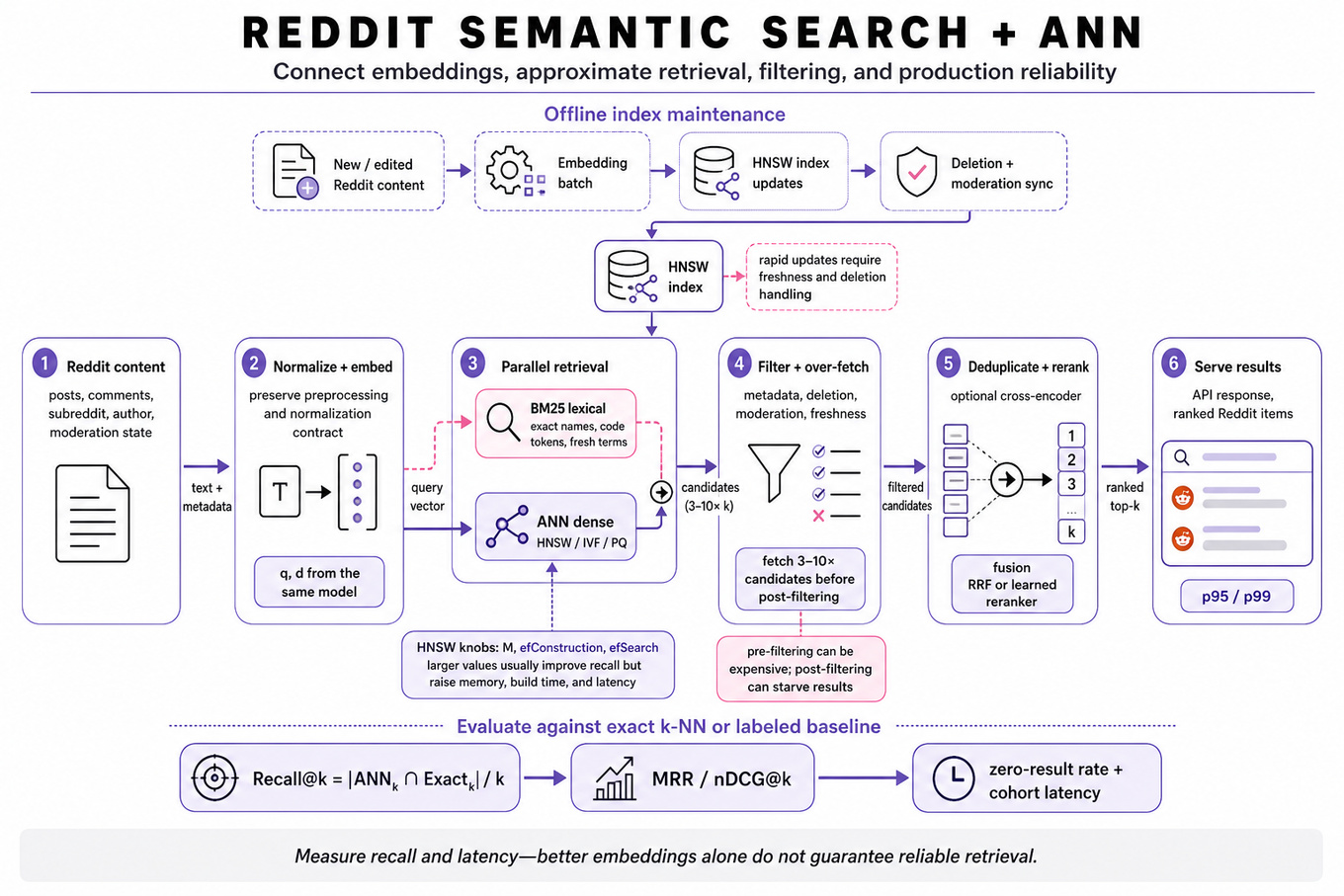
What's being tested
A strong candidate must connect semantic embedding models, approximate nearest-neighbor (ANN) indexes, and production model-serving constraints into one reliable retrieval pipeline. The interviewer is probing whether you can choose an index, define recall and latency targets, preserve offline/online parity, and handle Reddit-specific issues such as rapidly changing content, deletions, moderation state, and noisy user-generated text. They also want evidence that you can diagnose failures with measurements rather than treating “better embeddings” as the universal solution.
Core knowledge
-
Dense retrieval represents a query and document with vectors from the same embedding model, then ranks candidates by similarity. For normalized embeddings, cosine similarity is equivalent to inner product: ; always preserve the model’s preprocessing and normalization contract.
-
ANN indexes trade exactness for speed by avoiding exhaustive comparison against every vector.
HNSWoffers strong recall and flexible updates through graph search;IVFpartitions vectors into centroids and probes selected cells;PQcompresses vectors to reduce memory, usually at some recall cost. -
HNSWtuning centers onM,efConstruction, and query-timeefSearch. Larger values generally improve recall but increase memory, build time, and latency; exposeefSearchas a controlled runtime knob and benchmark it againstp95andp99, not only averages. -
Retrieval recall should be measured against an exact nearest-neighbor or high-quality labeled baseline: . Also track downstream
MRR,nDCG@k, success rate, zero-result rate, and latency by query cohort. -
Hybrid retrieval combines lexical matching, such as
BM25, with dense retrieval. Lexical search protects exact entities, subreddit names, usernames, code tokens, and fresh terms that embeddings may miss; fusion can use reciprocal-rank fusion or a learned reranker. -
A practical pipeline is query normalization → embedding generation → parallel lexical and ANN retrieval → metadata filtering → deduplication → optional cross-encoder reranking. Filtering before ANN can be difficult or expensive; post-filtering may return too few results, so over-fetch candidates by a factor such as 3–10 and measure the effect.
-
Embedding quality depends on training data and objective, not merely vector dimension. Use hard negatives that are lexically similar but semantically wrong, sample across subreddits and languages, and prevent temporal leakage by training and evaluating with time-based splits.
-
Freshness and index updates require an explicit policy. New posts may enter a mutable delta index or a separate recent-content index while periodic bulk indexes are rebuilt; query both, merge results, and remove deleted or moderated content through tombstones or filtering.
-
Online/offline parity means the serving path uses the same tokenizer, model version, normalization, language handling, truncation limits, and metadata rules as evaluation. Store model and index versions with every result so regressions can be reproduced and rollbacks are safe.
-
Capacity planning must include vector memory, replicas, rebuild overhead, and embedding-generation cost. A rough dense-memory estimate is bytes for
float32, before ANN graph or index overhead;float16or product quantization reduces memory but requires recall validation. -
Evaluation sets should include head, torso, and tail queries; spelling errors; long natural-language questions; exact-name queries; multilingual content; and adversarial or unsafe text. Slice recall and ranking quality by language, subreddit, content age, query length, and traffic tier.
-
Monitoring should separate model, index, and serving failures: embedding norm or distribution drift, query-to-document similarity shifts, ANN recall sampled against exact search, index age, missing-vector rate, filter rejection rate,
p50/p95/p99latency, timeout rate, and zero-result rate.
Worked example — Design a Reddit semantic search and ANN retrieval system
First, clarify whether the goal is related-post discovery, user-facing search, or candidate generation, and establish corpus size, freshness SLA, top-, languages, filters, and p99 latency budget. I would state an initial architecture of query embedding, parallel BM25 and ANN retrieval, metadata filtering, fusion, and optional reranking. The main pillars would be embedding-model training and versioning, ANN index selection and update strategy, offline/online evaluation, and production monitoring with rollback. I would choose HNSW for a high-recall mutable index if memory permits, while keeping a lexical path for exact terms and a delta index for recent posts. A key tradeoff is whether to post-filter ANN candidates, which simplifies index management but may lose recall under restrictive subreddit or moderation filters. I would validate the design with exact-search recall, judged relevance, age and language slices, and load tests at target concurrency. I would explicitly test deleted and moderated posts so stale vectors cannot surface content. If I had more time, I would compare a cross-encoder reranker against a cheaper feature-based reranker and quantify its incremental quality per millisecond.
A second angle — Debug a semantic-search recall regression
Here the framing shifts from initial architecture to fault isolation: first determine whether the regression is in embeddings, index construction, filtering, candidate fusion, or labels. Compare the affected model and index against the previous versions using identical queries, then measure exact-neighbor recall before applying downstream filters. Check for tokenizer changes, normalization mismatches, truncated inputs, stale or missing vectors, reduced efSearch, altered shard routing, and a larger corpus that changed candidate competition. Slice the drop by query type, language, content age, and subreddit to distinguish a global model problem from a coverage or freshness problem. The best answer proposes a safe rollback or dual-read comparison while identifying the root cause with versioned artifacts and targeted metrics.
Common pitfalls
Pitfall: Claiming ANN “returns the nearest neighbors” without qualification is analytically wrong. State that it approximates exact search and define recall against an exact or trusted high-quality baseline.
Pitfall: Jumping straight to
HNSWparameters without asking about corpus size, update frequency, filtering, and latency makes the answer sound memorized. Tie every parameter choice to a measurable constraint.
Pitfall: Treating embedding quality as the only source of relevance ignores lexical misses, stale indexes, moderation filters, and reranking. Explain how you would localize failures across each pipeline stage.
Connections
The interviewer may pivot to cross-encoder reranking, hybrid lexical-dense retrieval, contrastive learning with hard negatives, or feature and model drift monitoring. They may also connect retrieval quality to online experimentation while expecting you to preserve offline/online parity and guardrail metrics.
Further reading
-
Efficient and Robust Approximate Nearest Neighbor Search Using Hierarchical Navigable Small World Graphs — The foundational
HNSWpaper and its graph-search tradeoffs. -
The Faiss Library — Practical implementations of
IVF,PQ, and other vector-index approaches. -
Dense Passage Retrieval for Open-Domain Question Answering — A useful reference for dual-encoder training and retrieval evaluation.