Stripe Connect Marketplace Architecture
Asked of: Software Engineer
Last updated
What's being tested
This topic tests whether you can decompose a multi-party payments system into clear services, state transitions, and failure-handling paths. The interviewer is probing your understanding of money movement, connected-account isolation, idempotency, asynchronous webhooks, and reconciliation—not merely whether you can draw boxes labeled “payments” and “payouts.” Stripe cares because marketplace integrations must remain correct under retries, duplicate events, partial failures, disputes, and regulatory constraints while serving many independent platforms and sellers.
Core knowledge
-
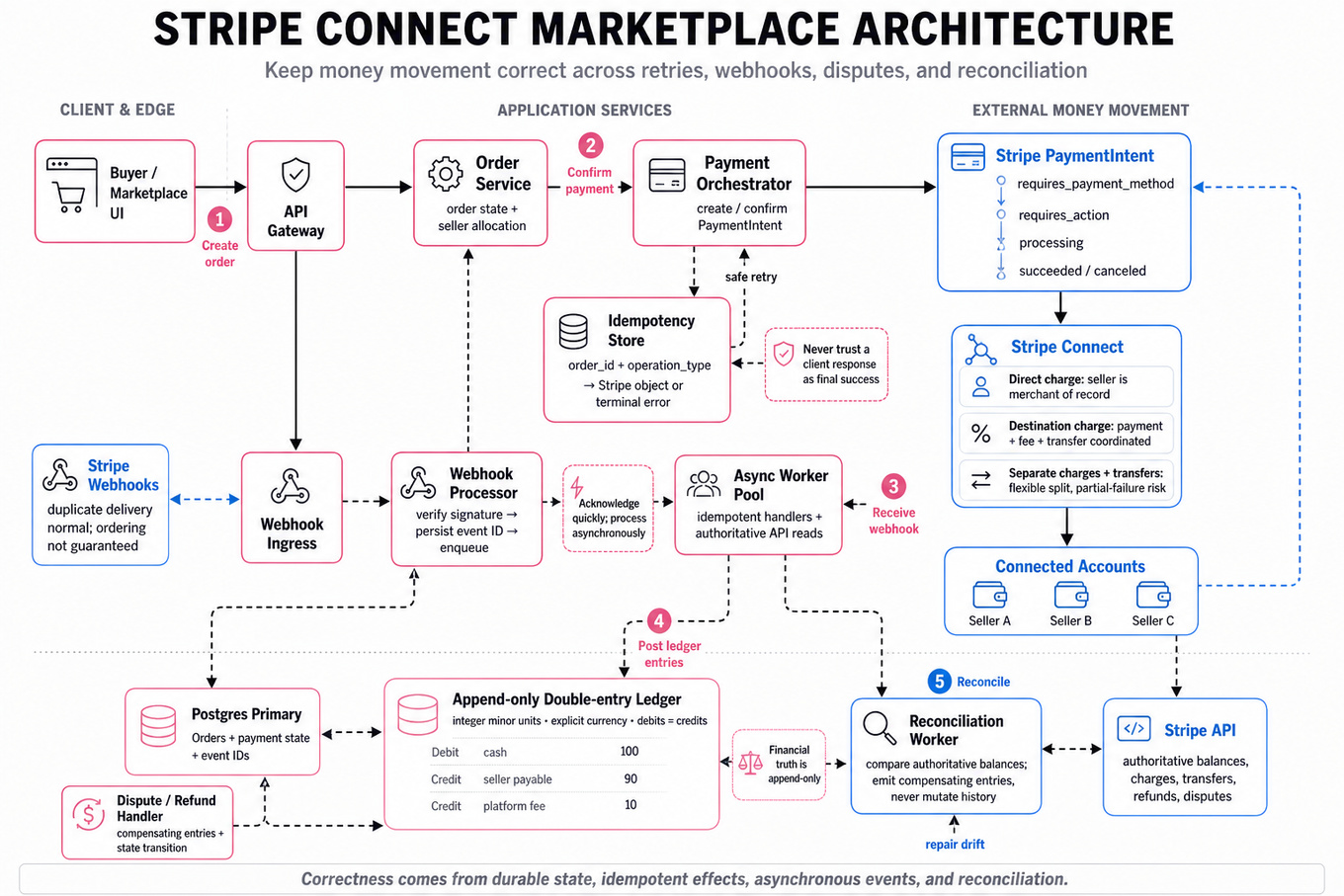
Connect account models determine who is merchant of record, who bears disputes, and where funds settle. Compare direct charges, destination charges, and separate charges-and-transfers; state the operational and liability tradeoffs rather than treating them as interchangeable.
-
Payment intent state machines should be explicit:
requires_payment_method,requires_action,processing,succeeded, andcanceled. Never infer success from a client response alone; persist the server-side state and accept asynchronous completion through signedStripewebhooks. -
Idempotency is required at every externally retried money-moving operation. Generate a stable key from the business operation, such as
order_id + operation_type, and store the resultingStripeobject or terminal error so a timeout cannot create duplicate charges or transfers. -
Double-entry ledgering separates financial truth from mutable marketplace records. Represent each posting as balanced debits and credits, use integer minor units, record currency explicitly, and make entries append-only; corrections should be compensating entries rather than updates.
-
Funds-flow choices affect atomicity. A destination charge can associate the customer payment, platform fee, and connected-account transfer in one
Stripeoperation; separate charges and transfers provide flexibility for split orders but require careful handling of transfer timing and partial success. -
Webhook processing should be durable and replay-safe: verify the signature, persist the event ID, enqueue work, acknowledge quickly, and process asynchronously. Duplicate delivery is normal; ordering is not guaranteed, so handlers must be idempotent and derive state from the event plus authoritative API reads when necessary.
-
Distributed consistency requires a state machine around orders, payment intents, transfers, and payouts. Use transactional local updates plus an outbox or durable event record; do not attempt a distributed transaction spanning your database and
Stripe. -
Reconciliation compares your internal ledger and order state with
Stripeobjects and balance transactions. Schedule incremental checks using creation timestamps and cursors, then run periodic full-window reconciliation; distinguish missing data, duplicate data, amount mismatch, and legitimately delayed settlement. -
Failure handling must classify errors: validation failures are usually permanent, network timeouts are ambiguous and require idempotent retry, rate limits need bounded backoff, and authentication or capability errors require operational remediation. Never blindly retry every
4xxresponse. -
Security and tenant isolation require authorization on every platform and connected-account resource. Store platform/account identifiers server-side, avoid trusting client-supplied amounts or seller IDs, encrypt sensitive configuration, verify webhook signatures, and ensure logs do not expose payment credentials or unnecessary personal data.
-
Payouts and refunds are separate lifecycle concerns from the initial payment. A refund may require reversing transfers or debiting a connected account depending on the flow; model these as explicit operations with their own idempotency keys, permissions, ledger entries, and asynchronous terminal states.
-
Scalability boundaries should be explicit. Partition work by platform or account where practical, use queue backpressure and per-account rate limiting, and query by indexed IDs and time windows. Preserve ordering only where a specific account’s state machine requires it; global ordering is expensive and unnecessary.
Worked example
Representative prompt: Design a Stripe Connect marketplace architecture. In the first 30 seconds, clarify whether the platform is merchant of record, whether one checkout can contain multiple sellers, whether sellers receive immediate transfers or later payouts, and what correctness guarantees are required for refunds and disputes. I would organize the answer around four pillars: the checkout and Connect charge model, an internal order and double-entry ledger, asynchronous webhook-driven state transitions, and reconciliation plus operational recovery. I would store an order-level idempotency key, create the appropriate PaymentIntent server-side, persist the Stripe identifiers, and treat webhooks—not browser responses—as authoritative for completion. For a multi-seller order, I would explicitly compare separate charges and transfers with a destination-charge design, explaining how each affects atomicity, fee allocation, and partial fulfillment. I would add an outbox-backed worker so database commits and event publication are reliable without pretending the database and Stripe share a transaction. The key tradeoff is simplicity versus flexibility: destination charges reduce coordination, while separate transfers support more complex seller allocation but create more failure and reconciliation cases. I would close by saying that, with more time, I would specify refund/dispute behavior, account capability failures, webhook replay tooling, rate limits, and a reconciliation runbook.
A second angle
Design reliable marketplace payouts and reconciliation uses the same architecture but emphasizes delayed settlement rather than checkout latency. The central questions become how to represent available versus pending funds, how to handle payout failures, and how to detect divergence between internal postings and Stripe balance transactions. A strong answer would use append-only ledger entries, cursor-based reconciliation, idempotent payout commands, and explicit compensation for reversals. It should also distinguish a temporarily delayed payout from an actual accounting mismatch instead of treating every discrepancy as a retryable API error.
Common pitfalls
Pitfall: Saying “charge the card, then update the seller balance” without defining who owns the funds, how the platform fee is represented, or what happens when the second operation fails. Separate payment state, transfer state, and ledger state, then explain their allowed transitions.
Pitfall: Claiming that a successful API response or frontend callback proves payment completion. Payments can require customer action or complete asynchronously; use persisted server state and verified webhook events, with idempotent handlers and replay support.
Pitfall: Drawing a generic microservices diagram while skipping money correctness. Interviewers usually care more about duplicate charges, refunds, disputes, retries, and reconciliation than about whether you selected
Kafkaversus another queue.
Connections
The interviewer may pivot to distributed transactions, the outbox pattern, double-entry accounting, webhook security, or designing an idempotent API. Be prepared to discuss state-machine invariants, eventual consistency, and recovery workflows without claiming exactly-once execution across external systems.
Further reading
-
Stripe Connect documentation — authoritative overview of connected accounts, charge types, transfers, and platform responsibilities.
-
Stripe Idempotent requests — concrete guidance for safely retrying API operations.
-
Martin Kleppmann, Designing Data-Intensive Applications — strong treatment of consistency, event delivery, transactions, and distributed-system failure modes.
Related concepts
- Stripe PaymentIntent Lifecycle And State Machines
- Stripe API Pagination, Expansion, And Rate Limits
- Marketplace And Payments Product MechanicsProduct / Decision Making
- Sharding And Partitioning For Payment Data
- Large-Scale Marketplace System DesignSystem Design
- Donation And Payment PlatformsSystem Design