Technical Communication For Nontechnical Audiences
Asked of: Software Engineer
Last updated
What's being tested
This prompt tests whether you can translate a technical system into the listener’s decision, not whether you can recite implementation details. A strong Software Engineer identifies the audience’s goals, explains consequences in concrete terms, states important limits, and checks understanding without being patronizing. Upstart values this because engineers must communicate decisions about reliability, latency, privacy, and risk to product partners, operations teams, executives, and customers who may not share an engineering vocabulary.
Core knowledge
-
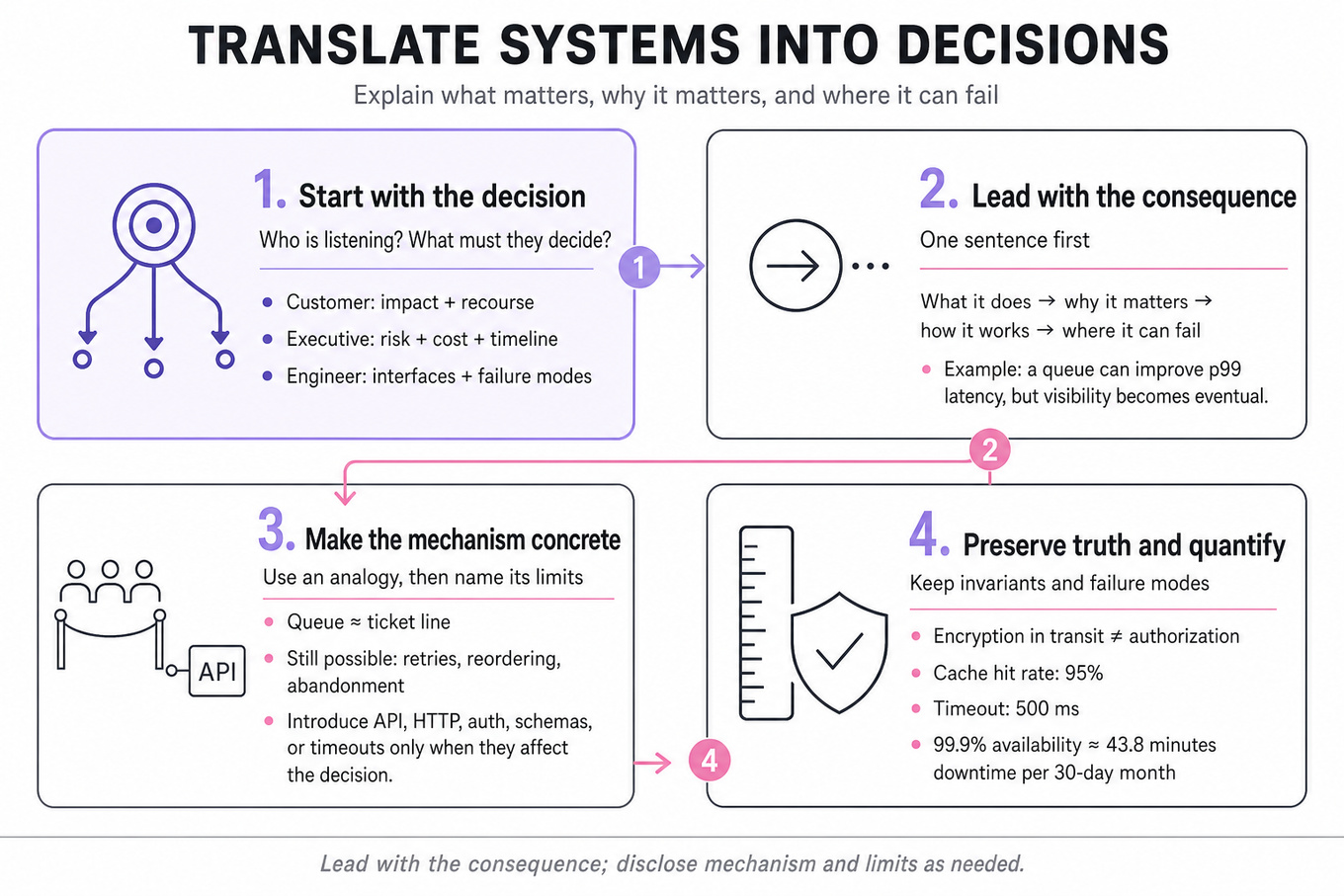
Audience modeling means first identifying what the listener needs to decide, their technical baseline, and their constraints. A customer needs impact and recourse; an executive needs risk, cost, and timeline; an engineer needs interfaces, failure modes, and operational details.
-
Progressive disclosure starts with the one-sentence conclusion, then adds mechanism, evidence, and implementation details only as needed. A useful structure is: “What it does, why it matters, how it works, and where it can fail.”
-
Decision-oriented communication connects a technical property to a measurable consequence. For example, replacing synchronous calls with a queue may improve user-facing
p99latency but introduce eventual consistency, retry behavior, and delayed visibility. -
Analogy mapping makes an unfamiliar mechanism concrete by preserving the important relationship, not every implementation detail. A queue can resemble a ticket line, but explicitly state that messages may be retried, reordered, or abandoned—limitations the analogy hides.
-
Abstraction boundaries prevent both jargon overload and misleading simplification. Explain an API as “a defined way for two programs to request and return information,” then introduce HTTP methods, authentication, schemas, or timeouts only when they affect the decision.
-
Technical accuracy under simplification requires preserving invariants and failure modes. Never claim “encryption makes data safe”; distinguish encryption in transit, encryption at rest, authorization, key management, and the residual risk of compromised credentials.
-
Quantification turns vague claims into useful tradeoffs. State numbers such as “the cache serves 95% of reads,” “the timeout is 500 ms,” or “the availability target is 99.9%,” and explain that 99.9% availability permits roughly 43.8 minutes of downtime per 30-day month.
-
Uncertainty and confidence should be explicit rather than hidden behind definitive language. Separate known facts, assumptions, estimates, and open questions: “We observed elevated
p99latency; we suspect database contention, but tracing has not confirmed the cause.” -
Failure-mode communication explains what users observe, how the system degrades, and what mitigations exist. For a dependency outage, distinguish timeout, retry, fallback, queueing, and fail-closed behavior; repeated retries can create a retry storm and worsen the incident.
-
Security and privacy communication should describe data sensitivity and exposure without revealing unnecessary details. Explain the purpose of least privilege, redaction, audit logs, and retention limits in terms of who could access what, for how long, and what harm would result.
-
Checks for understanding should test the listener’s mental model, not merely ask “Does that make sense?” Ask, “Given this design, what would you expect a user to see if the payment service is unavailable?” or have them restate the decision and tradeoff.
-
Communication artifacts should match the audience and urgency. An incident update needs impact, scope, timeline, mitigation, and next update; an architecture review needs alternatives, constraints, failure modes, and decision ownership. A diagram should show only the components relevant to the decision.
Worked example: Explain Technology to a Nontechnical Audience
For “Explain Technology to a Nontechnical Audience,” a strong candidate first asks who the audience is, what decision they need to make, and whether the explanation concerns normal behavior, a new design, or an incident. In the first 30 seconds, I would state an assumption such as: “I’ll explain a service queue to an operations leader deciding whether a delayed response is acceptable.” I would organize the answer around four pillars: the user-visible purpose, the basic mechanism, the benefit, and the important failure modes or limits. I might say, “Instead of making a person wait while two systems coordinate, we place the request in a durable work list and process it shortly afterward.” I would explicitly flag the tradeoff: queues improve responsiveness and resilience, but the result is no longer immediately consistent and a request can be delayed or require retry handling. I would avoid terms such as “consumer,” “partition,” and “at-least-once delivery” unless the listener asks for implementation detail. I would then check understanding with, “If processing is temporarily unavailable, what behavior would be acceptable—showing a pending status, retrying automatically, or failing immediately?” I would close with, “If I had more time, I’d show the expected delay range, duplicate-prevention behavior, and the monitoring signal we would use to detect stuck work.”
A second angle
The same communication skill applies when explaining a production incident to a nontechnical customer-support team, where the priority is accurate action rather than architecture education. Start with the customer impact, affected scope, current workaround, and next update time before describing the root cause. For example, say “some applications may remain pending longer than usual” rather than “the worker fleet is experiencing consumer lag.” Preserve uncertainty by distinguishing “we confirmed” from “we are investigating.” The audience should leave knowing what to tell customers, what not to promise, and when the next reliable update will arrive.
Common pitfalls
Pitfall: Giving a technically correct but decision-useless explanation. Saying “we use asynchronous processing with retries” does not tell the listener whether the user sees a success, a pending state, or a duplicate operation; connect the mechanism to observable behavior.
Pitfall: Using an analogy as if it were the system. “The queue is just like a line” hides reordering, duplicate delivery, expiration, and dead-letter handling; state the analogy’s boundary and name the one or two differences that affect the decision.
Pitfall: Overcorrecting toward either jargon or oversimplification. Listing
Kafka,gRPC, andRedismay overwhelm a nontechnical audience, while saying “the system is reliable” conceals availability targets and failure modes; offer layers of detail and quantify meaningful limits.
Connections
An interviewer may pivot to incident management, architecture decision records, stakeholder alignment, or design reviews. They may also ask how you communicate a tradeoff involving eventual consistency, privacy, observability, or an SLO.
Further reading
-
The Pyramid Principle — a practical framework for leading with the conclusion and organizing supporting reasoning.
-
The Design of Everyday Things — useful for understanding mental models, affordances, and communicating system behavior through observable outcomes.
Practice questions
Related concepts
- Technical Leadership, Impact, And Trade-OffsBehavioral & Leadership
- Technical Leadership, Project Impact And TradeoffsBehavioral & Leadership
- Technical Leadership, Communication, And Mission FitBehavioral & Leadership
- Behavioral Storytelling And Tradeoff CommunicationBehavioral & Leadership
- Technical Fundamentals for Non-Technical Product Managers
- PM Technical Fundamentals For Non-Technical Candidates