Top-K, Heaps, Quickselect, And Frequency Analysis
Asked of: Software Engineer
Last updated
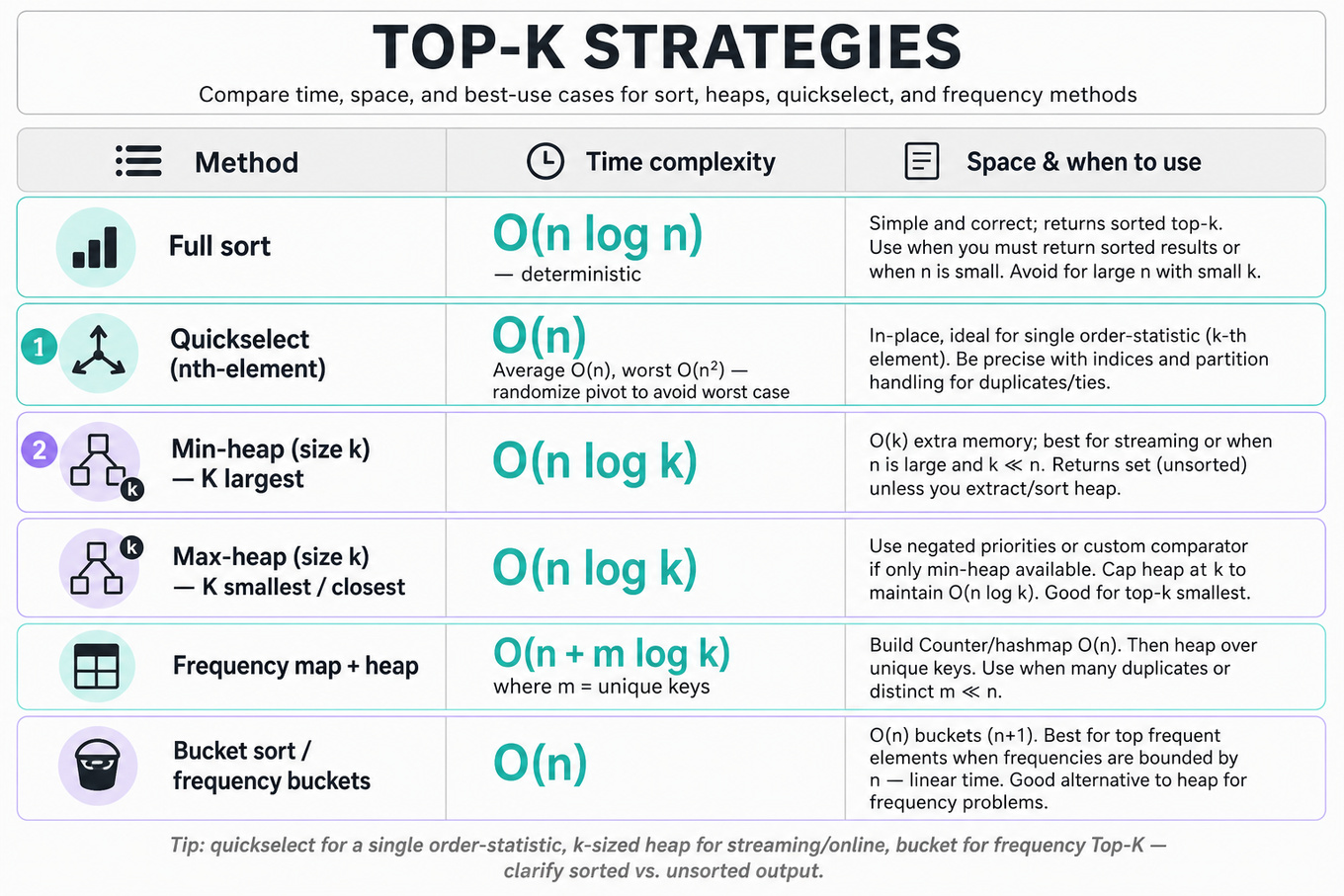
What's being tested
Top-K selection tests whether you can avoid unnecessary full sorting when only a small subset or order statistic is needed. Interviewers probe your command of heaps, quickselect, frequency maps, and complexity tradeoffs under constraints like duplicates, ties, and large n.
Patterns & templates
-
K closest points — compare squared distance
x*x + y*y; use full sortO(n log n), max-heapO(n log k), or quickselect averageO(n). -
K-th largest element — convert to index
n - kin sorted ascending order; implementquickselect(nums, left, right, target)carefully. -
Min-heap for K largest — push elements, pop when size exceeds
k; final heap contains answer set inO(n log k)time. -
Max-heap for K smallest / closest — store negative priority or custom comparator; cap heap size at
kto avoidO(n)heap growth. -
Frequency analysis — build
Counter/ hashmap inO(n), then select topkby heap, bucket sort, or quickselect over unique keys. -
Bucket sort for frequencies — array of
n + 1buckets givesO(n)time for top frequent elements; space isO(n). -
Quickselect partitioning — average
O(n), worst-caseO(n^2); randomize pivot and be precise about<,>, and equal values.
Common pitfalls
Pitfall: Sorting everything by default is correct but may miss the expected optimization when the interviewer asks for
O(n)orO(n log k).
Pitfall: For K-th largest, confusing
kwith zero-based index causes off-by-one errors; usetarget = len(nums) - k.
Pitfall: Returning heap contents without considering order is usually fine for “top K elements,” but not for “sorted top K”; clarify output requirements.
Practice these
The practice cards below cover the canonical variants — solve all of them and time yourself.
Featured in interview prep guides
Practice questions
- Find kth largest element in arrayMeta · Software Engineer · Onsite · medium
- Implement list cloning and k-frequency finderMeta · Software Engineer · Technical Screen · easy
- Find K-th Largest and Longest VacationMeta · Software Engineer · Technical Screen · medium
- Design LCA and find K closest pointsMeta · Software Engineer · Technical Screen · medium
- Find the kth largest elementMeta · Software Engineer · Technical Screen · medium
- Maintain top N payersMeta · Software Engineer · Online Assessment · medium
- Solve linked-list and top-K algorithm tasksMeta · Software Engineer · Onsite · medium
- Solve linked list, top-K, and string reductionMeta · Software Engineer · Onsite · medium
- Design LRU cache and pick k closest pointsMeta · Software Engineer · Technical Screen · medium
- Find minimum and most frequent number efficientlyMeta · Software Engineer · Technical Screen · medium
- Find k most frequent elements, discuss O(n)Meta · Software Engineer · Technical Screen · medium
Related concepts
- Heaps, Top-K, And Streaming SelectionCoding & Algorithms
- Top-K Selection, Heaps, And RankingCoding & Algorithms
- Heaps, Priority Queues, and Top-K SelectionCoding & Algorithms
- Heaps, Streaming Median, and Top-K SelectionCoding & Algorithms
- Top-K Ranking And SelectionSystem Design
- Top-K Selection And Order StatisticsCoding & Algorithms