Trees, Recursion, And BST Traversal
Asked of: Software Engineer
Last updated
What's being tested
These problems test recursive tree traversal, BST-ordered navigation, and careful handling of hierarchical data with depth, keys, or ancestry constraints. Interviewers are probing whether you can choose the right traversal shape, preserve invariants, and explain complexity without overcomplicating the implementation.
Patterns & templates
-
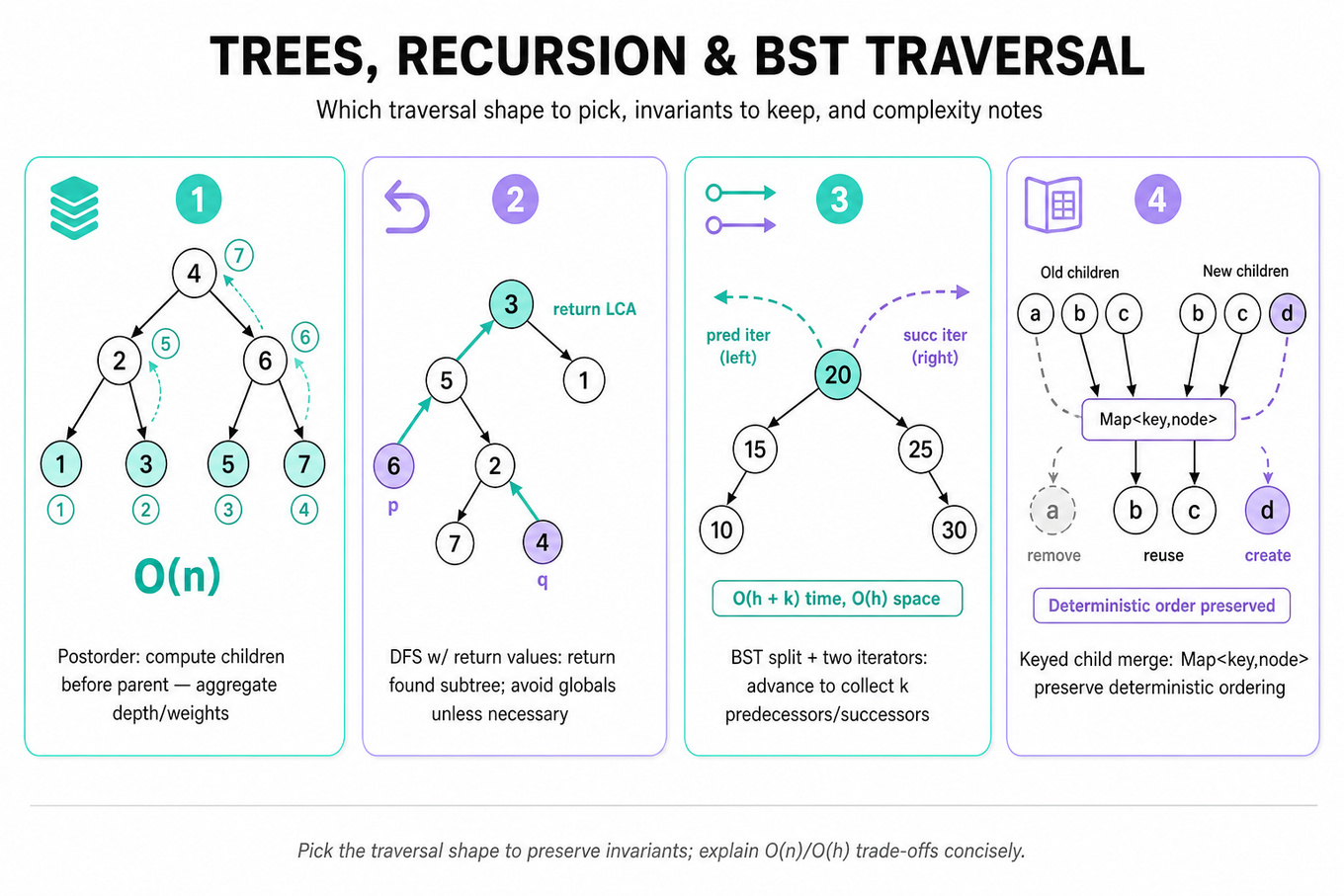
Postorder recursion for aggregation — compute child results before parent; useful for depth, weighted sums, and merge semantics;
O(n)time. -
DFS with return values — functions like
lca(root, p, q)return “found node/subtree answer”; avoid global state unless it simplifies proof. -
BST predecessor/successor traversal — split around target, then advance two iterators;
O(h + k)time,O(h)space. -
Keyed child reconciliation — merge N-ary children using
Map<key, node>; preserve deterministic ordering if the prompt requires it. -
Two-pass depth computation — first compute
maxDepth, then sum using weightmaxDepth - depth + 1; alternative BFS level-sum avoids explicit weights. -
Null/base-case discipline — define behavior for empty tree, missing nodes, duplicate keys, leaf depth, and single-node trees before coding.
-
Complexity narration — use
nfor total nodes,hfor tree height,kfor requested outputs; distinguish balanced vs skewed BSTs.
Common pitfalls
Pitfall: Treating an N-ary tree like a binary tree; always clarify child representation and key uniqueness before merging.
Pitfall: For LCA, returning a node when only one target exists unless the prompt guarantees both nodes are present.
Pitfall: For k closest in BST, doing full inorder sort when the expected solution uses ordered traversal and stops after
k.
Practice these
The practice cards below cover the canonical variants — solve all of them and time yourself.
Featured in interview prep guides
Practice questions
- Compute inverse-depth weighted sum of nested listsLinkedIn · Software Engineer · Technical Screen · medium
- Merge two N-ary trees by key rulesLinkedIn · Software Engineer · Onsite · medium
- Solve six algorithmic problemsLinkedIn · Software Engineer · Onsite · medium
- Find k closest values in a BSTLinkedIn · Software Engineer · Technical Screen · medium
- Find lowest common ancestorLinkedIn · Software Engineer · Onsite · medium
Related concepts
- Tree Traversal And Hierarchical StructuresCoding & Algorithms
- Trees, Tries, and Hierarchical DataCoding & Algorithms
- Trees And Hierarchical StructuresCoding & Algorithms
- Tree And Linked Structure AlgorithmsCoding & Algorithms
- Trees, Linked Lists, And Pointer AlgorithmsCoding & Algorithms
- BST Algorithms And Lowest Common AncestorCoding & Algorithms