LinkedIn Software Engineer Interview Prep Guide
Everything LinkedIn actually asks Software Engineer candidates — concept walkthroughs, worked examples, and the real interview questions, drawn from candidate reports. Free to read.
Last updated
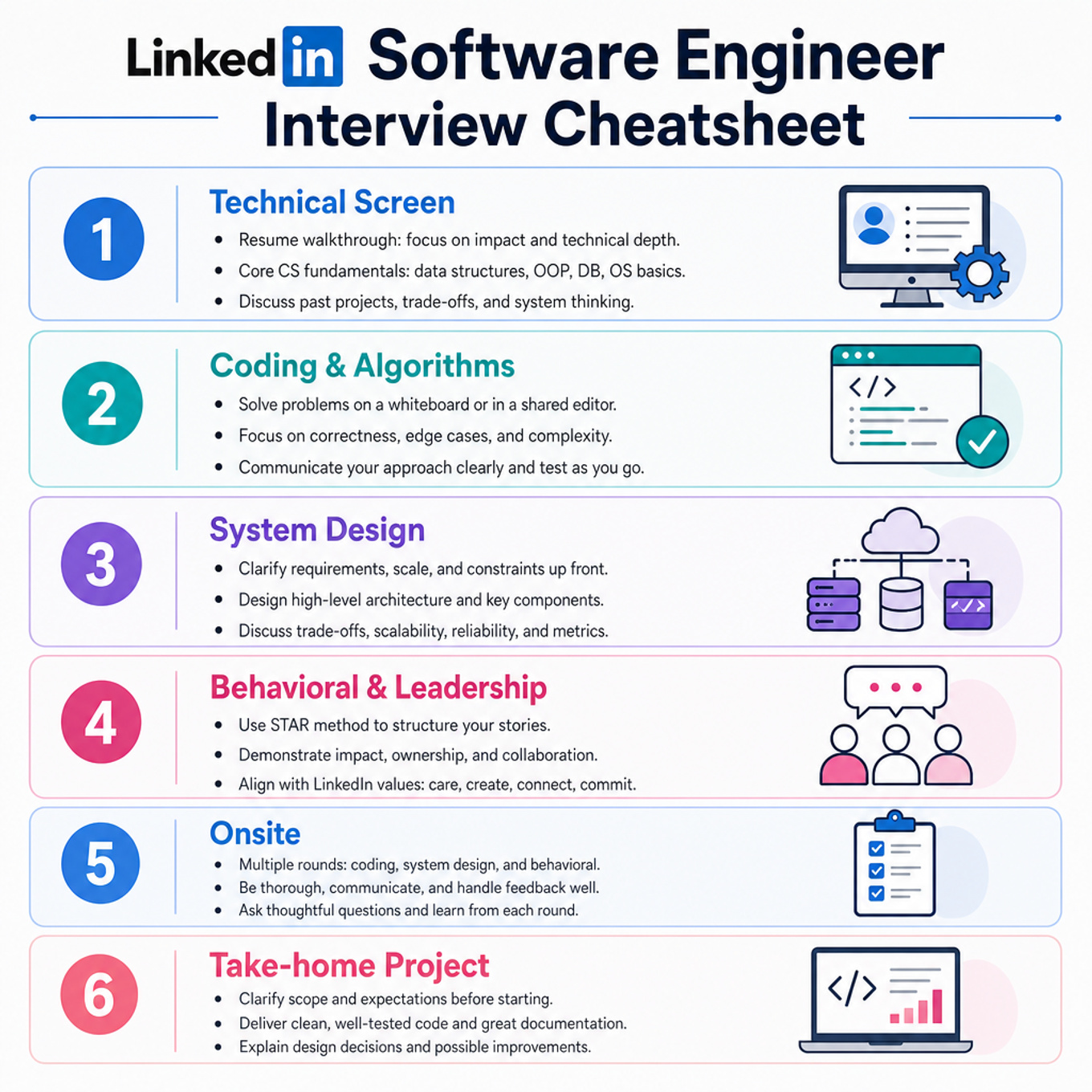
Technical Screen
Coding & Algorithms
-
Arrays, Strings, Hash Maps, And Sliding Windows — covered in depth under Onsite below.
-
Trees, Recursion, And BST Traversal — covered in depth under Onsite below.
-
Linked Lists, Stacks, Caches, And Pointer Techniques — covered in depth under Onsite below.
-
Dynamic Programming And Mutable Range Queries — covered in depth under Take-home Project below.
System Design
-
Top-K Ranking And Selection — covered in depth under Onsite below.
-
Distributed Key-Value Storage And Transactions — covered in depth under Onsite below.
-
High-Throughput Streams, Jobs, And Observability — covered in depth under Onsite below.
Behavioral & Leadership
- Technical Leadership, Project Ownership, And Stakeholder Communication — covered in depth under Onsite below.
Onsite
Coding & Algorithms
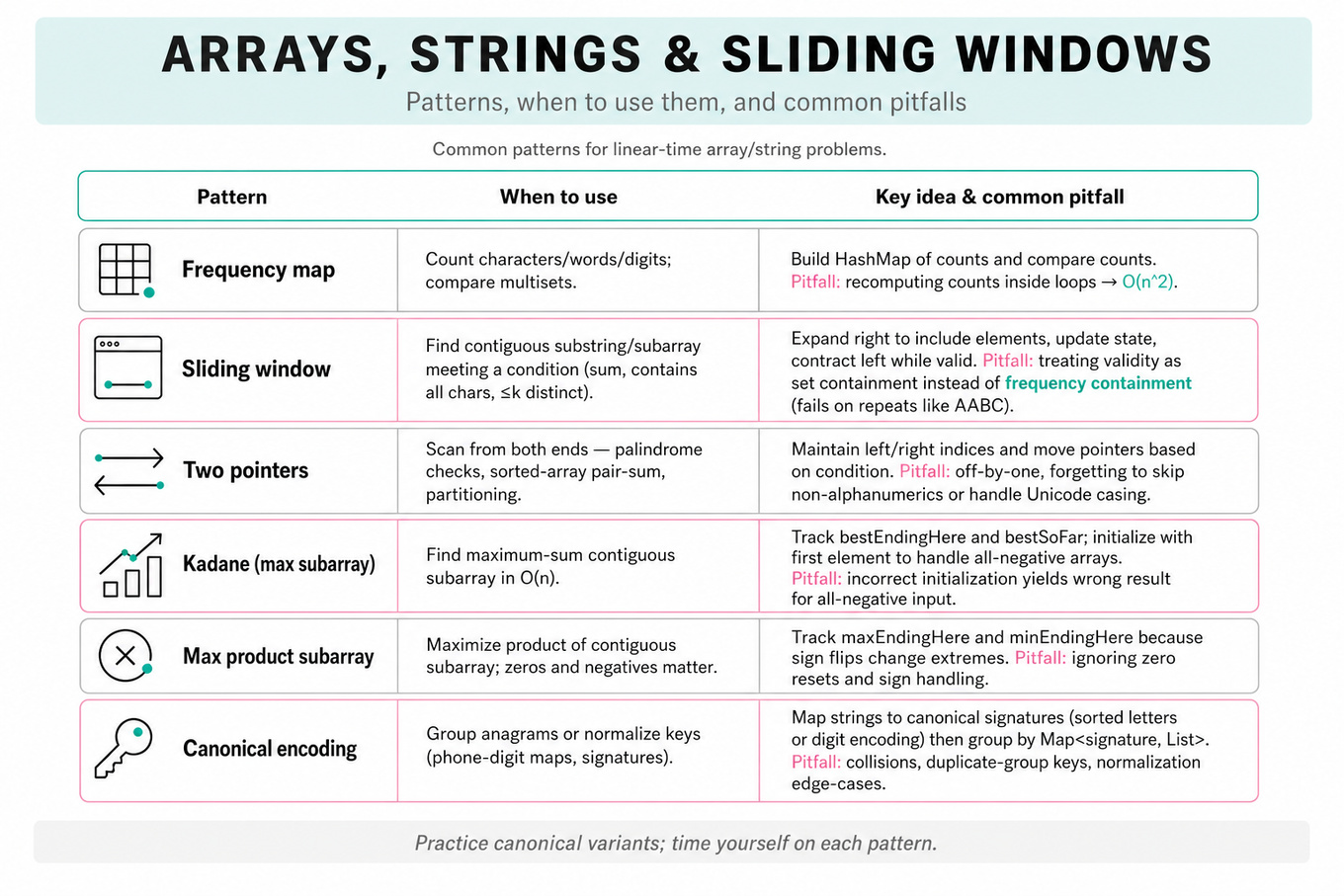
What's being tested
These problems test linear-time string/array processing using hash maps, two pointers, and sliding windows. Interviewers are probing whether you can turn brute-force substring/subarray enumeration into O(n) or O(n log n) solutions while handling edge cases cleanly.
Patterns & templates
-
Frequency map with
dict/HashMap— count characters, words, or digit encodings; compare counts instead of repeatedly scanning substrings. -
Sliding window over contiguous substrings — expand right, update state, contract left while valid; typical
O(n)time andO(k)space. -
Minimum window substring — maintain
need,have, andformed; update answer only when all required frequencies are satisfied. -
Two-pointer string scan — use left/right indices for sanitized palindrome checks; skip non-alphanumeric characters before comparing normalized values.
-
Kadane’s algorithm for max subarray sum — track
bestEndingHereandbestSoFar; initialize with first element to handle all-negative arrays. -
Max product subarray — track both
maxEndingHereandminEndingHerebecause multiplying by a negative flips extremes. -
Canonical encoding — map letters to phone digits or normalized signatures, then group collisions with
Map<signature, List<String>>.
Common pitfalls
Pitfall: Recomputing substring counts inside nested loops turns an intended
O(n)sliding-window solution intoO(n^2 * alphabet).
Pitfall: Treating “valid window” as set containment instead of frequency containment breaks cases with repeated characters like
AABC.
Pitfall: Forgetting empty strings, single-character strings, Unicode casing, all-negative arrays, zeros in product arrays, and duplicate grouped keys.
Practice these
The practice cards below cover the canonical variants — solve all of them and time yourself.
Practice questions
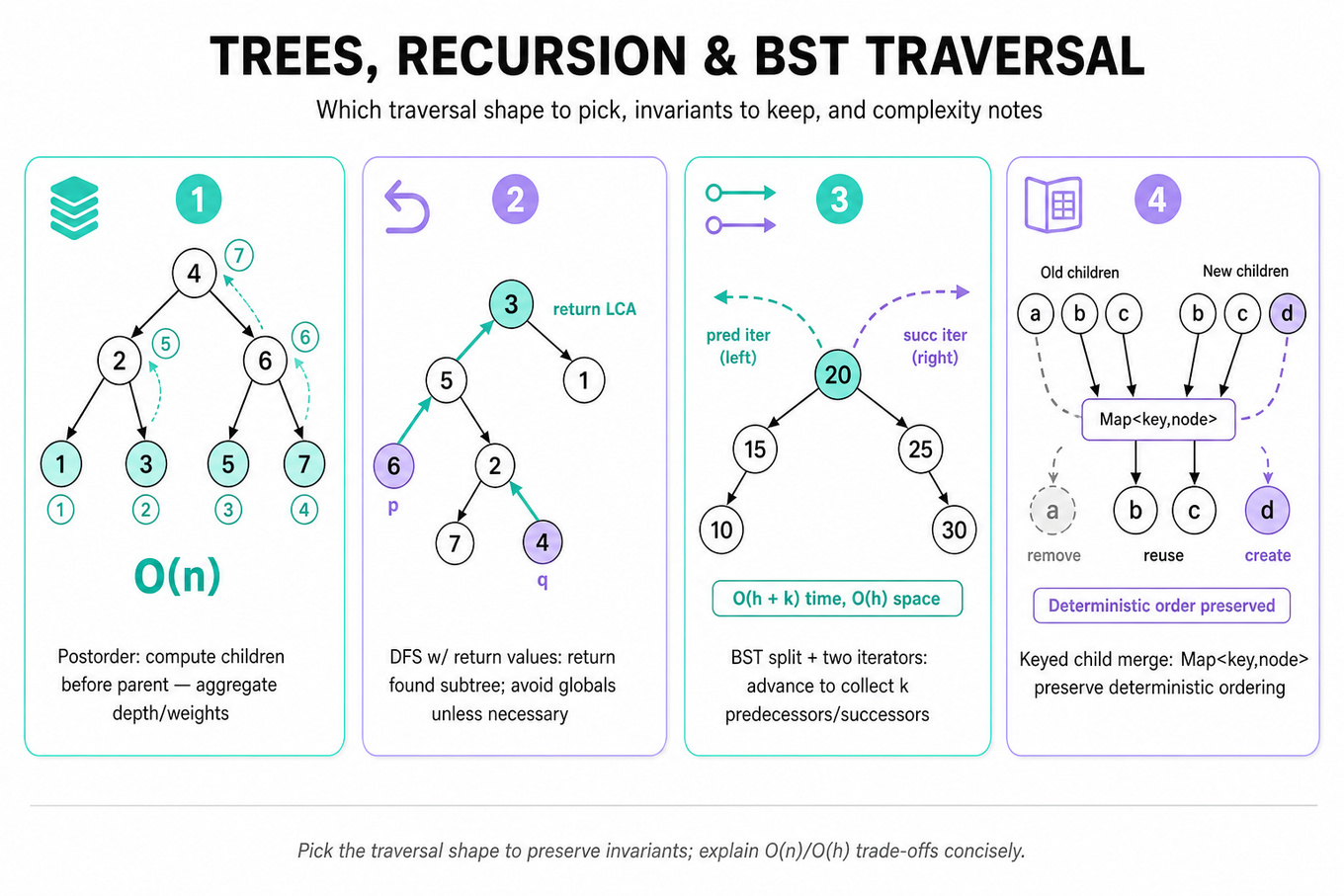
What's being tested
These problems test recursive tree traversal, BST-ordered navigation, and careful handling of hierarchical data with depth, keys, or ancestry constraints. Interviewers are probing whether you can choose the right traversal shape, preserve invariants, and explain complexity without overcomplicating the implementation.
Patterns & templates
-
Postorder recursion for aggregation — compute child results before parent; useful for depth, weighted sums, and merge semantics;
O(n)time. -
DFS with return values — functions like
lca(root, p, q)return “found node/subtree answer”; avoid global state unless it simplifies proof. -
BST predecessor/successor traversal — split around target, then advance two iterators;
O(h + k)time,O(h)space. -
Keyed child reconciliation — merge N-ary children using
Map<key, node>; preserve deterministic ordering if the prompt requires it. -
Two-pass depth computation — first compute
maxDepth, then sum using weightmaxDepth - depth + 1; alternative BFS level-sum avoids explicit weights. -
Null/base-case discipline — define behavior for empty tree, missing nodes, duplicate keys, leaf depth, and single-node trees before coding.
-
Complexity narration — use
nfor total nodes,hfor tree height,kfor requested outputs; distinguish balanced vs skewed BSTs.
Common pitfalls
Pitfall: Treating an N-ary tree like a binary tree; always clarify child representation and key uniqueness before merging.
Pitfall: For LCA, returning a node when only one target exists unless the prompt guarantees both nodes are present.
Pitfall: For k closest in BST, doing full inorder sort when the expected solution uses ordered traversal and stops after
k.
Practice these
The practice cards below cover the canonical variants — solve all of them and time yourself.
Practice questions
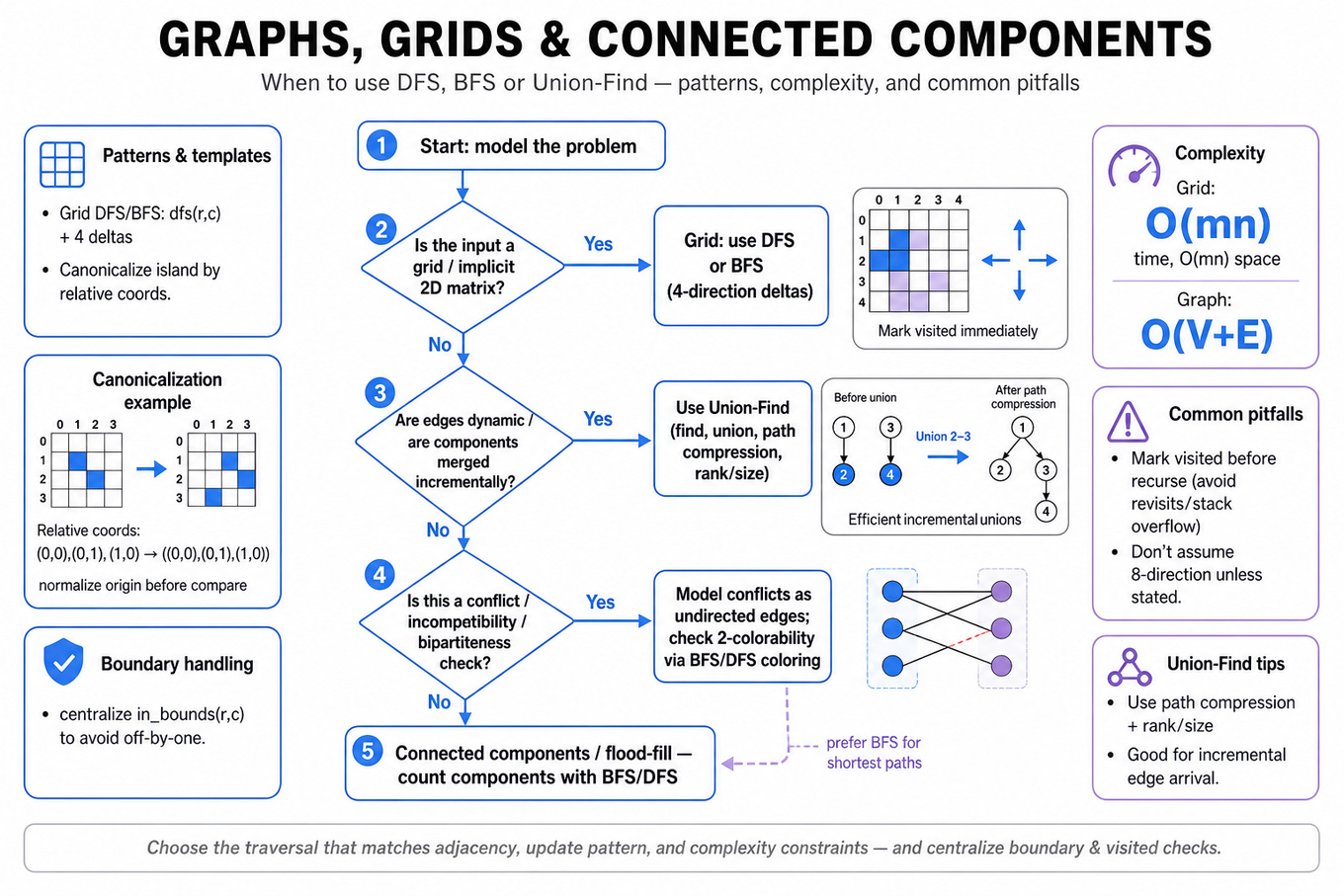
What's being tested
These problems test graph traversal over implicit graphs: grids, pairwise conflict graphs, and connected components. Interviewers are probing whether you can model adjacency correctly, choose DFS, BFS, or Union-Find, and explain correctness plus or complexity.
Patterns & templates
-
Grid DFS/BFS — write
dfs(r, c)with 4-direction deltas; mark visited immediately to avoid duplicate work and cycles. -
Connected components — increment count when finding an unvisited valid node, then flood-fill the entire component; total time is
O(nodes + edges). -
Island shape canonicalization — store relative coordinates from the island origin, e.g.
(r-r0, c-c0), then serialize to a tuple for set comparison. -
Union-Find — use
find,union, path compression, and rank/size when components are dynamic or edges arrive incrementally. -
Conflict graph detection — model exclusions as undirected edges; use coloring with BFS/DFS when checking whether incompatible groups can coexist.
-
Boundary handling — centralize
in_bounds(r, c)and validity checks; avoid scattered conditionals that cause off-by-one bugs. -
Complexity discipline — for an
m x ngrid, each cell is visited once:O(mn)time,O(mn)worst-case space for recursion/queue/visited.
Common pitfalls
Pitfall: Marking a grid cell visited after recursive calls can revisit the same cell repeatedly or overflow the stack.
Pitfall: Counting diagonal neighbors as connected unless the prompt explicitly says 8-direction adjacency.
Pitfall: For distinct island shapes, comparing absolute coordinates instead of normalized relative coordinates makes identical translated shapes look different.
Practice these
The practice cards below cover the canonical variants — solve all of them and time yourself.
Practice questions
What's being tested
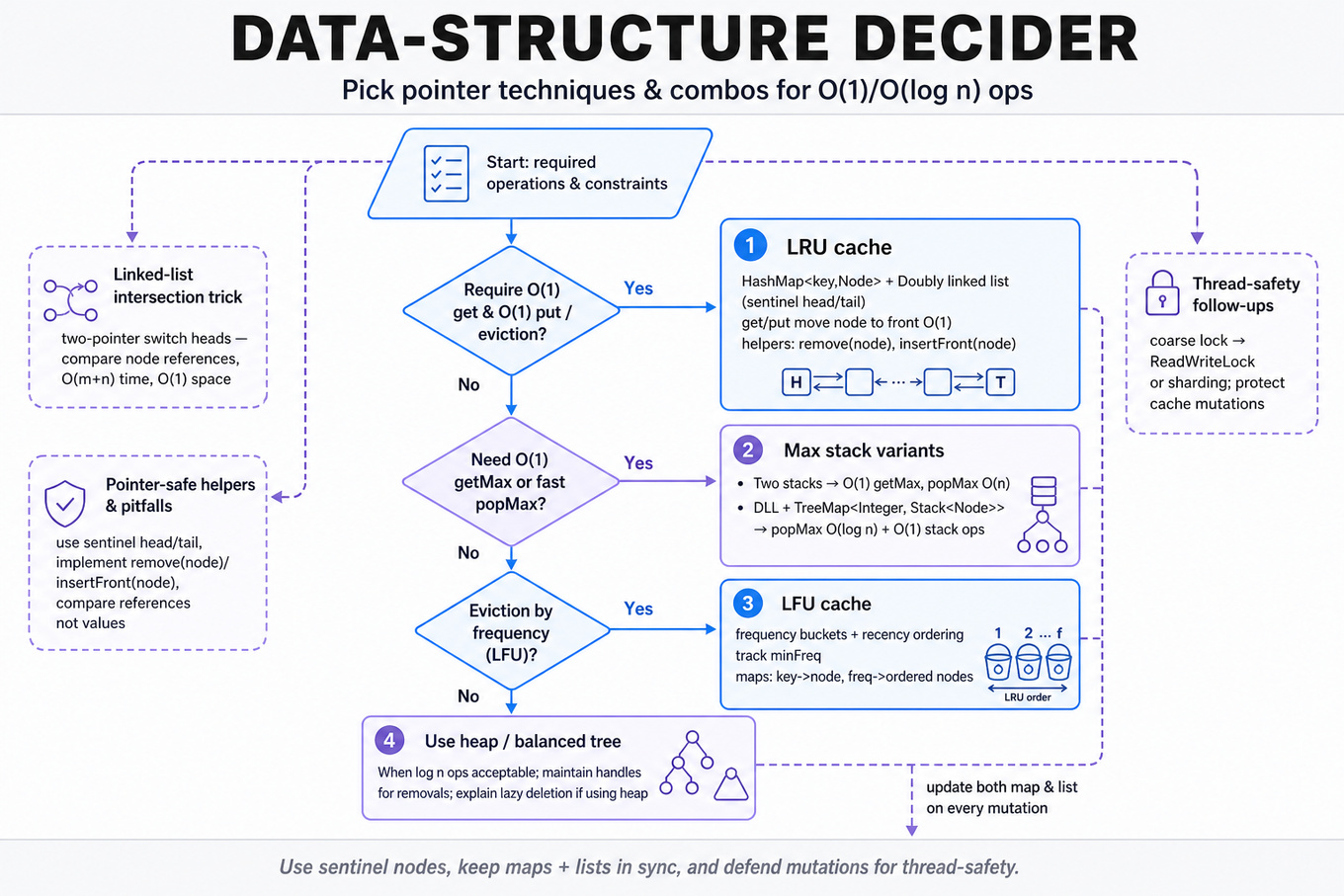
These problems test data-structure design with strict operation-level complexity targets: usually O(1) or O(log n) for get, put, push, pop, peekMax, and removal. Interviewers are probing pointer discipline, reference equality, cache eviction invariants, and whether you can combine structures like hash maps, doubly linked lists, stacks, heaps, and balanced trees cleanly.
Patterns & templates
-
LRU cache =
HashMap<key, Node>+ doubly linked list;getandputmove nodes to front inO(1). -
Pointer-safe list operations need helpers like
remove(node),insertFront(node), and sentinelhead/tailnodes to avoid null-heavy edge cases. -
Linked-list intersection uses two pointers switching heads:
a = a ? a.next : headB; detects shared node by reference inO(m+n)time,O(1)space. -
Max stack variants trade off operations: two stacks give
getMax()inO(1), butpopMax()may requireO(n)temporary movement. -
Efficient
popMax()usually combines a doubly linked list for stack order withTreeMap<Integer, Stack<Node>>for max lookup/removal inO(log n). -
LFU/cache follow-ups require frequency buckets plus recency ordering; track
minFreq, key-to-node map, and freq-to-ordered-nodes map. -
Thread-safety follow-up: protect cache mutations with a lock; mention coarse-grained locking first, then
ReadWriteLockor sharding if contention matters.
Common pitfalls
Pitfall: Comparing linked-list node values instead of node references for intersection; intersection means the exact same object, not equal data.
Pitfall: Claiming
O(1)max removal from a heap without explaining lazy deletion or node handles; standard heaps do not remove arbitrary elements inO(1).
Pitfall: Forgetting to update both structures on every mutation: cache map and linked list, or max index and stack order.
Practice these
The practice cards below cover the canonical variants — solve all of them and time yourself.
Practice questions
System Design

What's being tested
Top-K ranking and selection tests whether you can move between single-machine order statistics and distributed real-time aggregation without losing correctness, latency, or memory control. Interviewers are probing for the right data structure under constraints: heap vs quickselect vs balanced tree vs approximate sketches vs stream-processing state. LinkedIn cares because feeds, search suggestions, job recommendations, trending entities, ads, and notifications all need fast ranking over large, changing datasets. A strong Software Engineer answer shows you can define semantics, choose algorithms, shard safely, merge partial results, and explain freshness/accuracy tradeoffs.
Core knowledge
-
Top-K selection means returning the largest or smallest
kitems by a score, while k-th order statistic means returning the item at rankk. For a static array, use quickselect for expected time and extra space, or a size-kmin-heap for time. -
Heap-based ranking is the default when
k << nand input is streaming or too large to sort. Maintain a min-heap of sizek; if a new item beatsheap[0], replace it. This avoids full ) sorting and uses memory. -
Quickselect is best for in-memory static selection when you only need the k-th element or an unordered Top-K partition. It has expected time but worst-case unless you randomize pivots or use median-of-medians with deterministic but higher constants.
-
Exact frequency Top-K over events requires maintaining counts, usually in a hash map plus heap or ordered set. For
Ndistinct keys, exact counting costs memory; once cardinality reaches tens or hundreds of millions, you usually need sharding, approximation, or offline aggregation. -
Approximate heavy-hitter algorithms reduce memory for high-cardinality streams. Count-Min Sketch estimates frequency with one-sided error: estimate is with probability using width and depth . Space-Saving and Misra-Gries track candidate heavy hitters in bounded memory.
-
Sliding-window Top-K is harder than all-time Top-K because old events expire. Common approaches include time-bucketed counters, e.g. per-minute maps for the last hour, then merge buckets at query time; or stream processors such as
Apache Flink/Kafka Streamswith windowed state and timers. -
Window granularity controls cost and freshness. If the service needs Top-K over the last 1 hour with 1-minute buckets, each query merges up to 60 bucket maps. Smaller buckets improve expiry precision but increase metadata, merge cost, and state churn.
-
Distributed aggregation usually follows a two-level plan: each shard computes local Top-K or local counts, then a coordinator merges candidates. Local Top-K alone can be incorrect for global Top-K if an item is rank
k+1on every shard but globally huge, so exact global results require merging counts for enough candidates or partitioning by key. -
Partitioning by key makes exact counts simpler: hash each normalized search term, member id, or entity id to one owner shard. All increments for that key go to the same shard, avoiding cross-shard count reconciliation. The downside is hot keys; handle them with batching, local buffering, or special hot-key splitting.
-
Ranking semantics must be explicit: all-time vs last
Nminutes, raw counts vs unique users, case folding, punctuation normalization, bot filtering, and tie-breaking. For example,"LinkedIn","linkedin", and"linked in"may or may not collapse depending on product requirements. -
Read/write path tradeoff is central. Precompute Top-K continuously for low-latency reads, or compute on demand for simpler writes but slower queries. A common design stores precomputed leaderboards in
Redissorted sets or an in-memory heap, with durable counts inCassandra,MySQL, or another backing store. -
Correctness under concurrency includes idempotency, duplicate events, eventual consistency, and monotonicity expectations. If events can be retried, count updates need dedupe keys or accepted approximate overcounting. For user-facing rankings, define whether
p99read latency or exactness is more important.
Worked example
For Design a Top-K search words service, start by clarifying scope: “Are we ranking all-time searches, last hour/day, or both? Is Top-K global or per country/language? Do we count raw searches or unique users? What latency and freshness do reads require?” Then declare assumptions, such as 1 million search events per second, Top 100 queries globally, near-real-time freshness within 10 seconds, and reads at low p99 latency.
A strong answer can be organized around four pillars: event ingestion, normalization/counting, Top-K computation, and serving. In the write path, search events are normalized consistently, assigned a key, and sent through a durable log like Kafka; consumers aggregate counts by time bucket and key. For all-time Top-K, maintain per-key counters and a candidate heap or sorted set; for sliding windows, maintain bucketed counters and periodically merge the active buckets into a materialized Top-K view.
The key design decision to flag is exact vs approximate. Exact Top-K requires retaining counts for all distinct search terms in the active window, which may be expensive with massive cardinality; approximate approaches such as Count-Min Sketch plus a candidate heap reduce memory but may include false positives near the cutoff. For a search suggestions service, approximate rankings may be acceptable if the top terms are stable and downstream filters remove bad terms; for billing or compliance-style metrics, exactness would matter more.
Close by explaining operational concerns without overbuilding: expose a read API like GET /top-searches?window=1h&k=100, cache precomputed results in Redis, monitor freshness lag, dropped events, shard hot spots, and result churn. If you had more time, add regional Top-K, per-language normalization, abuse filtering hooks, and a backfill path to recompute rankings from durable logs.
A second angle
For Find the k-th largest element in an array, the same ranking concept appears without distributed-system concerns. The main constraint is algorithmic efficiency: sorting is simple but costs , while quickselect gives expected by partitioning around a pivot until the target rank lands in place. A heap solution is still useful when the array is streamed or k is small relative to n, because it uses memory and never needs all elements sorted. The interviewer is checking whether you can pick the simplest correct technique for the constraint rather than forcing a system-design solution onto a coding problem.
Common pitfalls
Pitfall: Treating “Top-K” as “sort everything.”
Sorting the full dataset is often acceptable for small arrays, but it is the wrong default for high-volume streams or large cardinality ranking. Say explicitly when sorting is fine, then move to heaps, quickselect, sketches, or precomputation as scale grows.
Pitfall: Ignoring semantics before designing storage.
A tempting but weak answer is “count every word and store the top results in Redis.” That misses the hard parts: time window, deduplication, normalization, tie-breaking, geographic grouping, and whether rankings must be exact. Clarifying these early makes the rest of the design defensible.
Pitfall: Merging local Top-K lists as if it were always correct.
If each shard sends only its local Top 100, the true global #1,000 may be missed even if its aggregate count should place it globally in the Top 100. For exact results, partition by key or merge broader candidate sets with counts; for approximate results, state the error tradeoff.
Connections
Interviewers may pivot from this topic into leaderboard design, rate-limited stream processing, cache invalidation, consistent hashing, or ranking feed serving. Coding follow-ups often involve heaps, quickselect, sliding windows, or LRU/LFU cache design.
Further reading
-
“Finding Frequent Items in Data Streams” by Cormode and Hadjieleftheriou — survey of heavy-hitter algorithms used for approximate Top-K.
-
“Space-Saving Algorithm” by Metwally, Agrawal, and El Abbadi — classic bounded-memory frequent-items approach.
-
Designing Data-Intensive Applications by Martin Kleppmann — practical background on logs, stream processing, replication, and consistency tradeoffs.
Practice questions
What's being tested
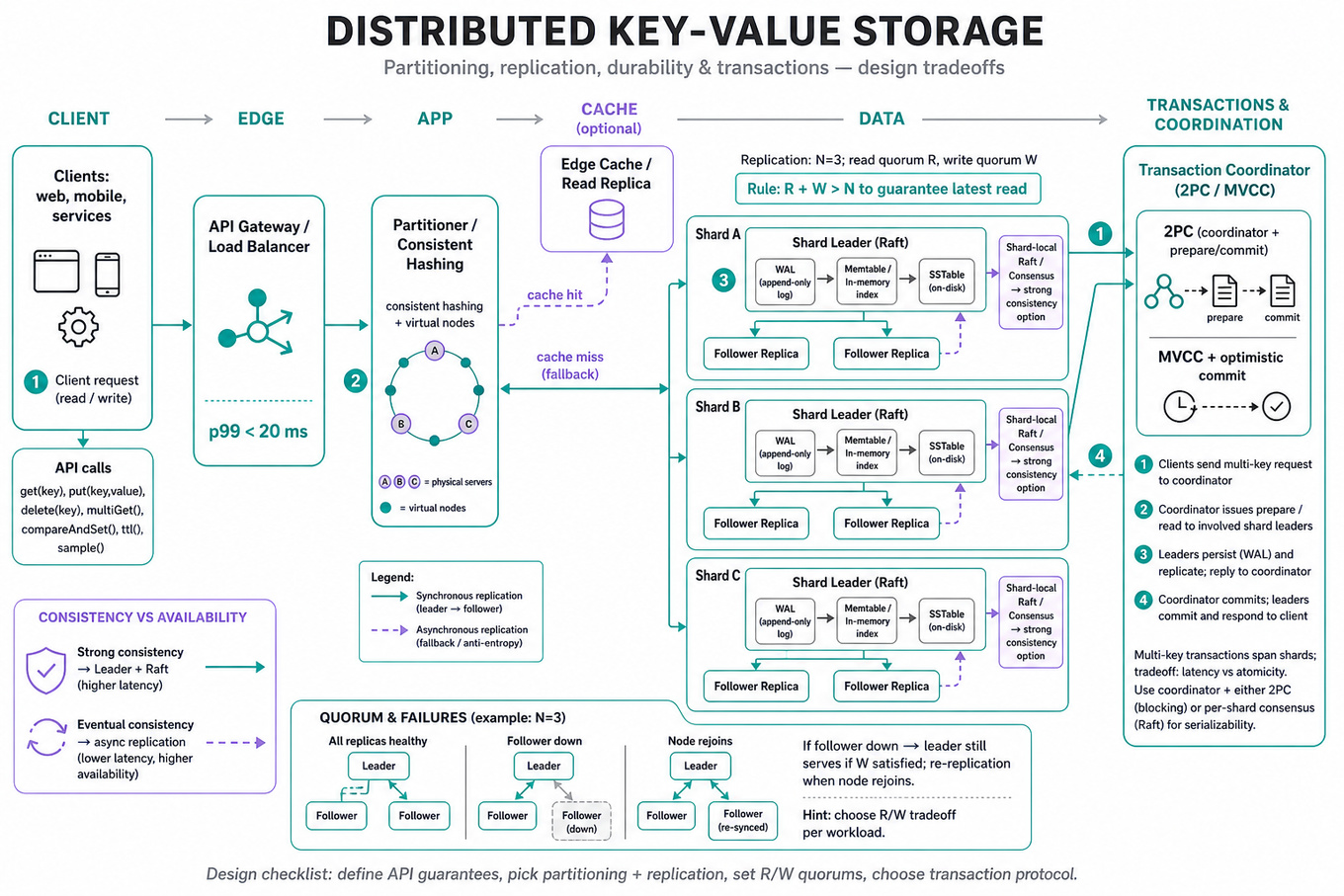
Interviewers are probing whether you can design storage systems that remain correct under scale, concurrency, and failure. The shared skill is translating a simple API like get(key), put(key, value), delete(key), or sample() into choices about partitioning, replication, durability, consistency, and transactions. LinkedIn cares because many product features depend on low-latency reads and writes over massive datasets: profiles, feeds, notifications, counters, sessions, indexes, and metadata stores. A strong Software Engineer answer shows you can start with clean single-node semantics, then evolve the design into a distributed system while explicitly naming tradeoffs.
Core knowledge
-
Key-value store API design should start with exact operations and guarantees:
get,put,delete, optionalcompareAndSet,multiGet,ttl, range scans, and batch writes. Clarify expected object size, QPS, read/write ratio, latency target likep99 < 20ms, and whether values are opaque blobs or structured records. -
In-memory hash maps give expected
getandput, but not automatically thread safety, memory control, TTL expiration, or durability. A production in-memory design usually needs lock striping,RWLock, optimistic concurrency, background eviction, and possibly append-only logging for recovery. -
Partitioning distributes keys across nodes. Consistent hashing maps keys and servers onto a ring, reducing movement when nodes join or leave from keys to roughly keys, where is key count and is server count. Virtual nodes improve balance when physical machines differ in capacity.
-
Replication improves availability and read scalability. With replication factor , write quorum , and read quorum , a common rule is to read the latest acknowledged write, assuming no conflicting writes and correctly tracked versions. Systems like
DynamoDB-style stores use tunable quorums to trade latency for consistency. -
Consistency models must be stated precisely. Strong consistency means reads observe the latest committed write, often requiring a leader or consensus. Eventual consistency allows replicas to converge asynchronously. Read-your-writes consistency is weaker than linearizability but often important for user-facing flows.
-
Consensus protocols such as Raft or Paxos are used when a shard needs a single agreed log of writes. They simplify correctness for leader-based replication but add write latency, require majority availability, and complicate cross-region operation. Do not casually say “use consensus everywhere” without discussing cost.
-
Storage engines differ by workload. LSM trees, used by systems like
RocksDBandCassandra, optimize high write throughput via memtables, sorted string tables, and compaction. B-trees, used by many relational databases, are good for point reads and range scans with in-place page updates. -
Durability usually means acknowledged writes survive process or machine failure. Common mechanisms are a write-ahead log, periodic snapshots, synchronous replication, and
fsyncpolicy. Acknowledge-after-memory is fastest but can lose data; acknowledge-after-quorum-disk is safer but increasesp99latency. -
Transactions bundle operations with ACID guarantees: atomicity, consistency, isolation, and durability. Atomicity means all-or-nothing; isolation controls how concurrent transactions interact; durability means committed state survives failure. In key-value systems, single-key transactions are much easier than multi-key or cross-shard transactions.
-
Isolation levels describe allowed anomalies. Read committed prevents dirty reads but permits non-repeatable reads. Repeatable read prevents non-repeatable reads but may allow write skew depending on implementation. Serializable isolation makes concurrent execution equivalent to some serial order, often via two-phase locking, optimistic concurrency control, or serializable snapshot isolation.
-
Distributed transactions across shards require coordination. Two-phase commit provides atomic commit but can block if the coordinator fails; adding consensus-backed transaction coordinators improves availability but raises complexity. Many scalable systems avoid cross-shard transactions by careful key design, denormalization, idempotent operations, or saga-style workflows.
-
Rebalancing and hot keys are common edge cases. Uniform hashing does not protect against one celebrity-profile key receiving 100x traffic. Mitigations include request coalescing, caching, key splitting, adaptive replication, rate limiting, and moving virtual nodes gradually to avoid cache misses and network spikes.
Worked example
For Design a scalable key-value store, a strong candidate first frames the problem by asking: “Are we optimizing for reads or writes, what is the value size, do we need strong consistency, what is the expected QPS and data volume, and is this single-region or multi-region?” Then they declare a reasonable baseline, such as opaque values up to 1 MB, billions of keys, high read QPS, p99 under tens of milliseconds, and per-key atomic writes.
The answer skeleton should have four pillars: API and data model, storage engine, distribution strategy, and failure handling. For storage, you might choose an LSM-based local engine with a memtable, append-only WAL, immutable SSTables, Bloom filters, and compaction. For distribution, use consistent hashing with virtual nodes, a routing layer that maps keys to shard replicas, and metadata maintained in a configuration service. For availability, replicate each shard to three nodes with leader-based writes or quorum writes, plus background repair for stale replicas.
One tradeoff to flag explicitly is leader-based replication versus quorum replication. A leader gives simpler linearizable per-key writes and easier conflict handling, but failover and cross-region writes are harder; quorum replication can lower write unavailability but needs vector clocks, timestamps, or conflict resolution. A good close is: “If I had more time, I’d drill into compaction tuning, hot-key mitigation, backup/restore, and how we would validate correctness under node failure using chaos tests.”
A second angle
For Scale a Distributed Randomized Multiset, the same storage concepts apply, but the hard part shifts from ordinary key routing to preserving globally uniform random sampling. If each shard stores a local multiset, sampling by “pick a random shard, then random item” is biased unless all shards have equal item counts. A better design tracks each shard’s cardinality and samples shard with probability , then samples uniformly within that shard. Rebalancing now must update both item placement and the global count metadata, and failures must not cause double-counting or invisible items. This is still a distributed key-value/data-structure problem, but the correctness property is statistical uniformity rather than just successful get and put.
Common pitfalls
Pitfall: Saying “use consistent hashing and replication” as if that completes the design.
That answer names two components but skips the real interview signal: what happens during node failure, stale reads, rebalancing, compaction, and hot partitions. A stronger answer ties each mechanism to a specific requirement, such as “replication factor 3 tolerates one node failure under majority quorum, but writes fail if two replicas are unavailable.”
Pitfall: Treating ACID as memorized vocabulary instead of concurrency behavior.
A weak explanation says “atomic, consistent, isolated, durable” and stops. A better one gives anomalies: dirty read, non-repeatable read, phantom read, lost update, and write skew, then connects them to isolation levels and implementation choices like two-phase locking or MVCC.
Pitfall: Over-designing with global transactions and strong consistency for every operation.
Many large-scale systems intentionally avoid cross-shard serializable transactions because they increase latency and reduce availability. Land better by saying which operations need strong guarantees, which can be eventually consistent, and how you would use idempotency keys, conditional writes, or per-entity partitioning to contain transaction scope.
Connections
Interviewers can pivot from this topic into caching, consistent hashing, database indexing, leader election, distributed consensus, or rate limiting. They may also ask you to compare systems such as Redis, DynamoDB, Cassandra, Bigtable, RocksDB, and ZooKeeper from a latency, consistency, and operations perspective.
Further reading
-
Dynamo: Amazon’s Highly Available Key-value Store — foundational paper on consistent hashing, replication, vector clocks, and tunable consistency.
-
The Google File System / Bigtable papers — useful for understanding tablet partitioning, compaction, and large-scale storage design.
-
Designing Data-Intensive Applications by Martin Kleppmann — best single reference for replication, partitioning, transactions, logs, and consistency models.
Practice questions

What's being tested
Interviewers are probing whether you can design high-throughput distributed systems that run reliably under load: schedulers, worker fleets, query dashboards, and observability pipelines. For LinkedIn-scale products, backend systems must handle large fan-out, bursty traffic, partial failures, and operational debugging without relying on manual intervention. A strong Software Engineer answer shows you can reason about coordination, fault tolerance, capacity planning, data modeling, observability, and clear API boundaries. The interviewer is less interested in naming tools and more interested in whether your design survives retries, worker crashes, hot partitions, duplicate work, and degraded dependencies.
Core knowledge
-
Work queues decouple producers from workers and absorb bursts. Systems commonly use
`Kafka`,`RabbitMQ`,`SQS`, or a database-backed queue. Key design choices are ordering, visibility timeout, retry policy, dead-letter handling, and whether jobs are pull-based or push-based. -
Job state machines prevent ambiguous execution status. A practical model is
PENDING → CLAIMED → RUNNING → SUCCEEDED | FAILED | CANCELED, with timestamps, attempt count, owner worker, heartbeat deadline, and idempotency key. Avoid a single nullablestatusfield without ownership metadata. -
Leases and heartbeats are the standard way to handle worker failure. A worker claims a job for lease duration , periodically extends it, and another worker may reclaim it after expiration. Choose longer than normal heartbeat jitter but short enough to meet recovery SLOs.
-
Idempotency is mandatory for retryable distributed work. Use an idempotency key, deterministic output location, compare-and-set updates, or unique constraints in
`Postgres`/`MySQL`. Assume at-least-once execution unless you can prove otherwise; exactly-once is usually implemented as idempotent effects plus deduplication. -
Concurrency control prevents duplicate claims and corrupted updates. Options include optimistic locking with
version,SELECT ... FOR UPDATE SKIP LOCKED, compare-and-swap in`Redis`, or partition ownership through`Kafka`consumer groups. Explain the failure mode each mechanism prevents. -
Partitioning and sharding determine whether the system scales. Partition by stable keys such as
tenant_id,job_type, ormetric_name, but watch for hot tenants and skew. Throughput estimate: required workers , where is jobs/sec, is average service time, and is target utilization. -
Backpressure protects downstream systems from overload. Use bounded queues, per-tenant quotas, rate limits, adaptive worker concurrency, and circuit breakers. A mature answer distinguishes shedding low-priority work from failing critical jobs and exposes backlog age as a leading indicator.
-
Scheduling algorithms depend on product requirements. FIFO is simple, priority queues support urgent work, round-robin improves tenant fairness, and weighted fair queuing handles premium tiers. For recurring jobs, store
next_run_atand use a scanner or timer wheel rather than waking every worker. -
Time-window queries need pre-aggregation at high volume. Raw event scans work for small systems, but dashboards usually need rollups by minute/hour in
`ClickHouse`,`Druid`,`Pinot`,`Elasticsearch`, or time-series stores like`Prometheus`/`Thanos`. Common indexes include(metric_name, timestamp)and(tenant_id, timestamp). -
Observability pipelines collect metrics, logs, and traces differently. Metrics are numeric and aggregatable, logs are high-cardinality event records, and traces connect spans across services. Design ingestion, storage retention, sampling, cardinality limits, and query latency separately for each signal.
-
SLO-driven alerting is better than alerting on every resource threshold. Define availability or latency targets such as
99.9%success and`p99`< 300ms; alert on error-budget burn rate, sustained backlog age, failed job ratio, or ingestion lag. Avoid noisy alerts on transient`CPU`spikes. -
Capacity planning should be explicit and numeric. Estimate events/sec, bytes/event, replication factor, retention, and query QPS. Storage formula: daily storage , then adjust for compression and indexes.
Worked example
For Design scalable job scheduler and query dashboard, a strong candidate starts by clarifying scope: “Are jobs one-off or recurring? What scale should I assume for scheduled jobs/sec, worker runtime, and dashboard freshness? Do users need exact counts or approximate near-real-time views?” Then declare assumptions, such as millions of jobs/day, minute-level dashboard freshness, and at-least-once execution with idempotent job handlers.
Organize the answer around four pillars: first, the scheduler API and data model for job creation, status, priority, next_run_at, attempts, and ownership; second, the dispatch path, likely a scanner that moves due jobs into a queue or partitions jobs by time bucket; third, the worker execution model with leases, heartbeats, retries, dead-letter queues, and idempotency; fourth, the query dashboard backed by rollups for counts by status, latency percentiles, failure reasons, and backlog age.
A specific tradeoff to flag is database polling versus queue-native scheduling. Polling `Postgres` with SKIP LOCKED is simple and consistent for moderate scale, but can become expensive with millions of due jobs; a `Kafka`- or `Redis`-backed design scales dispatch better but requires more careful recovery and ordering semantics.
Close by discussing operational readiness: “I would add metrics for scheduler lag, claim latency, job runtime, retry rate, dead-letter count, and dashboard query latency; if I had more time, I’d cover multi-region failover, tenant isolation, and schema evolution for job payloads.”
A second angle
For Design a company-wide monitoring system, the same core ideas apply, but the primary workload is high-volume telemetry ingestion rather than job execution. Instead of claiming jobs with leases, you would discuss agents, collectors, batching, sampling, and ingestion queues that absorb spikes from thousands of services. The dashboard side becomes more central: time-series storage, label cardinality, rollups, retention tiers, and query fan-out determine whether engineers can debug incidents quickly. The reliability tradeoff shifts from “avoid duplicate job effects” to “avoid dropping critical alerts while accepting sampled logs or traces during overload.”
Common pitfalls
Pitfall: Treating “distributed scheduler” like a cron table plus workers.
A tempting answer is “store jobs in a database and have workers poll for pending rows,” but that is incomplete without leases, atomic claims, retries, duplicate handling, and recovery after worker death. A better answer names the exact concurrency mechanism and walks through what happens when a worker crashes mid-job.
Pitfall: Designing for average throughput instead of tail behavior.
Many candidates compute daily jobs or events and stop there. Interviewers care about burst handling, `p99` latency, hot tenants, large payloads, retry storms, and cascading failures; call out peak-to-average ratio, queue depth, backlog age, and rate limits.
Pitfall: Listing observability tools without an observability model.
Saying “use `Prometheus`, `Grafana`, `ELK`, and tracing” does not explain what you measure or why. Tie each signal to an operational question: metrics for health and alerts, logs for discrete failure evidence, traces for request flow, and dashboards for SLOs and capacity trends.
Connections
Interviewers may pivot from this area into rate limiting, leader election, distributed locking, event-driven architecture, or multi-region reliability. They may also ask for a deeper dive on `Kafka` consumer groups, `Redis` queues, database indexing, API idempotency, or incident response using metrics and traces.
Further reading
-
Designing Data-Intensive Applications — Martin Kleppmann’s book is the best single source for replication, partitioning, streams, consistency, and fault tolerance.
-
The Google SRE Book — practical treatment of SLOs, alerting, error budgets, overload, and operational reliability.
-
Dapper, a Large-Scale Distributed Systems Tracing Infrastructure — foundational paper for understanding distributed tracing design tradeoffs.
Practice questions
What's being tested
A strong answer shows you can design a time-zone-aware distributed system, not just CRUD for events. Interviewers are probing whether you understand instant time vs. civil time, recurrence semantics, availability/conflict detection, access control, and consistency tradeoffs when users collaborate across regions. LinkedIn cares because scheduling touches messaging, recruiting, interviews, events, reminders, and cross-border collaboration; subtle bugs around daylight saving time or recurrence can create user-visible failures. The best candidates separate the user-facing calendar model from the storage/query model and explain how correctness is preserved at scale.
Core knowledge
-
Instant time and civil time are different concepts. Store immutable instants as UTC timestamps, but preserve user intent with local fields like
start_local=2026-03-08 09:00,timezone=America/Los_Angeles, andtzdb_version. “Every Monday at 9 AM” must remain 9 AM local after daylight saving transitions. -
IANA time zones such as
America/New_Yorkare not the same as fixed offsets likeUTC-05:00. Offsets change due to daylight saving time and government rule updates. Never model recurring events using only offsets; useIANA tzdbidentifiers and convert to UTC only for concrete occurrences. -
Event data modeling usually separates an
EventSeriesfrom anEventInstance. A series stores recurrence rules, organizer, attendees, permissions, title, location, and timezone. Instances store materialized or exception-specific occurrences, including canceled instances, moved instances, and per-attendee response state. -
Recurrence rules are commonly represented with
RFC 5545concepts:RRULE,RDATE,EXDATE,COUNT,UNTIL,BYDAY, andBYMONTHDAY. For example, “second Tuesday every month” is not equivalent to “every 28 days”; a correct model needs calendar-aware expansion. -
DST edge cases must be handled explicitly. A local time can be nonexistent, such as
02:30during spring-forward, or ambiguous, such as01:30during fall-back. Define policy: reject invalid local times, shift forward, or require disambiguation; silently converting is a common correctness bug. -
Materialization strategy is a key scalability tradeoff. On-the-fly recurrence expansion is flexible but expensive for wide availability queries. Pre-materializing occurrences for a rolling window, such as 6–18 months, speeds reads and conflict checks; beyond that, regenerate asynchronously when queried or when rules change.
-
Availability lookup typically uses interval overlap logic: two meetings conflict if
a.start < b.end AND b.start < a.end. For a single user, aPostgresGiST index overtstzrangeor a sorted interval index works well; for large systems, shard byuser_idand query a bounded time window. -
Conflict detection can be strong or advisory. For a personal calendar, strong prevention with transactions may be acceptable. For multi-attendee scheduling, conflict detection is often best-effort because attendee calendars may change after invite creation; use optimistic checks and surface conflicts rather than globally locking calendars.
-
Consistency boundaries should be intentional. Creating an event, attendee links, and organizer calendar entry can be strongly consistent within one shard or transaction. Fanout to attendee calendars, notifications, reminders, search indexes, and email can be eventually consistent through asynchronous jobs.
-
Multi-tenancy and access control matter in calendar design. Model calendar ownership, event visibility, free/busy exposure, delegation, shared calendars, and private events. A user may be allowed to see “busy” without seeing title, attendees, or location, so authorization must apply to both event reads and availability APIs.
-
Idempotency prevents duplicate meetings and duplicate attendee responses. Client retries should pass an
Idempotency-Key, and write paths should use unique constraints such as(organizer_id, client_request_id). This is especially important when creation triggers downstream fanout like reminders and invitations. -
Query patterns drive storage choices. Common APIs include
GET /calendars/{id}/events?start=&end=,POST /events,PATCH /events/{id},POST /events/{id}/respond, andGET /freebusy. Optimize for bounded time-range reads, not unbounded “all events”; require pagination and maximum query windows.
Worked example
For Design a Global Calendar Service, a strong candidate would start by clarifying whether the system supports one-off events, recurring events, shared calendars, attendee invites, reminders, and free/busy lookup across time zones. In the first 30 seconds, they might declare assumptions: millions of users, globally distributed reads, bounded time-window queries, and correctness around daylight saving time as a hard requirement. They would then organize the answer around four pillars: API surface, data model, recurrence/time-zone handling, and scaling/consistency.
The data model should distinguish EventSeries, EventInstance, Calendar, Attendee, and Reminder, with UTC timestamps for concrete instances plus local-time intent and timezone for recurrence. The recurrence section should mention RFC 5545-style rules and exception dates rather than storing every event as independent rows forever. The storage section might use a relational store such as Postgres or MySQL for authoritative event metadata, sharded by calendar or user, with range indexes for time-window queries. A concrete tradeoff to flag is whether to expand recurrence on read or materialize a rolling window; a strong answer says materialize the next N months for fast free/busy and regenerate when recurrence rules or tzdb behavior changes.
They should also address write flows: create event transactionally for the organizer, then asynchronously fan out attendee copies, reminders, and notifications. The close should show maturity: “If I had more time, I’d go deeper on permission boundaries, offline/mobile sync tokens, and migration strategy when time-zone rules change.”
A second angle
For Design a scalable calendar system, the same concepts apply, but the interviewer may focus more on scale, multi-tenancy, and availability APIs than on pure time semantics. Here, the candidate should quickly identify hot paths: fetching a user’s agenda for a week, checking free/busy for many attendees, and updating recurring events. The architecture should emphasize sharding by user_id or calendar_id, denormalized attendee calendar entries, and cached/materialized availability windows. The main design tension is write amplification versus read efficiency: copying an event to every attendee makes reads fast but requires careful update propagation and idempotent fanout. A strong answer also distinguishes authoritative event state from derived views like search, reminders, and notification queues.
Common pitfalls
Pitfall: Treating time zones as fixed numeric offsets.
A tempting but wrong answer is “store everything in UTC and we’re done.” UTC is correct for concrete instants, but it does not preserve recurrence intent. Better: store UTC for specific occurrences and also store local time, IANA tzdb zone, recurrence rule, and possibly tzdb_version for future expansion.
Pitfall: Hand-waving recurrence as “repeat every 7 days.”
That works for some weekly meetings but fails for monthly rules, business-day rules, exceptions, skipped meetings, and daylight saving transitions. A better answer names RFC 5545-style recurrence, explains EXDATE/overrides, and describes either on-demand expansion or rolling materialization.
Pitfall: Over-indexing on global consensus.
Some candidates propose distributed transactions across every attendee calendar for each invite. That is usually unnecessary and brittle. A better design uses a strongly consistent organizer write, idempotent fanout, optimistic conflict detection, and repair/retry jobs for derived attendee state.
Connections
Interviewers can pivot from this topic into notification/reminder systems, offline sync and conflict resolution, access control design, or distributed consistency. They may also ask about search indexing, mobile delta sync tokens, or designing a free/busy API that scales for large meeting invites.
Further reading
-
RFC 5545: Internet Calendaring and Scheduling Core Object Specification — the canonical reference for
RRULE,EXDATE, recurrence, and calendar interchange semantics. -
IANA Time Zone Database — authoritative source for real-world time-zone identifiers and rule changes.
-
Falsehoods Programmers Believe About Time — concise catalog of time-related assumptions that break production systems.
Practice questions
Behavioral & Leadership
What's being tested
Interviewers are probing whether you can take technical ownership beyond writing code: define the problem, make tradeoffs, align engineers and stakeholders, handle feedback, and drive a system to a measurable outcome. For a Software Engineer at LinkedIn, this matters because many projects affect shared infrastructure, member-facing reliability, data flows, or cross-team APIs where unclear ownership creates outages, delays, or duplicated work. Strong answers show that you can reason about architecture, operational risk, stakeholder communication, and team resilience without drifting into vague “I collaborated well” storytelling. The interviewer is listening for evidence that you can explain the system, defend decisions, unblock people, and leave the team stronger than you found it.
Core knowledge
-
Ownership scope means being accountable for outcomes, not just tasks. A strong engineer identifies dependencies, risks, rollout plans, observability gaps, and decision owners across services such as
GraphQLgateways,Kafkaconsumers,MySQLstores, or internal RPC APIs. -
Stakeholder mapping should separate decision makers, implementation partners, reviewers, and affected customers. For a backend migration, stakeholders might include service owners, SRE, security, client teams, data consumers, and on-call responders; each needs different detail and timing.
-
Technical tradeoffs should be explicit: latency vs consistency, developer velocity vs operational complexity, extensibility vs overengineering, cost vs reliability, and correctness vs time-to-market. Name the rejected alternative and explain why it lost under the project constraints.
-
SLO-driven thinking makes leadership concrete. If a service has an availability target of
99.9%, the monthly error budget is roughly minutes. Tie architecture decisions top95,p99, error rate, saturation, and recovery time. -
Incident management requires separating mitigation from root cause. During an outage, first reduce blast radius using rollback, feature flag disablement, traffic shedding, or failover; later perform a blameless postmortem with timeline, contributing factors, action items, and owners.
-
Rollout strategy is a leadership tool. Safer launches use dark reads, shadow traffic, canaries, percentage-based feature flags, dual writes, backward-compatible schemas, and fast rollback. For high-traffic systems, prefer progressive rollout over “big bang” migrations.
-
Knowledge transfer prevents single points of failure. Good mechanisms include design docs, runbooks, onboarding checklists, architecture diagrams, recorded walkthroughs, code ownership rotation, paired debugging, and explicit
READMEsections for local setup, alerts, and common failure modes. -
Design documentation should be decision-oriented, not a prose dump. Include problem statement, goals/non-goals, API changes, data model, scalability assumptions, alternatives considered, migration plan, observability, security/privacy considerations, and open questions.
-
Feedback handling is evaluated by what changed afterward. A strong story includes the feedback, your initial reaction, the technical or behavioral adjustment you made, and evidence that the change improved code review quality, incident response, collaboration, or delivery predictability.
-
Conflict resolution should move from opinion to evidence. Use latency traces, load tests, production metrics, customer impact, cost estimates, and risk matrices to decide between designs. If evidence is incomplete, propose a bounded spike with a clear decision deadline.
-
Communication cadence should match project risk. For a low-risk library cleanup, async updates may be enough; for an infrastructure migration touching many services, use weekly status, launch readiness reviews, escalation paths, and clear “green/yellow/red” risk reporting.
-
Measurable outcomes make behavioral answers credible. Instead of “I improved reliability,” say “we reduced
p99latency from 850 ms to 420 ms,” “cut on-call pages by 35%,” “migrated 18 services with zero Sev1s,” or “reduced onboarding time from two weeks to four days.”
Worked example
For “Describe leading an infrastructure initiative,” start by framing the situation in the first 30 seconds: “I’ll describe a project where I led the migration of a shared notification service from synchronous fanout to an asynchronous queue-backed architecture; the main constraints were reliability, latency, and avoiding disruption to downstream teams.” Clarify the scale, your role, and the success criteria: request volume, number of services affected, existing p99 latency or error rate, and whether you were the tech lead, primary implementer, or coordinator.
Organize the answer around four pillars: the original system and pain point, the design alternatives, the rollout and risk management plan, and the measured outcome. For the system explanation, keep it precise: synchronous RPC fanout caused cascading failures when one downstream dependency slowed, so the proposed design moved non-critical work behind Kafka or an internal queue with idempotent consumers and retry limits. For the tradeoff, explicitly say that asynchronous processing improved availability and tail latency but introduced eventual consistency, duplicate-delivery handling, and more operational surfaces.
Then describe how you aligned stakeholders: you wrote a design doc, reviewed API compatibility with client teams, got SRE input on alerts and dashboards, and created a migration schedule with service owners. Show project ownership by mentioning observability: dashboards for queue depth, consumer lag, p95/p99 processing time, dead-letter count, and end-to-end success rate. Close with impact and reflection: “We reduced checkout-path latency by 30%, eliminated a class of cascading failures, and documented a runbook so new on-call engineers could handle queue backlogs.” If you had more time, say you would add automated load tests or chaos testing for downstream dependency failures.
A second angle
For “How do you win project buy-in?” the same skill is tested, but the emphasis shifts from execution to persuasion. The strongest framing is not “I convinced everyone I was right,” but “I made the cost of inaction, technical risk, and migration path clear enough for teams to make an informed decision.” For example, if you want buy-in for deprecating an old API, show production error rates, maintenance burden, security risk, and the compatibility plan for consumers. Your answer should include how you handled objections, such as a client team worried about migration effort, by offering adapters, deadlines, office hours, and test environments. The key is to demonstrate influence through technical clarity and risk reduction, not authority.
Common pitfalls
Pitfall: Giving a generic leadership story with no technical spine.
Saying “I coordinated meetings and kept everyone aligned” is too shallow for a Software Engineer interview. Anchor the story in architecture, constraints, metrics, and failure modes: what was slow, brittle, unsafe, expensive, or hard to operate, and what engineering decision changed that.
Pitfall: Presenting tradeoffs as if one option was obviously perfect.
Real systems rarely have free wins. If you chose caching, mention staleness and invalidation; if you chose async processing, mention retries and duplicate handling; if you chose a migration, mention backward compatibility and rollback. This shows maturity under ambiguity.
Pitfall: Blaming stakeholders or teammates for conflict.
A weak answer says, “The other team didn’t understand the system.” A stronger answer says, “I realized we were optimizing for different risks, so I wrote down the failure scenarios, compared impact, and proposed a small validation test before committing to the design.”
Connections
Interviewers may pivot from here into system design, especially API design, distributed reliability, caching, queues, and migration strategy. They may also ask follow-ups on incident response, code review leadership, onboarding, or how you would debug production issues using logs, metrics, and traces.
Further reading
-
Site Reliability Engineering, Google — practical framing for
SLOs, error budgets, incident response, and operational ownership. -
The Staff Engineer’s Path by Tanya Reilly — strong guidance on technical leadership, influence, and leading without formal authority.
-
Team Topologies by Matthew Skelton and Manuel Pais — useful vocabulary for team boundaries, platform ownership, and reducing cross-team coordination load.
Practice questions
Take-home Project
Coding & Algorithms
What's being tested
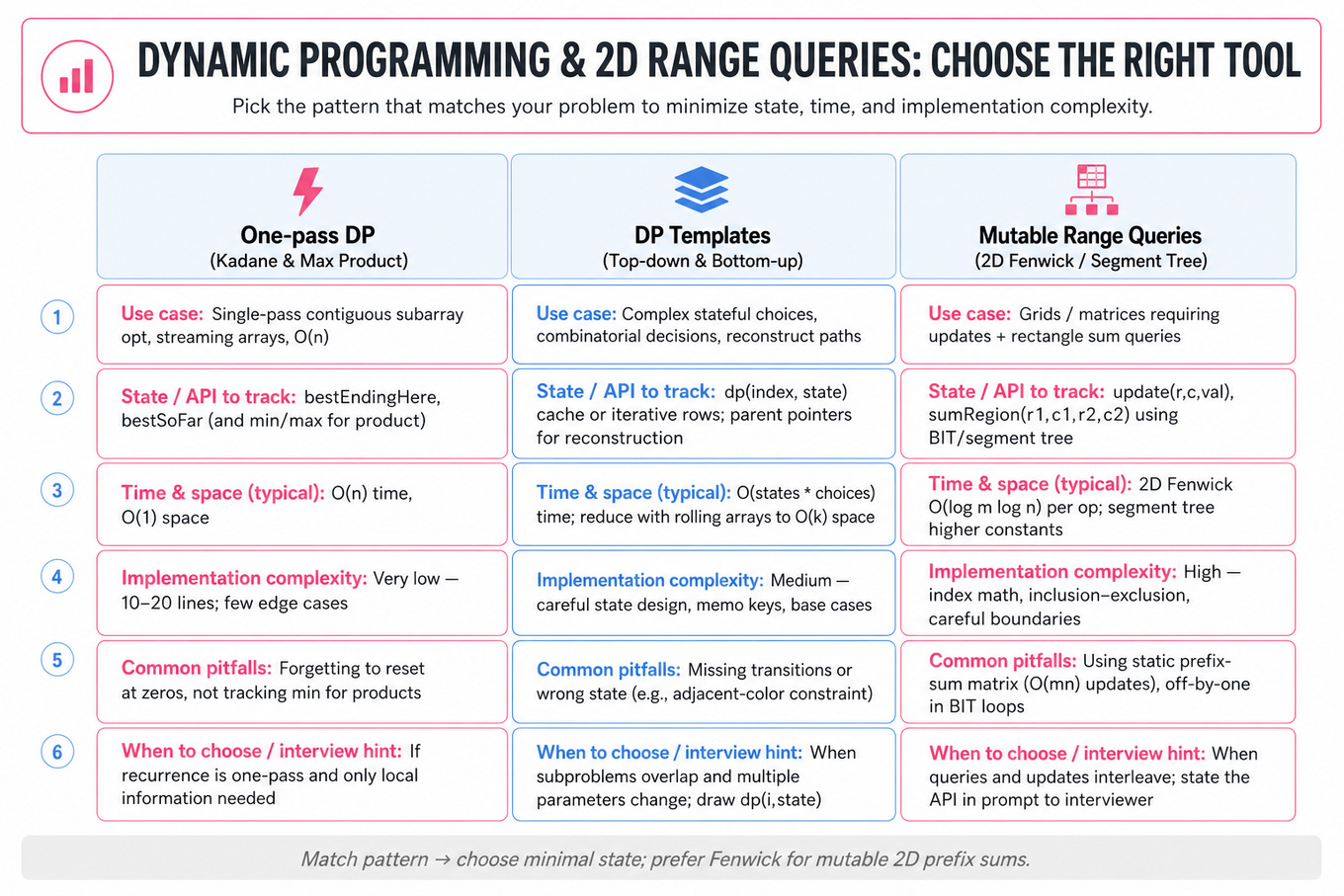
This tests dynamic programming, contiguous subarray optimization, and mutable range-query data structures under interview constraints. You need to recognize when a problem is a one-pass recurrence, a memoized state transition, or a data structure API such as `update(row, col, val)` plus `sumRegion(r1, c1, r2, c2)`.
Patterns & templates
-
Kadane’s algorithm for maximum subarray sum — track
bestEndingHereandbestSoFar;O(n)time,O(1)space. -
Maximum product subarray — track both
maxEndingHereandminEndingHere; negatives swap roles, zeros reset naturally. -
Top-down DP with memoization — define
dp(i, state)before coding; cache with array/map; prove transitions cover all legal choices. -
Bottom-up DP with rolling arrays — convert recurrence to iteration; reduce space from
O(nk)toO(k)when only previous row matters. -
Solution reconstruction — store
parent[i][state]or recompute choices fromdp; do not optimize away information if output path is required. -
2D Fenwick tree / Binary Indexed Tree — point update and rectangle sum in
O(log m log n)using inclusion-exclusion over prefix sums. -
2D segment tree alternative — supports richer operations but is harder to implement; usually only choose it if updates/queries are not simple sums.
Common pitfalls
Pitfall: Using a static prefix-sum matrix for mutable queries gives
O(1)reads butO(mn)updates, which fails dynamic-update constraints.
Pitfall: For maximum product subarray, tracking only the maximum misses cases where a large negative becomes optimal after multiplying by another negative.
Pitfall: In DP color-assignment problems, forgetting the “adjacent colors differ” constraint in the state transition produces locally cheap but invalid assignments.
Practice these
The practice cards below cover the canonical variants — solve all of them and time yourself.
Practice questions