Distributed Key-Value Storage And Transactions
Asked of: Software Engineer
Last updated
What's being tested
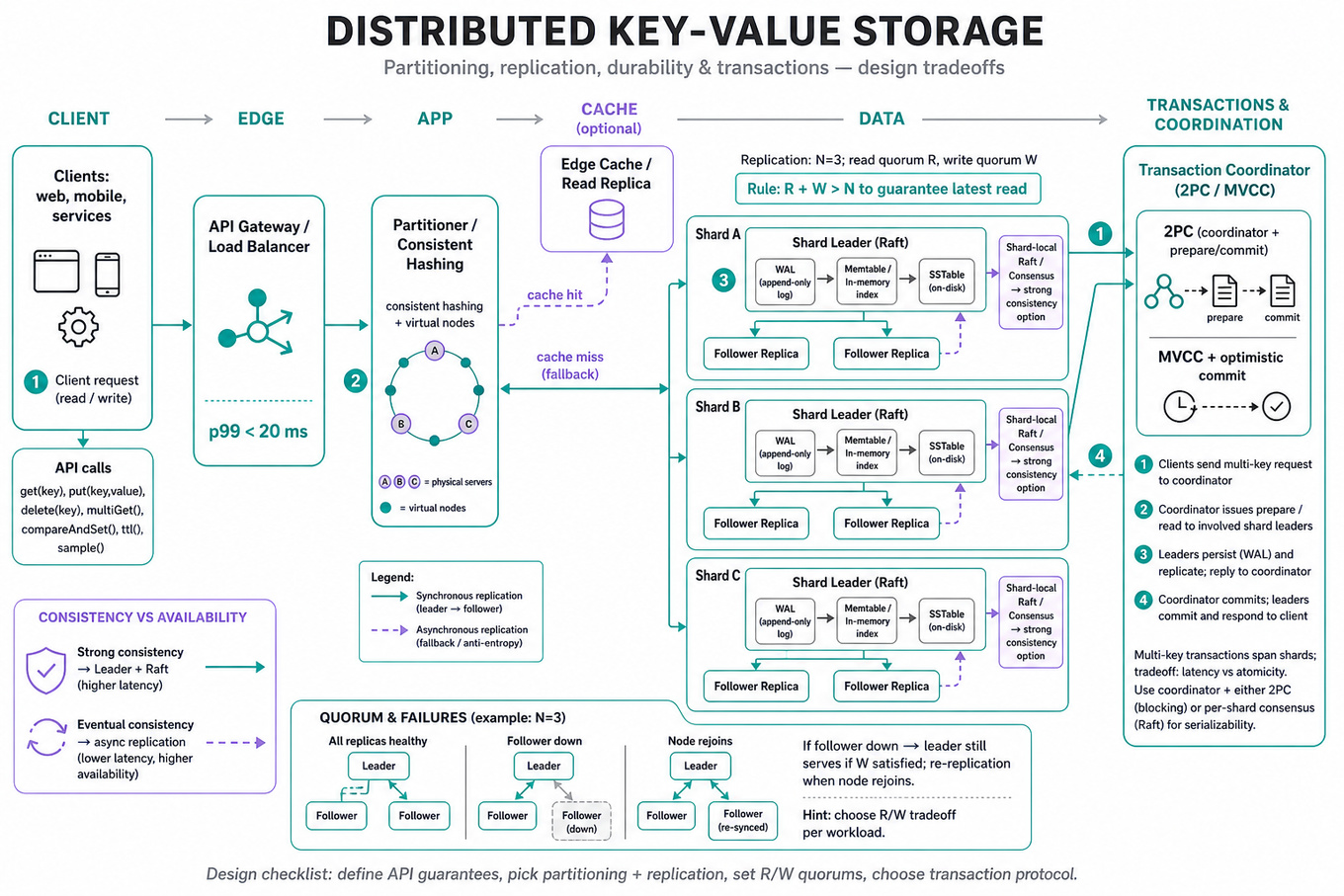
Interviewers are probing whether you can design storage systems that remain correct under scale, concurrency, and failure. The shared skill is translating a simple API like get(key), put(key, value), delete(key), or sample() into choices about partitioning, replication, durability, consistency, and transactions. LinkedIn cares because many product features depend on low-latency reads and writes over massive datasets: profiles, feeds, notifications, counters, sessions, indexes, and metadata stores. A strong Software Engineer answer shows you can start with clean single-node semantics, then evolve the design into a distributed system while explicitly naming tradeoffs.
Core knowledge
-
Key-value store API design should start with exact operations and guarantees:
get,put,delete, optionalcompareAndSet,multiGet,ttl, range scans, and batch writes. Clarify expected object size, QPS, read/write ratio, latency target likep99 < 20ms, and whether values are opaque blobs or structured records. -
In-memory hash maps give expected
getandput, but not automatically thread safety, memory control, TTL expiration, or durability. A production in-memory design usually needs lock striping,RWLock, optimistic concurrency, background eviction, and possibly append-only logging for recovery. -
Partitioning distributes keys across nodes. Consistent hashing maps keys and servers onto a ring, reducing movement when nodes join or leave from keys to roughly keys, where is key count and is server count. Virtual nodes improve balance when physical machines differ in capacity.
-
Replication improves availability and read scalability. With replication factor , write quorum , and read quorum , a common rule is to read the latest acknowledged write, assuming no conflicting writes and correctly tracked versions. Systems like
DynamoDB-style stores use tunable quorums to trade latency for consistency. -
Consistency models must be stated precisely. Strong consistency means reads observe the latest committed write, often requiring a leader or consensus. Eventual consistency allows replicas to converge asynchronously. Read-your-writes consistency is weaker than linearizability but often important for user-facing flows.
-
Consensus protocols such as Raft or Paxos are used when a shard needs a single agreed log of writes. They simplify correctness for leader-based replication but add write latency, require majority availability, and complicate cross-region operation. Do not casually say “use consensus everywhere” without discussing cost.
-
Storage engines differ by workload. LSM trees, used by systems like
RocksDBandCassandra, optimize high write throughput via memtables, sorted string tables, and compaction. B-trees, used by many relational databases, are good for point reads and range scans with in-place page updates. -
Durability usually means acknowledged writes survive process or machine failure. Common mechanisms are a write-ahead log, periodic snapshots, synchronous replication, and
fsyncpolicy. Acknowledge-after-memory is fastest but can lose data; acknowledge-after-quorum-disk is safer but increasesp99latency. -
Transactions bundle operations with ACID guarantees: atomicity, consistency, isolation, and durability. Atomicity means all-or-nothing; isolation controls how concurrent transactions interact; durability means committed state survives failure. In key-value systems, single-key transactions are much easier than multi-key or cross-shard transactions.
-
Isolation levels describe allowed anomalies. Read committed prevents dirty reads but permits non-repeatable reads. Repeatable read prevents non-repeatable reads but may allow write skew depending on implementation. Serializable isolation makes concurrent execution equivalent to some serial order, often via two-phase locking, optimistic concurrency control, or serializable snapshot isolation.
-
Distributed transactions across shards require coordination. Two-phase commit provides atomic commit but can block if the coordinator fails; adding consensus-backed transaction coordinators improves availability but raises complexity. Many scalable systems avoid cross-shard transactions by careful key design, denormalization, idempotent operations, or saga-style workflows.
-
Rebalancing and hot keys are common edge cases. Uniform hashing does not protect against one celebrity-profile key receiving 100x traffic. Mitigations include request coalescing, caching, key splitting, adaptive replication, rate limiting, and moving virtual nodes gradually to avoid cache misses and network spikes.
Worked example
For Design a scalable key-value store, a strong candidate first frames the problem by asking: “Are we optimizing for reads or writes, what is the value size, do we need strong consistency, what is the expected QPS and data volume, and is this single-region or multi-region?” Then they declare a reasonable baseline, such as opaque values up to 1 MB, billions of keys, high read QPS, p99 under tens of milliseconds, and per-key atomic writes.
The answer skeleton should have four pillars: API and data model, storage engine, distribution strategy, and failure handling. For storage, you might choose an LSM-based local engine with a memtable, append-only WAL, immutable SSTables, Bloom filters, and compaction. For distribution, use consistent hashing with virtual nodes, a routing layer that maps keys to shard replicas, and metadata maintained in a configuration service. For availability, replicate each shard to three nodes with leader-based writes or quorum writes, plus background repair for stale replicas.
One tradeoff to flag explicitly is leader-based replication versus quorum replication. A leader gives simpler linearizable per-key writes and easier conflict handling, but failover and cross-region writes are harder; quorum replication can lower write unavailability but needs vector clocks, timestamps, or conflict resolution. A good close is: “If I had more time, I’d drill into compaction tuning, hot-key mitigation, backup/restore, and how we would validate correctness under node failure using chaos tests.”
A second angle
For Scale a Distributed Randomized Multiset, the same storage concepts apply, but the hard part shifts from ordinary key routing to preserving globally uniform random sampling. If each shard stores a local multiset, sampling by “pick a random shard, then random item” is biased unless all shards have equal item counts. A better design tracks each shard’s cardinality and samples shard with probability , then samples uniformly within that shard. Rebalancing now must update both item placement and the global count metadata, and failures must not cause double-counting or invisible items. This is still a distributed key-value/data-structure problem, but the correctness property is statistical uniformity rather than just successful get and put.
Common pitfalls
Pitfall: Saying “use consistent hashing and replication” as if that completes the design.
That answer names two components but skips the real interview signal: what happens during node failure, stale reads, rebalancing, compaction, and hot partitions. A stronger answer ties each mechanism to a specific requirement, such as “replication factor 3 tolerates one node failure under majority quorum, but writes fail if two replicas are unavailable.”
Pitfall: Treating ACID as memorized vocabulary instead of concurrency behavior.
A weak explanation says “atomic, consistent, isolated, durable” and stops. A better one gives anomalies: dirty read, non-repeatable read, phantom read, lost update, and write skew, then connects them to isolation levels and implementation choices like two-phase locking or MVCC.
Pitfall: Over-designing with global transactions and strong consistency for every operation.
Many large-scale systems intentionally avoid cross-shard serializable transactions because they increase latency and reduce availability. Land better by saying which operations need strong guarantees, which can be eventually consistent, and how you would use idempotency keys, conditional writes, or per-entity partitioning to contain transaction scope.
Connections
Interviewers can pivot from this topic into caching, consistent hashing, database indexing, leader election, distributed consensus, or rate limiting. They may also ask you to compare systems such as Redis, DynamoDB, Cassandra, Bigtable, RocksDB, and ZooKeeper from a latency, consistency, and operations perspective.
Further reading
-
Dynamo: Amazon’s Highly Available Key-value Store — foundational paper on consistent hashing, replication, vector clocks, and tunable consistency.
-
The Google File System / Bigtable papers — useful for understanding tablet partitioning, compaction, and large-scale storage design.
-
Designing Data-Intensive Applications by Martin Kleppmann — best single reference for replication, partitioning, transactions, logs, and consistency models.
Featured in interview prep guides
Practice questions
- Scale a Distributed Randomized MultisetLinkedIn · Software Engineer · Technical Screen · medium
- Design a scalable key-value storeLinkedIn · Software Engineer · Onsite · medium
- Design an in-memory key-value store using mapsLinkedIn · Software Engineer · Onsite · medium
- Explain database transactions and ACIDLinkedIn · Software Engineer · Technical Screen · medium
Related concepts
- Distributed Key-Value StorageSystem Design
- Durable Key-Value Stores And CachesSystem Design
- Distributed Storage, Replication, and ConsistencySystem Design
- Key-Value Stores, Caches, And WAL DurabilitySystem Design
- Distributed Systems Reliability And StorageSystem Design
- Persistent Key-Value StoresCoding & Algorithms