Caching And Stateful Data Structure Design
Asked of: Software Engineer
Last updated
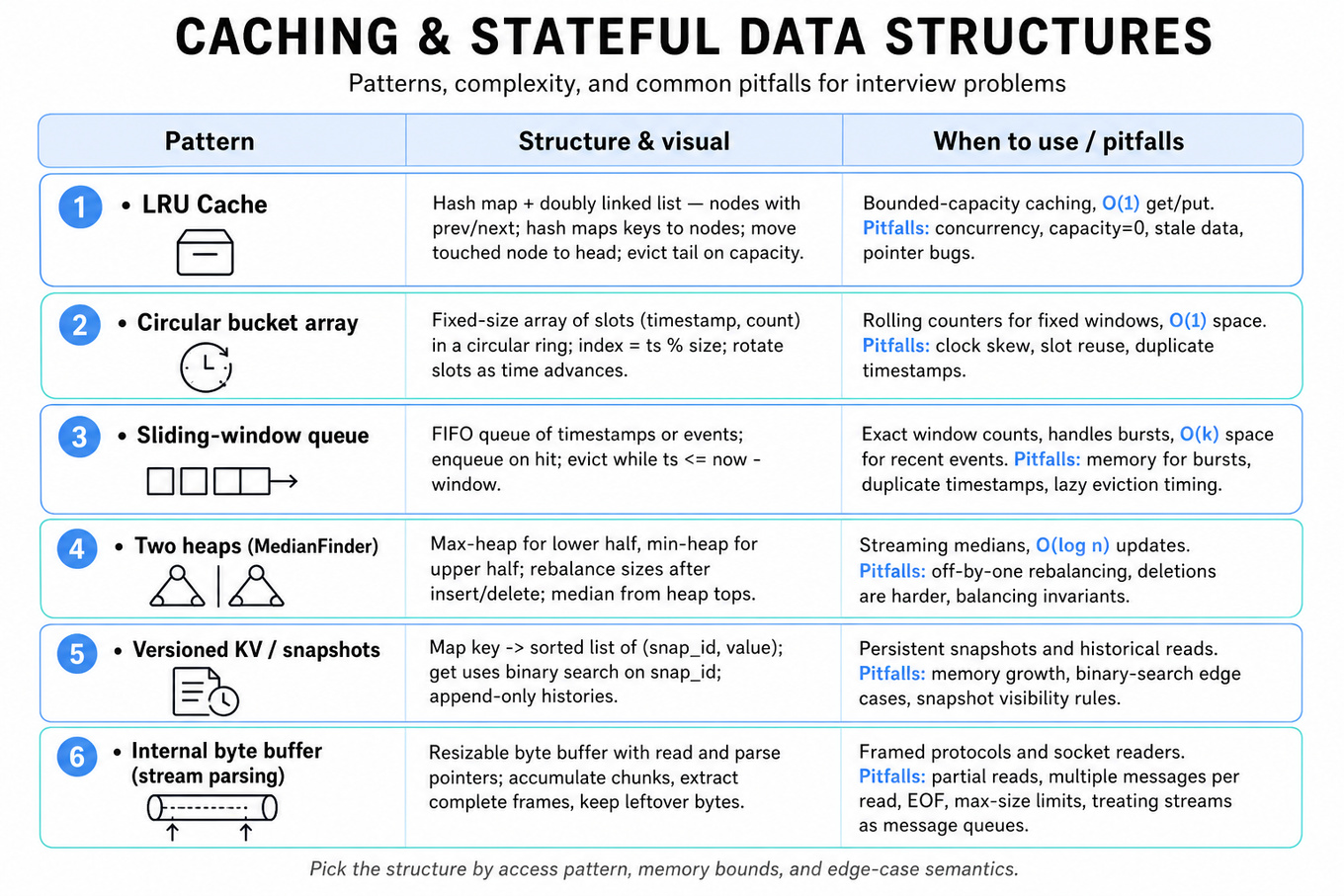
What's being tested
This tests stateful data structure design: maintaining mutable state with precise API semantics, predictable complexity, and correct behavior under edge cases. Expect variants involving LRU eviction, sliding-window expiration, streaming order statistics, versioned storage, and buffered stream parsing.
Patterns & templates
-
Hash map + doubly linked list for
LRUCache.get/put—O(1)average time; always move touched nodes to the head. -
Circular bucket array for rolling counters — store
(timestamp, count)per slot;O(1)space for fixed windows like 300 seconds. -
Queue of events for exact sliding windows — enqueue timestamps, evict while
ts <= now - window;O(k)space for recent hits. -
Two heaps for
MedianFinder— max-heap lower half, min-heap upper half; rebalance sizes so median isO(1). -
Versioned key histories for snapshot KV stores — map key to sorted
(snap_id, value)list;getuses binary search inO(log v). -
Internal byte buffer for socket readers — accumulate chunks, parse complete frames, retain leftovers; handle EOF, partial reads, and max-size limits.
-
API-first reasoning — define
get,put,snapshot,readMessage,hit,getHitssemantics before coding; complexity follows from invariants.
Common pitfalls
Pitfall: Treating streams like message queues. A socket
read()can return partial messages, multiple messages, or zero bytes before EOF.
Pitfall: Forgetting stale-state cleanup. Rolling counters, LRU nodes, and snapshot histories all require explicit rules for expiration or version visibility.
Pitfall: Giving only the happy path.
Appleinterviewers often probe empty inputs, duplicate timestamps, overwrite semantics, capacity zero, and boundary times.
Practice these
The practice cards below cover the canonical variants — solve all of them and time yourself.
Featured in interview prep guides
Practice questions
- Design a rolling five-minute hit counterApple · Software Engineer · Technical Screen · medium
- Design video platform and catalog systemApple · Software Engineer · Onsite · hard
- Design and scale a Yelp-like platformApple · Software Engineer · Onsite · hard
- Implement rotation, LRU cache, streaming median, cycle detectionApple · Software Engineer · Onsite · medium
- Implement a robust socket message readerApple · Software Engineer · Technical Screen · medium
- Implement deep clone for complex objectsApple · Software Engineer · Technical Screen · medium
- Design a snapshotable key-value storeApple · Software Engineer · Technical Screen · medium
Related concepts
- Stateful Data Structures And OOP API DesignCoding & Algorithms
- Core Data Structures, Caches, And Clean ImplementationCoding & Algorithms
- Durable Key-Value Stores And CachesSystem Design
- In-Memory Stateful Data ModelingCoding & Algorithms
- Stateful In-Memory Data Structures And Temporal SemanticsCoding & Algorithms
- In-Memory Stateful API DesignCoding & Algorithms