Stateful Data Structures And OOP API Design
Asked of: Software Engineer
Last updated
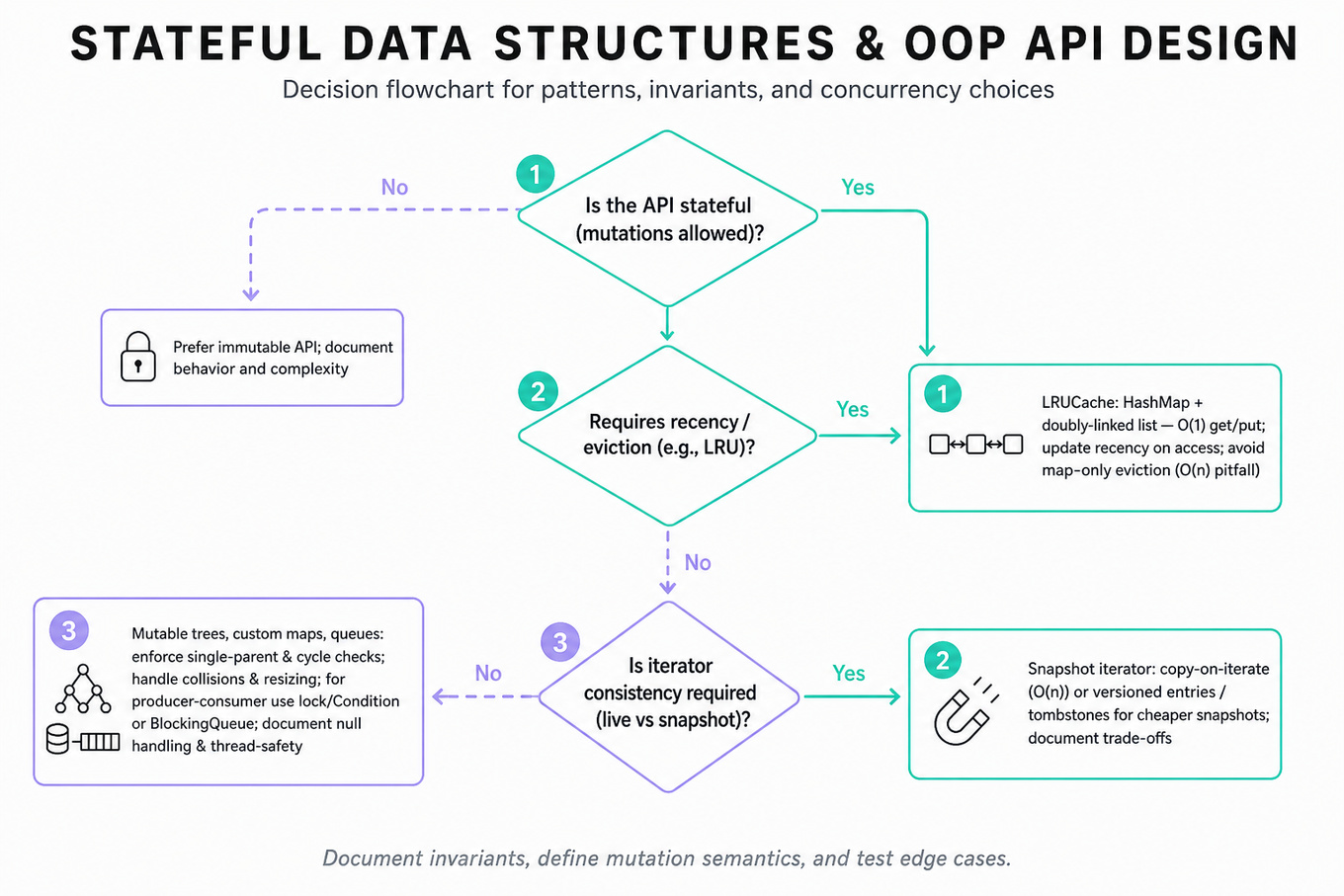
What's being tested
You’re being tested on stateful data structure design: maintaining invariants across mutating operations while exposing a clean, predictable API. Microsoft interviewers are probing whether you can combine OOP modeling, iterator semantics, cache eviction, tree ownership rules, and concurrency-safe queues without losing track of edge cases.
Patterns & templates
-
Hash map + doubly linked list for
LRUCache:get/putinO(1)average time; always update recency after successful access. -
Snapshot iterator via copy-on-iterate or versioned entries: trade
O(n)snapshot cost for simple consistency, or use tombstones for lower upfront cost. -
Mutable tree API with
parent,children,addChild,removeChild: enforce single-parent ownership and reject cycles before mutation. -
Iterator traversal templates: DFS uses a
stack, BFS uses aqueue; define whether traversal reflects live mutations or a fixed snapshot. -
Custom hash map with buckets and resizing: handle collisions, load factor,
hashCode/equals, negative hashes, duplicate keys, and rehashing cost. -
Producer-consumer queue requires clear synchronization: use
lock/Condition,BlockingQueue, or atomic primitives; avoid busy-waiting and missed wakeups. -
API design discipline: separate storage invariants from public methods; document complexity, mutation behavior, null handling, and thread-safety guarantees.
Common pitfalls
Pitfall: Implementing
LRUCachewith only a hash map makes eviction require scanning, turningputintoO(n).
Pitfall: Returning a live iterator over a mutable collection without defining behavior causes skipped elements, duplicates, or concurrent modification bugs.
Pitfall: Tree APIs often forget cycle checks, allowing
node.addChild(ancestor)and corrupting traversal, serialization, and parent pointers.
Practice these
The practice cards below cover the canonical variants — solve all of them and time yourself.
Featured in interview prep guides
Practice questions
- Implement SQL Table and DNA OrderingMicrosoft · Software Engineer · Onsite · medium
- Explain OOP design and API rolloutMicrosoft · Software Engineer · Technical Screen · hard
- Implement concurrent structures and debug queue codeMicrosoft · Software Engineer · Technical Screen · hard
- Implement a Snapshot Set IteratorMicrosoft · Software Engineer · Technical Screen · medium
- Implement interval room counter and token managerMicrosoft · Software Engineer · Onsite · easy
- Implement a calendar with non-overlapping bookingsMicrosoft · Software Engineer · Technical Screen · medium
- Build a time-based key-value storeMicrosoft · Software Engineer · Technical Screen · medium
- Implement a Tic-Tac-Toe game classMicrosoft · Software Engineer · Technical Screen · medium
- Design cache with least-recently-used evictionMicrosoft · Software Engineer · Technical Screen · medium
- Implement a generic tree Node classMicrosoft · Software Engineer · Onsite · medium
Related concepts
- Mutable Data Structure DesignCoding & Algorithms
- Caching And Stateful Data Structure DesignCoding & Algorithms
- Core Data Structures, Caches, And Clean ImplementationCoding & Algorithms
- Stateful In-Memory Data StructuresCoding & Algorithms
- Mutable Data Structures And O(1) DesignCoding & Algorithms
- Composite Data Structures and O(1) OperationsCoding & Algorithms