Mutable Data Structures And O(1) Design
Asked of: Software Engineer
Last updated
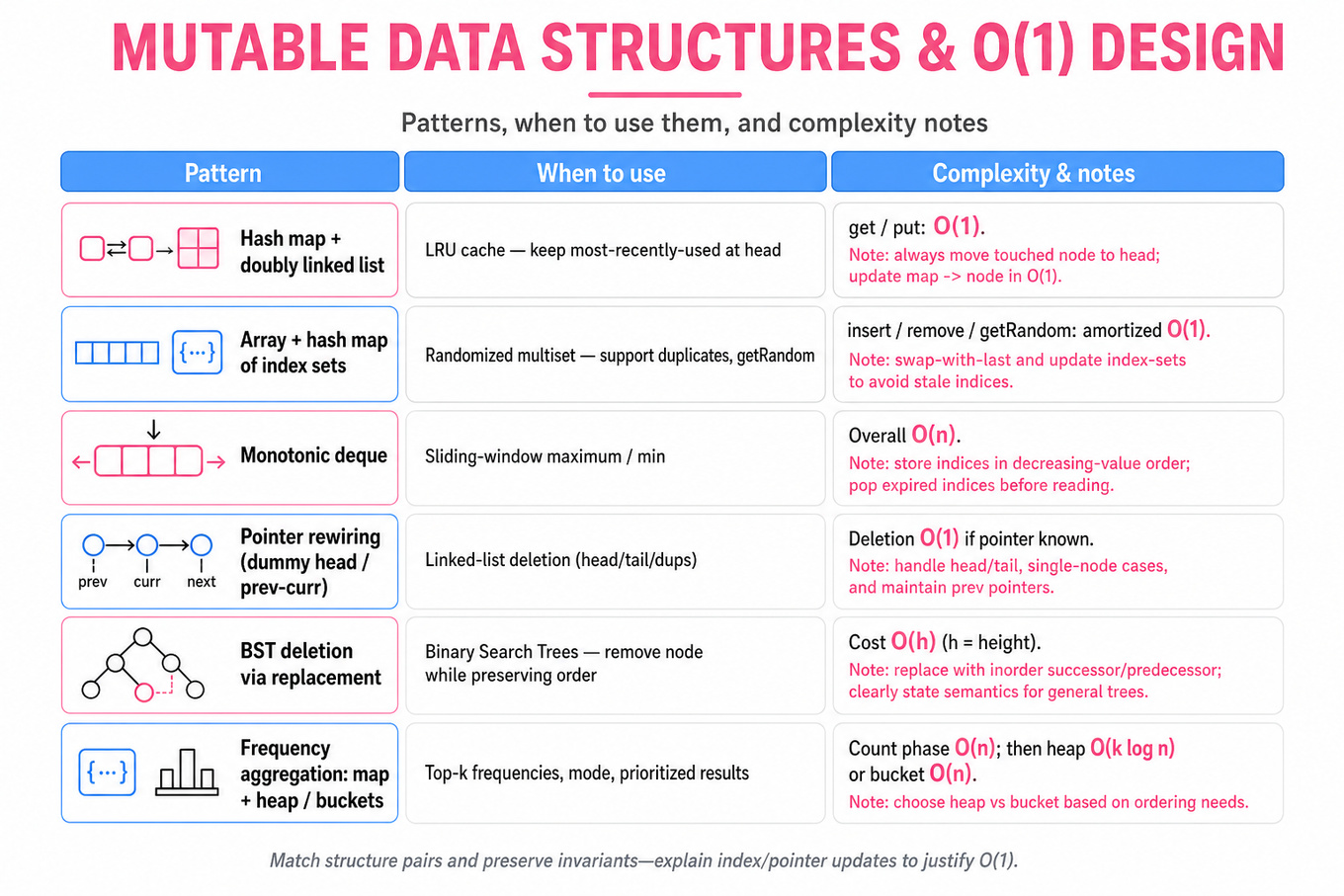
What's being tested
You’re being tested on mutable data structure invariants: how to update pointers, indices, maps, queues, and tree links without breaking correctness. The strongest answers combine the right structure pairings—hash map + list, array + index set, deque + window—with clear O(1) or O(n) complexity arguments.
Patterns & templates
-
Hash map + doubly linked list for
LRUCache—get/putinO(1); always move touched nodes to head. -
Array + hash map of index sets for randomized multiset —
insert,remove,getRandomaverageO(1); swap-delete from array tail. -
Monotonic deque for sliding maximum — keep indices in decreasing value order; pop expired indices before reading window max.
-
Pointer rewiring for linked-list deletion — use dummy head, track
prev/curr; handle deleting head, tail, and repeated values. -
Binary tree deletion via replacement — for BSTs, replace with inorder successor/predecessor; for general trees, define deletion semantics first.
-
Shape normalization for distinct islands — DFS/BFS record relative offsets or path signatures; avoid absolute coordinates and traversal-order ambiguity.
-
Frequency aggregation with heaps or maps — use
Counter/hash map first, then heap/bucket depending on required ordering and complexity.
Common pitfalls
Pitfall: Claiming
O(1)deletion from an array-backed randomized set without explaining the swap-with-last index update.
Pitfall: Forgetting stale indices in a sliding-window deque, causing maxima from outside the current window.
Pitfall: Mutating linked lists or trees without covering root/head deletion, single-node structures, duplicates, and null children.
Practice these
The practice cards below cover the canonical variants — solve all of them and time yourself.
Featured in interview prep guides
Practice questions
- Delete nodes in linked list and binary treeTikTok · Software Engineer · Technical Screen · medium
- Implement an LRU cacheTikTok · Software Engineer · Technical Screen · easy
- Reverse nodes in even-length linked-list groupsTikTok · Software Engineer · Technical Screen · medium
- Design LRU cache with O(1) operationsTikTok · Software Engineer · Technical Screen · medium
- Solve array and tree algorithm challengesTikTok · Software Engineer · Technical Screen · medium
- Implement distinct islands and sliding maximaTikTok · Software Engineer · Technical Screen · medium
- Implement O(1) randomized multisetTikTok · Software Engineer · Technical Screen · medium
Related concepts
- Mutable Data Structure DesignCoding & Algorithms
- Core Data Structures, Caches, And Clean ImplementationCoding & Algorithms
- Composite Data Structures and O(1) OperationsCoding & Algorithms
- Mutable Data Structure API DesignSoftware Engineering Fundamentals
- LRU Cache And O(1) Data StructuresCoding & Algorithms
- Stateful Data Structures And OOP API DesignCoding & Algorithms