Apple Software Engineer Interview Prep Guide
Everything Apple actually asks Software Engineer candidates — concept walkthroughs, worked examples, and the real interview questions, drawn from candidate reports. Free to read.
Last updated
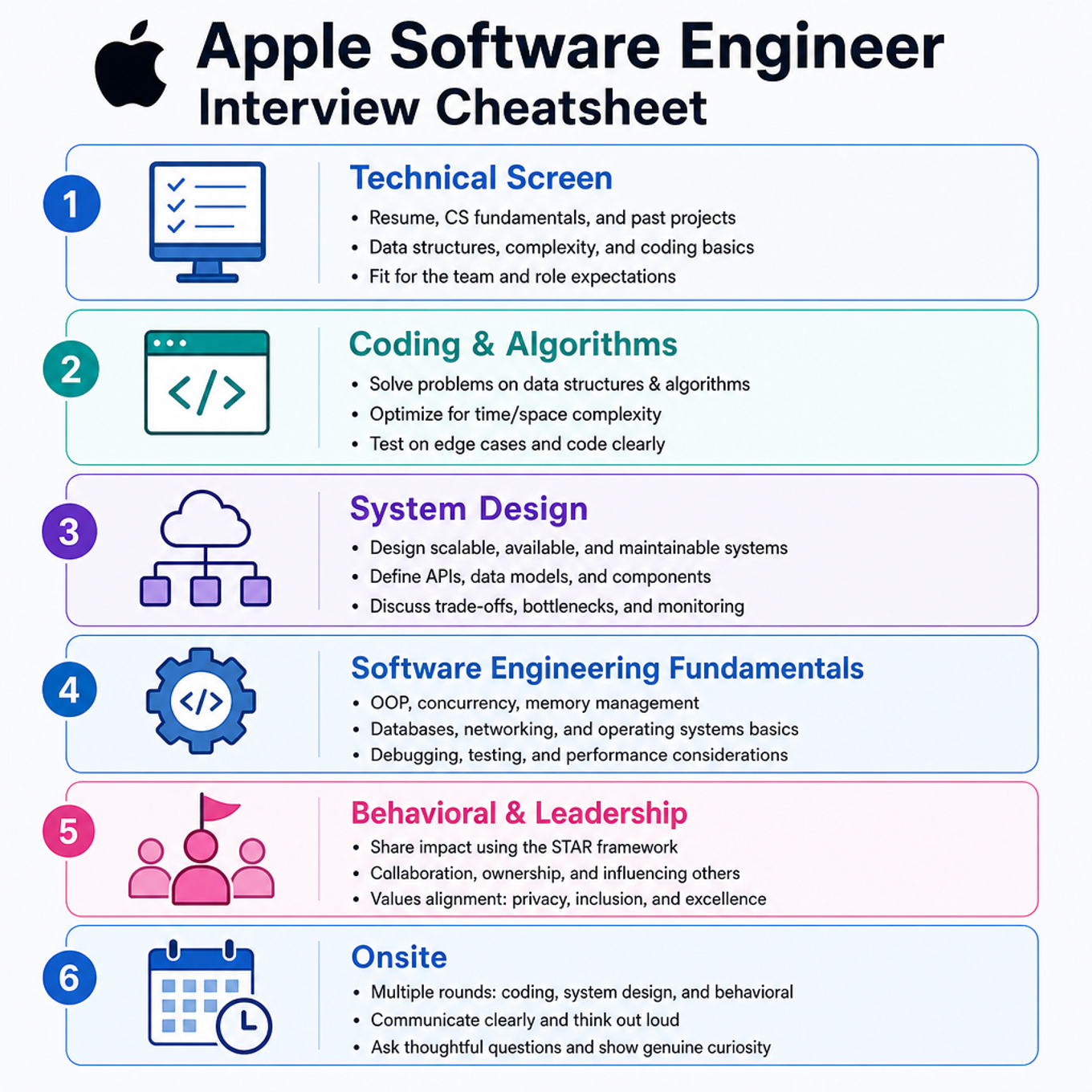
Technical Screen
Coding & Algorithms
-
Core Data Structures, Sorting, And Complexity — covered in depth under Onsite below.
-
Depth-First Search, Connected Components, And Cycles — covered in depth under Onsite below.
-
Heaps, Top-K, And Streaming Selection — covered in depth under Onsite below.
What's being tested
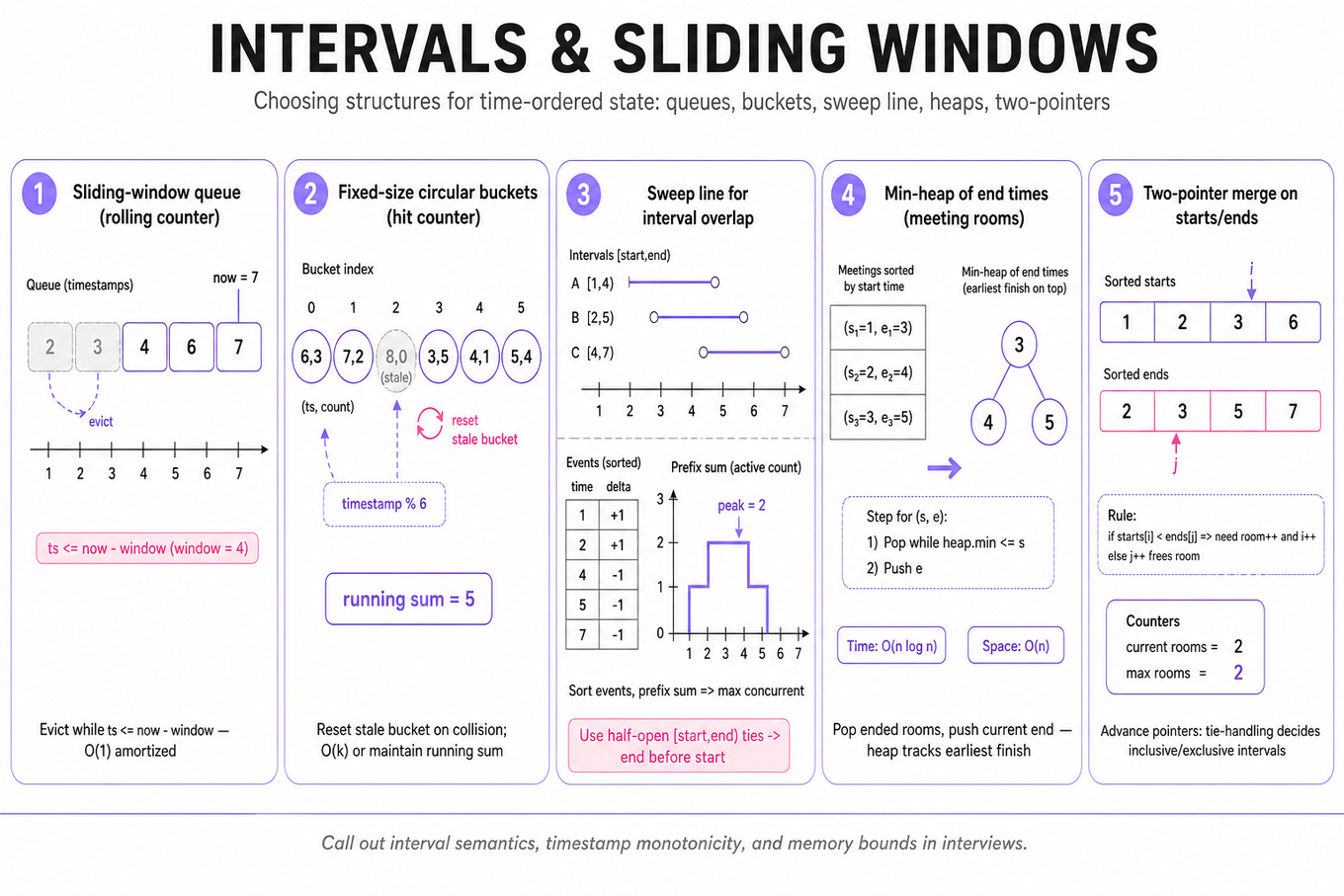
Apple interviewers are probing time-ordered state management: intervals, expiring events, sorted timelines, and resource counts over time. You need to choose the right structure—queue, heap, two pointers, sweep line, or buckets—and explain complexity, boundary semantics, and edge cases clearly.
Patterns & templates
-
Sliding window queue for rolling counters — store timestamps or
(timestamp, count)pairs; evict whilets <= now - window;O(1)amortized. -
Fixed-size circular buckets for hit counters — bucket by
timestamp % 300; reset stale buckets;O(300)query or maintain running sum. -
Sweep line for interval overlap — convert
[start, end)into(start, +1),(end, -1); sort events; max prefix sum gives rooms. -
Min-heap of end times for meeting rooms — sort by start, pop ended meetings, push current end;
O(n log n)time,O(n)space. -
Two-pointer merge over sorted starts/ends — sort starts and ends separately; advance start for new room, end for freed room; watch tie rules.
-
Time-series single-pass optimization — track best prior minimum and current profit;
O(n)time,O(1)space; don’t sort prices. -
State-machine scanning for brackets or edge detection — stack for nesting, previous-state variables for discrete transitions; validate empty and malformed input.
Common pitfalls
Pitfall: Treating interval ends as inclusive by default; most scheduling problems use half-open intervals
[start, end)so back-to-back meetings do not conflict.
Pitfall: Designing a hit counter that stores every event when the interviewer expects bounded memory for high-throughput repeated timestamps.
Pitfall: Giving only the final algorithm without clarifying timestamp monotonicity, duplicate times, clock granularity, and whether queries can arrive out of order.
Practice these
The practice cards below cover the canonical variants — solve all of them and time yourself.
Practice questions
-
Object-Oriented Design, API Design, And Testability — covered in depth under Onsite below.
-
Caching And Stateful Data Structure Design — covered in depth under Onsite below.
System Design
- Scalable Backend Architecture And Data Modeling — covered in depth under Onsite below.
What's being tested
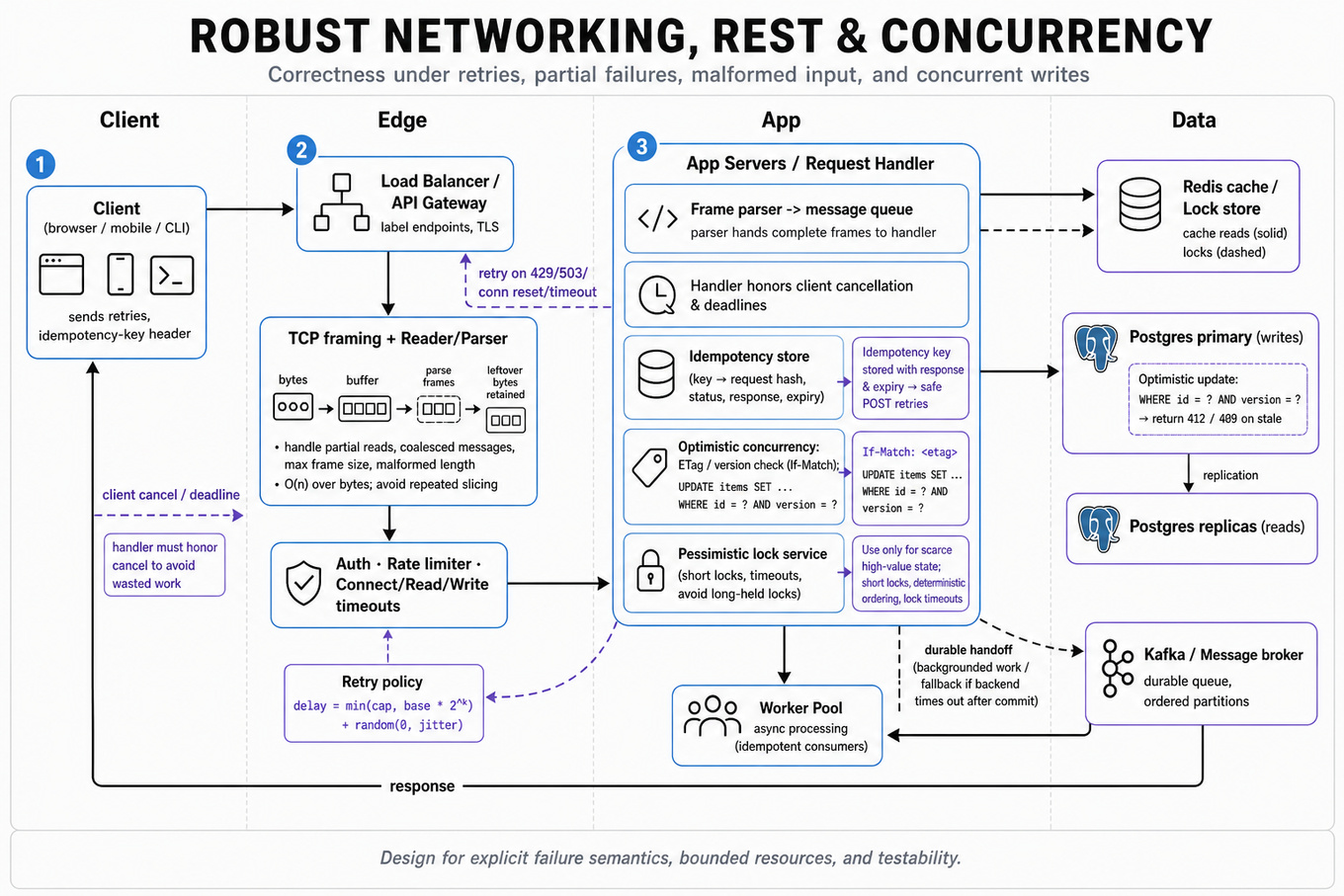
This area tests whether a Software Engineer can build APIs and networked components that behave correctly under retries, partial failures, concurrent writes, malformed input, and changing scale. Apple interviewers are probing for practical distributed-systems judgment: not just “can you write the happy path,” but can you preserve correctness when clients disconnect, requests are duplicated, two users update the same resource, or a backend times out after committing. Strong answers combine clean API design, explicit failure semantics, bounded resource usage, and testability.
Core knowledge
-
TCP stream framing is mandatory because sockets deliver bytes, not messages. A robust reader needs a delimiter protocol, fixed-length header, or length-prefixed frame; it must handle partial reads, coalesced messages, EOF, malformed lengths, and maximum frame sizes.
-
Internal buffering separates network reads from message parsing. Keep a mutable byte buffer, append chunks from
recv, parse complete frames, and retain leftovers. Complexity should be over bytes read; avoid repeated slicing that turns parsing into . -
Timeouts and cancellation are correctness features, not polish. Use connect, read, write, and overall request deadlines; distinguish timeout from EOF and protocol errors. Server-side handlers should honor client cancellation to avoid wasted work and stale writes.
-
REST idempotency means repeated identical requests have the same intended effect.
GET,PUT, andDELETEare naturally idempotent when modeled well;POSTusually needs an idempotency key, commonly stored with request hash, status, response body, and expiration. -
Optimistic concurrency control uses a resource version,
updated_at, monotonically increasingversion, orETag. Clients sendIf-Match: <etag>; the server updates withWHERE id = ? AND version = ?, returning412 Precondition Failedor409 Conflictif stale. -
Pessimistic locking can be appropriate for scarce, high-value state, but it reduces throughput and risks deadlocks. Prefer short database transactions, deterministic lock ordering, and lock timeouts; avoid holding locks while calling external services.
-
Retry safety requires classifying failures. Retry
429,503, connection resets, and timeouts with exponential backoff and jitter, e.g. ; do not blindly retry non-idempotent mutations. -
Error contracts should be stable and machine-readable. Use appropriate HTTP statuses:
400validation,401unauthenticated,403unauthorized,404not found,409conflict,412precondition failed,422semantic validation,429rate limited,5xxserver failure. -
Authentication and authorization are separate checks.
JWT, session tokens, or mTLS prove identity; authorization verifies the caller can perform the action on that resource. Enforce authorization server-side even if the client hides unavailable actions. -
Rate limiting protects shared services from overload and abuse. Common algorithms include token bucket, leaky bucket, and fixed/sliding windows. Return
429withRetry-After; choose limits per user, device, IP, API key, or resource depending on abuse mode. -
Snapshot semantics require a clear read model. A snapshotable key-value store can use copy-on-write maps, immutable persistent data structures, or multi-version concurrency control; reads at snapshot
sshould see the latest version for each key. -
Python concurrency has subtle guarantees.
dictandlistoperations may be individually safe from interpreter crashes under theGIL, but compound operations like “check then insert” are not atomic. Usethreading.Lock,asyncio.Lock, queues, or single-writer ownership.
Worked example
For Implement a robust REST API method, a strong candidate should first clarify the resource, mutation semantics, caller identity, and whether duplicate submissions are possible: “Is this create, update, or money-moving? Do clients retry after timeouts? Do we need exactly-once effect or just idempotent observable behavior?” Then declare assumptions, such as using Postgres, JSON over HTTP, authenticated users, and a versioned row model. Organize the answer around four pillars: API contract, validation/authz, concurrency/idempotency, and failure handling/testing.
For a create-like POST, use an Idempotency-Key header scoped to user and endpoint; store the request hash and final response in an idempotency_requests table with a unique constraint on (user_id, key). If the same key arrives with a different request hash, return 409 Conflict; if the original is still processing, either wait briefly or return 409/202 depending on product semantics. For update-like methods, prefer PUT /resource/{id} or PATCH /resource/{id} with ETag and If-Match, implemented via an atomic conditional update.
Flag the key tradeoff explicitly: storing full responses makes retries simple and consistent, but increases storage and requires TTL cleanup; recomputing responses saves space but risks drifting behavior if state changes. Testing should include duplicate request races, stale version updates, auth failures, validation failures, database transaction rollback, and retry-after-commit scenarios. Close by saying that with more time, you would add observability: structured logs with request IDs, metrics for 409/412/429, latency percentiles like p95 and p99, and alerts on idempotency-store failures.
A second angle
For Implement a robust socket message reader, the same reliability mindset applies, but the API boundary is lower-level: the danger is assuming one recv equals one logical message. The candidate should define the wire protocol first, usually a length-prefixed frame with a fixed-size header and a maximum allowed body size. Concurrency control shifts from HTTP row versions to buffer ownership: one reader should own the socket buffer, parse complete frames, and hand immutable messages to worker threads or an event loop. Failure semantics must be precise: EOF with an empty buffer is clean close, EOF mid-frame is a protocol error, oversized length is rejection, and timeout is distinct from malformed input. Testing should simulate fragmented headers, multiple messages in one read, zero-byte reads, slowloris behavior, and malicious length values.
Common pitfalls
Pitfall: Treating retries as a transport concern only.
A tempting answer is “the client can retry on timeout,” but this can double-charge, create duplicate rows, or overwrite newer data. A better answer names which operations are safe to retry, adds idempotency keys or conditional updates, and defines what the server returns for duplicate in-flight or completed requests.
Pitfall: Hand-waving “use locks” without specifying scope.
Locks can protect in-memory structures inside one process, but they do not solve races across multiple app servers. For REST methods backed by a database, use unique constraints, transactions, row versions, and conditional writes; for in-process buffers, use ownership or explicit mutexes with minimal critical sections.
Pitfall: Over-indexing on the happy-path object model.
Candidates often design elegant endpoints but omit size limits, malformed input handling, EOF behavior, authorization, rate limits, and observability. Apple-style systems questions reward engineers who state invariants and failure modes: maximum payload, timeout policy, error mapping, transaction boundary, and tests for adversarial cases.
Connections
Interviewers may pivot from here into distributed transactions, eventual consistency, database isolation levels, or cache invalidation. They may also ask for implementation-level details in Python, Swift, Java, or Go, especially around thread safety, async I/O, and memory usage under high concurrency.
Further reading
-
Designing Data-Intensive Applications — Martin Kleppmann’s practical treatment of replication, transactions, consistency, and fault tolerance.
-
RFC 9110: HTTP Semantics — authoritative reference for HTTP methods, status codes, conditional requests, and semantics.
-
Stripe API Idempotency — clear production pattern for safely retrying mutation requests.
Practice questions
Software Engineering Fundamentals
What's being tested
Interviewers are probing debugging discipline, not just whether you can guess the bug. A strong Software Engineer shows they can reproduce a failure, reduce the search space, inspect state, reason about control flow, add targeted instrumentation, and validate the fix without creating regressions. Apple cares because many failures happen at boundaries: device firmware to OS, client to server, API to database, stream protocol to parser, or test environment to production behavior. The interviewer is looking for structured ownership under ambiguity: how you move from symptom to root cause, communicate uncertainty, and leave the system more observable than you found it.
Core knowledge
-
Reproducibility is the first debugging milestone: capture exact inputs, environment, version, config flags, timestamps, device state, and concurrency conditions. If reproduction is flaky, estimate frequency, run repeated trials, and preserve evidence with logs, traces, core dumps, packet captures, or failing test seeds.
-
Minimization reduces the problem to the smallest failing case. For a Python loop bug, that might mean a 5-line script with fixed inputs; for a socket reader, a fake stream returning partial reads; for firmware, a 30-minute deterministic soak test with controlled power, temperature, and traffic.
-
Binary search debugging applies beyond code history. Use
git bisectfor regressions, feature-flag toggles for behavior changes, dependency version pinning for library changes, and divide-and-conquer logging to locate where state first diverges from expectations. -
Control-flow correctness depends on invariants. For loops, articulate “what must be true before and after each iteration,” then check termination: the loop variable must move monotonically toward the exit condition. Watch off-by-one errors, mutation during iteration, stale cached state, and conditions using
andversusor. -
Observability for production systems usually combines logs, metrics, and traces. Logs answer “what happened?”, metrics answer “how often and how bad?”, and traces answer “where did latency or failure propagate?” In APIs, useful metrics include
request_count,error_rate,p50,p95,p99, retry count, timeout count, and saturation. -
Structured logging beats free-text logging during incidents. Include
request_id,user_idor anonymized equivalent,device_idwhen appropriate, version, endpoint, error code, latency, retry attempt, and dependency status. Avoid logging secrets, auth tokens, raw payloads with personal data, or excessive high-cardinality fields. -
Error handling should preserve diagnosability. In Python, avoid broad
except Exception: pass; either handle the specific exception or wrap it with context using exception chaining:raise MyError("failed reading frame") from e. In API code, return stable error codes while logging detailed server-side context. -
Socket streams are not message streams.
recv(n)may return fewer thannbytes, multiple logical messages can arrive together, and EOF is represented byrecv()returningb"". Robust readers need message framing, usually length-prefix framing or delimiter framing, plus internal buffering and maximum-frame-size enforcement. -
Idempotency is central to reliable REST operations. For unsafe methods such as
POST /payments, accept anIdempotency-Key, persist the first result atomically, and return the same result for retries. This prevents duplicate side effects when clients retry after timeouts or connection resets. -
Concurrency bugs require reasoning about interleavings, not only lines of code. Use locks, transactions, optimistic concurrency control with version columns, unique constraints, or compare-and-swap depending on the data model. A test that passes 1,000 times single-threaded says little about races under parallel load.
-
Production rollback strategy is part of debugging. A safe response may be disable feature flag, roll back binary, shed load, raise rate limits, or degrade gracefully before root cause is known. The engineering judgment is separating mitigation from permanent fix and documenting both.
-
Validation means proving the fix addresses root cause. Add a regression test that fails before the fix, verify targeted metrics recover, monitor
p95/p99and error budgets after deployment, and check for secondary effects such as increased memory, CPU, battery drain, or retry storms.
Worked example
For Implement a robust socket message reader, a strong candidate first clarifies the protocol: “Is this a TCP stream? Are messages length-prefixed or delimiter-separated? What are the maximum message size, timeout behavior, encoding, and EOF semantics?” Then they declare assumptions, such as “I’ll implement a length-prefixed reader where the first 4 bytes are a big-endian unsigned length, with a maximum frame size to prevent memory abuse.” The answer should be organized around four pillars: framing, buffering, error handling, and tests. For framing, they explain why one recv() call is insufficient and implement a helper like read_exactly(n) that loops until n bytes are read or EOF occurs. For buffering, they either maintain an internal bytearray across calls or consume exactly the length header plus payload per message. For error handling, they distinguish clean EOF before a header, truncated frame after a partial header or payload, timeout, malformed length, and frame too large. The key tradeoff is delimiter versus length-prefix framing: delimiters are human-readable and simple but require escaping and scanning; length-prefix is efficient and binary-safe but requires careful size validation. They would close by saying, “If I had more time, I’d add fuzz tests, simulated partial reads, timeout tests, and metrics such as malformed-frame count and average frame size.”
A second angle
For How to root-cause Wi‑Fi chip stops after 30 minutes, the same debugging discipline applies, but the failure surface shifts from application code to hardware-adjacent behavior. The candidate should still start with reproducibility: exact device model, OS build, firmware version, access point, channel, traffic pattern, power state, thermal state, and whether “stops” means no packets, firmware crash, driver reset, or user-visible disconnect. Instead of unit tests, the tools might include driver logs, firmware traces, packet capture, heartbeat counters, power-management state, and a controlled soak test. The main difference is that instrumentation may perturb the system, so the candidate should compare low-overhead counters against more invasive tracing. A strong answer avoids guessing “memory leak” immediately and proposes a hypothesis matrix: timer rollover, power-save transition, resource exhaustion, firmware watchdog, AP interoperability, or thermal throttling.
Common pitfalls
Pitfall: Jumping straight to a fix before proving the failure mode.
A tempting answer is “I’d change the loop condition” or “I’d add a retry” without explaining how you know that is the bug. A better answer states the expected invariant, captures the actual state at failure, identifies the first point of divergence, and only then changes code.
Pitfall: Treating logs as an afterthought instead of a debugging tool.
Weak answers say “I’d check the logs” generically. Strong answers name exactly what they need: correlation IDs, version, endpoint, dependency latency, error code, retry attempt, socket byte counts, firmware state transition, or loop variable values at each iteration.
Pitfall: Confusing mitigation with root cause.
Rolling back, restarting a service, or resetting a chip may restore service, but it does not explain why the issue happened. Say explicitly: “First I would mitigate user impact; then I would preserve evidence and continue root-cause analysis so we can prevent recurrence.”
Connections
Interviewers may pivot from debugging into testing strategy, especially regression tests, fuzzing, property-based tests, and fault injection. They may also move toward API reliability, including idempotency, rate limiting, retries, timeouts, backoff, and circuit breakers. For systems-heavy roles, expect adjacent questions on distributed tracing, concurrency control, protocol design, and production incident communication.
Further reading
-
The Practice of Programming — Kernighan and Pike — Practical debugging, testing, interface design, and defensive programming advice for working engineers.
-
Site Reliability Engineering — Google SRE Book — Strong background on monitoring, incident response, error budgets, and production reliability practices.
-
Debugging: The 9 Indispensable Rules — David J. Agans — A concise framework for reproducing, isolating, and fixing technical failures systematically.
Practice questions
Behavioral & Leadership
- Behavioral Ownership, Communication, And Leadership — covered in depth under Onsite below.
Onsite
Coding & Algorithms

What's being tested
Apple coding screens probe data-structure selection, sorting tradeoffs, and precise time/space complexity reasoning under small implementation constraints. Expect to justify why an array, hash map, heap, stack, queue, or set is the right fit, then code cleanly with edge cases handled.
Patterns & templates
-
Hash map aggregation — use
dict/defaultdict(list)for per-key grouping inO(n)average time; discuss collision and memory tradeoffs. -
Top-k per key — maintain a min-heap of size
kwithheapq;O(n log k)beats full sorting atO(n log n). -
Two pointers on sorted arrays — shrink/search from both ends in
O(n)time; confirm whether sorting costO(n log n)is allowed. -
Sliding window for contiguous substrings/subarrays — expand right, contract left, update counts in
dict; watch duplicate handling and empty inputs. -
Stack validation — bracket matching, monotonic stack, and undo-style parsing;
O(n)time,O(n)worst-case space. -
Python list/dict mechanics —
list.appendamortizedO(1),dictlookup averageO(1), insertion order preserved in Python 3.7+. -
Complexity narration — state variables clearly:
nitems,munique keys,kretained scores; separate algorithmic cost from input parsing.
Common pitfalls
Pitfall: Sorting everything when only top three are needed; use a bounded heap or fixed-size sorted list per student instead.
Pitfall: Claiming
dictoperations are alwaysO(1)without saying average-case; adversarial hashing and resizing are real caveats.
Pitfall: Coding the happy path first and missing empty arrays, duplicate values, single-element inputs, invalid brackets, or tied scores.
Practice these
The practice cards below cover the canonical variants — solve all of them and time yourself.
Practice questions
What's being tested
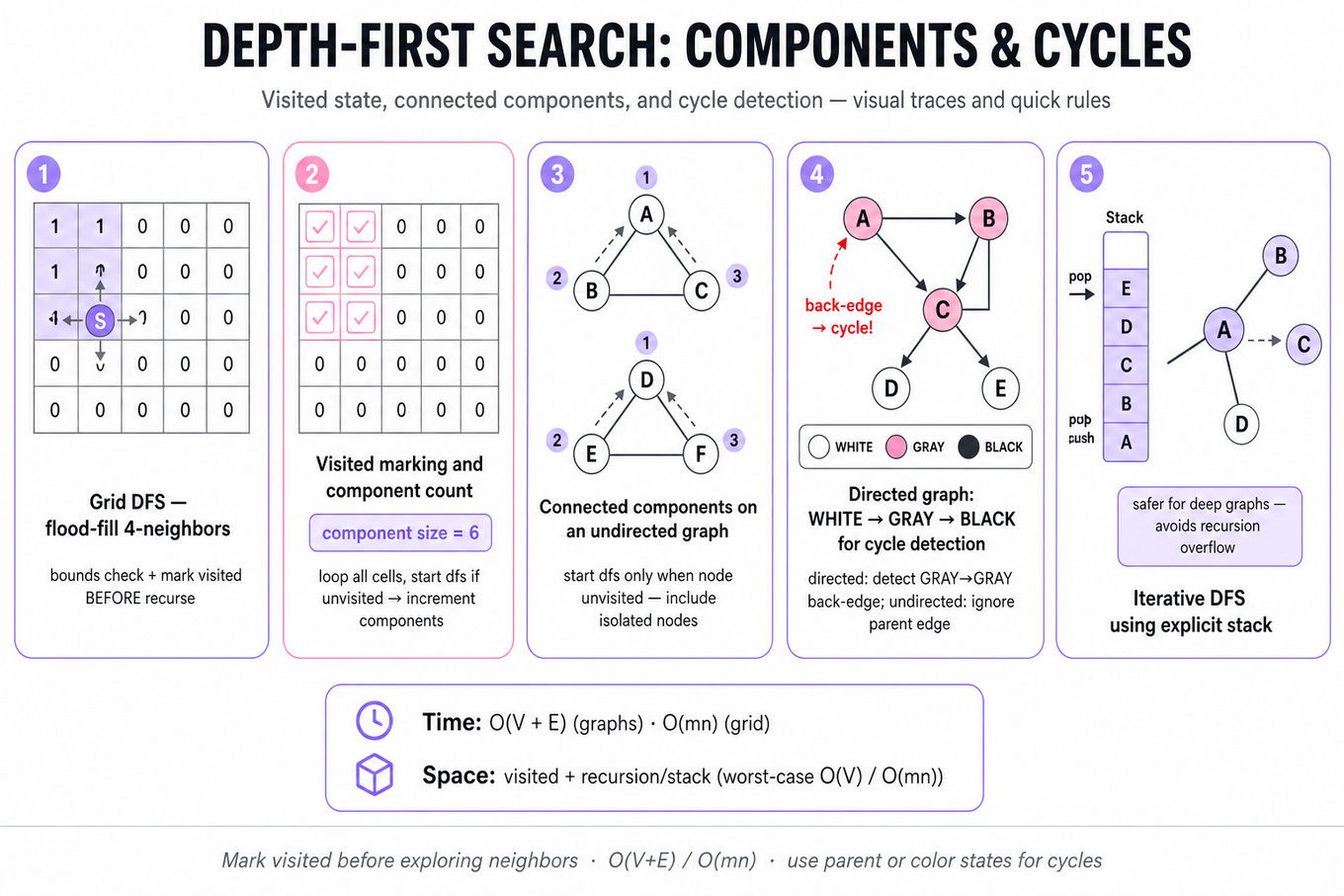
Depth-first search questions test whether you can traverse implicit or explicit graphs, mark visited state, and aggregate connected components without double-counting. Expect grids, adjacency lists, island sizing, cycle detection, and recursive-vs-iterative tradeoffs with clear O(V + E) or O(mn) complexity.
Patterns & templates
-
Grid DFS — use
dfs(r, c)with 4-neighbor deltas; bounds-check before visiting;O(mn)time,O(mn)worst-case stack. -
Connected components — loop over every node/cell, start
dfsonly if unvisited, increment component count or accumulate size. -
Visited marking — use
set(), boolean matrix, or in-place mutation like changing'1'to'0'; avoid revisiting cyclic paths. -
Iterative DFS — replace recursion with explicit
stack; safer for large grids or deep graphs where recursion may overflow. -
Cycle detection — for undirected graphs, track
parent; for directed graphs, use color states:WHITE,GRAY,BLACK. -
Adjacency construction — convert edge lists into
defaultdict(list)before traversal; include isolated nodes if the problem counts them. -
Complexity narration — say
O(V + E)for graphs,O(mn)for grids; space is visited plus recursion/stack depth.
Common pitfalls
Pitfall: Marking a cell visited after recursive calls can cause infinite recursion or double-counting; mark before exploring neighbors.
Pitfall: Treating diagonal cells as connected when the prompt specifies 4-directional connectivity.
Pitfall: Using recursive DFS blindly on large inputs; mention iterative DFS when depth could approach
Vormn.
Practice these
The practice cards below cover the canonical variants — solve all of them and time yourself.
Practice questions
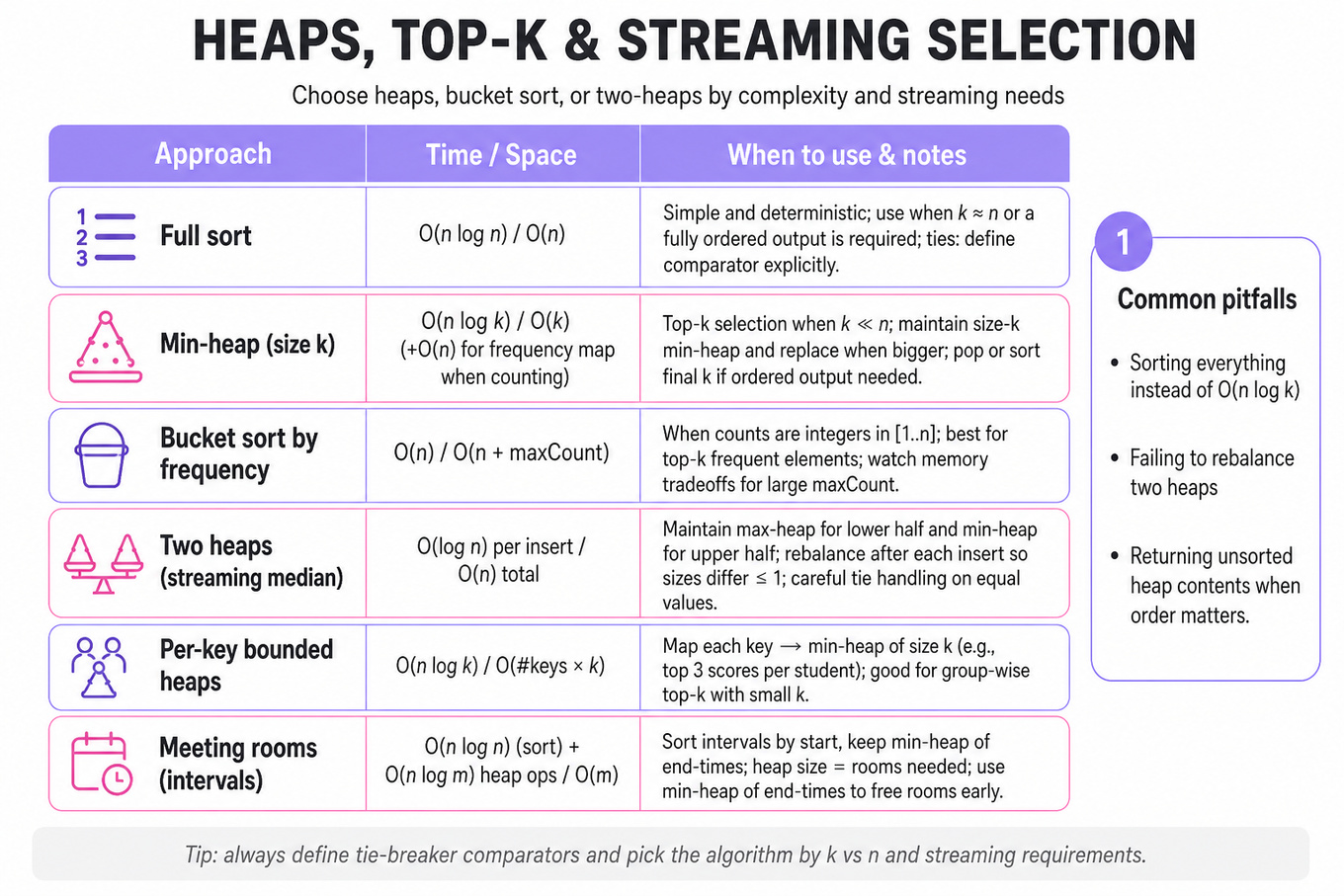
What's being tested
Heaps, top-k selection, and streaming aggregation test whether you can avoid full sorting when only a small ranked subset is needed. Interviewers look for correct data-structure choice, precise O(...) complexity, and clean handling of ties, duplicates, and incremental updates.
Patterns & templates
-
Top-k frequent elements — count with
HashMap, maintain size-kmin-heap;O(n log k)time,O(n)space. -
Bucket sort for frequencies — when counts are integers in
[1,n], use frequency buckets forO(n)time; watch memory tradeoffs. -
Streaming median — use max-heap for lower half and min-heap for upper half; rebalance so sizes differ by at most one.
-
Per-key top-k — map each key to a bounded min-heap, e.g. top three scores per student;
O(n log k)with tinyk. -
Meeting rooms — sort intervals by start time, track earliest ending meeting in min-heap; heap size equals rooms needed.
-
Tie-breaking discipline — define comparator explicitly: frequency first, then value/order if required; avoid nondeterministic heap output.
-
Heap API fluency — know
heappush,heappop,heapreplace, and negative-value max-heap simulation inPython.
Common pitfalls
Pitfall: Sorting everything with
O(n log n)when a bounded heap givesO(n log k)and is the expected optimization.
Pitfall: Forgetting to rebalance two heaps in streaming median after every insert, causing wrong medians after skewed input.
Pitfall: Returning heap contents directly when the problem requires sorted output; pop or sort the final
kelements if order matters.
Practice these
The practice cards below cover the canonical variants — solve all of them and time yourself.
Practice questions
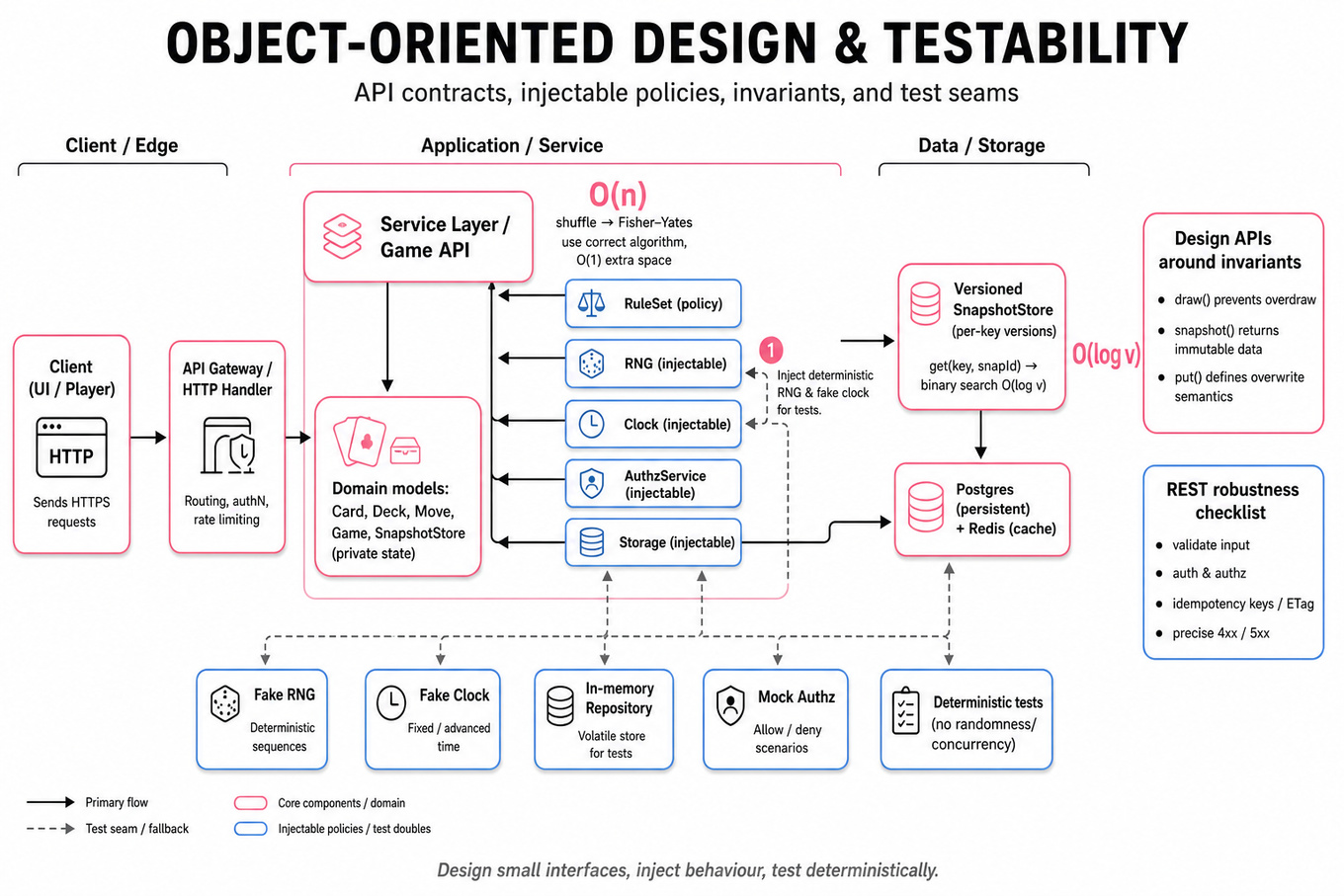
What's being tested
These prompts test object-oriented design, API contract design, and testability under changing requirements. Interviewers want to see clear abstractions, explicit invariants, deterministic tests for randomness/concurrency, and complexity-aware implementations.
Patterns & templates
-
Model domain objects first — define
Card,Deck,Move,Game,SnapshotStore; keep state private and expose minimal methods. -
Separate policy from mechanism — inject
RuleSet,Random,Clock,AuthzService, orStorageso behavior changes without rewriting core logic. -
Design APIs around invariants —
draw()should prevent overdraw,snapshot()should return immutable versions,put()should define overwrite/delete semantics. -
Use standard algorithms deliberately — Fisher–Yates
shuffle()isO(n)time,O(1)extra space; avoid biased random swaps or repeated random removal. -
Versioned data structures — snapshotable stores often use per-key sorted version lists;
get(key, snapId)via binary search isO(log v). -
REST robustness checklist — validate input, authenticate, authorize, enforce idempotency keys, handle conflicts with
ETag/version fields, return precise4xx/5xx. -
Test seams — inject deterministic RNGs, fake clocks, in-memory repositories, and mock clients; cover ties, empty decks, duplicate requests, races, and rollback cases.
Common pitfalls
Pitfall: Jumping straight to classes without clarifying operations, mutability, error behavior, and expected scale.
Pitfall: Treating randomness or concurrency as “hard to test” instead of injecting dependencies and asserting deterministic outcomes.
Pitfall: Overengineering with inheritance-heavy hierarchies when a small interface plus composition would be simpler and more extensible.
Practice these
The practice cards below cover the canonical variants — solve all of them and time yourself.
Practice questions
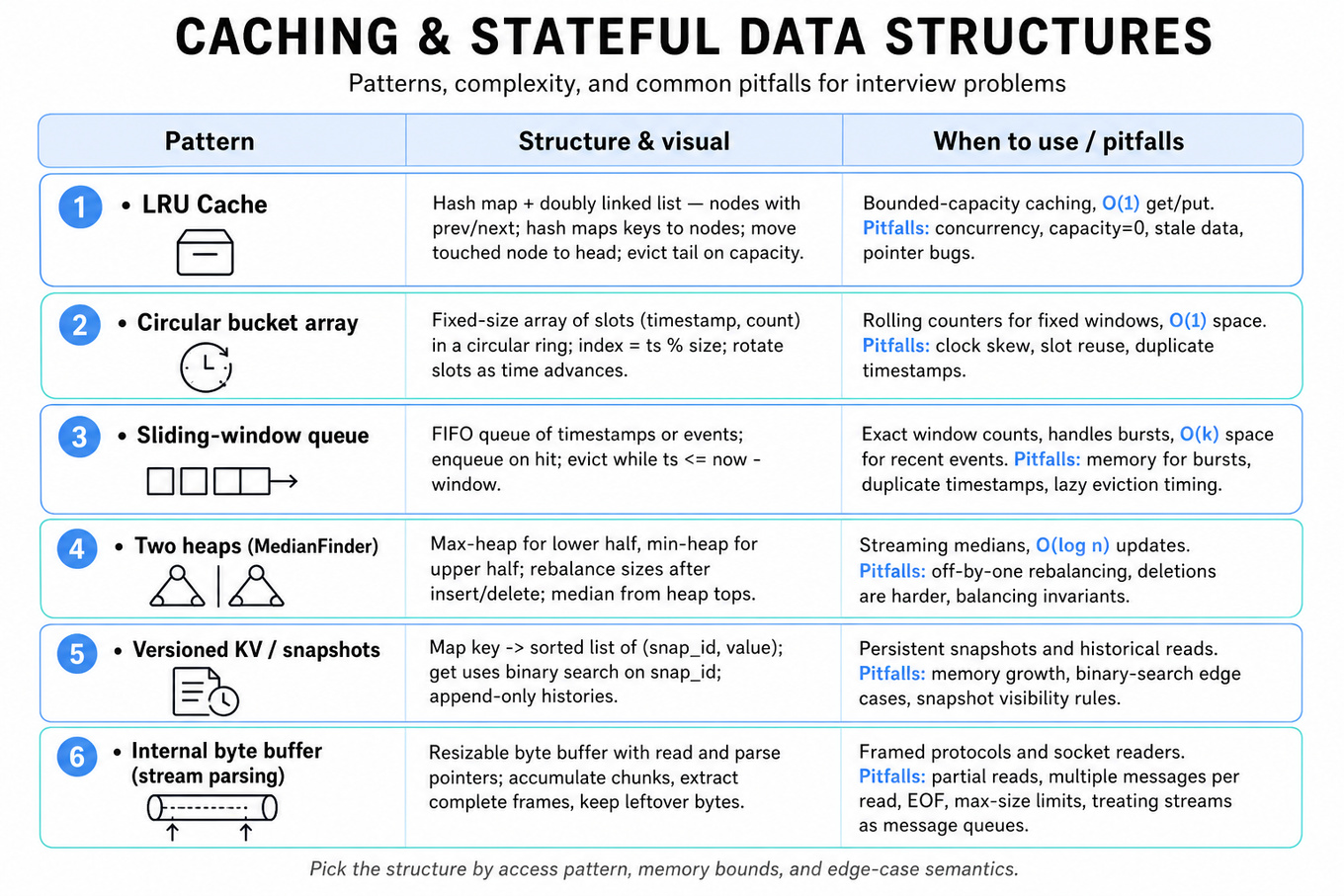
What's being tested
This tests stateful data structure design: maintaining mutable state with precise API semantics, predictable complexity, and correct behavior under edge cases. Expect variants involving LRU eviction, sliding-window expiration, streaming order statistics, versioned storage, and buffered stream parsing.
Patterns & templates
-
Hash map + doubly linked list for
LRUCache.get/put—O(1)average time; always move touched nodes to the head. -
Circular bucket array for rolling counters — store
(timestamp, count)per slot;O(1)space for fixed windows like 300 seconds. -
Queue of events for exact sliding windows — enqueue timestamps, evict while
ts <= now - window;O(k)space for recent hits. -
Two heaps for
MedianFinder— max-heap lower half, min-heap upper half; rebalance sizes so median isO(1). -
Versioned key histories for snapshot KV stores — map key to sorted
(snap_id, value)list;getuses binary search inO(log v). -
Internal byte buffer for socket readers — accumulate chunks, parse complete frames, retain leftovers; handle EOF, partial reads, and max-size limits.
-
API-first reasoning — define
get,put,snapshot,readMessage,hit,getHitssemantics before coding; complexity follows from invariants.
Common pitfalls
Pitfall: Treating streams like message queues. A socket
read()can return partial messages, multiple messages, or zero bytes before EOF.
Pitfall: Forgetting stale-state cleanup. Rolling counters, LRU nodes, and snapshot histories all require explicit rules for expiration or version visibility.
Pitfall: Giving only the happy path.
Appleinterviewers often probe empty inputs, duplicate timestamps, overwrite semantics, capacity zero, and boundary times.
Practice these
The practice cards below cover the canonical variants — solve all of them and time yourself.
Practice questions
System Design
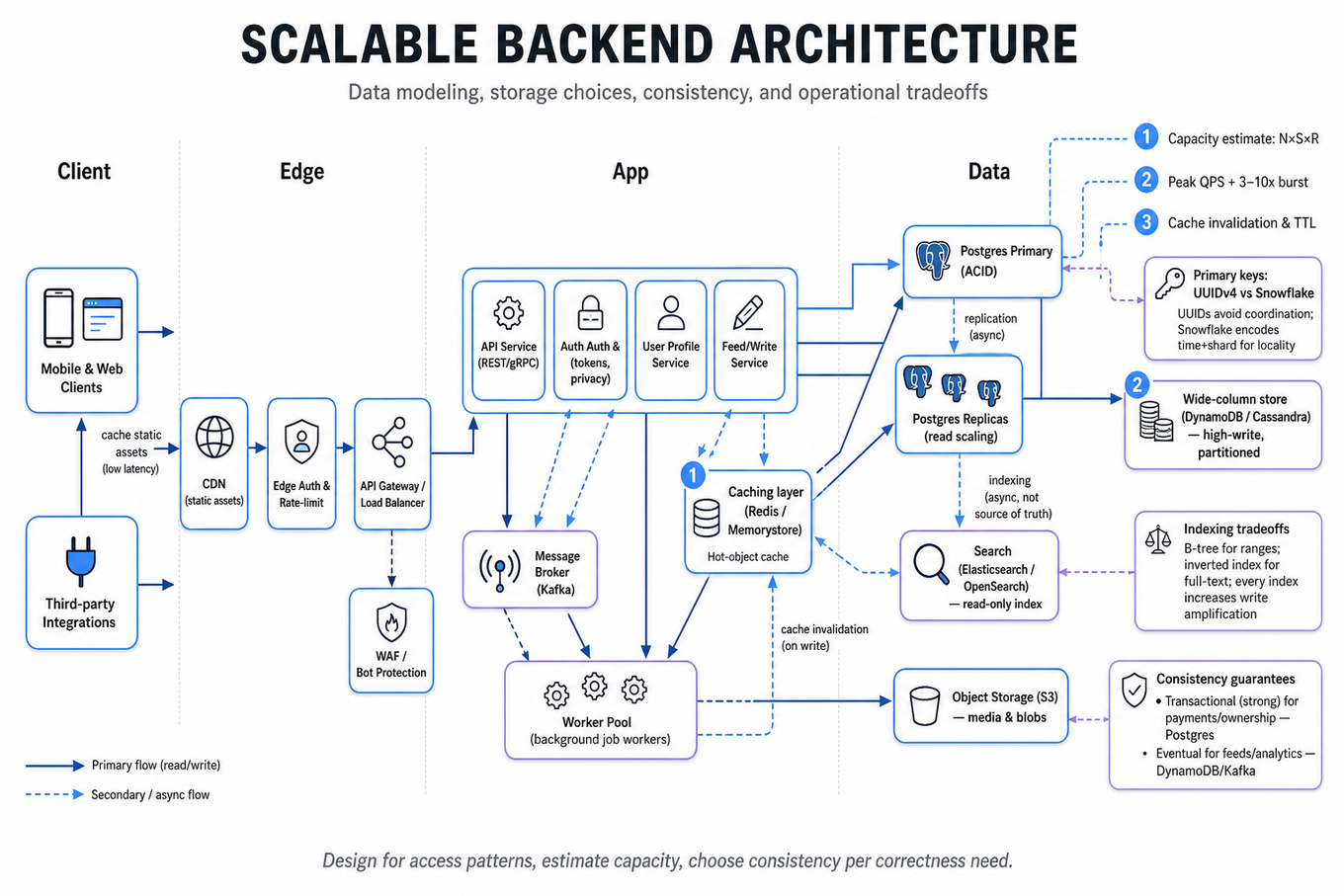
What's being tested
You’re being tested on whether you can turn ambiguous product behavior into a scalable backend design with clear APIs, data models, storage choices, consistency guarantees, and operational tradeoffs. Apple interviewers care because many consumer-facing systems must be reliable, privacy-conscious, low-latency, and evolvable across huge user populations and device ecosystems. The interviewer is probing whether you can reason from requirements to architecture: what data is owned where, which reads/writes dominate, how indexes and caches work, and what breaks under concurrency or scale. Strong answers balance correctness with pragmatism: not every system needs global consensus, but you should know when eventual consistency is unacceptable.
Core knowledge
-
Requirements framing comes first: identify core entities, read/write paths, latency targets, durability needs, and consistency expectations. A good system design answer usually starts with “who calls this, how often, and what correctness guarantee do they need?” before naming databases or services.
-
Capacity estimation should drive design choices. Estimate storage as , where is object count, is average object size, and is replication factor. Estimate peak load using average
QPSmultiplied by a burst factor, often 3–10x for consumer systems. -
Data modeling should reflect access patterns, not just normalized entities.
Postgresworks well for relational integrity and moderate scale;DynamoDB,Cassandra, orBigtable-style stores fit high-write, key-value or wide-column workloads;ElasticsearchorOpenSearchfit full-text search but should not be the source of truth. -
Primary keys affect scale and operability. Random
UUIDv4avoids coordination but hurts locality;Snowflake-style IDs encode timestamp and shard bits; database sequences are simple but can bottleneck or reveal ordering. For distributed writes, avoid hot partitions such as monotonically increasing keys without sharding. -
Indexing is a performance contract. B-tree indexes support equality and range queries; inverted indexes power full-text search; geospatial indexes such as
Geohash,S2, orR-treesupport nearby queries. Every index speeds reads but increases write amplification and storage cost. -
Caching reduces read pressure but introduces freshness and invalidation problems. Use
RedisorMemcachedfor hot objects, query results, sessions, and rate-limit counters. Common patterns include cache-aside, write-through, and TTL-based invalidation; always specify what stale data is acceptable. -
Replication improves availability and read scalability. Leader-follower replication gives simple write ordering but can create stale follower reads; multi-leader helps geographically distributed writes but introduces conflict resolution; quorum systems use rules like to improve consistency.
-
Sharding distributes data when one machine or database cluster is insufficient. Shard by stable, high-cardinality keys such as
user_id,business_id, oraccount_id; avoid low-cardinality keys like country or status. Plan for resharding using consistent hashing or logical shard maps. -
Consistency models should match product semantics. Reviews, ratings, and catalog metadata may tolerate eventual consistency; wallet balances, payments, and entitlement grants usually require strong consistency, idempotency, and auditable state transitions. Say explicitly where stale reads are safe and where they are not.
-
Concurrency control prevents lost updates and double execution. Use optimistic locking with a
versioncolumn, compare-and-swap, database transactions, unique constraints, or idempotency keys. For financial or entitlement systems, design around append-only ledgers rather than mutable balance fields alone. -
API design should include method semantics, authentication, authorization, pagination, idempotency, and error behavior.
POSTmay create resources,PUTis commonly idempotent replacement,PATCHis partial update, andGETshould be side-effect-free. Cursor pagination is more stable than offset pagination at scale. -
Operational concerns are part of backend design. Mention observability with
p50,p95,p99, error rate, saturation, and queue depth; safe deploys with canaries and rollback; and failure modes such as cache stampedes, hot keys, replica lag, partial writes, and regional outages.
Worked example
For Design and scale a Yelp-like platform, a strong candidate would start by clarifying scope: “Are we designing search and reviews only, or also reservations, ads, and messaging? What read/write volume should I assume? Do we need real-time review visibility?” Then they would declare a reasonable baseline: millions of businesses, hundreds of millions of reviews, read-heavy traffic, low-latency nearby search, and eventual consistency acceptable for aggregate ratings.
The answer can be organized around four pillars: data model, write path, read/search path, and scaling/operations. The data model might include User, Business, Review, Photo, and RatingAggregate, with the authoritative data stored in Postgres or a sharded relational store initially, then split by access pattern as scale grows. The write path handles creating reviews with authorization, duplicate prevention, moderation status, and asynchronous aggregate updates through a queue such as Kafka or SQS.
For reads, business detail pages can use cache-aside with Redis, while search uses a dedicated Elasticsearch index containing denormalized business fields, categories, rating summaries, and geospatial coordinates. The key tradeoff to call out is that the search index is not the source of truth: it may lag the primary database, so the UI must tolerate slightly stale rating counts or business metadata. Nearby search needs geospatial indexing, usually by bounding box plus ranking, Geohash, or S2 cells, with a final distance calculation to avoid returning incorrect edge results.
A strong close would mention abuse and operations without over-expanding: “If I had more time, I’d cover review spam defenses at the API boundary, hot-business caching during spikes, index rebuild strategy, and privacy controls around user-generated content.”
A second angle
For Migrate a monolithic wallet to microservices, the same architecture and data modeling skills apply, but the constraints become stricter. In a Yelp-like system, stale review counts are usually acceptable; in a wallet, stale balances or double debits are not. The data model should center on an append-only ledger, immutable transaction records, idempotency keys, and well-defined service ownership boundaries such as WalletService, PaymentService, and RiskService.
The migration framing should emphasize safety: strangler-fig decomposition, dual reads/writes only when carefully controlled, reconciliation jobs, and rollback paths. Instead of optimizing primarily for search latency, the key design decision is how to preserve transactional integrity across services without relying on distributed transactions everywhere. A strong answer would discuss sagas, outbox patterns, and auditability, while being clear that the ledger remains the system of record.
Common pitfalls
Pitfall: Jumping straight to microservices,
Kafka, andRediswithout first defining entities, traffic shape, and correctness requirements.
This sounds senior but often hides weak fundamentals. A better answer starts with the core read/write flows and introduces complexity only when a bottleneck or reliability requirement justifies it.
Pitfall: Treating every datastore as interchangeable.
Saying “use NoSQL for scale” is too vague. The interviewer wants to hear why a key-value store, relational database, search index, object store, or cache fits a specific access pattern, and what tradeoff you accept in consistency, query flexibility, or operational burden.
Pitfall: Ignoring concurrency and failure modes.
Many candidates design the happy path only: create review, update rating, return success; or debit wallet, call payment provider, update balance. Stronger answers discuss retries, duplicate requests, partial failures, idempotency keys, optimistic locking, reconciliation, and what the user sees when a dependency is degraded.
Connections
The interviewer may pivot into distributed transactions, event-driven architecture, API idempotency, geospatial search, cache invalidation, or database indexing. For senior-leaning loops, expect follow-ups on migration strategy, schema evolution, backfills, regional failover, and how to debug elevated p99 latency or inconsistent reads.
Further reading
-
Designing Data-Intensive Applications — The best single book for replication, partitioning, transactions, stream processing, and storage tradeoffs.
-
The Log: What every software engineer should know about real-time data’s unifying abstraction — Practical explanation of logs, event streams, and state propagation.
-
Idempotency Keys —
StripeAPI docs — Clear real-world pattern for safe retries in production APIs.
Practice questions
Behavioral & Leadership
What's being tested
Apple behavioral engineering interviews probe ownership, communication, and leadership under ambiguity: whether you can move technical work forward without waiting for perfect instructions, while keeping quality high. For a Software Engineer, this means explaining how you scoped a system, made tradeoffs, coordinated with teammates, handled blockers, and protected users when things went wrong. Interviewers are not looking for generic teamwork slogans; they are listening for concrete engineering judgment: design decisions, risk management, debugging discipline, rollout strategy, and how you influenced without formal authority. Apple especially values this because many teams work on tightly integrated hardware/software experiences where privacy, performance, reliability, and polish depend on engineers communicating clearly across boundaries.
Core knowledge
-
STAR structure is the baseline: Situation, Task, Action, Result. For senior-leaning answers, extend it to STAR-L: add Learning and how you changed a process, test plan, design review, or rollout checklist afterward.
-
Ownership means you drove the outcome, not that you personally wrote every line of code. Strong answers separate your individual contribution from the team’s work: “I owned the
APIcontract and migration plan; two teammates implemented client changes; I reviewed edge cases and coordinated rollout.” -
Impact metrics should be engineering-specific when possible:
p95latency,p99latency, crash-free sessions, error rate,CPUusage, memory footprint, battery drain, build time, deployment frequency, rollback count, or on-call pages. Avoid only saying “users liked it” unless you connect it to measurable system behavior. -
Tradeoff analysis is central. Be ready to discuss why you chose a simpler design over a more general one, synchronous vs asynchronous processing, strong consistency vs eventual consistency, local caching vs freshness, feature flag rollout vs big-bang release, or
SQLschema migration vs compatibility shim. -
Risk communication should be explicit. A strong engineer surfaces schedule and quality risk early: “The integration was blocked for two days; I posted status in the team channel, proposed two mitigation paths, and gave the tech lead a decision deadline before it affected the release branch.”
-
Escalation judgment is not complaining upward. Good escalation includes evidence, attempted mitigations, options, and a recommendation: “I tried async messages, checked whether the owner was overloaded, documented the blocked interface, and proposed either pairing for 30 minutes or switching to a compatible stub.”
-
Technical leadership often looks like reducing ambiguity: writing a design doc, defining an
APIcontract, decomposing a migration, creating a test matrix, adding observability, or making a reversible rollout plan. You do not need a manager title to demonstrate leadership. -
Incident ownership should include detection, containment, diagnosis, remediation, and prevention. For example: alert on elevated
5xx, roll back via feature flag, inspect logs/traces, patch the bad null-handling path, add regression tests, and document a postmortem action item. -
Communication fidelity matters across audiences. With engineers, use implementation detail: race condition, cache invalidation, schema compatibility, lock contention. With managers or partner teams, translate to risk: user impact, release confidence, testing gap, recovery plan, and decision needed.
-
Project scope clarity helps interviewers calibrate level. State number of services, approximate traffic, data size, platforms, team size, timeline, and constraints: “three engineers, six weeks,
iOSclient plus backend service, 20M daily requests, targetp95 < 150ms.” -
Apple-specific engineering values often show up indirectly: privacy by design, on-device performance, energy efficiency, accessibility, correctness, and seamless user experience. Tie your decisions to user trust and product quality without drifting into product strategy.
-
LLM or AI project answers should stay grounded in software engineering ownership: model-serving integration, prompt orchestration, latency budgets, caching, evaluation harnesses, privacy boundaries, fallback behavior, and monitoring. Avoid overclaiming model architecture work unless you actually trained or modified the model.
Worked example
For “How would you handle an unresponsive teammate?”, a strong candidate first frames the situation rather than jumping to escalation. In the first 30 seconds, say you would clarify urgency, dependency criticality, prior communication attempts, whether the teammate owns a blocking API or code review, and whether there may be timezone, workload, or personal-context issues. Then organize the answer around four pillars: understand the blocker, communicate directly and empathetically, reduce project risk, and escalate only with context.
A good skeleton might be: “First, I’d confirm exactly what I need from them and by when. Second, I’d reach out in the lowest-friction way, such as a concise message with the decision needed, link to the design doc, and proposed default. Third, I’d unblock what I can by using a mock, feature flag, or interface stub. Fourth, if the delay threatens the milestone, I’d escalate to the tech lead with options, not blame.”
One tradeoff to flag is between waiting for the right owner and making unilateral changes. Waiting preserves ownership and context, but it can stall the release; proceeding with a reversible stub or compatibility layer can reduce risk while keeping the teammate informed. Close by saying that after the immediate issue, you would improve the process: clearer DRI assignment, review SLA, backup owner, or smaller integration checkpoints. If you had more time, you would also ask whether the pattern is systemic, such as overloaded code owners or unclear priority, rather than treating it as a personality problem.
A second angle
For “Describe your recent project and scope”, the same ownership signal appears through project narrative rather than conflict handling. Start with the technical context: service, client surface, traffic level, constraints, and what you personally owned. Then explain scope boundaries: what you built, what you delegated, what you intentionally did not solve, and how you coordinated integration points. The interviewer is listening for whether you can distinguish implementation detail from engineering impact. A strong answer might mention a migration from a synchronous request path to an asynchronous job queue, but it should also explain rollout safety, observability, and measurable improvement such as reducing p99 latency or on-call alerts.
Common pitfalls
Pitfall: Giving a “hero engineer” story where you saved the project by working nights and bypassing everyone.
This can sound impressive but often signals poor planning, weak collaboration, or lack of sustainable engineering practice. A stronger answer shows how you created leverage: clarified ownership, improved tests, wrote documentation, introduced feature flags, or made the system easier for the whole team to operate.
Pitfall: Staying too abstract: “I communicated clearly, aligned stakeholders, and delivered impact.”
Behavioral answers need evidence. Replace vague language with artifacts and numbers: “I wrote a two-page design doc, got signoff from the iOS and backend owners, shipped behind a feature flag to 5% of traffic, and reduced p95 startup latency from 420ms to 260ms.”
Pitfall: Over-indexing on technical depth while ignoring people and risk.
For project questions, candidates often spend five minutes on architecture diagrams but never explain the challenge, disagreement, decision process, or outcome. Apple interviewers want to know how you behave inside a high-quality engineering team, so connect the design to collaboration: reviews, testing strategy, rollout, escalation, and lessons learned.
Connections
Interviewers may pivot from this area into system design tradeoffs, debugging and incident response, cross-functional collaboration, or technical project scoping. Be ready to turn a behavioral story into deeper discussion of API design, observability, performance, privacy, testing, or rollout mechanics.
Further reading
-
The Staff Engineer’s Path by Tanya Reilly — practical guidance on technical leadership, influence, scope, and operating beyond assigned tickets.
-
Crucial Conversations by Patterson, Grenny, McMillan, and Switzler — useful framework for handling blocked, tense, or high-stakes teammate conversations without blame.
Practice questions