Intervals, Sliding Windows, And Time-Ordered State
Asked of: Software Engineer
Last updated
What's being tested
Apple interviewers are probing time-ordered state management: intervals, expiring events, sorted timelines, and resource counts over time. You need to choose the right structure—queue, heap, two pointers, sweep line, or buckets—and explain complexity, boundary semantics, and edge cases clearly.
Patterns & templates
-
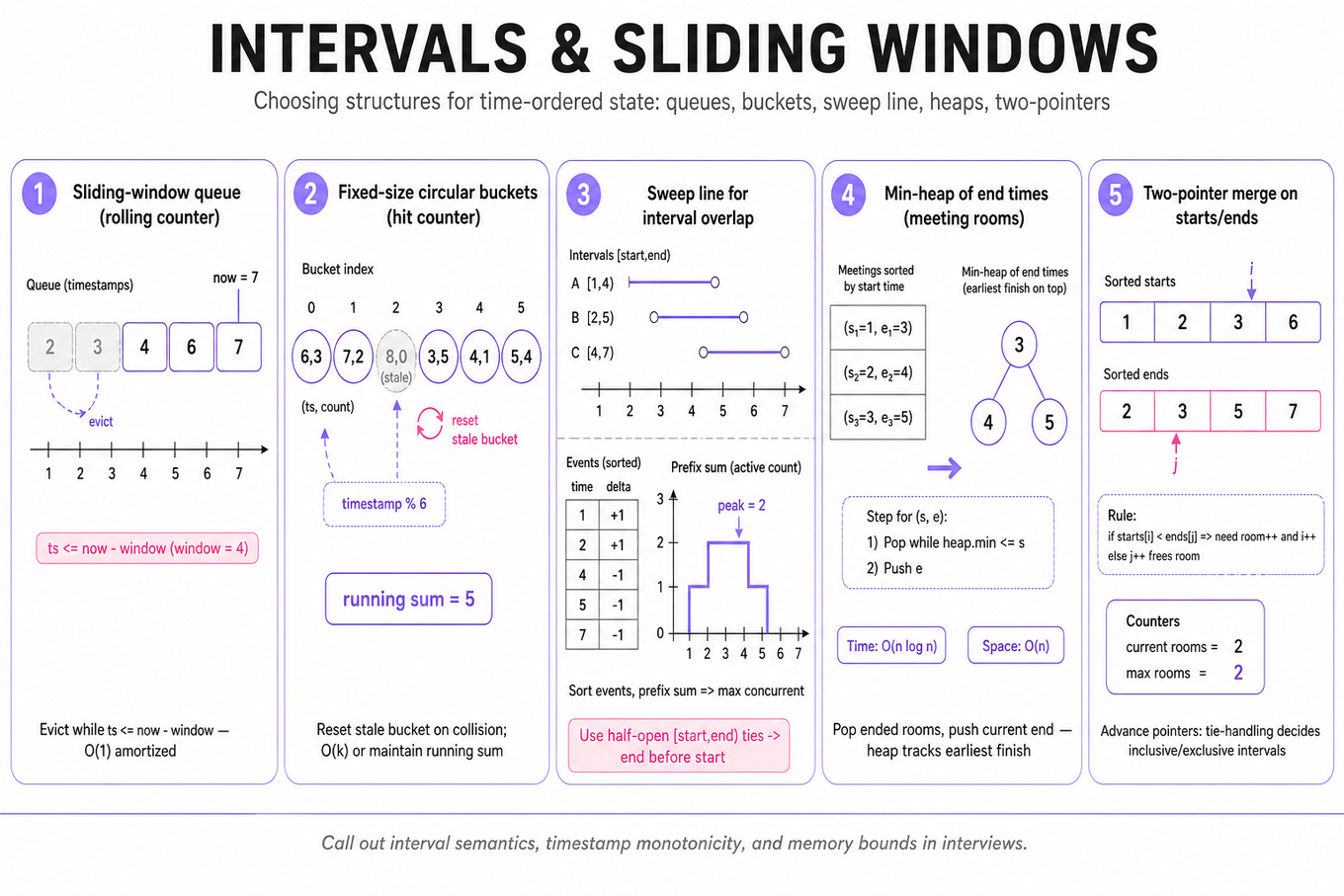
Sliding window queue for rolling counters — store timestamps or
(timestamp, count)pairs; evict whilets <= now - window;O(1)amortized. -
Fixed-size circular buckets for hit counters — bucket by
timestamp % 300; reset stale buckets;O(300)query or maintain running sum. -
Sweep line for interval overlap — convert
[start, end)into(start, +1),(end, -1); sort events; max prefix sum gives rooms. -
Min-heap of end times for meeting rooms — sort by start, pop ended meetings, push current end;
O(n log n)time,O(n)space. -
Two-pointer merge over sorted starts/ends — sort starts and ends separately; advance start for new room, end for freed room; watch tie rules.
-
Time-series single-pass optimization — track best prior minimum and current profit;
O(n)time,O(1)space; don’t sort prices. -
State-machine scanning for brackets or edge detection — stack for nesting, previous-state variables for discrete transitions; validate empty and malformed input.
Common pitfalls
Pitfall: Treating interval ends as inclusive by default; most scheduling problems use half-open intervals
[start, end)so back-to-back meetings do not conflict.
Pitfall: Designing a hit counter that stores every event when the interviewer expects bounded memory for high-throughput repeated timestamps.
Pitfall: Giving only the final algorithm without clarifying timestamp monotonicity, duplicate times, clock granularity, and whether queries can arrive out of order.
Practice these
The practice cards below cover the canonical variants — solve all of them and time yourself.
Featured in interview prep guides
Practice questions
- Compute conflicts and minimum meeting roomsApple · Software Engineer · Technical Screen · hard
- Solve mixed coding tasks from interviewsApple · Software Engineer · Technical Screen · medium
- Solve interval, grid-fill, and heap tasksApple · Software Engineer · Technical Screen · medium
- Solve three easy algorithm problemsApple · Software Engineer · Technical Screen · easy
- Design a rolling five-minute hit counterApple · Software Engineer · Technical Screen · medium
- Compute minimum required meeting roomsApple · Software Engineer · Technical Screen · medium
Related concepts
- Sliding Window Counters and Rate LimitingSystem Design
- Time Interval Overlap And Sweep-Line AlgorithmsCoding & Algorithms
- Sweep Line And Sliding Window OptimizationCoding & Algorithms
- Sliding Window Counters And QPSCoding & Algorithms
- Temporal Event Processing And Interval AlgorithmsCoding & Algorithms
- Sliding Window And Time Window Counters