Time Interval Overlap And Sweep-Line Algorithms
Asked of: Software Engineer
Last updated
What's being tested
These problems test interval arithmetic and sweep-line algorithms for time-based concurrency, payroll, and distinct-entity counting. Interviewers are probing whether you handle half-open intervals, boundary tie-breaking, duplicate IDs, partial-hour math, and complexity tradeoffs without overcomplicating the implementation.
Patterns & templates
-
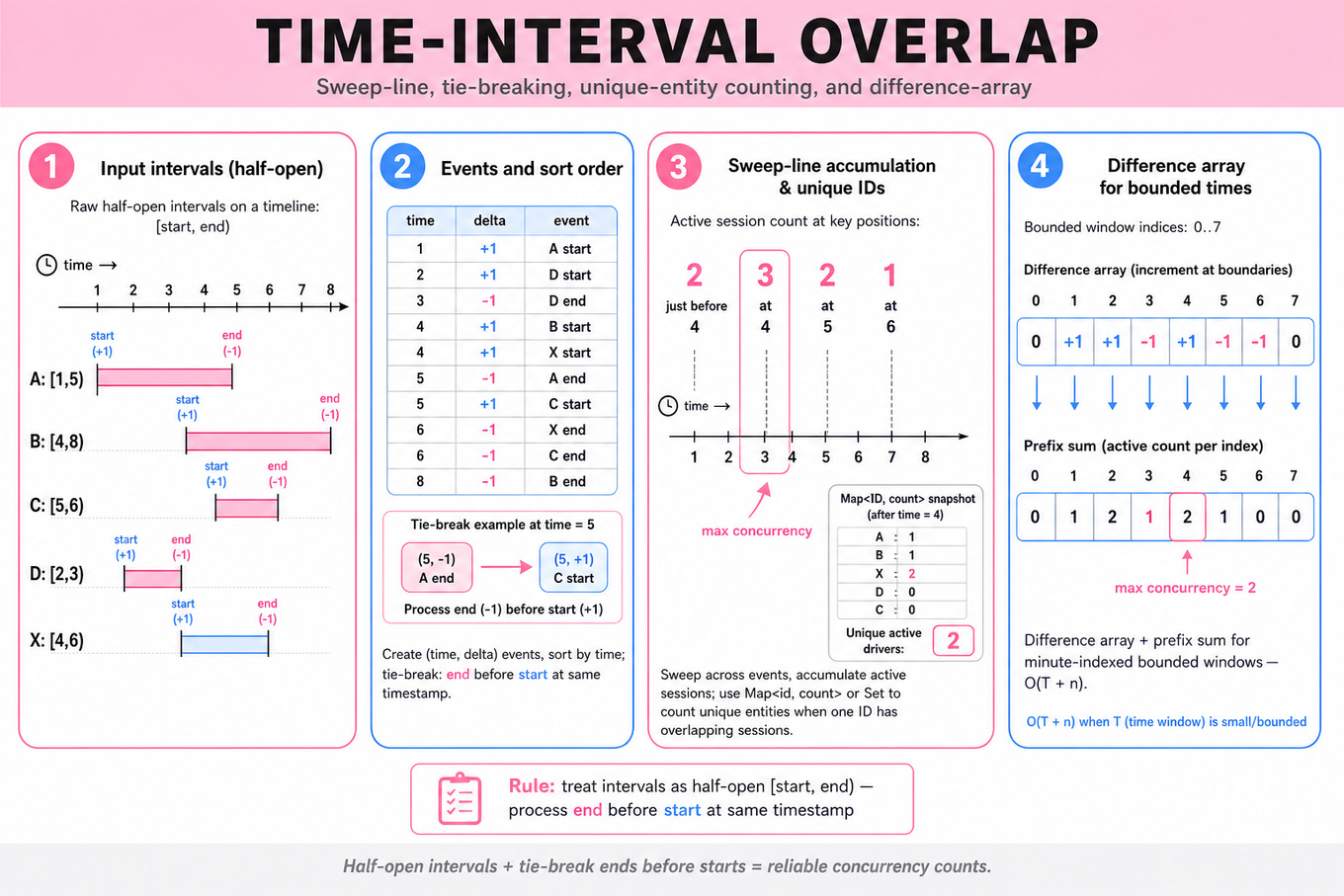
Sweep line with events — create
(time, delta)pairs, sort by time, accumulate active count;O(n log n)time,O(n)space. -
Tie-breaking for half-open intervals — for
[start, end), process end events before start events at the same timestamp to avoid false overlap. -
Distinct active entities — use
Map<id, count>orSet<id>when one driver/dasher can have overlapping sessions; don’t just sum intervals. -
Fixed 24-hour window — clamp intervals to
[windowStart, windowEnd)before creating events; discard intervals withstart >= endafter clamping. -
Difference array for bounded time — if timestamps are minute/second-indexed within 24 hours, use prefix sums in
O(T + n)instead of sorting. -
Partial-hour pay math — compute duration as
end - start, multiply by rate per unit time; avoid rounding until final output unless specified. -
Binary search over sorted intervals/events — for repeated “active at time t” queries, preprocess starts/ends and answer with
starts <= t - ends <= tstyle counts.
Common pitfalls
Pitfall: Treating intervals as closed
[start, end]makes a driver ending at10:00overlap one starting at10:00.
Pitfall: Counting sessions instead of unique drivers/dashers overstates concurrency when the same entity has duplicate or overlapping intervals.
Pitfall: Rounding each partial hour independently can introduce payroll errors; accumulate exact minutes/seconds first.
Practice these
The practice cards below cover the canonical variants — solve all of them and time yourself.
Featured in interview prep guides
Practice questions
- Implement a balance tracker and interval mergerRippling · Software Engineer · Technical Screen · medium
- Compute total wages and partial-hour paymentsRippling · Software Engineer · Technical Screen · medium
- Compute peak concurrent drivers in 24 hoursRippling · Software Engineer · Technical Screen · medium
- Compute unique-dasher concurrency with tie-breakingRippling · Software Engineer · Technical Screen · medium
- Compute maximum simultaneous driversRippling · Software Engineer · Technical Screen · medium
- Compute peak busy dashers with overlapsRippling · Software Engineer · Technical Screen · medium
- Compute max simultaneous drivers last 24 hoursRippling · Software Engineer · Technical Screen · medium
- Compute concurrent online driversRippling · Software Engineer · Technical Screen · medium
Related concepts
- Intervals, Sliding Windows, And Time-Ordered StateCoding & Algorithms
- Sweep Line And Sliding Window OptimizationCoding & Algorithms
- Intervals, Line Sweep, And Range UpdatesCoding & Algorithms
- Interval Merging And Range ManipulationCoding & Algorithms
- Interval Scheduling And Calendar SystemsCoding & Algorithms
- Temporal Event Processing And Interval AlgorithmsCoding & Algorithms