Rippling Software Engineer Interview Prep Guide
Everything Rippling actually asks Software Engineer candidates — concept walkthroughs, worked examples, and the real interview questions, drawn from candidate reports. Free to read.
Last updated
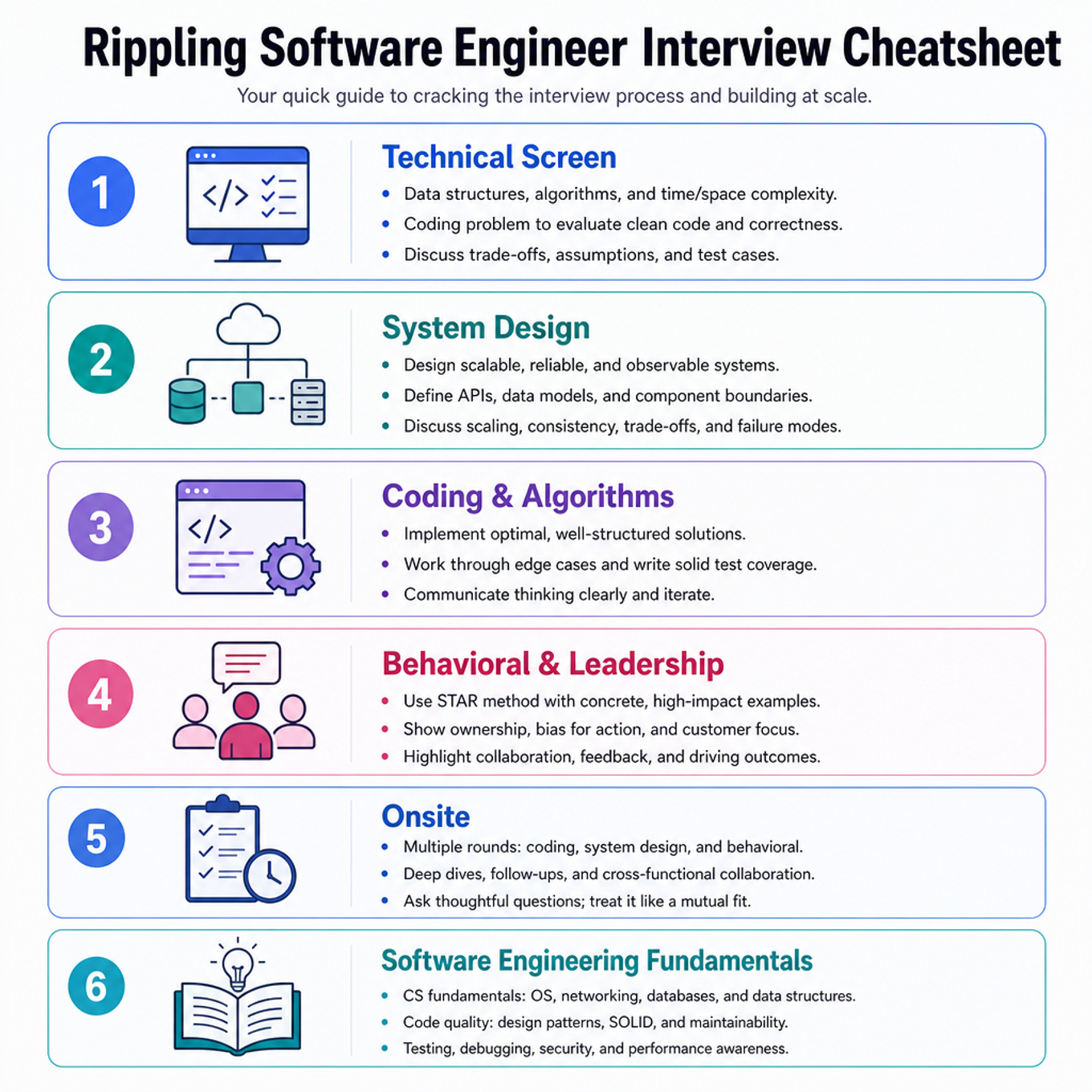
Technical Screen
System Design
What's being tested
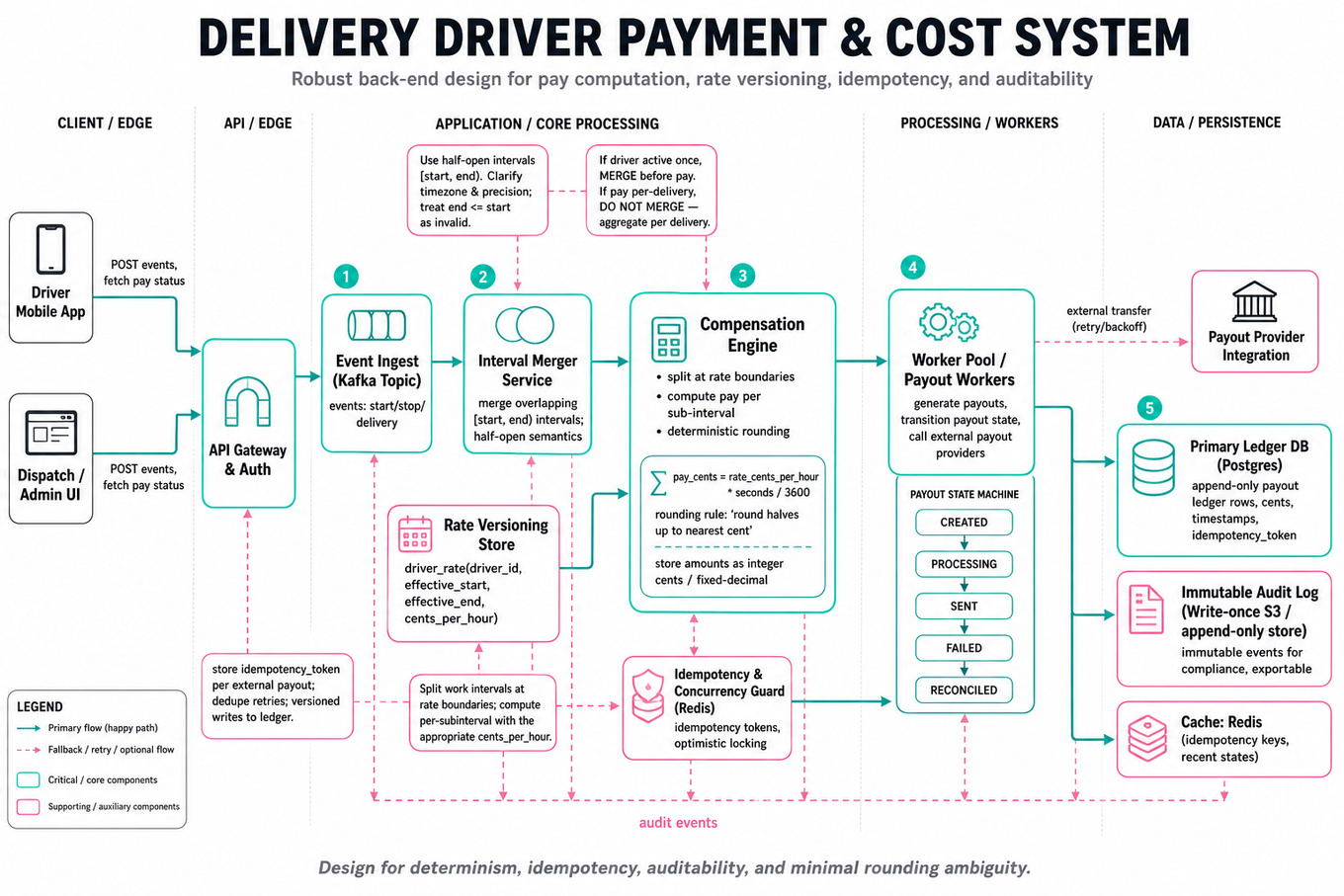
These interviews test whether you can design a correct financial backend system under messy real-world constraints: overlapping work intervals, partial-hour pay, rate changes, concurrent updates, and payout state transitions. Rippling cares because payroll-like systems require engineering discipline: a one-cent rounding bug, duplicate payout, or race condition can become a compliance and trust issue. The interviewer is probing for concrete modeling choices, not vague “microservices”: how you represent time, money, rates, idempotency, and mutable payment state. Strong answers balance simple in-memory or single-service designs with clear paths to persistence, scaling, and auditability.
Core knowledge
-
Money should never be represented as floating point. Store amounts in integer minor units, such as cents, or use fixed-precision decimals like
BigDecimal/Decimal. For hourly pay, compute and define deterministic rounding. -
Time intervals need explicit semantics. Prefer half-open intervals, , because adjacent shifts like
[10:00, 11:00)and[11:00, 12:00)do not overlap. Always clarify timezone, timestamp precision, whetherend <= startis invalid, and how daylight-saving transitions are handled. -
Interval merging is the core algorithm for avoiding double payment across overlapping deliveries or shifts. Sort by
start_time, then merge ifnext.start <= current.end; this isO(n log n)time andO(n)space. If intervals arrive online, use a balanced tree keyed by start time. -
Partial-hour payment should be proportional to elapsed time, not rounded hours unless the business rule says so. A 15-minute delivery at
$20/houris$5.00, computed as cents. Be explicit about rounding fractional cents. -
Rate changes require temporal versioning. Store rate rules as effective intervals, for example
driver_rate(driver_id, effective_start, effective_end, cents_per_hour). To compute pay, split work intervals at rate boundaries, then apply the appropriate rate to each sub-interval. -
Overlapping deliveries and concurrent work are different cases. If the driver can handle multiple deliveries simultaneously but should only be paid once for active time, merge intervals before applying wages. If cost is per-delivery reimbursement, do not merge; aggregate each delivery independently.
-
Idempotency keys prevent duplicate state mutations. For APIs like
POST /payouts, require anIdempotency-Keyand store the request hash plus result. Retrying the same request returns the same payout record; retrying with the same key but different payload should return a conflict. -
Transactional payout state needs a small finite-state machine. Typical states are
CALCULATED -> APPROVED -> SUBMITTED -> PAIDwith terminal states likeFAILEDorCANCELED. Guard transitions using database transactions, row locks, and compare-and-set conditions. -
Auditability matters as much as the final total. Persist inputs, rate versions, calculation version, rounding policy, and generated line items. A good payroll design can answer, “Why was this driver paid
$123.45for Tuesday?” without recomputing against changed business rules. -
Concurrency control depends on the consistency boundary. For a single driver’s payroll period, use a transaction with
SELECT ... FOR UPDATEinPostgres, optimistic locking via aversioncolumn, or per-driver locks in an in-memory implementation. Avoid global locks unless the scope is tiny. -
Aggregation APIs should distinguish reads from writes. Write path records immutable delivery or shift events; read path computes totals by driver, time range, and status. For small
N, compute on demand; for millions of intervals, maintain pre-aggregated daily buckets plus raw data for correction. -
Cost calculation is not always payroll calculation. Driver pay may be time-based, delivery cost may include base fee, distance, surge, tips, reimbursements, and platform adjustments. Model this as composable line items rather than one giant formula so rules can evolve safely.
Worked example
For Design a driver payroll service, a strong candidate starts by clarifying scope: “Are drivers paid hourly, per delivery, or both? Can intervals overlap? Do rates change within a pay period? Do we need to trigger real bank payouts or just calculate owed wages?” Then they declare assumptions: use UTC timestamps, half-open intervals, cents as integers, and one payroll period per driver.
The answer can be organized around four pillars. First, define the data model: Driver, WorkInterval, RateRule, PayrollRun, PayrollLineItem, and Payout. Second, explain the calculation engine: fetch intervals for a driver and period, validate them, merge overlapping paid-time intervals, split by rate-rule boundaries, and compute cents using deterministic rounding. Third, describe state management: calculated payroll runs are immutable snapshots, while payouts move through controlled states like APPROVED, SUBMITTED, and PAID. Fourth, cover idempotency and retries for payout creation so duplicate API calls cannot pay a driver twice.
One tradeoff to flag explicitly is whether to calculate payroll on demand or materialize payroll runs. On-demand calculation is simpler for small data and always reflects latest inputs, but immutable payroll snapshots are safer once money movement or approval begins. A good close would be: “If I had more time, I’d add correction runs for late delivery events, audit logs for every calculation input, and monitoring around duplicate payout attempts and rounding deltas.”
A second angle
For Design a delivery cost aggregator, the same fundamentals apply, but the framing shifts from payroll correctness over a pay period to live aggregation under concurrency. Instead of modeling a full payout lifecycle, focus on an in-memory component that ingests delivery start/end/cost updates and serves metrics like total active cost or cost by driver. The key decisions become thread safety, lock granularity, and whether reads require strongly consistent totals or can tolerate slightly stale snapshots. A strong design might keep per-driver aggregates in a ConcurrentHashMap, use immutable event records, and update totals with atomic operations or striped locks. The candidate should still call out money precision and interval semantics, but the center of gravity is concurrent aggregation rather than financial settlement.
Common pitfalls
Pitfall: Treating time intervals as simple durations and ignoring overlaps.
A tempting answer is to sum (end - start) for every delivery and multiply by the hourly rate. That overpays when deliveries overlap or when a driver has duplicate events. A stronger answer says whether overlap should merge, stack, or be rejected, then implements that rule with interval sorting or an interval tree.
Pitfall: Saying “use floats and round at the end.”
Floating point can produce nondeterministic-looking cents, especially across languages or repeated aggregations. Use cents as integers or fixed decimal types, and define where rounding happens: per line item, per day, or per payroll run. The interviewer is looking for financial-system instincts, not just arithmetic.
Pitfall: Jumping straight to distributed architecture without solving correctness.
Starting with Kafka, sharding, and multiple services can sound sophisticated but often hides missing fundamentals. First show the single-node or single-database correctness model: schema, interval algorithm, transaction boundary, idempotency, and state machine. Then scale reads, ingestion, or aggregation only after the invariants are clear.
Connections
The interviewer may pivot into ledger design, idempotent API design, event sourcing, concurrency control, or interval data structures. You may also see coding follow-ups that ask you to implement wage calculation, merge intervals, compute partial-hour payments, or maintain live totals with thread-safe updates.
Further reading
-
Martin Fowler, “Money” pattern — classic reference on representing monetary values safely in application code.
-
Stripe API idempotent requests — practical model for safe retries in payment-like APIs.
-
[Designing Data-Intensive Applications, Martin Kleppmann] — strong background on transactions, consistency, logs, and state management in distributed systems.
Practice questions
-
Expense Rules Engines — covered in depth under Onsite below.
-
Event Ingestion And Streaming Analytics — covered in depth under Onsite below.
Coding & Algorithms
What's being tested
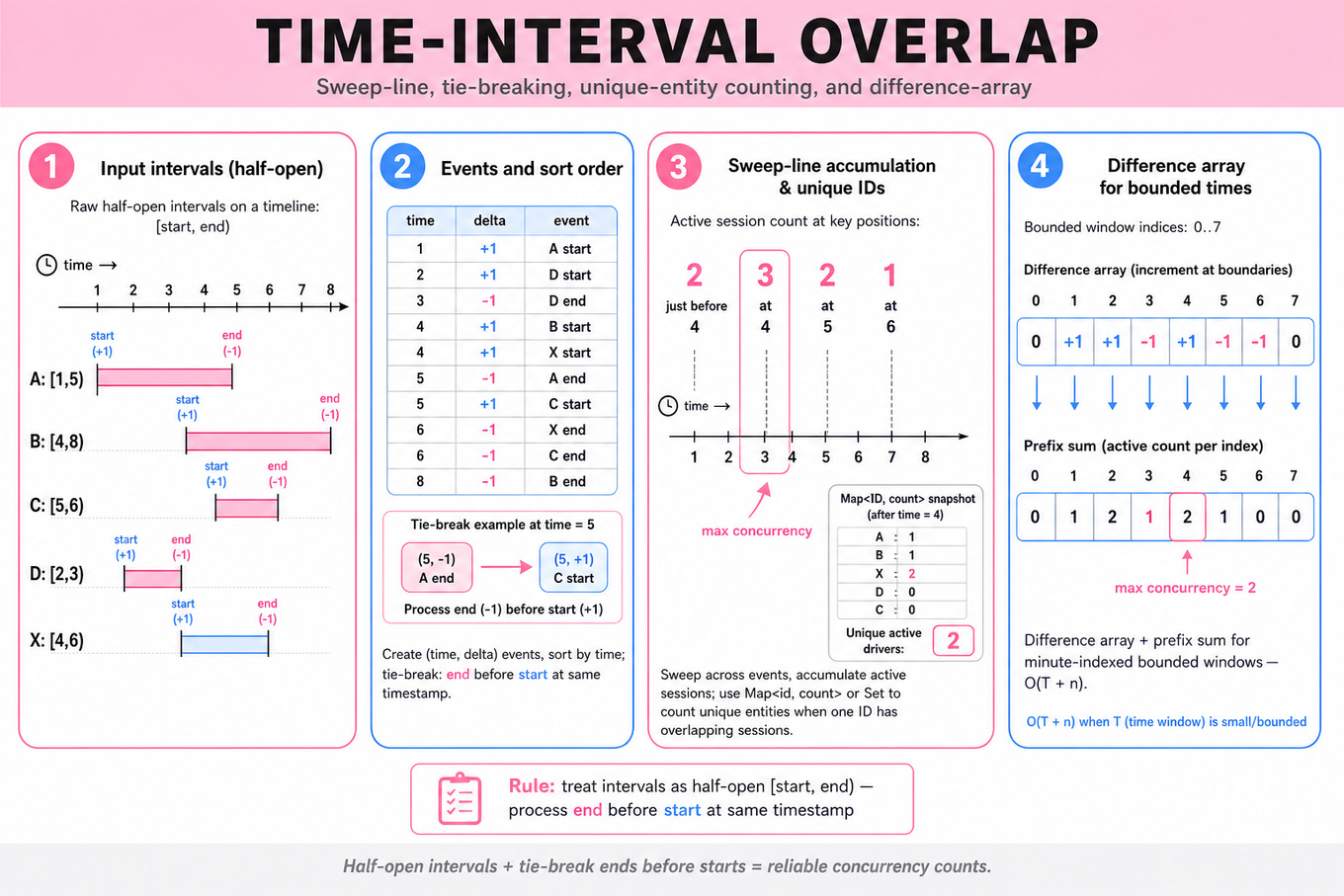
These problems test interval arithmetic and sweep-line algorithms for time-based concurrency, payroll, and distinct-entity counting. Interviewers are probing whether you handle half-open intervals, boundary tie-breaking, duplicate IDs, partial-hour math, and complexity tradeoffs without overcomplicating the implementation.
Patterns & templates
-
Sweep line with events — create
(time, delta)pairs, sort by time, accumulate active count;O(n log n)time,O(n)space. -
Tie-breaking for half-open intervals — for
[start, end), process end events before start events at the same timestamp to avoid false overlap. -
Distinct active entities — use
Map<id, count>orSet<id>when one driver/dasher can have overlapping sessions; don’t just sum intervals. -
Fixed 24-hour window — clamp intervals to
[windowStart, windowEnd)before creating events; discard intervals withstart >= endafter clamping. -
Difference array for bounded time — if timestamps are minute/second-indexed within 24 hours, use prefix sums in
O(T + n)instead of sorting. -
Partial-hour pay math — compute duration as
end - start, multiply by rate per unit time; avoid rounding until final output unless specified. -
Binary search over sorted intervals/events — for repeated “active at time t” queries, preprocess starts/ends and answer with
starts <= t - ends <= tstyle counts.
Common pitfalls
Pitfall: Treating intervals as closed
[start, end]makes a driver ending at10:00overlap one starting at10:00.
Pitfall: Counting sessions instead of unique drivers/dashers overstates concurrency when the same entity has duplicate or overlapping intervals.
Pitfall: Rounding each partial hour independently can introduce payroll errors; accumulate exact minutes/seconds first.
Practice these
The practice cards below cover the canonical variants — solve all of them and time yourself.
Practice questions
- Stateful In-Memory Data Structures — covered in depth under Onsite below.

What's being tested
This tests binary search over structure, not just over explicit values: using sorted order, monotonic predicates, and partition invariants to cut the search space. You need to reason about correctness, edge cases, and complexity while keeping implementation clean under interview pressure.
Patterns & templates
-
Partition binary search for median — search smaller array; ensure
`leftA`<=`rightB`&&`leftB`<=`rightA`; runsO(log min(m,n)). -
Sentinel boundaries — use
-infand+inffor empty partition sides; avoids special-casing first/last cuts. -
Odd/even median handling — if total length odd, return
max(leftA,leftB); if even, average withmin(rightA,rightB). -
Monotonic predicate search — when partition is too far left/right, move
loorhibased on violated inequality. -
Convex/unimodal search — compare
f(mid1)andf(mid2)or neighboring samples; shrink toward the lower side. -
Ternary search / golden-section search — for unknown convex functions over continuous domains; stop by precision
eps, not exact equality. -
Complexity discipline — median target should be logarithmic; convex query problems should discuss function-call cost and convergence tolerance.
Common pitfalls
Pitfall: Searching the larger array in median problems can produce invalid complementary partitions or unnecessary boundary complexity.
Pitfall: Treating convex search like ordinary binary search without defining the monotonic signal, such as slope sign or adjacent comparisons.
Pitfall: Forgetting numeric edge cases: empty arrays, duplicate values, integer overflow in averaging, and floating-point termination.
Practice these
The practice cards below cover the canonical variants — solve all of them and time yourself.
Practice questions
What's being tested
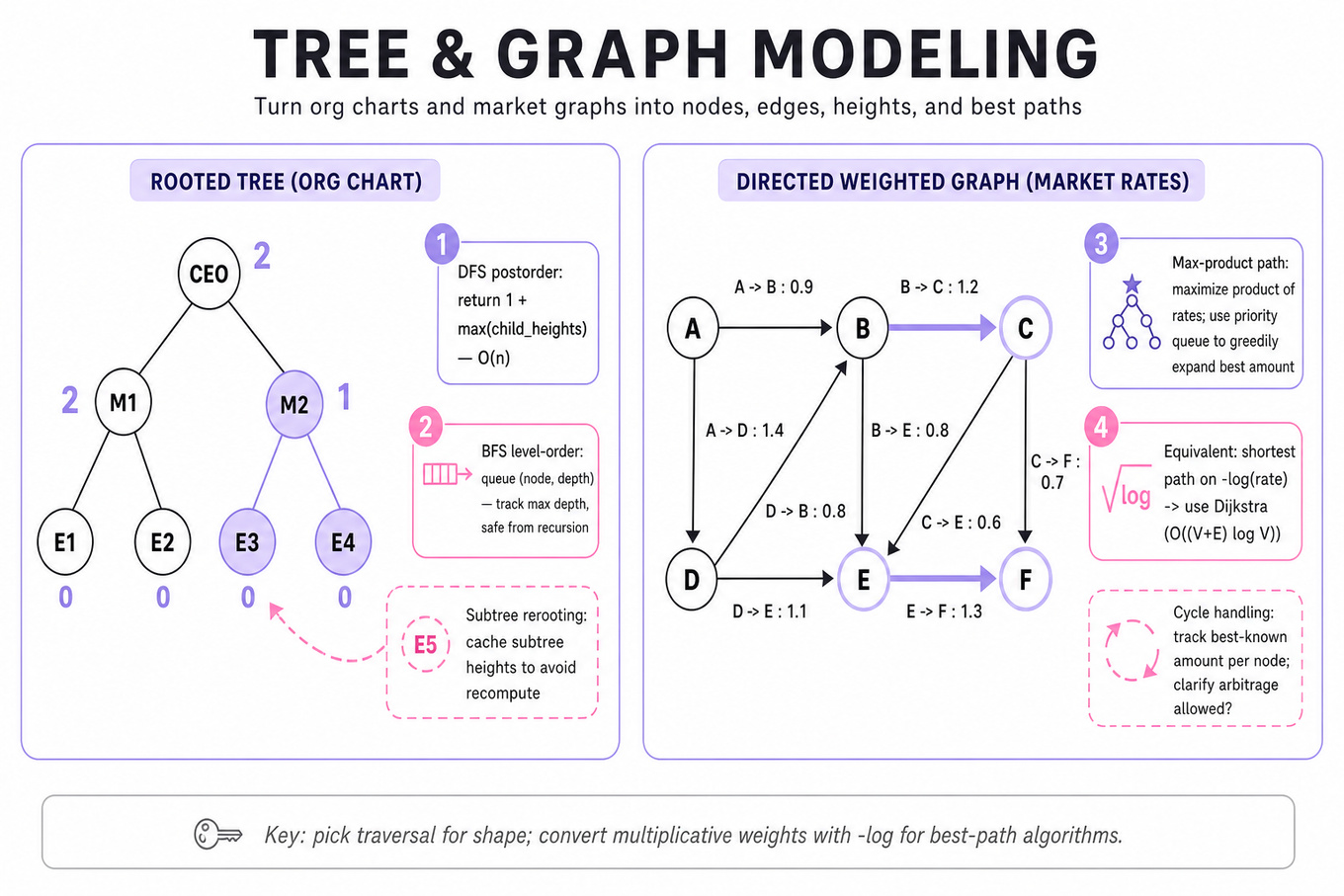
These problems test tree traversal and graph path modeling: turning business-shaped relationships like reporting lines or currency markets into nodes, edges, weights, and constraints. Interviewers are probing whether you can choose the right traversal, compute structural properties efficiently, and reason about optimization over paths or subtrees.
Patterns & templates
-
DFS postorder on rooted trees computes subtree height in
O(n)time; return1 + max(child_heights)and handle leaf height consistently. -
BFS level-order traversal is ideal for reporting layers; queue
(node, depth)pairs and track max depth without recursion-stack risk. -
Subtree rerooting / promotion simulation needs cached subtree heights; avoid recomputing depth from scratch after every hypothetical move.
-
Directed weighted graph modeling for currencies: edge
A -> Bhas multiplicative rater; path value is product of edge weights. -
Max-product path can use modified
Dijkstrawith priority queue maximizing amount; equivalent to shortest path on-log(rate)weights. -
Cycle handling is mandatory in graphs; use
visited/best-known amount maps, and clarify whether arbitrage cycles are allowed. -
Complexity target: tree traversals should be
O(n); graph conversion should beO((V + E) log V)with heap-based best-path search.
Common pitfalls
Pitfall: Mixing height definitions. Clarify whether a single CEO node has height
0edges or1layer before coding.
Pitfall: Treating currency conversion as unweighted BFS. Fewest hops is not necessarily the best conversion rate.
Pitfall: Forgetting disconnected components or missing paths. Return impossible explicitly, not
0unless the prompt defines that behavior.
Practice these
The practice cards below cover the canonical variants — solve all of them and time yourself.
Practice questions
Behavioral & Leadership
- Project Ownership, Impact, And Team Fit — covered in depth under Onsite below.
Onsite
System Design
What's being tested
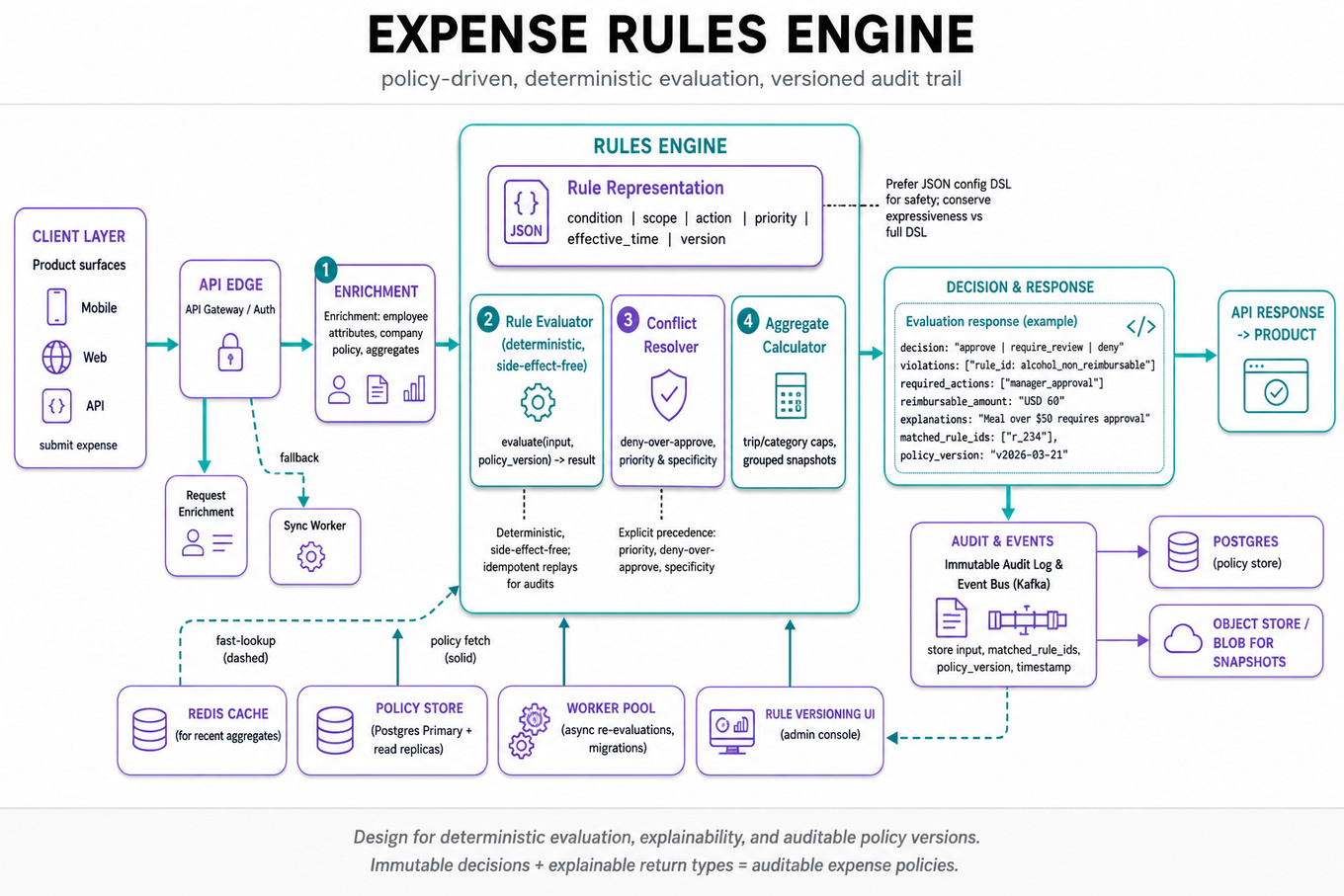
A strong answer shows you can design a policy-driven backend system where expense decisions are configurable, explainable, versioned, and scalable across many companies. Rippling cares because expense policies are customer-specific, change frequently, and affect money movement, employee experience, compliance, and auditability. The interviewer is probing whether you can move beyond hardcoded if/else logic into a flexible rules engine with clear data models, deterministic evaluation, conflict resolution, immutable history, and aggregate calculations like trip-level or category-level caps. They will also test whether you can design APIs and return types that are backward-compatible and useful to product surfaces, approvals, and audits.
Core knowledge
-
Rule representation is the center of the design. A good model separates
condition,scope,action,priority,effective_time, andversion. Example: “For employees inUS, meal expenses over$75require manager approval” should be data/config, not deployed code. -
DSL versus configuration is a key tradeoff. A JSON config such as
{ field: "category", op: "eq", value: "meal" }is safer and easier to validate, while a full domain-specific language is more expressive but harder to secure, test, migrate, and explain. -
Rule evaluation should usually be deterministic and side-effect-free. Given an expense, policy version, company, employee attributes, and relevant aggregates,
evaluate(input) -> resultshould always return the same output. This enables replay, debugging, audit trails, and idempotent retries. -
Return types matter as much as rule matching. A strong response includes
decision,violations,required_actions,reimbursable_amount,explanations,matched_rule_ids, andpolicy_version. Avoid returning onlytrue/false; product and support teams need to know why a claim failed or needs review. -
Conflict resolution must be explicit. If one rule says “auto-approve under
$100” and another says “alcohol is non-reimbursable,” define precedence usingpriority, deny-over-approve semantics, specificity, or ordered evaluation. For financial systems, conservative defaults like “hard violation beats auto-approval” are easier to defend. -
Aggregate rules require grouping and snapshot semantics. Trip-level limits need records grouped by keys like
(company_id, employee_id, trip_id, category)and time windows. For example, computetotal_meals_for_trip = sum(amount where category = meal)before applying “meals over$300per trip require approval.” -
Performance depends on candidate rule selection before evaluation. Do not scan every company’s rules. Partition by
tenant_id, filter by effective date, employee country, expense category, and status, then evaluate a small candidate set. Complexity should trend toward , where is candidate rules and is relevant aggregate records. -
Versioning and immutability are non-negotiable. Store policy versions as immutable records, e.g.
policy_id,version,effective_from,created_by,created_at. An expense submitted on Monday should be evaluated under the policy active on Monday, even if the company changes its rules on Tuesday. -
Explainability should be first-class. Persist an evaluation trace containing matched rules, failed predicates, input facts, aggregate values, and final decision. This helps customer support answer, “Why was this rejected?” and helps engineers replay production bugs without guessing.
-
Multi-tenancy affects data access and caching. Rules should be keyed by
company_idor tenant, with strong isolation in queries and cache keys. A cache likeRediscan hold active policy versions, but cache invalidation must respect publication events, effective dates, and policy version IDs. -
API design should support both synchronous and asynchronous paths. A single expense swipe may need low-latency evaluation, while bulk reimbursement or backfills can run asynchronously. Expose an endpoint like
POST /expense-evaluationswith idempotency keys and returnevaluation_id,decision,policy_version, and explanations. -
Testing strategy should include golden cases and property-like checks. Store fixtures such as “meal under limit,” “trip total exceeds cap,” and “policy changed after submission.” For a rules engine, regression tests are often more important than unit tests because customers depend on exact historical behavior.
Worked example
For “Design expense rules engine and return type,” a strong candidate starts by clarifying whether the engine is evaluating corporate card swipes, reimbursement submissions, or both; whether decisions must be real-time; and whether rules are per-company, per-employee group, or global templates. They should state assumptions: multi-tenant SaaS, company-specific policies, expenses have fields like amount, currency, merchant, category, employee_id, submitted_at, and some rules need aggregate context.
The answer can be organized around four pillars: data model, evaluation flow, response contract, and operational concerns. For the data model, define PolicyVersion, Rule, Predicate, Action, and EvaluationRecord; each rule has scope, condition tree, effect, priority, and effective dates. For evaluation, load the policy version for (company_id, submitted_at), gather expense facts and aggregate facts, evaluate predicates deterministically, resolve conflicts, and produce a final decision. For the return type, include decision = APPROVED | NEEDS_REVIEW | REJECTED, violations, warnings, required_approvals, reimbursable_amount, matched_rules, and human-readable explanations.
One design decision to flag explicitly is whether to implement a custom JSON rule format or embed a general expression language. A constrained JSON AST is less expressive but safer: it is easier to validate, migrate, index, explain, and expose in an admin UI. The candidate can close by saying that, with more time, they would cover policy publishing workflows, audit permissions, bulk re-evaluation, and how to simulate the impact of a draft policy before activating it.
A second angle
For “Extend rules for trip-level aggregates and outputs,” the same engine design applies, but the hard part shifts from single-record predicates to aggregate fact computation. Instead of evaluating only expense.amount > 75, the engine may need sum(meal.amount) for trip_id = X, count(hotel_nights), or max(daily_transport_total). A good design introduces a fact provider abstraction: the rule engine asks for named facts like trip.meal_total, while a separate aggregation layer computes them from expense records. The candidate should be careful about timing: do aggregates include pending expenses, rejected expenses, card authorizations, or only submitted claims? The output also becomes richer because the employee needs to know not just “violated trip cap,” but “trip meal total is $340; policy limit is $300; this expense contributes $55.”
Common pitfalls
Pitfall: Treating the system as a chain of hardcoded
if/elsestatements.
This may work for three policies but fails when every customer has different limits, exceptions, approval paths, and effective dates. A better answer defines a configurable rule model, a deterministic evaluator, and a versioned publishing workflow.
Pitfall: Ignoring historical correctness.
A tempting but wrong design always reads the latest company policy at evaluation time. That breaks audits and creates inconsistent outcomes after policy edits; instead, persist policy_version on each evaluation and make policies immutable once published.
Pitfall: Returning only a binary approval result.
A boolean response forces every downstream system to reverse-engineer intent. Strong answers model decisions, violations, required actions, and explanations separately so UI, approvals, accounting, and support can consume the same evaluation safely.
Connections
The interviewer may pivot from this topic into workflow orchestration for approvals, idempotency for reimbursement submissions, ledger design for money movement, or schema evolution for backward-compatible APIs. They may also ask for a coding-oriented version, such as aggregating expenses by person, trip, and category using hash maps with time and space.
Further reading
-
Martin Fowler, “Rules Engine” — useful framing on when a rules engine helps and when it adds unnecessary complexity.
-
Martin Fowler, “Audit Log” — relevant to immutable evaluation records and explainability.
-
Designing Data-Intensive Applications by Martin Kleppmann — strong background for versioning, consistency, caching, and replayable systems.
Practice questions
What's being tested
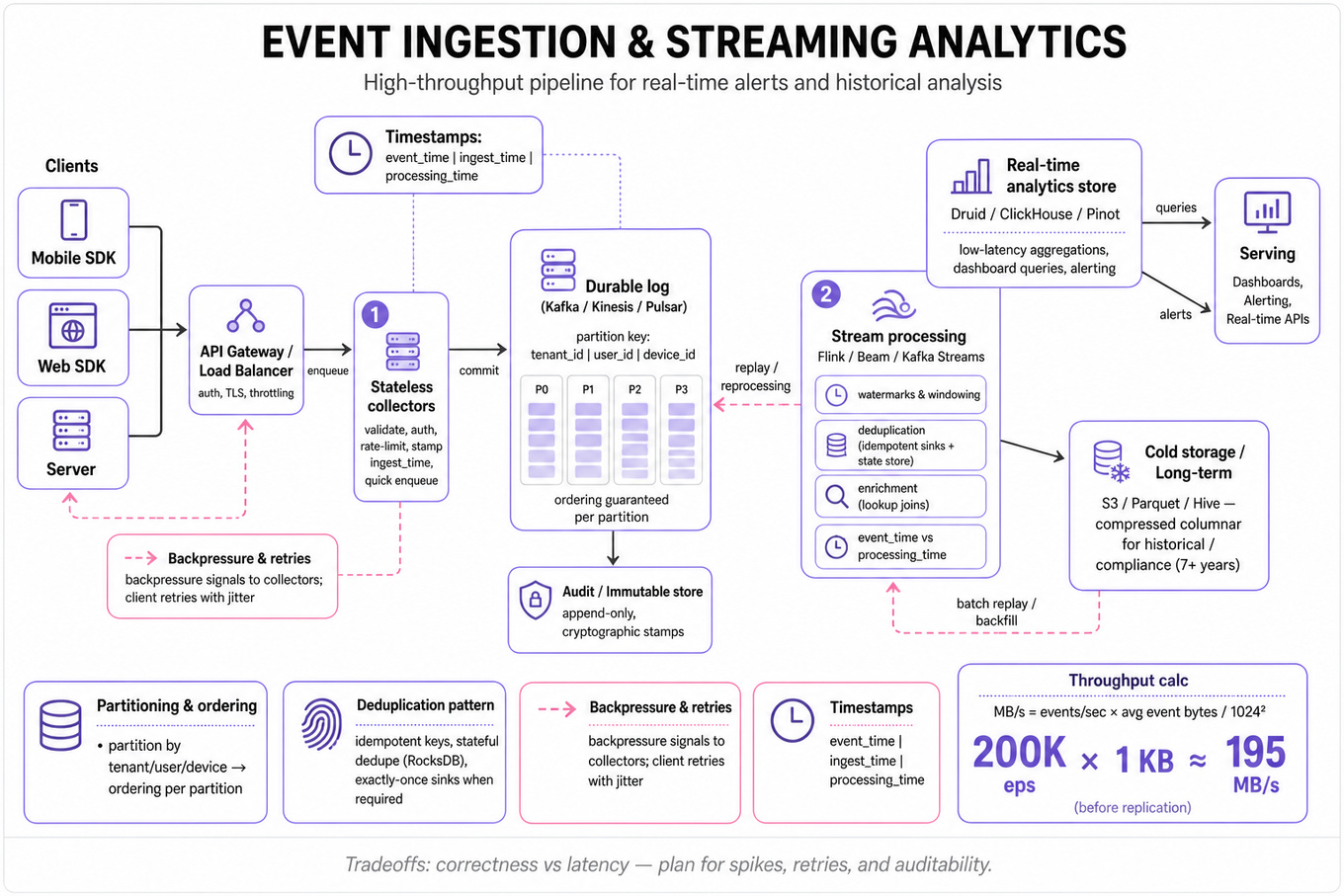
These interviews test whether you can design a high-throughput event pipeline that accepts client/server events, preserves enough correctness for analytics, and serves both real-time and historical queries. The interviewer is probing your ability to reason about ingestion APIs, stream processing, storage models, deduplication, backpressure, latency, and failure recovery without losing sight of product-facing requirements like dashboards, alerts, and auditability. Rippling cares because many core systems generate operational events: employee actions, payroll workflows, device activity, approvals, integrations, and compliance logs. A strong Software Engineer answer should show practical distributed-systems judgment: what must be strongly correct, what can be eventually consistent, and how the system behaves under spikes, retries, and partial outages.
Core knowledge
-
Start from requirements: ask for event volume, event size, write/read ratio, latency target, retention, query patterns, and correctness expectations. A design for 10K events/sec with 5-second dashboard freshness differs from 5M events/sec with sub-second alerting and 7-year compliance retention.
-
Use an ingestion layer to decouple producers from storage. A typical path is client/server SDKs →
API Gatewayor load balancer → stateless collectors → durable log such asKafka,Kinesis, orPulsar. Collectors validate, authenticate, rate-limit, stamp server receive time, and enqueue quickly. -
Separate event time from processing time.
event_timeis when the action happened;ingest_timeis when the backend received it;processing_timeis when the stream job saw it. Real systems need all three because mobile clients, offline devices, retries, and clock skew produce out-of-order data. -
Partitioning determines scalability and ordering. Partition by
tenant_id,user_id,device_id, ordelivery_iddepending on the query and ordering needs.Kafkaonly guarantees ordering within a partition, so “all events for one user in order” implies partitioning by user or routing related keys consistently. -
Throughput math should be explicit. Estimate write bandwidth as
For 200K events/sec at 1 KB each, ingestion is about 195 MB/sec before replication, indexes, and enrichment overhead.
-
Deduplication is mandatory when clients retry. Use an idempotency key such as
event_id = UUIDv7or a deterministic key liketenant_id:user_id:client_sequence. Store recent IDs inRedis, a compactedKafkatopic, or stream processor state with TTL. Exactly-once is expensive; “effectively once” via idempotent writes is usually the practical target. -
Choose storage by access pattern. Raw immutable events can live in
S3/object storage for cheap retention and replay. Aggregates can live inRedis,DynamoDB,Cassandra,ClickHouse,Druid,Pinot, orElasticsearchdepending on whether the workload is key-value lookup, time-series aggregation, OLAP slicing, or full-text search. -
Real-time analytics usually needs pre-aggregation. A dashboard asking “active users per minute by tenant” should not scan raw events on every refresh. Use stream jobs in
Flink,Spark Structured Streaming,Kafka Streams, or consumers that maintain tumbling/sliding window aggregates likecount(distinct user_id)orsum(clicks). -
Windowing has correctness tradeoffs. A tumbling window has fixed non-overlapping buckets; a sliding window overlaps; a session window groups activity separated by inactivity. Late events require a watermark and allowed lateness policy, e.g., close a 1-minute window after
event_time + 2 minutes, then emit corrections for later arrivals. -
Backpressure and load shedding must be designed. If stream consumers fall behind, queue lag grows and dashboards become stale. Protect the system with bounded queues, autoscaling consumers, rate limits per tenant, circuit breakers, and graceful degradation such as sampling low-value events while preserving critical audit events.
-
Schema evolution should be boring and safe. Events need
event_name,schema_version,tenant_id,actor_id,entity_id,event_time,event_id, and a typed payload. Prefer backward-compatible changes: add nullable fields, avoid renaming existing fields, and keep unknown fields tolerable for older consumers. -
Observability is part of the design. Track
ingest_qps,ingest_error_rate,queue_lag_seconds,consumer_lag,dropped_events,dedupe_rate,p95/p99latency, and aggregate freshness. Include replay tooling because bugs in stream logic should be fixable by reprocessing raw events.
Worked example
For “Design a user behavior monitoring system”, a strong candidate starts by clarifying whether the system is for product analytics, security monitoring, or operational debugging, because those imply different latency and retention requirements. In the first 30 seconds, say something like: “I’ll assume 100M events/day, multi-tenant traffic, near-real-time dashboards within 10 seconds, and raw event retention for replay.” Then organize the answer around four pillars: event producers and SDK/API contract, durable ingestion through Kafka-like storage, stream processing for aggregates and alerts, and serving stores for real-time plus historical queries.
For ingestion, describe stateless collectors behind a load balancer that authenticate tenants, validate schemas, assign server timestamps, and write to partitioned topics. For processing, explain that consumers enrich events with tenant/user metadata, deduplicate by event_id, and maintain windowed counters. For storage, keep raw events in object storage, recent searchable events in ClickHouse or Elasticsearch, and hot dashboard aggregates in Redis or an OLAP store. A useful tradeoff to flag is whether to optimize for exact distinct counts or approximate cardinality using HyperLogLog; exact counts are costly at high scale, while approximations are often acceptable for monitoring. Close by saying that with more time you would detail privacy controls, per-tenant rate limits, replay/backfill behavior, and alerting for pipeline lag.
A second angle
For “Design a real-time delivery dashboard”, the same event-streaming backbone applies, but the dominant constraint shifts from generic event analytics to location freshness and stateful entity tracking. Instead of only counting events, the system must maintain the latest state per delivery driver or order: last GPS point, status, ETA, and assignment. Partitioning by delivery_id or driver_id matters because you want ordered updates for each moving entity. The serving layer may need geospatial indexes such as PostGIS, Redis GEO, geohashes, or S2 cells to answer “show active deliveries in this viewport.” The tradeoff becomes freshness versus cost: updating every GPS ping gives smoother maps but can overwhelm storage and clients, so you may throttle, coalesce, or send only significant location changes.
Common pitfalls
Pitfall: Designing only the happy path: client sends event, backend stores it, dashboard reads it.
A better answer discusses retries, duplicate events, delayed mobile uploads, consumer lag, poison messages, partial outages, and replay. Interviewers want to hear how the system behaves when Kafka is slow, one tenant floods the service, or a stream job deploy introduces a bad aggregation.
Pitfall: Claiming “exactly-once processing” without explaining the mechanism.
In most real systems, exactly-once semantics require coordination between the stream processor, offsets, transactions, and the sink, and many sinks do not support it cleanly. A stronger Software Engineer answer says: “I’ll make writes idempotent using event_id, commit offsets after durable writes, and design aggregates to tolerate replay.”
Pitfall: Jumping into tools before naming the access patterns.
Saying “use Kafka, Flink, and Cassandra” is not a design by itself. First identify the required reads: latest status lookup, time-series dashboard, ad hoc filtering, alert triggers, raw replay, or compliance audit. Then map each read/write pattern to the simplest storage and processing model that satisfies it.
Connections
An interviewer can pivot from here into rate limiting, idempotent API design, distributed counters, log-based architectures, geospatial indexing, or observability systems. They may also ask you to compare push versus pull dashboards, batch versus streaming computation, or consistency versus availability during regional failures.
Further reading
-
Designing Data-Intensive Applications — best single source for logs, streams, replication, partitioning, and storage tradeoffs.
-
The Log: What every software engineer should know about real-time data’s unifying abstraction — explains why append-only logs underpin systems like
Kafka. -
Google Dataflow Model paper — deep treatment of event time, watermarks, windows, and late data.
Practice questions
Coding & Algorithms
What's being tested
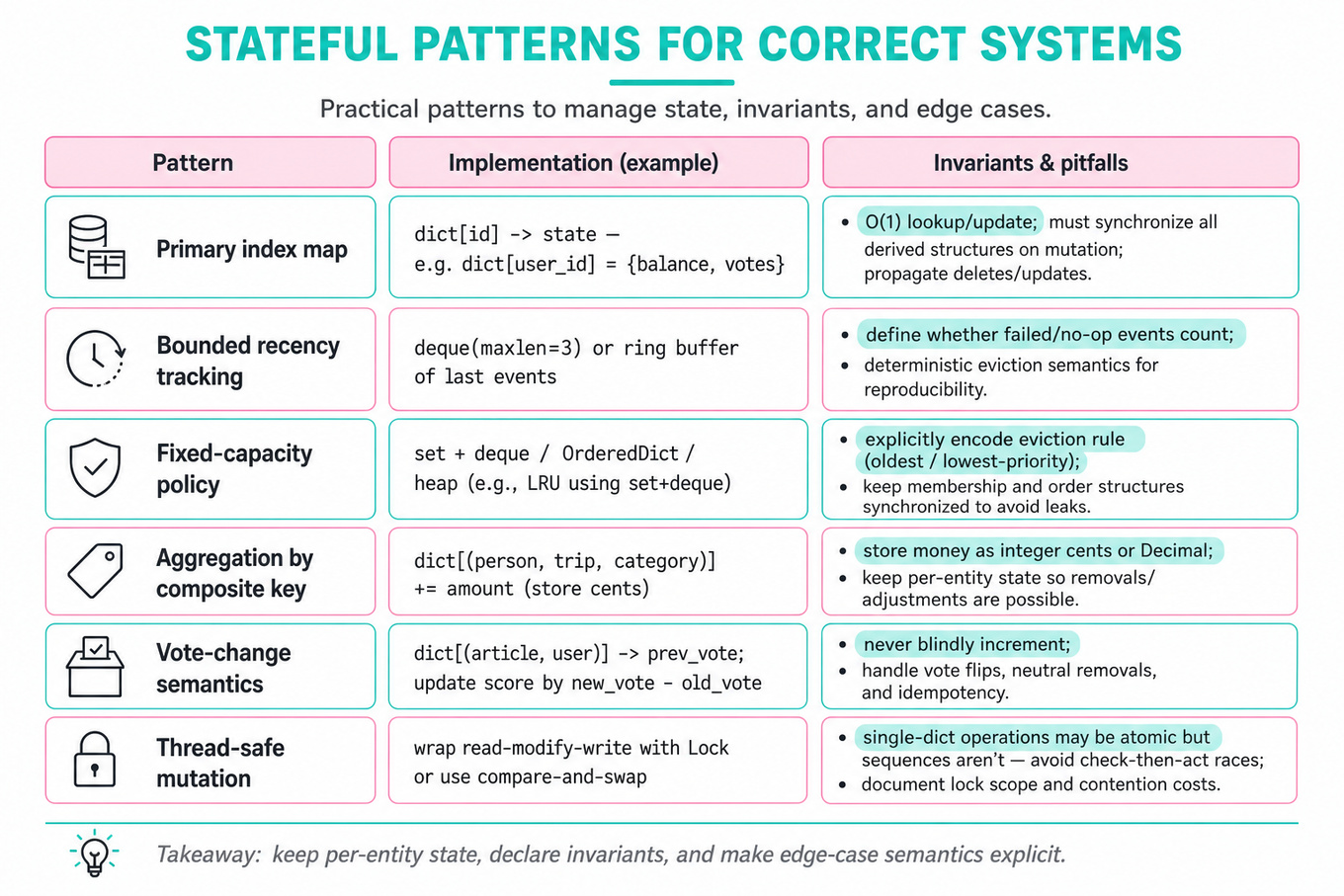
These problems test stateful in-memory API design: choosing maps, heaps, sets, queues, and counters that preserve invariants across calls. Interviewers look for deterministic updates, clear edge-case semantics, and complexity awareness under repeated operations, often with light concurrency constraints.
Patterns & templates
-
Primary index map — use
`dict[id] -> state`forO(1)lookup/update; keep all derived structures synchronized on mutation. -
Bounded recency tracking — use
`deque(maxlen=3)`or ring buffer for last-N events; define whether failed/no-op events count. -
Fixed-capacity policy — combine
`set`membership with ordered structure like`deque`,`OrderedDict`, or heap; specify eviction rule deterministically. -
Aggregation by composite key — use
`dict[(person, trip, category)] += amount`; store money as integer cents, not floating-point. -
Vote-change semantics — track previous user vote in
`dict[(article, user)]`; update score bynew_vote - old_vote, not by blindly incrementing. -
Thread-safe mutation — wrap compound read-modify-write paths with
`Lock`; single dictionary operations are not enough for invariant safety. -
Ranking and tie-breakers — normalize inputs, compute comparable tuples, then
sort(key=...); explicitly encode tie rules and invalid-card handling.
Common pitfalls
Pitfall: Maintaining only aggregate totals loses information needed for updates, removals, or vote flips; keep per-entity state plus derived counters.
Pitfall: Using
`float`for currency aggregation can introduce rounding bugs; use cents,`Decimal`, or minor currency units.
Pitfall: Hand-waving concurrency with “use a map” misses race conditions between membership checks, evictions, and counter updates.
Practice these
The practice cards below cover the canonical variants — solve all of them and time yourself.
Practice questions
Software Engineering Fundamentals

What's being tested
This tests whether you can turn HTTP semantics and REST API design into working, robust server code rather than just describing endpoints. Rippling cares because many product surfaces depend on reliable internal services: clear contracts, safe request handling, predictable errors, and maintainable routing matter as much as the happy-path implementation. Interviewers are probing for practical backend instincts: parsing protocol boundaries, choosing status codes, validating inputs, modeling resources, handling concurrency, and defending against common security bugs like path traversal. Strong answers make tradeoffs explicit and show how the design would evolve from an in-memory toy service to production-ready code.
Core knowledge
-
HTTP/1.1 request parsing starts with the request line:
METHOD path HTTP/1.1, followed by headers, a blank line, then an optional body. Never assume a singlerecv()contains the full request; read until\r\n\r\n, then useContent-Lengthfor the body. -
Status codes are part of the API contract. Use
200 OKfor successful reads,201 CreatedwithLocationfor new resources,204 No Contentfor successful deletes,400 Bad Requestfor malformed input,404 Not Found,409 Conflict,415 Unsupported Media Type, and500 Internal Server Error. -
RESTful resource modeling should use nouns and stable identifiers:
/questions,/questions/{id},/questions/{id}/answers. UseGETfor reads,POSTfor creation,PATCHorPUTfor updates, andDELETEfor removal; avoid RPC-style paths like/createQuestion. -
Idempotency distinguishes safe retries from duplicate writes.
GET,PUT, andDELETEshould be idempotent;POSTgenerally is not unless you add anIdempotency-Keypattern. In interviews, call out retry behavior even if you do not implement the full mechanism. -
Routing can start as a table mapping
(method, path_pattern)to handlers, with path parameters extracted by regex or segmented matching. A simple trie or ordered pattern matcher is enough for small services; avoid fragileif path.startswith(...)chains once nested resources appear. -
Input validation should happen at the boundary: parse
Content-Type, reject invalid JSON, enforce required fields, limit lengths, and normalize strings. For a Q&A service, validate question title/body, answer body, sort fields, page size, and ownership assumptions if authentication is in scope. -
Pagination and sorting prevent unbounded responses. Offset pagination with
limitandoffsetis simple but degrades for large offsets; cursor pagination using(created_at, id)is more stable. Caplimit, for examplemin(requested_limit, 100), to protect latency and memory. -
Concurrency models include one thread per connection, a fixed thread pool, or an event loop using
select,poll, orepoll. For an interview implementation, a bounded thread pool is easier to reason about; protect shared maps with locks or use immutable snapshots where possible. -
Persistence choices should match the exercise scope. An in-memory dictionary is acceptable for a minimal implementation, but call out restart loss and race conditions.
SQLiteis a strong next step for local durability;Postgresfits multi-user production services with indexes and transactions. -
Security basics matter even for local servers. Prevent path traversal by URL-decoding once, normalizing with something like
pathlib.Path.resolve(), and verifying the resolved path remains under the configured document root. Reject.., encoded traversal, and symlink escapes. -
Observability should include structured request logs with method, path, status, latency, and request id. Track counters for
2xx,4xx,5xx, and latency percentiles such asp95andp99; even in an interview, mention where logs would sit in the code path. -
Testing strategy should cover protocol and API behavior, not only handler logic. Include unit tests for routing and validation, integration tests using real sockets or an HTTP client, malformed request tests, concurrent request tests, and shutdown tests that verify no new connections are accepted.
Worked example
For Implement a minimal local HTTP server, a strong candidate first clarifies scope: “Do I need HTTP/1.1 keep-alive, static file serving, multiple routes, TLS, or just plain local localhost traffic?” Then they declare assumptions: support GET and maybe POST, parse Content-Length, return valid status lines and headers, serve from a configured root, and handle multiple clients concurrently. The answer can be organized around four pillars: socket lifecycle, request parsing, routing/response generation, and operational concerns like security, logging, and graceful shutdown. For sockets, they would describe bind(), listen(), accept(), then dispatch each connection to a worker thread or thread pool. For parsing, they would emphasize reading until the header delimiter, enforcing maximum header/body sizes, and producing 400 Bad Request instead of crashing on malformed input. For static file routes, they would explicitly normalize the requested path and verify it stays inside the document root before opening the file. One tradeoff to flag is thread-per-connection versus a bounded pool: thread-per-connection is simpler, but a pool prevents local resource exhaustion under many slow clients. They should close by saying that if they had more time, they would add keep-alive support, MIME type detection, request ids, integration tests with malformed packets, and a shutdown path that stops accepting new connections while allowing active requests to complete.
A second angle
For Implement a RESTful Q&A service, the focus shifts from protocol mechanics to resource design and application correctness. The same HTTP knowledge still applies, but the interviewer now expects clean endpoint definitions such as POST /questions, GET /questions/{id}, POST /questions/{id}/answers, and GET /questions?limit=20&cursor=.... A good solution defines data models, validation rules, status codes, and persistence boundaries before writing handlers. The main tradeoff is whether to keep data in memory for speed and simplicity or introduce SQLite/Postgres to get durability, uniqueness constraints, and transactions. The candidate should also cover pagination, sorting by created_at or score, consistent error response shape, and tests for missing fields, nonexistent IDs, and concurrent creates.
Common pitfalls
Pitfall: Treating HTTP as “read one string, split by spaces, return text.”
This misses protocol edge cases that backend interviewers care about: partial reads, headers, body length, malformed requests, and valid response formatting. A better answer acknowledges a minimal supported subset but still implements that subset correctly and defensively.
Pitfall: Designing endpoints around actions instead of resources.
Paths like POST /askQuestion, POST /editAnswer, and GET /getAllQuestions suggest weak REST instincts. Prefer resource-oriented paths, use the HTTP method to express the action, and make status codes and response bodies predictable.
Pitfall: Going too deep on production architecture before solving the local problem.
Jumping immediately to load balancers, service meshes, Kubernetes, or distributed databases can look like avoidance if the task is to implement a minimal server. Land the core implementation first, then briefly explain the next production steps: durability, authentication, rate limits, metrics, and deployment.
Connections
Interviewers may pivot from here into system design, especially API versioning, rate limiting, authentication, and data consistency. They may also move toward concurrency control, asking about locks, thread pools, race conditions, and graceful shutdown. For implementation-heavy rounds, expect follow-ups on testing strategy, malformed input handling, and debugging latency or 5xx spikes.
Further reading
-
RFC 9110: HTTP Semantics — authoritative reference for methods, status codes, headers, and core HTTP behavior.
-
OWASP Path Traversal — practical examples of file path attacks and defenses.
-
Microsoft REST API Guidelines — concrete conventions for resource naming, errors, pagination, and versioning.
Practice questions
Behavioral & Leadership
What's being tested
Interviewers are evaluating end-to-end engineering ownership: whether you can take a real project from ambiguous problem to shipped system, explain the technical decisions, quantify the impact, and reflect on what you would improve. For a Software Engineer, this is not a generic “tell me about yourself” exercise; it probes system design judgment, debugging maturity, tradeoff analysis, and ability to work through cross-team constraints without losing technical accountability. Rippling cares because its platform combines HR, payroll, identity, devices, permissions, workflows, and third-party integrations, so engineers must build reliable systems that interact with many domains and failure modes. A strong answer shows you can own a slice of that complexity: define the problem, choose the right architecture, ship safely, measure outcomes, and collaborate well.
Core knowledge
-
Project framing should start with the problem, users, constraints, and your role. A good structure is: context → goal → architecture → hard decisions → execution → impact → reflection. Avoid beginning with implementation details before the interviewer understands why the system mattered.
-
Technical ownership means being clear about what you personally designed, built, reviewed, debugged, or coordinated. Say “I owned the
Postgresschema migration and rollout plan” rather than “we improved the backend,” especially when multiple engineers, PMs, or infra teams were involved. -
Architecture explanation should identify components, data flow, dependencies, and boundaries. For backend work, mention APIs, storage, async jobs, caches, permissions, idempotency, and observability where relevant; for frontend work, mention state management, rendering performance, API contracts, accessibility, and failure states.
-
Tradeoff analysis is more important than claiming the “best” solution. Compare alternatives using latency, durability, complexity, operational burden, cost, migration risk, and team familiarity. Example: synchronous API validation is simpler, but async processing with
SQSorKafkacan isolate retries and reducep99request latency. -
Impact measurement should use engineering metrics tied to outcomes. Examples include reducing
p95latency from 900 ms to 180 ms, cutting error rate from 2.1% to 0.2%, decreasing deploy rollback frequency, improving onboarding completion time, or reducing manual support tickets by 35%. -
Reliability reasoning should include failure modes and mitigations. For critical workflows, discuss retries, timeouts, circuit breakers, idempotency keys, audit logs, backfills, and safe degradation. A useful availability calculation is , but explain what user-visible failure means.
-
Data correctness matters in multi-tenant business software. Call out tenant isolation, authorization checks, migration safety, referential integrity, unique constraints, and auditability. A tempting cache or denormalization can be unsafe if stale permissions expose another company’s employee data.
-
Scalability claims need numbers. Instead of “it scaled well,” say “the old endpoint did an
O(n)scan over all employees per request; we added an indexed lookup on(company_id, employee_id), which kept reads under 50 ms for tenants with 100k employees.” -
Rollout strategy shows maturity. Strong answers mention feature flags, canary deploys, shadow reads, dual writes, backfills, dashboards, and rollback plans. For risky migrations, explain how you verified parity before switching traffic and what alert would trigger rollback.
-
Debugging depth should include hypotheses, evidence, instrumentation, and the fix. Name concrete tools when applicable:
Datadogdashboards,OpenTelemetrytraces, structured logs, database query plans, browser performance profiles, or synthetic tests. -
Collaboration and mentorship should stay technical. Good examples include aligning API contracts with another team, writing a design doc, unblocking a teammate on a race condition, improving code review quality, or creating runbooks. Avoid vague claims like “I communicated with stakeholders.”
-
Reflection should be specific and non-defensive. Strong candidates can say, “I underestimated the migration risk; next time I would build a shadow validation job earlier,” then explain how that learning changed a later project.
Worked example
For “Walk through a project deep dive,” a strong candidate spends the first 30 seconds setting scope: “I’ll use a backend project where I owned the redesign of our employee-permissions service; the goal was to reduce authorization latency and eliminate inconsistent access decisions during org changes.” Then clarify assumptions: what scale the system handled, what correctness requirements existed, and which parts you personally owned. Organize the answer around four pillars: the original architecture and pain points, the design alternatives considered, the implementation and rollout, and the measured impact. For the technical core, sketch the request path, storage model, cache invalidation strategy, and observability plan rather than listing every ticket completed.
A strong tradeoff to flag would be cache freshness versus latency: caching permission decisions reduced p95 latency, but stale entries could create security bugs, so you might choose short TTLs plus event-driven invalidation and a fallback database read on sensitive actions. Include one concrete failure mode, such as out-of-order org-change events causing incorrect access, and explain the guardrail, such as versioned updates or monotonic timestamps. Quantify results with before/after metrics: latency, error rate, support escalations, deploy safety, or engineering time saved. Close with a reflection: “If I had more time, I would add a replayable audit tool so we could reconstruct why a user had access at a given timestamp.”
A second angle
For “What was the hardest part of your project?” the same ownership concept shifts from broad narrative to focused judgment under pressure. Do not answer with only “the timeline was tight” or “there were many dependencies”; choose a technically meaningful difficulty like migrating live data, preserving backward compatibility, debugging a race condition, or balancing latency against correctness. The best framing is: why it was hard, what options you considered, what decision you made, and what you learned. For example, if the hardest part was a Postgres migration on a high-traffic table, discuss lock avoidance, batching, verification queries, and rollback—not just that the migration was “complex.” The interviewer is checking whether your definition of “hard” includes technical risk, not just workload.
Common pitfalls
Pitfall: Giving a project tour instead of an engineering argument.
A weak answer lists features shipped, meetings attended, and timelines. A stronger answer explains the system’s constraints, the alternatives you rejected, and the measurable effect of the decisions you made. Interviewers need enough detail to believe you could own similar systems again.
Pitfall: Reporting impact without causality or engineering metrics.
“Revenue went up” or “users liked it” is usually too broad for a Software Engineer unless you connect it to your technical work. Better: “We reduced duplicate job execution by adding idempotency keys, which cut payroll-sync support tickets by 40% and reduced retry-related database writes by 65%.”
Pitfall: Staying too shallow when challenged.
If the interviewer asks why you chose Redis, an event queue, a normalized schema, or a particular API boundary, do not repeat “it was faster” or “it was simpler.” Discuss read/write patterns, failure behavior, operational cost, consistency requirements, and how you validated the choice with load tests, query plans, or production telemetry.
Connections
This topic often pivots into system design, especially around scalability, reliability, data modeling, and API boundaries. It can also lead to debugging, incident response, code quality, mentorship, and team fit, where the interviewer asks how you work with others while maintaining technical ownership.
Further reading
-
Staff Engineer: Leadership Beyond the Management Track — useful examples of technical leadership, scope, influence, and project ownership without becoming a people manager.
-
Designing Data-Intensive Applications — deep background on storage, consistency, distributed systems, and reliability tradeoffs that strengthen project deep dives.
-
Accelerate — practical framing for engineering impact through deployment frequency, lead time, change failure rate, and recovery time.
Practice questions