Delivery Driver Payment And Cost Systems
Asked of: Software Engineer
Last updated
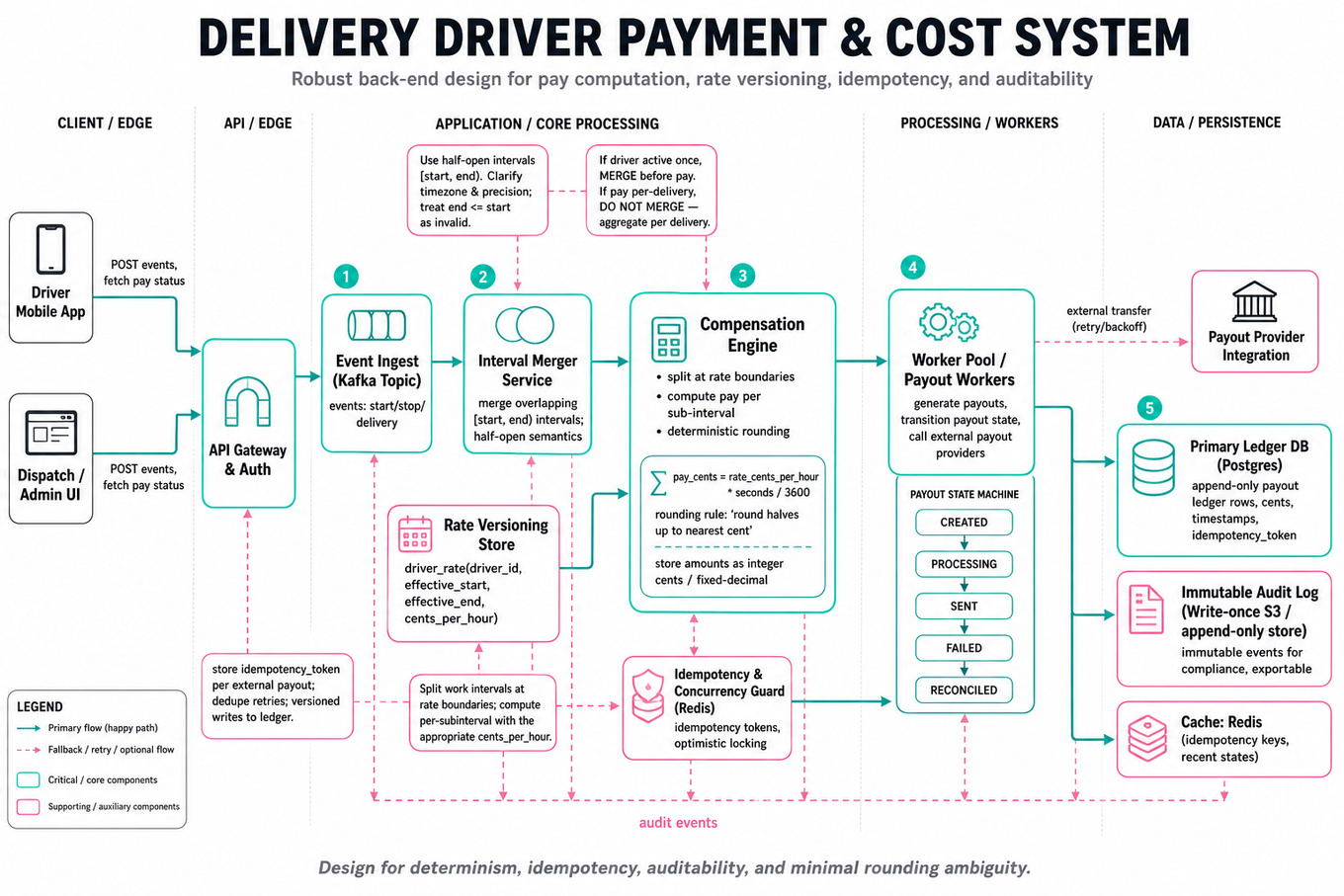
What's being tested
These interviews test whether you can design a correct financial backend system under messy real-world constraints: overlapping work intervals, partial-hour pay, rate changes, concurrent updates, and payout state transitions. Rippling cares because payroll-like systems require engineering discipline: a one-cent rounding bug, duplicate payout, or race condition can become a compliance and trust issue. The interviewer is probing for concrete modeling choices, not vague “microservices”: how you represent time, money, rates, idempotency, and mutable payment state. Strong answers balance simple in-memory or single-service designs with clear paths to persistence, scaling, and auditability.
Core knowledge
-
Money should never be represented as floating point. Store amounts in integer minor units, such as cents, or use fixed-precision decimals like
BigDecimal/Decimal. For hourly pay, compute and define deterministic rounding. -
Time intervals need explicit semantics. Prefer half-open intervals, , because adjacent shifts like
[10:00, 11:00)and[11:00, 12:00)do not overlap. Always clarify timezone, timestamp precision, whetherend <= startis invalid, and how daylight-saving transitions are handled. -
Interval merging is the core algorithm for avoiding double payment across overlapping deliveries or shifts. Sort by
start_time, then merge ifnext.start <= current.end; this isO(n log n)time andO(n)space. If intervals arrive online, use a balanced tree keyed by start time. -
Partial-hour payment should be proportional to elapsed time, not rounded hours unless the business rule says so. A 15-minute delivery at
$20/houris$5.00, computed as cents. Be explicit about rounding fractional cents. -
Rate changes require temporal versioning. Store rate rules as effective intervals, for example
driver_rate(driver_id, effective_start, effective_end, cents_per_hour). To compute pay, split work intervals at rate boundaries, then apply the appropriate rate to each sub-interval. -
Overlapping deliveries and concurrent work are different cases. If the driver can handle multiple deliveries simultaneously but should only be paid once for active time, merge intervals before applying wages. If cost is per-delivery reimbursement, do not merge; aggregate each delivery independently.
-
Idempotency keys prevent duplicate state mutations. For APIs like
POST /payouts, require anIdempotency-Keyand store the request hash plus result. Retrying the same request returns the same payout record; retrying with the same key but different payload should return a conflict. -
Transactional payout state needs a small finite-state machine. Typical states are
CALCULATED -> APPROVED -> SUBMITTED -> PAIDwith terminal states likeFAILEDorCANCELED. Guard transitions using database transactions, row locks, and compare-and-set conditions. -
Auditability matters as much as the final total. Persist inputs, rate versions, calculation version, rounding policy, and generated line items. A good payroll design can answer, “Why was this driver paid
$123.45for Tuesday?” without recomputing against changed business rules. -
Concurrency control depends on the consistency boundary. For a single driver’s payroll period, use a transaction with
SELECT ... FOR UPDATEinPostgres, optimistic locking via aversioncolumn, or per-driver locks in an in-memory implementation. Avoid global locks unless the scope is tiny. -
Aggregation APIs should distinguish reads from writes. Write path records immutable delivery or shift events; read path computes totals by driver, time range, and status. For small
N, compute on demand; for millions of intervals, maintain pre-aggregated daily buckets plus raw data for correction. -
Cost calculation is not always payroll calculation. Driver pay may be time-based, delivery cost may include base fee, distance, surge, tips, reimbursements, and platform adjustments. Model this as composable line items rather than one giant formula so rules can evolve safely.
Worked example
For Design a driver payroll service, a strong candidate starts by clarifying scope: “Are drivers paid hourly, per delivery, or both? Can intervals overlap? Do rates change within a pay period? Do we need to trigger real bank payouts or just calculate owed wages?” Then they declare assumptions: use UTC timestamps, half-open intervals, cents as integers, and one payroll period per driver.
The answer can be organized around four pillars. First, define the data model: Driver, WorkInterval, RateRule, PayrollRun, PayrollLineItem, and Payout. Second, explain the calculation engine: fetch intervals for a driver and period, validate them, merge overlapping paid-time intervals, split by rate-rule boundaries, and compute cents using deterministic rounding. Third, describe state management: calculated payroll runs are immutable snapshots, while payouts move through controlled states like APPROVED, SUBMITTED, and PAID. Fourth, cover idempotency and retries for payout creation so duplicate API calls cannot pay a driver twice.
One tradeoff to flag explicitly is whether to calculate payroll on demand or materialize payroll runs. On-demand calculation is simpler for small data and always reflects latest inputs, but immutable payroll snapshots are safer once money movement or approval begins. A good close would be: “If I had more time, I’d add correction runs for late delivery events, audit logs for every calculation input, and monitoring around duplicate payout attempts and rounding deltas.”
A second angle
For Design a delivery cost aggregator, the same fundamentals apply, but the framing shifts from payroll correctness over a pay period to live aggregation under concurrency. Instead of modeling a full payout lifecycle, focus on an in-memory component that ingests delivery start/end/cost updates and serves metrics like total active cost or cost by driver. The key decisions become thread safety, lock granularity, and whether reads require strongly consistent totals or can tolerate slightly stale snapshots. A strong design might keep per-driver aggregates in a ConcurrentHashMap, use immutable event records, and update totals with atomic operations or striped locks. The candidate should still call out money precision and interval semantics, but the center of gravity is concurrent aggregation rather than financial settlement.
Common pitfalls
Pitfall: Treating time intervals as simple durations and ignoring overlaps.
A tempting answer is to sum (end - start) for every delivery and multiply by the hourly rate. That overpays when deliveries overlap or when a driver has duplicate events. A stronger answer says whether overlap should merge, stack, or be rejected, then implements that rule with interval sorting or an interval tree.
Pitfall: Saying “use floats and round at the end.”
Floating point can produce nondeterministic-looking cents, especially across languages or repeated aggregations. Use cents as integers or fixed decimal types, and define where rounding happens: per line item, per day, or per payroll run. The interviewer is looking for financial-system instincts, not just arithmetic.
Pitfall: Jumping straight to distributed architecture without solving correctness.
Starting with Kafka, sharding, and multiple services can sound sophisticated but often hides missing fundamentals. First show the single-node or single-database correctness model: schema, interval algorithm, transaction boundary, idempotency, and state machine. Then scale reads, ingestion, or aggregation only after the invariants are clear.
Connections
The interviewer may pivot into ledger design, idempotent API design, event sourcing, concurrency control, or interval data structures. You may also see coding follow-ups that ask you to implement wage calculation, merge intervals, compute partial-hour payments, or maintain live totals with thread-safe updates.
Further reading
-
Martin Fowler, “Money” pattern — classic reference on representing monetary values safely in application code.
-
Stripe API idempotent requests — practical model for safe retries in payment-like APIs.
-
[Designing Data-Intensive Applications, Martin Kleppmann] — strong background on transactions, consistency, logs, and state management in distributed systems.
Featured in interview prep guides
Practice questions
Related concepts
- Donation And Payment PlatformsSystem Design
- Payment Processing And Ledger SystemsSystem Design
- Operational Delivery Quality DiagnosticsAnalytics & Experimentation
- Unit Economics And Pricing AnalyticsAnalytics & Experimentation
- DoorDash Monetization, Unit Economics, and Trade-offs
- SQLData Manipulation (SQL/Python)