SQL
Asked of: Data Scientist
Last updated
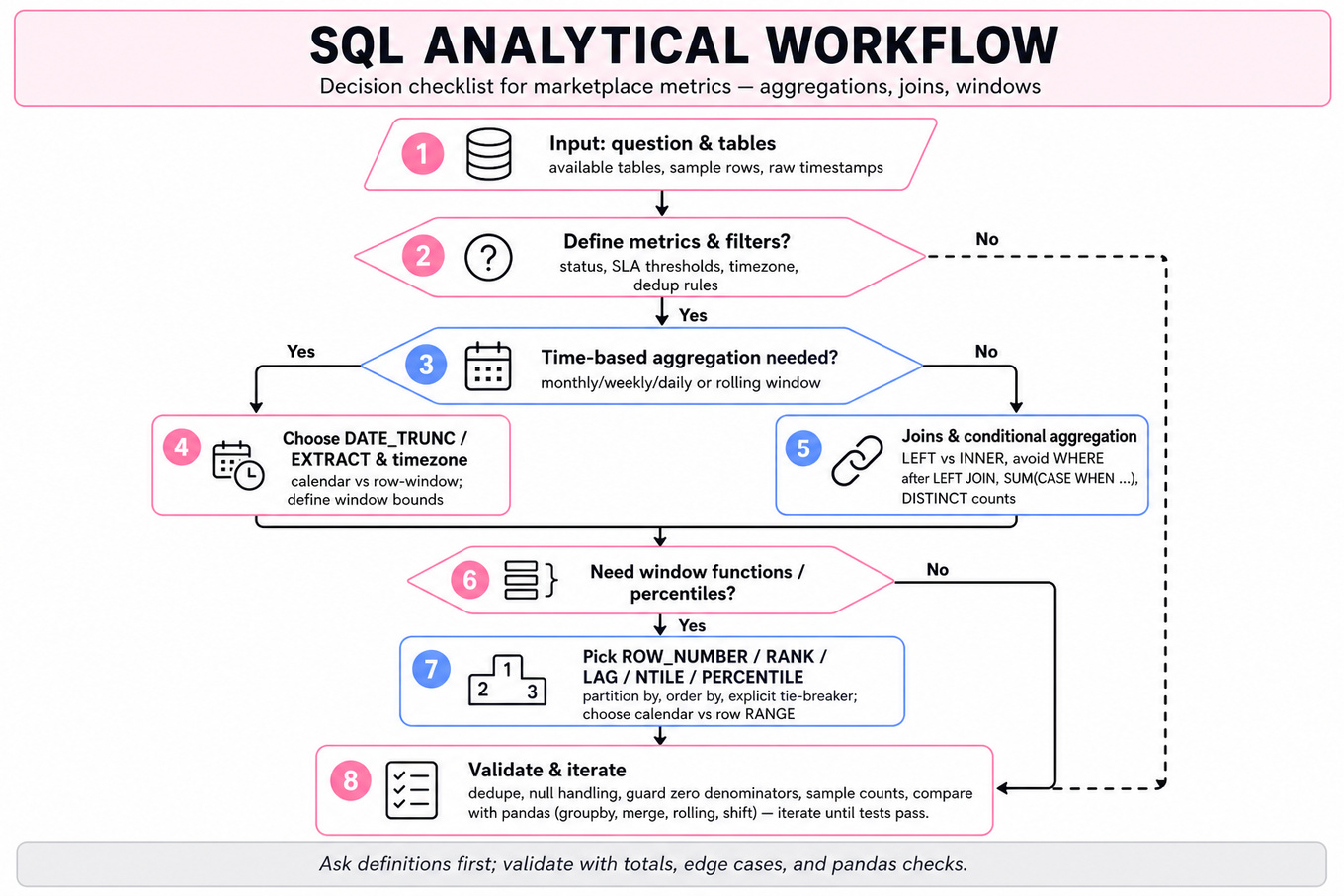
What's being tested
These questions test SQL analytical data manipulation for marketplace metrics: aggregating orders, joining customer/restaurant/event tables, grouping by time, ranking entities, and computing rates or percentiles. Interviewers are probing whether you can translate ambiguous DoorDash business definitions into correct SQL or Python logic with clean handling of timestamps, nulls, duplicates, and windowed metrics.
Patterns & templates
-
Time-based aggregation — use
`DATE_TRUNC`(`'month'`, `created_at`)or`EXTRACT`for monthly metrics; confirm timezone and order-status filters upfront. -
Conditional aggregation — compute rates with
`SUM`(`CASE WHEN condition THEN 1 ELSE 0 END) * 1.0 / `COUNT`(*); guard against zero denominators. -
Entity ranking — use
`ROW_NUMBER`,`RANK`, or`DENSE_RANK`with`PARTITION BY`for top customers, restaurants, or months; define tie-breaking explicitly. -
Windowed rolling metrics — use
`AVG`,`SUM`, or`COUNT`over`ROWS BETWEEN`or date-range windows; distinguish row-count windows from calendar windows. -
Percentiles and quartiles — use
`PERCENTILE_CONT`,`NTILE`(`4`), or`APPROX_PERCENTILE`; know whether the question needs exact thresholds or segmentation buckets. -
Event sequencing — use
`LAG`,`LEAD`, and`ROW_NUMBER()`OVER (`PARTITION BY order_id ORDER BY event_ts`) to identify request flows and latest valid states. -
Python equivalent — map
SQLpatterns to`pandas`:`groupby`,`agg`,`merge`,`rank`,`rolling`,`quantile`, and`shift`; watch memory for large tables.
Common pitfalls
Pitfall: Counting rows instead of distinct orders or customers can inflate metrics after joins, especially with order-event or item-level tables.
Pitfall: Treating “late,” “cold,” or “completed” as obvious definitions without asking for SLA thresholds, cancellation handling, and timestamp source.
Pitfall: Using
`WHERE`filters after a`LEFT JOIN`can silently turn it into an inner join and drop customers or restaurants with zero activity.
Practice these
The practice cards below cover the canonical variants — solve all of them and time yourself.
Featured in interview prep guides
Practice questions
- Calculate Order Request MetricsDoorDash · Data Scientist · Onsite · hard
- Compute rolling cold-delivery rates with windowsDoorDash · Data Scientist · Onsite · medium
- Write SQL for percent and window changesDoorDash · Data Scientist · Technical Screen · medium
- Model schema and query new-market readinessDoorDash · Data Scientist · Onsite · medium
- Write SQL for cold-complaint diagnostics with LAG/QUALIFYDoorDash · Data Scientist · Technical Screen · medium
- Write SQL to backtest refund policyDoorDash · Data Scientist · Technical Screen · medium
- Write complex SQL on DoorDash dataDoorDash · Data Scientist · Onsite · medium
- Solve multi-part SQL with sliding windowsDoorDash · Data Scientist · Technical Screen · medium
- Write SQL for cuisine median delivery timesDoorDash · Data Scientist · Onsite · medium
- Measure Late Deliveries and Identify Top Delayed RestaurantsDoorDash · Data Scientist · Technical Screen · medium
- Calculate Late Delivery Percentage and Top CustomersDoorDash · Data Scientist · Technical Screen · medium
- Find orders from bottom-quartile revenue restaurantsDoorDash · Data Scientist · Onsite · medium
Related concepts
- SQL Analytical QueryingData Manipulation (SQL/Python)
- SQL Analytical Querying And Data ModelingData Manipulation (SQL/Python)
- SQL And Python Data ManipulationData Manipulation (SQL/Python)
- SQL AnalyticsData Manipulation (SQL/Python)
- SQL Window Functions And AnalyticsData Manipulation (SQL/Python)
- SQL Product AnalyticsData Manipulation (SQL/Python)