SQL Analytics
Asked of: Data Scientist
Last updated
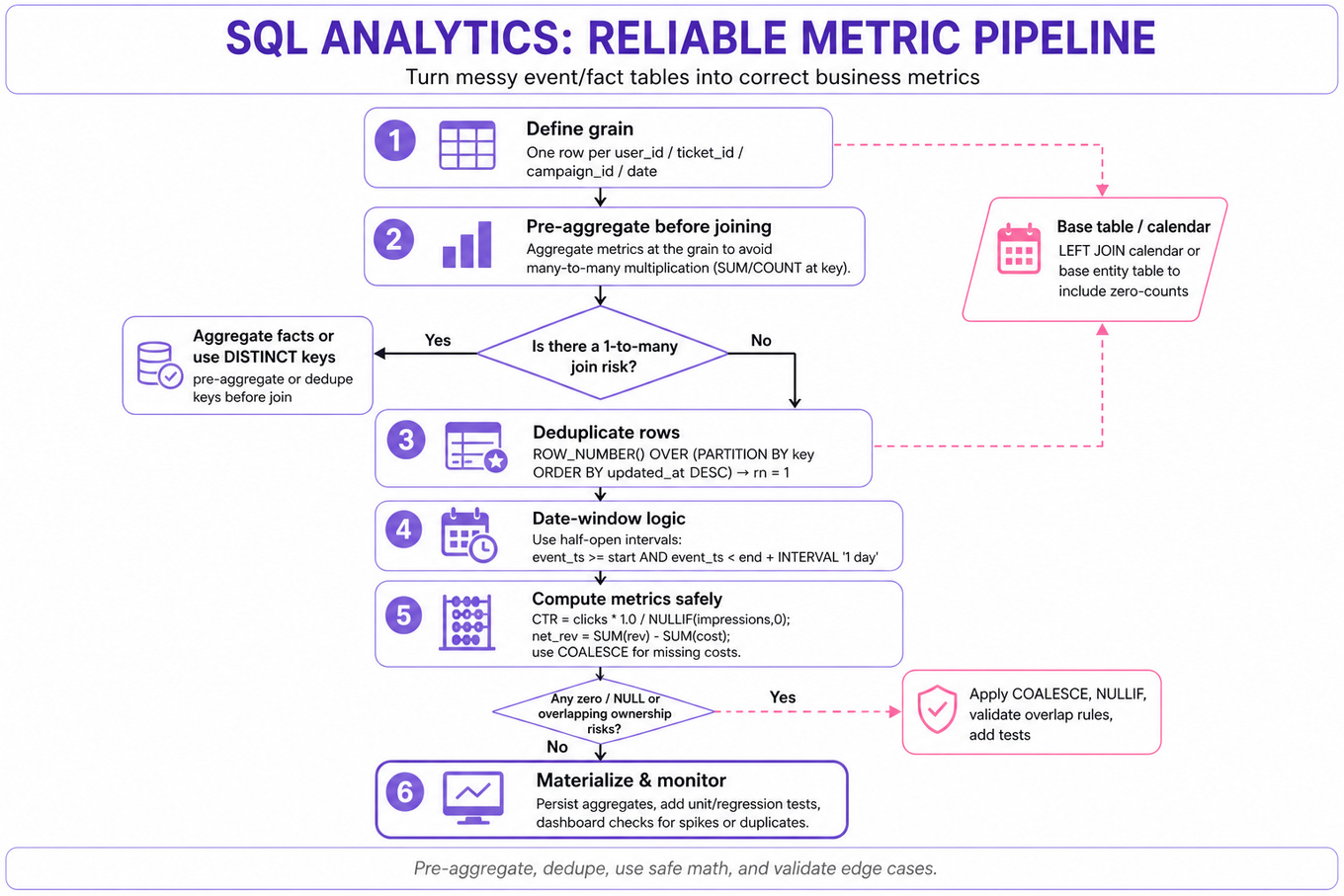
What's being tested
These prompts test SQL analytics: turning messy transactional or event tables into reliable business metrics using joins, filters, aggregation, deduplication, and date logic. For a Data Scientist, the bar is not just syntactically correct SQL; it is metric correctness under edge cases like duplicate rows, missing dates, zero denominators, overlapping ownership, and cost/revenue attribution.
Patterns & templates
-
Grain control before joining — define one row per
user_id,ticket_id,campaign_id, ordate; pre-aggregate to prevent many-to-many duplication. -
Conditional aggregation with
SUM(CASE WHEN ... THEN 1 ELSE 0 END)orCOUNT(*) FILTER (WHERE ...)for segmented metrics in one query. -
Revenue formulas should be explicit — net revenue often means
SUM(revenue) - SUM(cost); useCOALESCEfor missing costs or zero activity. -
Deduplication via
ROW_NUMBER() OVER (PARTITION BY key ORDER BY updated_at DESC); filterrn = 1before aggregating. -
Date-window filtering with half-open intervals like
event_ts >= start_date AND event_ts < end_date + INTERVAL '1 day'to avoid timestamp boundary bugs. -
Window functions such as
LAG,SUM(...) OVER, andLAST_VALUE IGNORE NULLSfor forward-fill, rolling totals, and time-windowed metrics. -
Safe rate metrics use
clicks * 1.0 / NULLIF(impressions, 0); never allow integer division or divide-by-zero errors inCTR.
Common pitfalls
Pitfall: Joining raw fact tables before aggregation can silently multiply revenue, visits, clicks, or donations.
Pitfall: Using
COUNT(column)when nulls matter can undercount; useCOUNT(*),COUNT(DISTINCT ...), or conditional counts deliberately.
Pitfall: Reporting only rows with activity misses required zero-count entities; use a base table or calendar table plus
LEFT JOIN.
Practice these
The practice cards below cover the canonical variants — solve all of them and time yourself.
Featured in interview prep guides
Practice questions
- Write SQL to compute campaign net revenueCapital One · Data Scientist · Onsite · medium
- Write SQL for theme-park revenue and visitsCapital One · Data Scientist · Onsite · medium
- Write SQL to quantify outage revenue lossCapital One · Data Scientist · Technical Screen · medium
- Impute, join, and upsert using SQL and PythonCapital One · Data Scientist · Technical Screen · medium
- Write one SQL for exam scores aggregationCapital One · Data Scientist · Online Assessment · medium
- Merge ad CSVs and compute CTRCapital One · Data Scientist · Online Assessment · medium
- Compute Customer Spend and Engineer Features for 2023Capital One · Data Scientist · Onsite · medium
- Determine Country with Most 'Sunny' DaysCapital One · Data Scientist · Onsite · medium
Related concepts
- SQL Analytics Joins, Aggregations, And Windows
- SQL Analytical QueryingData Manipulation (SQL/Python)
- SQL Analytics And Event Data ManipulationData Manipulation (SQL/Python)
- SQL Product AnalyticsData Manipulation (SQL/Python)
- SQL Analytical Querying And Data ModelingData Manipulation (SQL/Python)
- SQL Window Functions And AnalyticsData Manipulation (SQL/Python)