Expense Rules Engines
Asked of: Software Engineer
Last updated
What's being tested
A strong answer shows you can design a policy-driven backend system where expense decisions are configurable, explainable, versioned, and scalable across many companies. Rippling cares because expense policies are customer-specific, change frequently, and affect money movement, employee experience, compliance, and auditability. The interviewer is probing whether you can move beyond hardcoded if/else logic into a flexible rules engine with clear data models, deterministic evaluation, conflict resolution, immutable history, and aggregate calculations like trip-level or category-level caps. They will also test whether you can design APIs and return types that are backward-compatible and useful to product surfaces, approvals, and audits.
Core knowledge
-
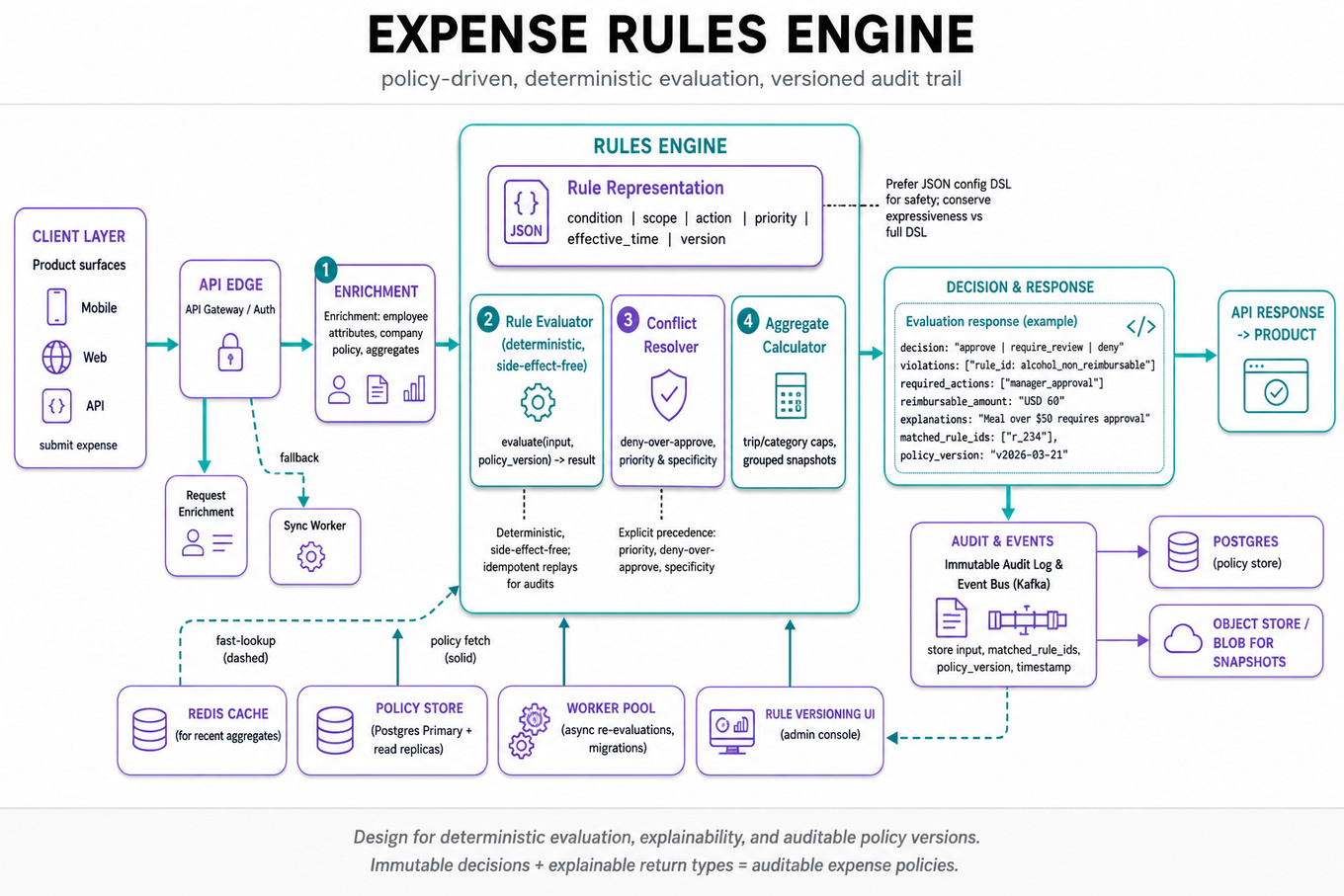
Rule representation is the center of the design. A good model separates
condition,scope,action,priority,effective_time, andversion. Example: “For employees inUS, meal expenses over$75require manager approval” should be data/config, not deployed code. -
DSL versus configuration is a key tradeoff. A JSON config such as
{ field: "category", op: "eq", value: "meal" }is safer and easier to validate, while a full domain-specific language is more expressive but harder to secure, test, migrate, and explain. -
Rule evaluation should usually be deterministic and side-effect-free. Given an expense, policy version, company, employee attributes, and relevant aggregates,
evaluate(input) -> resultshould always return the same output. This enables replay, debugging, audit trails, and idempotent retries. -
Return types matter as much as rule matching. A strong response includes
decision,violations,required_actions,reimbursable_amount,explanations,matched_rule_ids, andpolicy_version. Avoid returning onlytrue/false; product and support teams need to know why a claim failed or needs review. -
Conflict resolution must be explicit. If one rule says “auto-approve under
$100” and another says “alcohol is non-reimbursable,” define precedence usingpriority, deny-over-approve semantics, specificity, or ordered evaluation. For financial systems, conservative defaults like “hard violation beats auto-approval” are easier to defend. -
Aggregate rules require grouping and snapshot semantics. Trip-level limits need records grouped by keys like
(company_id, employee_id, trip_id, category)and time windows. For example, computetotal_meals_for_trip = sum(amount where category = meal)before applying “meals over$300per trip require approval.” -
Performance depends on candidate rule selection before evaluation. Do not scan every company’s rules. Partition by
tenant_id, filter by effective date, employee country, expense category, and status, then evaluate a small candidate set. Complexity should trend toward , where is candidate rules and is relevant aggregate records. -
Versioning and immutability are non-negotiable. Store policy versions as immutable records, e.g.
policy_id,version,effective_from,created_by,created_at. An expense submitted on Monday should be evaluated under the policy active on Monday, even if the company changes its rules on Tuesday. -
Explainability should be first-class. Persist an evaluation trace containing matched rules, failed predicates, input facts, aggregate values, and final decision. This helps customer support answer, “Why was this rejected?” and helps engineers replay production bugs without guessing.
-
Multi-tenancy affects data access and caching. Rules should be keyed by
company_idor tenant, with strong isolation in queries and cache keys. A cache likeRediscan hold active policy versions, but cache invalidation must respect publication events, effective dates, and policy version IDs. -
API design should support both synchronous and asynchronous paths. A single expense swipe may need low-latency evaluation, while bulk reimbursement or backfills can run asynchronously. Expose an endpoint like
POST /expense-evaluationswith idempotency keys and returnevaluation_id,decision,policy_version, and explanations. -
Testing strategy should include golden cases and property-like checks. Store fixtures such as “meal under limit,” “trip total exceeds cap,” and “policy changed after submission.” For a rules engine, regression tests are often more important than unit tests because customers depend on exact historical behavior.
Worked example
For “Design expense rules engine and return type,” a strong candidate starts by clarifying whether the engine is evaluating corporate card swipes, reimbursement submissions, or both; whether decisions must be real-time; and whether rules are per-company, per-employee group, or global templates. They should state assumptions: multi-tenant SaaS, company-specific policies, expenses have fields like amount, currency, merchant, category, employee_id, submitted_at, and some rules need aggregate context.
The answer can be organized around four pillars: data model, evaluation flow, response contract, and operational concerns. For the data model, define PolicyVersion, Rule, Predicate, Action, and EvaluationRecord; each rule has scope, condition tree, effect, priority, and effective dates. For evaluation, load the policy version for (company_id, submitted_at), gather expense facts and aggregate facts, evaluate predicates deterministically, resolve conflicts, and produce a final decision. For the return type, include decision = APPROVED | NEEDS_REVIEW | REJECTED, violations, warnings, required_approvals, reimbursable_amount, matched_rules, and human-readable explanations.
One design decision to flag explicitly is whether to implement a custom JSON rule format or embed a general expression language. A constrained JSON AST is less expressive but safer: it is easier to validate, migrate, index, explain, and expose in an admin UI. The candidate can close by saying that, with more time, they would cover policy publishing workflows, audit permissions, bulk re-evaluation, and how to simulate the impact of a draft policy before activating it.
A second angle
For “Extend rules for trip-level aggregates and outputs,” the same engine design applies, but the hard part shifts from single-record predicates to aggregate fact computation. Instead of evaluating only expense.amount > 75, the engine may need sum(meal.amount) for trip_id = X, count(hotel_nights), or max(daily_transport_total). A good design introduces a fact provider abstraction: the rule engine asks for named facts like trip.meal_total, while a separate aggregation layer computes them from expense records. The candidate should be careful about timing: do aggregates include pending expenses, rejected expenses, card authorizations, or only submitted claims? The output also becomes richer because the employee needs to know not just “violated trip cap,” but “trip meal total is $340; policy limit is $300; this expense contributes $55.”
Common pitfalls
Pitfall: Treating the system as a chain of hardcoded
if/elsestatements.
This may work for three policies but fails when every customer has different limits, exceptions, approval paths, and effective dates. A better answer defines a configurable rule model, a deterministic evaluator, and a versioned publishing workflow.
Pitfall: Ignoring historical correctness.
A tempting but wrong design always reads the latest company policy at evaluation time. That breaks audits and creates inconsistent outcomes after policy edits; instead, persist policy_version on each evaluation and make policies immutable once published.
Pitfall: Returning only a binary approval result.
A boolean response forces every downstream system to reverse-engineer intent. Strong answers model decisions, violations, required actions, and explanations separately so UI, approvals, accounting, and support can consume the same evaluation safely.
Connections
The interviewer may pivot from this topic into workflow orchestration for approvals, idempotency for reimbursement submissions, ledger design for money movement, or schema evolution for backward-compatible APIs. They may also ask for a coding-oriented version, such as aggregating expenses by person, trip, and category using hash maps with time and space.
Further reading
-
Martin Fowler, “Rules Engine” — useful framing on when a rules engine helps and when it adds unnecessary complexity.
-
Martin Fowler, “Audit Log” — relevant to immutable evaluation records and explainability.
-
Designing Data-Intensive Applications by Martin Kleppmann — strong background for versioning, consistency, caching, and replayable systems.
Featured in interview prep guides
Practice questions
- Aggregate expenses by person, trip, and categoryRippling · Software Engineer · Onsite · medium
- Design a flexible expense reimbursement systemRippling · Software Engineer · Technical Screen · hard
- Design a scalable expense rules engineRippling · Software Engineer · Technical Screen · hard
- Design expense rules engine and return typeRippling · Software Engineer · Technical Screen · medium
- Extend rules for trip-level aggregates and outputsRippling · Software Engineer · Technical Screen · medium
Related concepts
- Monetary Pay Computation And Event-Time AggregationData Manipulation (SQL/Python)
- Delivery Driver Payment And Cost SystemsSystem Design
- Wallets, Payments, And Refund LedgersSystem Design
- Revenue Referral Aggregation And RankingCoding & Algorithms
- Reinforcement Learning Reward Design for ControlMachine Learning
- Cart Service And Pricing Engine DesignSystem Design