Fraud Risk Modeling And Real-Time Decisioning
Asked of: Data Scientist
Last updated
What's being tested
PayPal is probing whether you can design a fraud risk modeling approach that balances financial loss, customer friction, operational capacity, and delayed ground truth. A strong Data Scientist answer is not just “train a classifier”; it explains signals, labels, model evaluation, thresholding, decision policies, and post-launch monitoring. Interviewers care because payments fraud decisions happen under asymmetric costs: a false negative can create chargeback loss, while a false positive can block a legitimate user and damage trust. They are also testing whether you understand real-world complications like class imbalance, label delay, selection bias, and adversarial behavior.
Core knowledge
-
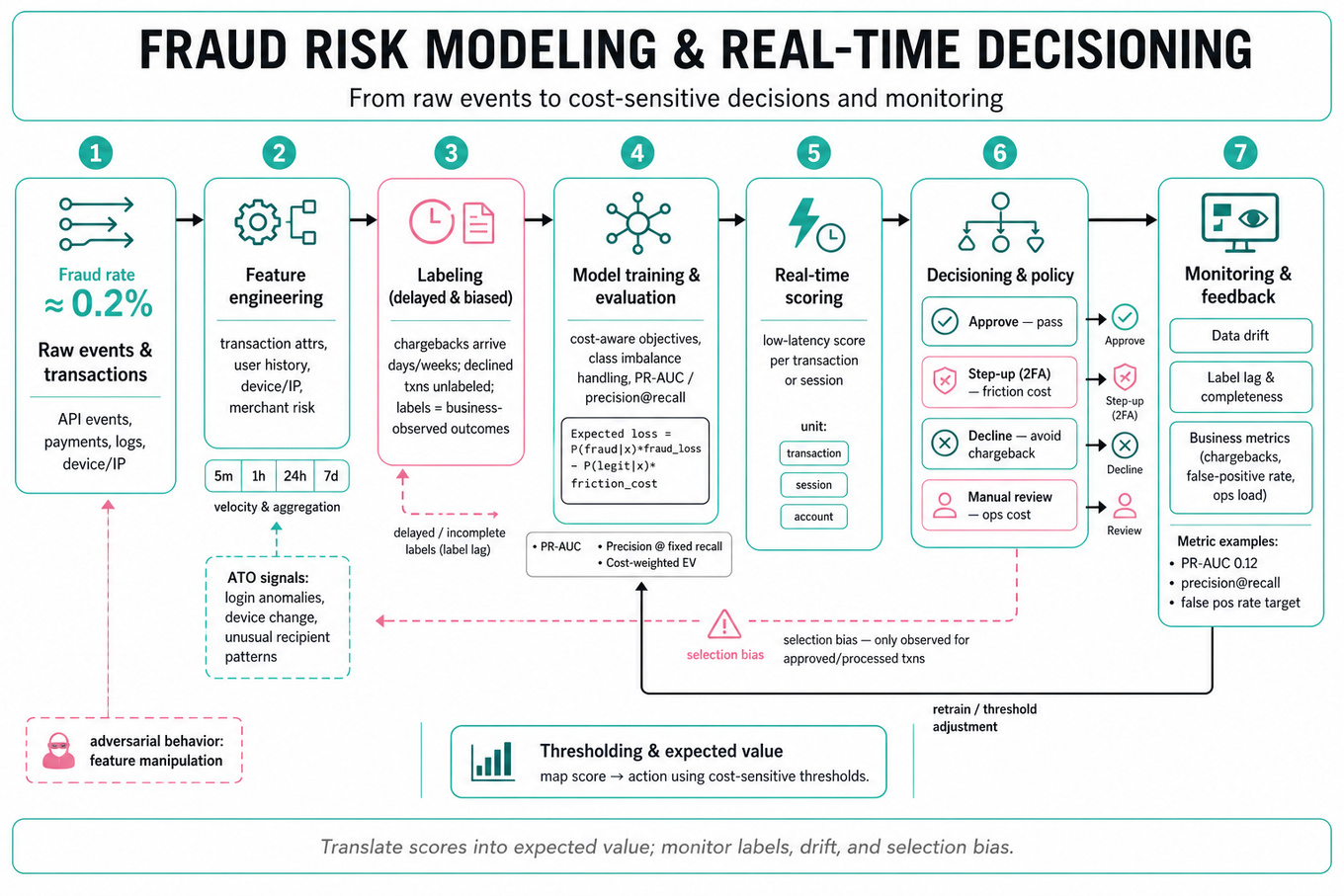
Fraud labels are often delayed, incomplete, and biased. Chargebacks may arrive days or weeks later; user reports may undercount fraud; declined transactions rarely reveal whether they would have been fraudulent. Treat labels as business-observed outcomes, not ground truth.
-
Feature families usually include transaction attributes, user history, device/IP signals, merchant or counterparty risk, velocity features, behavioral changes, and network relationships. For a Data Scientist, the key is deciding which signals are predictive and stable, not designing the ingestion system.
-
Velocity features are central in payments fraud: count, sum, unique counterparties, failed attempts, or location changes over rolling windows such as 5 minutes, 1 hour, 24 hours, and 7 days. Examples: “transactions in last 10 minutes” or “new devices used in last 24 hours.”
-
Account takeover signals differ from ordinary stolen-card fraud. ATO often shows login anomalies, password or email changes, new device fingerprints, unusual recipient patterns, and high-risk actions shortly after account changes. Model framing should reflect whether the unit is login, account, transaction, or session.
-
Class imbalance makes accuracy nearly useless. If fraud rate is 0.2%, a model that predicts “not fraud” always gets 99.8% accuracy. Prefer
PR-AUC, precision at fixed recall, recall at fixed false-positive rate, lift in top risk deciles, and cost-weighted business metrics. -
Cost-sensitive decisioning should translate model scores into expected value. A useful framing is:
Decline, step-up, review, or approve based on expected utility and business constraints. -
Thresholding is not one global cutoff by default. You may need segment-specific thresholds by geography, payment method, user tenure, merchant category, transaction amount, or available manual review capacity. A 2,000 transaction should not necessarily share the same decision threshold.
-
Model choices should match interpretability, speed, and tabular signal quality.
LogisticRegressionis transparent and calibratable;XGBoostorLightGBMoften perform well on tabular fraud features; unsupervised methods like isolation forests help when labels are sparse but should not replace supervised evaluation. -
Calibration matters because the score often drives monetary decisions. A model with high ranking quality but poor probability calibration can over-decline legitimate customers. Use reliability plots, Brier score, Platt scaling, or isotonic regression when the downstream policy interprets scores as probabilities.
-
Delayed-label evaluation requires careful time-based splits. Train on past data and evaluate on a future window whose labels have matured enough. Random splits leak future behavior and inflate performance, especially when fraud rings or repeated users appear in both train and test.
-
Selection bias appears when previous rules or models determine which transactions get approved, reviewed, or declined. Approved transactions have richer outcome labels than declined ones. Discuss reject inference, randomized review samples, shadow scoring, or sensitivity analysis rather than assuming observed labels are representative.
-
Real-time decisioning is a policy layer around the score. The Data Scientist should define score semantics, required feature freshness, decision thresholds, review queues, and monitoring metrics such as fraud loss rate, approval rate, false-positive rate, chargeback rate, and customer friction rate.
Worked example
For “Detect credit-card transaction fraud,” start by clarifying the decision point: “Are we scoring authorization attempts in real time, and can the actions be approve, decline, step-up authentication, or manual review?” Then ask about label sources such as chargebacks, confirmed disputes, customer reports, and bank feedback, plus the expected label delay. A strong answer would organize around four pillars: define the prediction target, construct transaction/user/device/merchant features, train and evaluate a supervised risk model, and convert scores into business actions under cost and capacity constraints. You would mention that the base rate is likely very low, so you would prioritize PR-AUC, recall at fixed precision, and expected dollar loss avoided instead of accuracy.
The answer should explicitly separate offline model quality from online policy quality: the model ranks risk, while the decision policy decides whether the predicted risk justifies friction. One concrete tradeoff to flag is aggressive declines versus customer experience: lowering the threshold may reduce fraud loss but increase false positives and failed legitimate payments. You could propose segment-specific thresholds, for example stricter treatment for high-dollar, new-device, cross-border transactions and more lenient treatment for trusted users with long clean histories. Close by saying that if you had more time, you would add monitoring for drift, delayed-label backtesting, and experiments or champion/challenger comparisons to measure incremental fraud reduction without over-blocking good users.
A second angle
For “Design a fraud mitigation strategy under constraints,” the same modeling concepts apply, but the center of gravity shifts from prediction to constrained optimization. Instead of simply maximizing PR-AUC, you need to decide how to allocate scarce interventions such as manual review slots, SMS verification, temporary holds, or transaction declines. A good framing is to rank transactions by expected preventable loss and apply action-specific thresholds subject to constraints like “only 10,000 reviews per day” or “customer friction cannot increase more than 20 basis points.” This also surfaces fairness and segmentation questions: if one geography or user tenure group receives disproportionate friction, you need to check whether that is justified by calibrated risk or caused by biased labels. The best answer shows how model scores become an operating policy, not just a dashboard.
Common pitfalls
Pitfall: Optimizing for
ROC-AUCalone.
ROC-AUC can look excellent in highly imbalanced fraud data while the top-risk queue is still operationally poor. A better answer ties evaluation to decisions: precision among reviewed transactions, recall at an acceptable false-positive rate, dollar loss prevented, and approval-rate impact.
Pitfall: Treating labels as clean and immediate.
A tempting but weak answer is “use chargebacks as labels and retrain weekly.” That misses label delay, partial observability, and bias from past declines. Say how you would use time-based validation, mature label windows, and possibly randomized audits or manual-review samples to estimate hidden fraud.
Pitfall: Jumping into infrastructure details instead of analytical design.
For a Data Scientist interview, do not spend the answer designing event streams, retry semantics, or storage partitions. Stay focused on target definition, signal design, model evaluation, calibration, thresholding, experiment design, and business metrics. You can mention that some features must be available at decision time, but you do not need to architect the serving layer.
Connections
Interviewers may pivot from here into SQL-based fraud signal detection, especially window functions for velocity or ATO patterns, or into experimentation under interference and delayed outcomes. They may also ask about anomaly detection, model monitoring, causal measurement of fraud interventions, or segmentation analysis when fraud patterns differ across users, merchants, or geographies.
Further reading
-
Credit Card Fraud Detection: A Realistic Modeling and a Novel Learning Strategy — Dal Pozzolo et al.; useful for class imbalance, temporal validation, and realistic fraud evaluation.
-
The Elements of Statistical Learning — Hastie, Tibshirani, and Friedman; strong foundation for supervised learning, regularization, calibration, and model assessment.
-
Hidden Technical Debt in Machine Learning Systems — Sculley et al.; helpful context for monitoring, feedback loops, and why offline model quality is not enough in production ML systems.
Featured in interview prep guides
Practice questions
- Design a fraud mitigation strategy under constraintsPayPal · Data Scientist · Technical Screen · hard
- Explain fraud types and evaluate a fraud modelPayPal · Data Scientist · Technical Screen · hard
- Implement sliding-window device anomalyPayPal · Data Scientist · Technical Screen · medium
- Write SQL to flag Venmo ATOPayPal · Data Scientist · Technical Screen · medium
- Detect credit-card transaction fraudPayPal · Data Scientist · Onsite · hard
- Analyze Transactions for Risk and Implement Mitigation StrategiesPayPal · Data Scientist · Onsite · medium
- Identify Unsupervised Techniques for Detecting Fraudulent TransactionsPayPal · Data Scientist · Onsite · medium
- Explain unsupervised fraud and evaluationPayPal · Data Scientist · Onsite · hard
- Design fraud detection from raw transactionsPayPal · Data Scientist · Onsite · hard
- Assess card transactions and plan risk strategyPayPal · Data Scientist · Onsite · hard
Related concepts
- Fraud, Bot, And Fake Account Detection
- Machine Learning System Design For Real-Time DecisionsMachine Learning
- Fraud And Anomaly Detection In Retail Marketplace
- Predictive Modeling For Delivery And Marketplace DecisionsMachine Learning
- Fraud and Bot Detection Systems
- Machine Learning Model Design And EvaluationMachine Learning