Apple Software Engineer Interview: The Complete Guide (2026)
Quick Overview
A comprehensive guide to the Apple software engineer interview process in 2026, covering all 4–8 rounds from the initial recruiter screen to the final onsite loop. Learn how to nail the unique "Why Apple?" question, prepare for production-quality coding rounds without IDE autocompletion, master privacy-first system design with on-device processing and offline-first architecture, and navigate Apple's craftsmanship-driven behavioral culture. Includes a detailed comparison of Apple vs. Google, Amazon, and Meta interview styles, top coding topics (concurrency, graph traversal, data structure design), sample system design questions like the iOS QuickType suggestion engine, and frequently asked questions about hiring timelines and difficulty level. Built for software engineers targeting Apple teams like Siri, iCloud, Apple Intelligence, and WebKit.
The Apple software engineering interview consists of 4 to 8 rounds spanning coding, system design, and behavioral assessment, with a unique emphasis on privacy-first architecture, hardware-software integration, and obsessive user-experience craftsmanship that no other FAANG company matches.
Unlike Google or Meta, Apple's interview process is highly decentralized like each product team (Siri, iCloud, Apple Intelligence, WebKit) runs its own hiring pipeline with team-specific technical deep dives.
Apple is the most secretive of the FAANG companies, and this extends to its hiring. There is no single public "interview playbook" like Amazon's Leadership Principles. But after extensive research into hundreds of 2026 candidate reports, a clear pattern has emerged across all Apple engineering loops.
This guide provides the exact interview structure, the unique Apple-specific signals interviewers are trained to detect, and the critical preparation strategies that separate rejected candidates from those who receive the offer.
Table of Contents
- The Apple Interview Pipeline
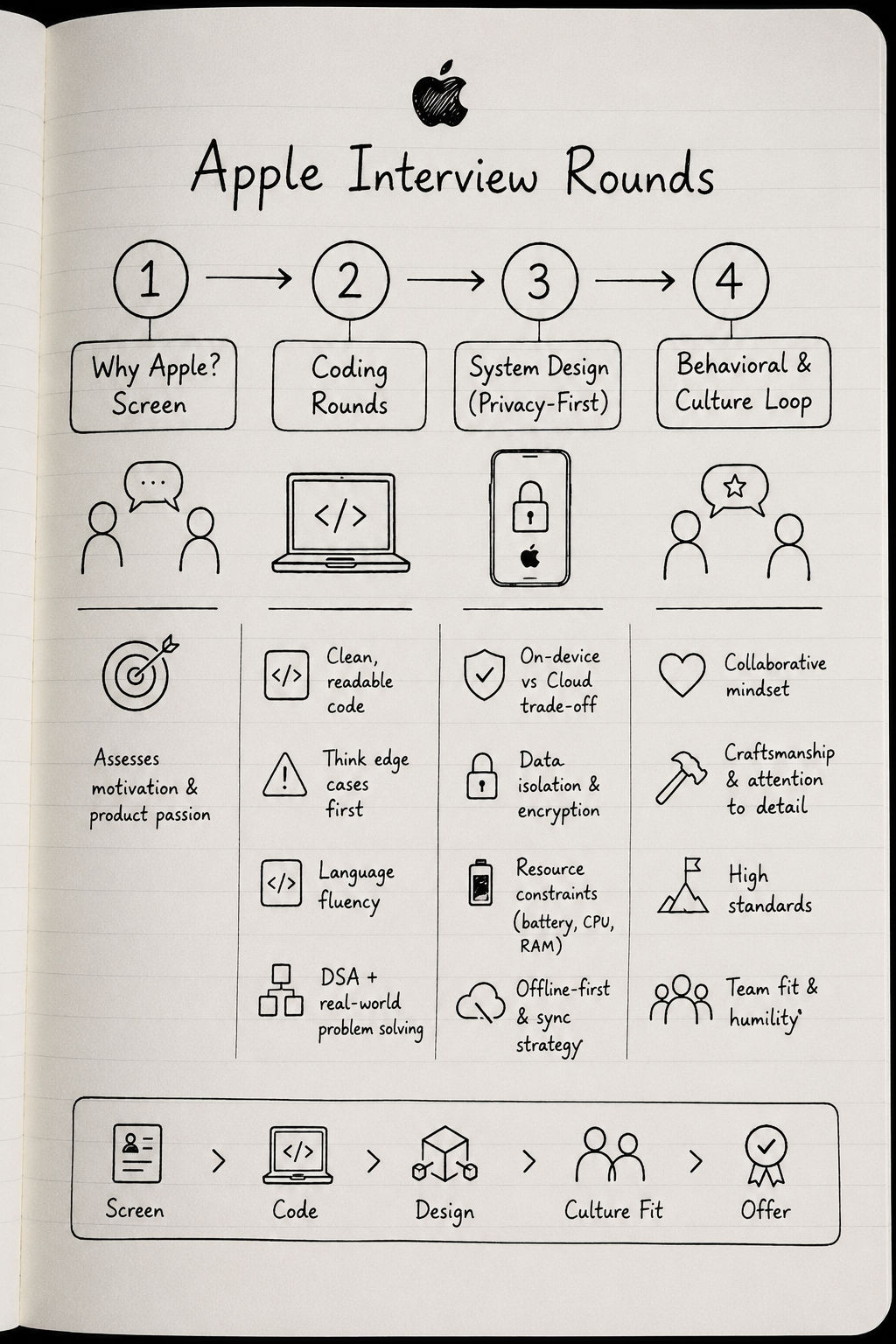
- Round 1: The "Why Apple?" Screen
- Round 2: Coding Rounds
- Round 3: System Design (Privacy-First)
- Round 4: The Behavioral & Culture Loop
- Apple vs. Other FAANG Interviews
- How to Prepare
- FAQ
The Apple Interview Pipeline
Apple's end-to-end hiring process typically takes 4 to 8 weeks from the initial recruiter screen to offer. Here is the standard structure:
| Stage | Duration | Focus |
|---|---|---|
| Recruiter Screen | 15–30 min | Background, motivation, and "Why Apple?" |
| Hiring Manager Call | 30–60 min | Technical ownership, past projects, team fit |
| Technical Phone Screen(s) | 1–2 rounds, 45–60 min each | Live coding in your primary language |
| Final Onsite Loop | 4–8 rounds, full day | Coding, System Design, Domain Deep-Dive, Behavioral |
Key Insight: Unlike Google (which has a centralized hiring committee), Apple's hiring decision is team-local. The hiring manager has significant influence. This means your cultural fit with the specific team matters enormously. To know the exact experience from one of the candidate, you can watch the below video.
Round 1: The "Why Apple?" Screen
Every Apple interview begins with the question: "Why do you want to work at Apple?"
This is not a throwaway icebreaker. Apple interviewers are trained to reject candidates who give generic answers like "Because Apple is a great company" or "I love my iPhone."
The Winning Formula:
- Name a specific Apple product decision you admire. Example: "I admire how Apple Intelligence processes LLM queries on-device using the Neural Engine rather than sending everything to the cloud. That architectural commitment to user privacy at the silicon level is why I want to be here."
- Connect it to your engineering specialty. Example: "My background in on-device ML optimization directly aligns with that mission. I want to push the boundary of what's possible in a 6-watt thermal envelope."
- Show genuine product passion, not corporate admiration. Apple values craftsmen, not corporate climbers.
Round 2: Coding Rounds
Apple's coding interviews lean toward practical, production-quality problems rather than abstract algorithmic puzzles. While you will still encounter classic DSA patterns (trees, graphs, dynamic programming), Apple interviewers weight code quality far more heavily than companies like Google.
What Apple Uniquely Evaluates:
- Clean, readable code without IDE autocompletion. Many Apple coding rounds are done on a plain whiteboard or a shared text editor with no syntax highlighting.
- Proactive error handling. Apple engineers obsess over edge cases. Before writing a single line, discuss: What if the input is null? What if the network drops? What if the array is enormous?
- Language fluency. If the role is iOS, you must demonstrate deep Swift proficiency (protocols, value types, memory management with ARC). If backend, expect questions in C++, Java, or Python with optimization follow-ups.
Top Coding Topics at Apple (2026):
- String manipulation and parsing (e.g., building a calculator, parsing nested expressions)
- Graph traversal with constrained resources (BFS/DFS with memory limits)
- Concurrency and threading (Grand Central Dispatch for iOS roles, mutex/semaphore patterns for backend)
- Data structure design (implement an LRU cache, design a thread-safe queue)
Round 3: System Design (Privacy-First)
Apple's system design round is fundamentally different from every other FAANG company because of one constraint that overrides all others: privacy.
At Google or Meta, the default system design answer involves shipping user data to a centralized cloud for processing. At Apple, the default assumption is that user data should never leave the device unless absolutely necessary.
The Apple System Design Checklist:
- On-Device vs. Cloud Trade-Off: For every component, explicitly state whether processing happens on the user's device (Neural Engine, Core ML) or in the cloud. Justify the decision based on latency, privacy, and compute requirements.
- Data Isolation: If data must be transmitted to Apple's servers, explain end-to-end encryption, differential privacy techniques, and how Apple avoids building a user profile.
- Resource Constraints: Apple hardware is beautiful but constrained. If the role involves mobile or embedded systems, your design must consider: CPU thermal throttling, battery impact, limited RAM, and storage constraints.
- Offline-First Architecture: Apple products are expected to work without internet. Your system design must include an offline mode with local persistence (Core Data, SQLite) and a conflict-resolution sync strategy when connectivity returns.
Sample Apple System Design Question: "Design the on-device suggestion engine for the iOS keyboard (QuickType). How do you balance prediction accuracy, privacy, and battery life?"
Round 4: The Behavioral & Culture Loop
Apple's behavioral interview is woven throughout the entire day, not isolated to a single round. Every interviewer evaluates your cultural fit alongside technical depth.
Apple's Core Cultural Signals:
- Craftsmanship: Do you sweat the details? Apple wants engineers who care about pixel alignment, animation curves, and the exact feel of a scroll gesture — not just functional correctness.
- Secrecy & Trust: Can you be trusted with unreleased products? Apple will subtly probe whether you are the type of person who would leak information.
- Cross-Functional Collaboration: Apple's org structure means engineers work incredibly closely with designers and hardware teams. You must demonstrate empathy for non-engineering disciplines.
- Ownership Without Ego: Show that you take full ownership of your work while remaining humble enough to accept aggressive design critique from Jonathan Ive's legacy culture.
Top Apple Behavioral Questions (2026):
- Why Apple? (The critical opener — see above.)
- Tell me about a product you shipped that you are most proud of. What made it special?
- Describe a time you fought for a detail that others thought was insignificant.
- Tell me about a time you collaborated with a designer or hardware engineer to solve a problem.
- How do you balance perfection with shipping on time?
Apple vs. Other FAANG Interviews
| Dimension | Apple | Amazon | Meta | |
|---|---|---|---|---|
| Hiring Authority | Team-local (Hiring Manager decides) | Centralized (Hiring Committee) | Bar Raiser + Hiring Manager | Hiring Committee |
| Behavioral Focus | Craftsmanship & Privacy | Googleyness & Ambiguity | 16 Leadership Principles | Core Values (Move Fast) |
| System Design Constraint | Privacy-first, on-device processing | Massive global scale | Cost optimization (Frugality) | Speed of iteration |
| Coding Style | Production quality, clean code | Algorithmic optimization | Working solution + testing | Practical + move fast |
| Secrecy Factor | Extremely high (NDA culture) | Moderate | Low | Low |
How to Prepare
- Research the Specific Team. Ask your recruiter exactly which product area you are interviewing for. Preparing for an Apple Intelligence (ML) role is completely different from preparing for an iCloud infrastructure role.
- Master Your "Why Apple?" Story. Rehearse a 60-second pitch that names a specific technical product decision you respect. Never give a generic answer.
- Study Privacy Architectures. Read Apple's published papers on Differential Privacy, on-device federated learning, and the Secure Enclave. These concepts will appear in your system design round.
- Practice Under Apple's Constraints. Use PracHub to run mock interviews specifically calibrated to Apple's unique style: no IDE autocompletion, privacy-first system design prompts, and aggressive follow-up questions about edge cases and resource constraints.
Frequently Asked Questions
How hard is the Apple software engineer interview?
The Apple software engineer interview is considered one of the most demanding in the industry, particularly because it combines the algorithmic rigor of Google with a unique emphasis on code quality, privacy-first system design, and deep product intuition. The level of detail expected in code review and edge-case handling is higher than at most other major tech companies.
Does Apple ask LeetCode questions?
Apple does include algorithmic coding challenges, but they tend to favor practical, production-style problems (like parsing, concurrency, and data structure implementation) over pure abstract puzzles. The emphasis is on writing clean, readable, error-handled code rather than finding the most optimal Big-O solution in the shortest time.
What makes Apple system design different?
Apple system design interviews are privacy-first. The default assumption is that user data should be processed on the device whenever possible, using the Neural Engine or Core ML. If data must leave the device, you must explicitly discuss end-to-end encryption, differential privacy, and data minimization. This privacy constraint does not exist at Google, Meta, or Amazon.
How long does the Apple hiring process take?
The Apple hiring process typically takes 4 to 8 weeks from the initial recruiter call to a final offer. However, Apple is known for being slower than other FAANG companies due to its decentralized team-based hiring model, where multiple rounds of internal alignment may be needed before an offer is extended.
Related Articles
Designing a News Feed: Who Pays for the Delivery?
Learn how hybrid feed systems use fan-out, outboxes, ranking, and read-time merging to handle celebrity posts at scale.
One Consistency Level Broke Our Store. Now Every Route Gets Its Own Choice.
Learn how CAP theorem, PACELC, quorum reads, and per-route consistency choices affect multi-region product pages and checkout flows.
Load Balancing vs Consistent Hashing: The 80% Cache Mistake
Load balancers spread traffic; consistent hashing owns state. A production war story on cache remap storms, hash rings, virtual nodes, and hot-key salting.
System Design Interview: The Complete 2026 Playbook
Master system design interviews with the complete 2026 playbook covering frameworks, scalability, FAANG interview prep, and distributed systems.
Comments (0)