System Design Interview: The Complete 2026 Playbook
Quick Overview
Master system design interviews with this comprehensive 2026 playbook for software engineers preparing for FAANG and top tech companies. Learn the complete system design interview framework, including requirement gathering, API design, high-level architecture, scalability, and technical deep dives. Understand what interviewers expect at the Mid, Senior, and Staff levels, avoid common mistakes, and develop a structured approach for designing scalable distributed systems. This guide also provides a complete learning roadmap covering caching, sharding, databases, messaging systems, CAP theorem, networking, and real-world system design patterns, with links to detailed deep dives for every major topic. Whether you're preparing for Google, Meta, Amazon, Microsoft, OpenAI, or other engineering interviews, this playbook helps you build interview-ready system design skills with confidence.
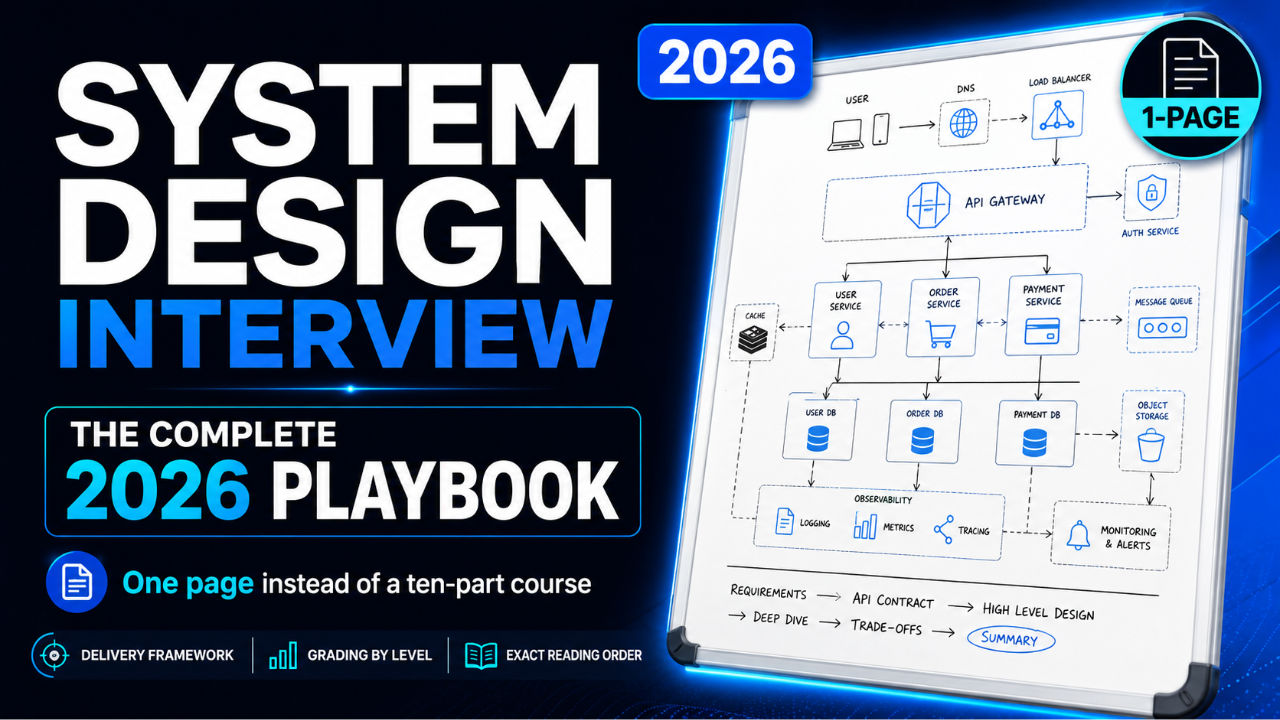
One page instead of a ten-part course: the delivery framework, what each level is graded on, and the exact order to read everything else.
Nobody Fails This Because They Forgot What a Load Balancer Is
Here is the uncomfortable truth: most people who fail a system design interview knew the technology just fine. They failed because forty minutes in, they had a wall of boxes and no working system, and nobody in the room could trace a single request through it.
System design is not a knowledge quiz. It is a delivery test. Your one job is to build something that works inside the clock, then make it better. A simple design that serves every endpoint beats an elaborate one that serves none.
The tell interviewers watch for is exactly that: can you follow one request from the API, through the service and cache, into the database, and back out? If your board cannot answer that, the depth does not count. The rest of this page is the fastest route to getting there.
What Gets Graded Changes by Level
The same prompt is scored against a different bar at each level. "Design Twitter" is really three different interviews.
| Level | What they're really testing | You pass when | You fail when |
|---|---|---|---|
| Mid (L4) | Can you deliver a complete, working system? | You finish a clean path: requirements, API, a high-level design that satisfies them. | You rabbit-hole on one component, run out of clock, and never close the loop. |
| Senior (L5) | Can you go deep without being dragged there? | You name the bottleneck before the interviewer does and tie each fix to a requirement. | You wait to be prompted, or you talk over every probe. |
| Staff (L6+) | Can you own ambiguity and defend trade-offs? | You set priorities, say what you're not building, and justify every call. | You architect for a billion users nobody asked for, or dodge the trade-off. |
Under every rubric sit the same four competencies: problem navigation, solution design, technical excellence, and communication. Companies rename them; the signal is identical. For 2026, senior-and-up scorecards add a fifth line, observability, so state it explicitly: "I would alert on p99 feed latency and dead-letter queue depth." That one sentence covers the row most candidates skip.
The Delivery Framework: Five Steps, One Clock
You get 35 to 45 minutes. Spend them in this order and you cannot run out of time on the wrong thing.
Requirements (~5 min). Functional first, as "users should be able to..." statements, top three only. Then non-functional, each pinned to a number or a trade-off: "feed under 200ms," "100M daily actives," "availability over consistency." A vague requirement like "it should be fast" is useless because it constrains nothing. When two qualities conflict, name the CAP-style choice out loud.
Core Entities (~2 min). List the nouns you will store and pass around: User, Tweet, Follow. Skip the full schema. You will discover the columns you need as the design forces them.
API (~5 min). Default to REST, one endpoint per functional requirement. This contract is what the rest of your design has to satisfy.
POST /v1/tweets
body: { "text": string }
GET /v1/feed?cursor={last_id} -> Tweet[]
Cursor, not offset. The feed moves under you while you page.
Derive the current user from the auth token in the header. Never accept a userId in the body: that's an IDOR vulnerability, and it costs you the technical-excellence score on sight.
High-Level Design (~10-15 min). Draw the boxes and arrows that satisfy each endpoint, one at a time. Get one request flowing from client to storage and back before you add anything. When you spot a place for a cache or a queue, mark it and move on. Layering complexity early is the top reason candidates never reach a finished system.
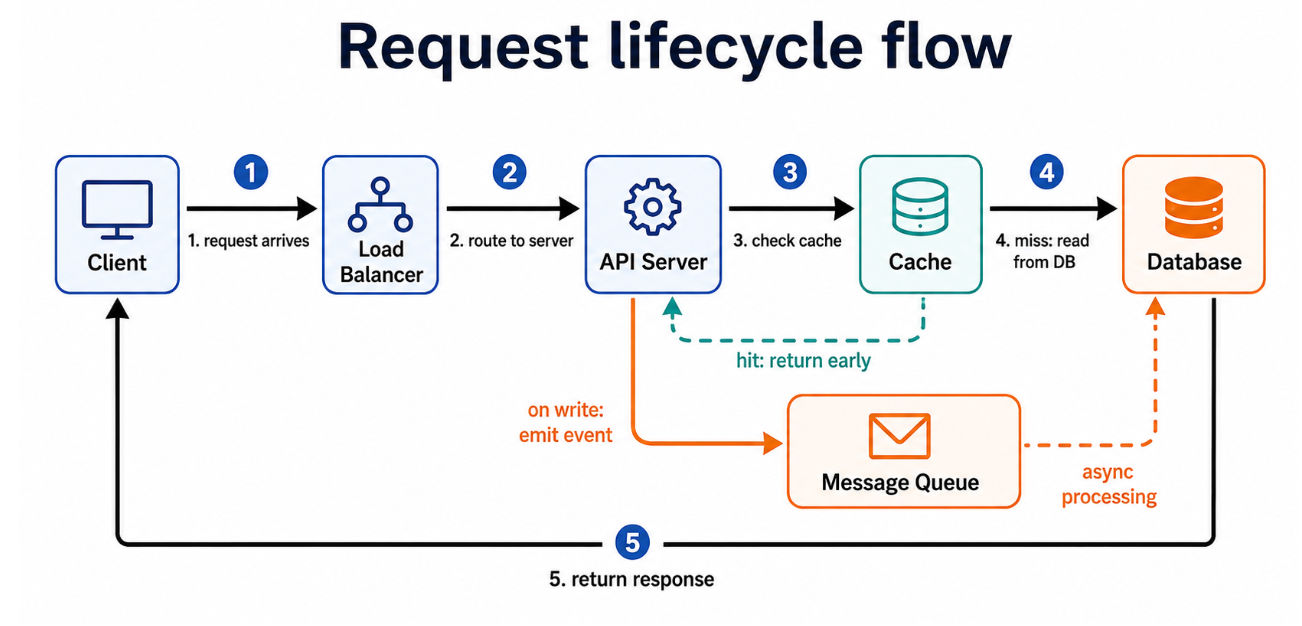
One request, end to end. This is the exact path an interviewer wants you to narrate; if you can trace it out loud, you have proven the design actually works.
Deep Dives (~10 min). Now harden the design against the non-functional requirements: sharding, caching, replication, and the fanout choice for the feed. This is where senior and staff candidates earn the level by leading the discussion instead of waiting for it.
A working system with one known bottleneck beats a "perfect" one you never finished. Interviewers reward converging on an answer, not sprawling toward one.
The Feed Problem: Two Ways to Fan Out
The Twitter feed is the classic deep dive, and it comes down to one decision. Fanout-on-write pushes each new tweet into every follower's precomputed feed cache: reads are instant, but a celebrity with millions of followers makes writes explode. Fanout-on-read builds the feed at request time by pulling recent tweets from everyone you follow: writes are cheap, but reads get heavy. Production systems blend the two, using fanout-on-write for ordinary users and fanout-on-read for celebrities. Naming that hybrid, and the exact point you would switch strategies, is a strong senior signal.
The Prep Map: Read This Before You Attempt That
Bookmark this section. Don't open thirty tabs. The framework is the hub; everything below is a spoke you chase only when a specific interview moment demands it.
First, the hub itself. Read the Delivery Framework, then How to Prepare, and don't touch anything else until you can run all five steps cold.
Core concepts, before your first case study. You need CAP Theorem the moment a requirement forces consistency against availability. Sharding and Consistent Hashing matter once one machine can't hold the data. Numbers to Know you memorize cold. Fill the gaps with Caching, Database Indexing, Data Modeling, API Design, and Networking Essentials.
Key technologies, to name a real box instead of a category. Reach for Redis for a cache or rate limiter and Kafka for async and streams. The load-bearing choice is the datastore, so know why PostgreSQL (relational, strong consistency) differs from Cassandra (write-heavy, tunable consistency) and DynamoDB (managed key-value) for your data. Then Elasticsearch for search, Flink for stream processing, and API Gateway plus ZooKeeper (or any coordination service) at the edge and for consensus.
Patterns, when a deep dive turns into one. Start with Dealing with Contention and Scaling Writes, which cover most deep dives. The rest are there for the week you hit them: Real-time Updates, Scaling Reads, Handling Large Blobs, Multi-step Processes, and Managing Long Running Tasks.
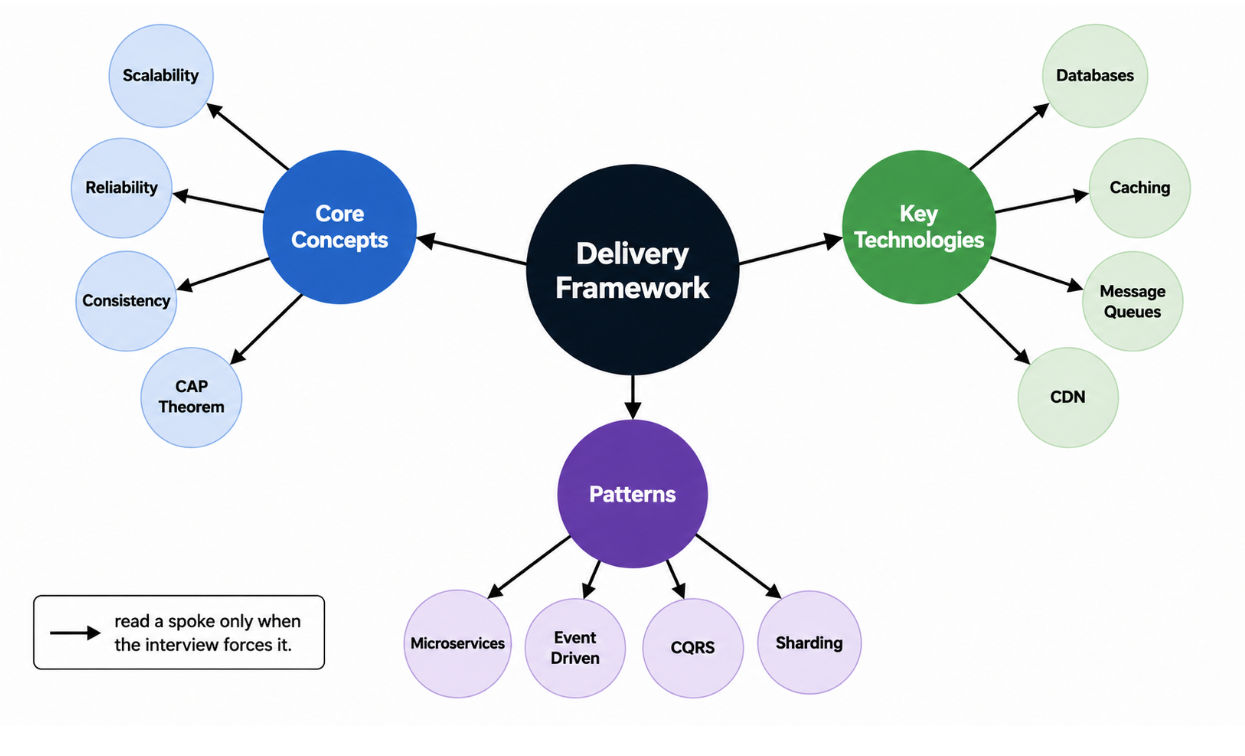
How to study without drowning. Master the hub first; each concept, technology, and pattern is a spoke you pull in only when a design actually needs it.
Three Corrections, and the 2026 Reality
Estimate only when the number changes a decision. Back-of-the-envelope math is worth it only when the result moves the design. Designing a top-K trending service, you estimate the topic count because it decides whether one min-heap holds the data or you must shard it. Multiplying daily actives by a payload size just to conclude "it's a lot" proves nothing except that you can multiply.
Simple beats elaborate, every time. A design that answers every endpoint and admits one weak spot passes. An elegant architecture that never returns a feed does not. Save the cleverness for the deep dive.
Leave the interviewer room. They have specific signals to collect, and they can't if you narrate over every probe. Pause, let them steer, and answer what they actually ask.
Then the logistics that changed. The 2026 loop is remote-first on a shared Excalidraw or Miro board, so practice on the real canvas before the day, because fumbling the tool wastes minutes. AI assistants are banned, and some loops now flag tab-switching and suspiciously fluent narration. And observability is graded now, so bake it in from the start.
The Two-Week Plan
Week one: build the reflex. Read the framework, then design one system a day, out loud, on a 45-minute timer in Excalidraw. "Done" means all five steps hit and a request that flows end to end. Start with Bitly, then a rate limiter, then a chat app, and chase a concept only when a design trips over it. Recording yourself feels awkward and works.
Week two: depth and targeting. Move to harder questions like Ticketmaster, Uber, and Dropbox, forcing one deep dive per session until you lead it unprompted. Then tune to your target. Meta's product-design loop rewards depth on the product model and access patterns; Amazon leans on cost and scale, so walk in with a rough dollar-per-GB-month number; most others want to watch you find the bottleneck.
Thank you for reading. If you found this useful, follow PracHub for more practical deep dives on engineering, system design, and interview preparation written to help you build skills that last beyond a single article.
Related Articles
Designing a News Feed: Who Pays for the Delivery?
Learn how hybrid feed systems use fan-out, outboxes, ranking, and read-time merging to handle celebrity posts at scale.
One Consistency Level Broke Our Store. Now Every Route Gets Its Own Choice.
Learn how CAP theorem, PACELC, quorum reads, and per-route consistency choices affect multi-region product pages and checkout flows.
Load Balancing vs Consistent Hashing: The 80% Cache Mistake
Load balancers spread traffic; consistent hashing owns state. A production war story on cache remap storms, hash rings, virtual nodes, and hot-key salting.
Apple Software Engineer Interview: The Complete Guide (2026)
Master the 2026 Apple software engineer interview. Covers coding, privacy-first system design, the "Why Apple?" round, and what makes Apple different from FAANG
Comments (0)