BFE.dev Review 2026: Is BigFrontend Enough for Frontend Interviews?
Quick Overview
BFE.dev is one of the largest dedicated frontend interview practice libraries, with 600+ questions across JavaScript, React, TypeScript, CSS, frontend knowledge, and system design. This 2026 review explains what BigFrontend does well, current Premium pricing, where it falls short for company-specific and full-loop preparation, and how to combine BFE.dev with PracHub for a focused 7-day frontend interview plan.
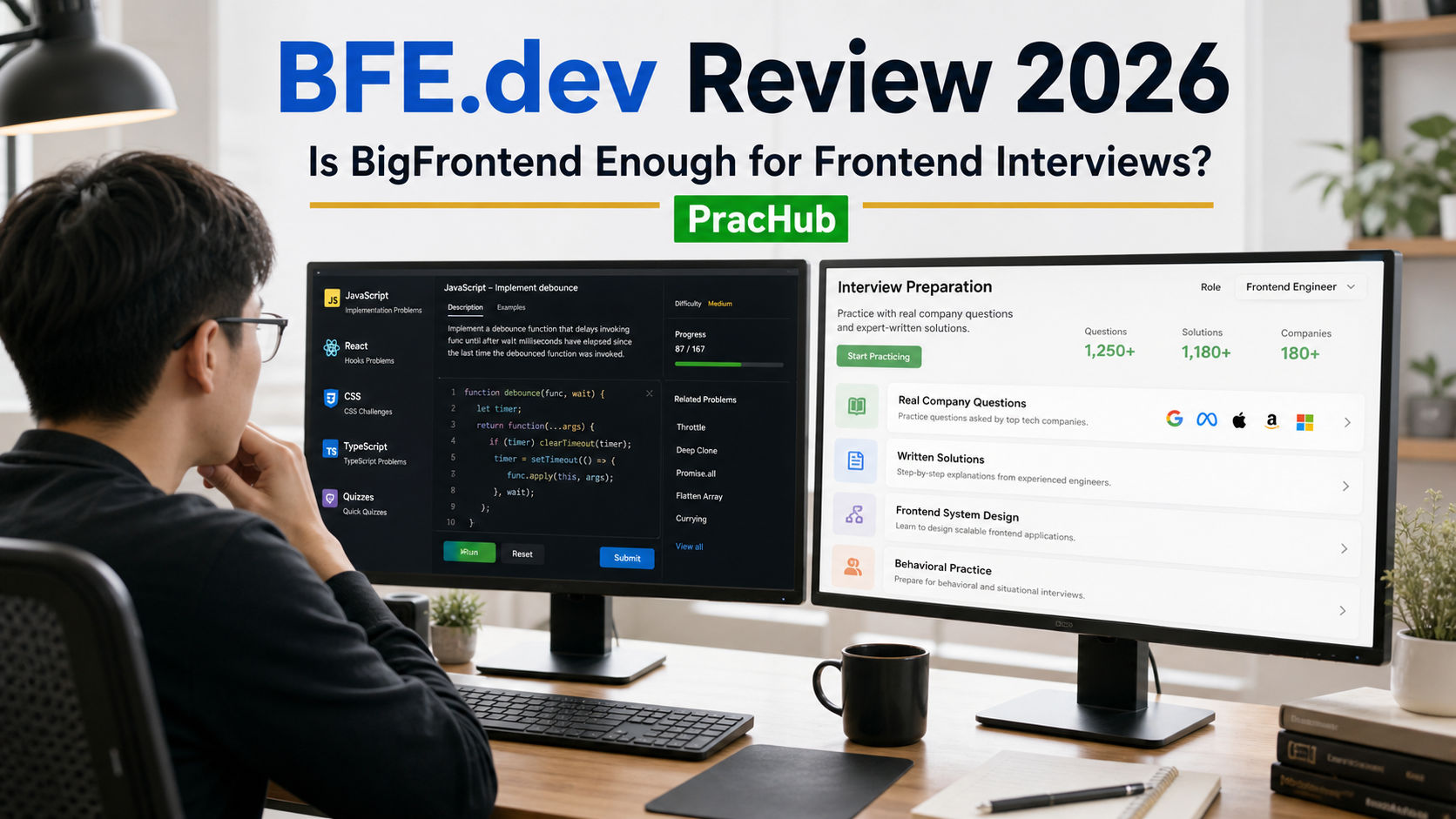
BigFrontend can make you much better at frontend coding without making you fully ready for a frontend interview. That distinction matters when your target loop includes JavaScript implementation, React, DSA, frontend system design, project discussion, and behavioral rounds.
BigFrontend has one of the broadest dedicated frontend practice libraries available. The question is not whether it is useful. It is whether solving more BigFrontend problems is the highest-value next step for your specific interview.
If an interview is already scheduled, begin with real interview questions with written solutions and company-specific interview prep on PracHub. Then use BigFrontend to repair the exact frontend skill gaps those prompts expose.
Quick Verdict
BigFrontend is excellent for frontend fundamentals and targeted drills, but it is not enough by itself for most complete frontend interview loops. It is especially strong for JavaScript implementations, language quizzes, TypeScript puzzles, React hooks, CSS, and frontend knowledge questions.
You should add company-specific practice, general coding or DSA where required, project deep dives, behavioral preparation, and timed mock conversations. The best workflow is diagnose with real prompts, drill on BigFrontend, then return to interview-style practice.
What Is BigFrontend in 2026?
BigFrontend (often shortened to BFE) describes itself as "LeetCode for Front-End." Its homepage currently lists more than 600 frontend questions across coding, quizzes, interview knowledge, and design.
| BigFrontend Category | Public Library Size | What You Practice |
|---|---|---|
| JavaScript coding | 170+ | Utilities, language behavior, async work, DOM, data structures |
| React coding | 10+ | Hooks, state, events, reusable components |
| JavaScript and React quizzes | 150+ combined | Semantics, output prediction, framework behavior |
| TypeScript puzzles | 60+ | Types, inference, generics, utility patterns |
| CSS questions | 20+ | Layout, selectors, rendering, responsive behavior |
| Frontend interview questions | 170+ | Browser, network, performance, security, architecture, behavioral topics |
| Frontend system design | 20+ | Widgets, web products, APIs, state, scale, UX trade-offs |
Counts change as the library evolves. BigFrontend also provides a browser-based editor, local execution, submissions, community discussion, screen recording, and AI-generated solutions that the site itself says to use with caution.
BigFrontend Pricing and Premium
Much of the practice library is free. As of August 2026, the official Premium page lists a monthly plan at $6 per month and a yearly plan at $48 billed annually. Prices can change, so verify them before subscribing.
Premium currently includes ad-free use, Crack Mode for interview questions, full Quick Code 75 access, one-click React quiz inspection, more custom lists, and full submission history. This is an inexpensive upgrade if those workflow features save you time, but it does not change the basic coverage question.
What BigFrontend Does Well
JavaScript implementation depth
Problems such as curry, debounce, throttle, Promise utilities, memoization, event emitters, and DOM traversal expose the details frontend engineers often forget while working inside frameworks. The editor makes it easy to turn passive knowledge into working code.
Short feedback loops
A focused problem is easier to repeat than a full mock interview. You can isolate one weakness, submit several approaches, inspect failures, and compare community solutions without spending an hour on setup.
Broader coverage than JavaScript alone
BigFrontend also covers React, TypeScript, CSS, browser behavior, networking, performance, security, and frontend system design. That makes it more relevant than a general algorithm platform for many frontend-specific rounds.
Where BigFrontend Falls Short
The library is organized around skills and individual questions, not your target company's current loop. A candidate may become excellent at implementation utilities while still being surprised by a production-style UI task, a company-specific DSA screen, a project deep dive, or a behavioral interview.
React coding is present but is much smaller than the JavaScript library. Senior candidates also need to practice ambiguous architecture discussions, product trade-offs, accessibility, performance diagnosis, technical leadership, and communication under follow-up questions.
Finally, reading a community or AI solution can create recognition without recall. In a live interview, you must clarify requirements, explain choices, debug aloud, and adapt when the interviewer changes the task.
BigFrontend vs. PracHub
| Candidate Need | BigFrontend | PracHub |
|---|---|---|
| Frontend skill drills | Excellent dedicated library | Use real role and company questions to diagnose gaps |
| JavaScript implementations | Deep coverage | Connect patterns to reported interview prompts |
| Company targeting | Some company tags | Built around company, role, category, round, and difficulty |
| Written solutions | Community and AI solutions | Real questions with written solutions and discussion |
| Full interview loop | Frontend-focused question practice | Coding, system design, behavioral, SQL, ML, and other rounds |
The Best Hybrid Workflow
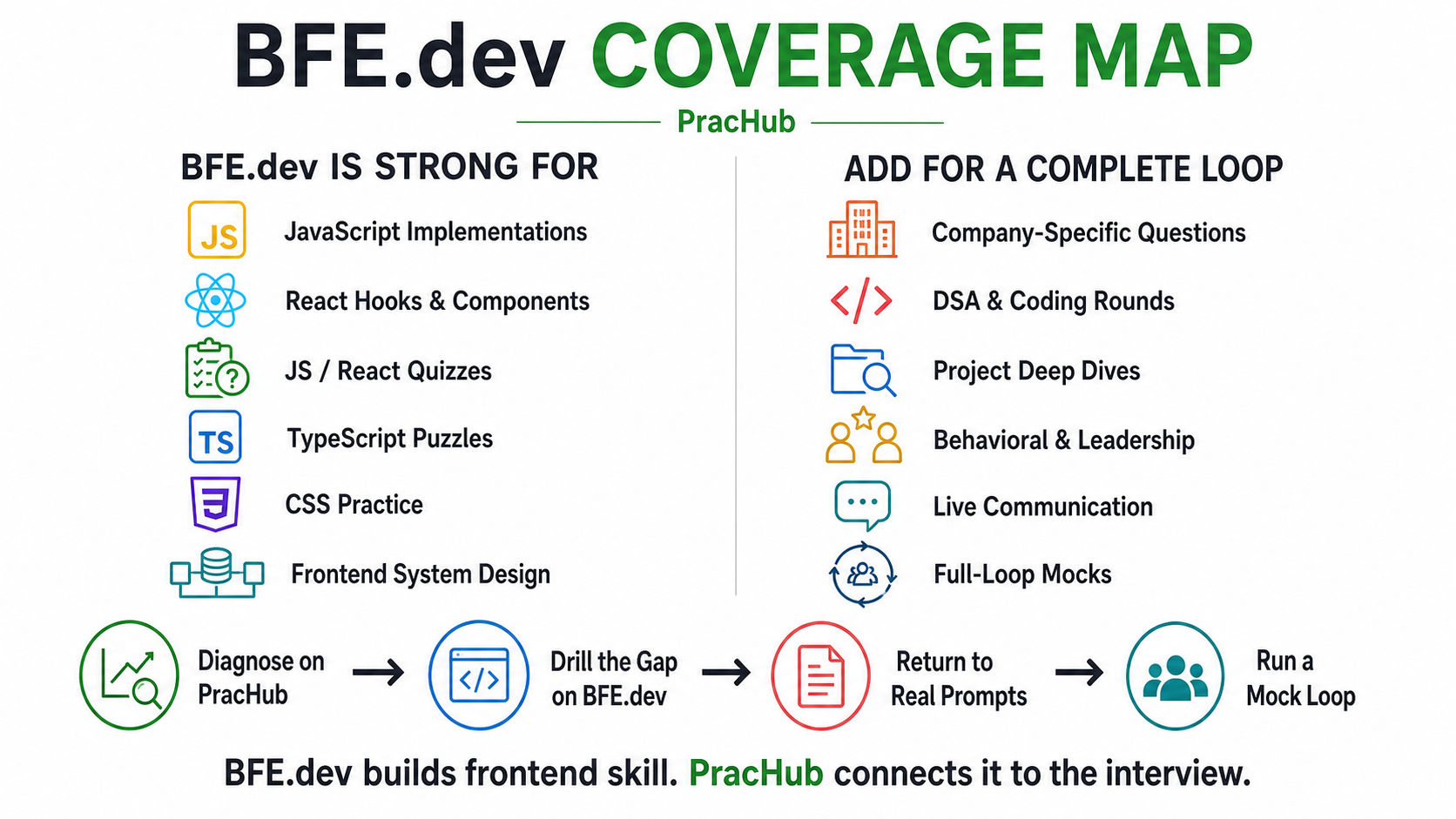
First, diagnose. Filter PracHub by your target company and frontend role. Attempt several recent questions without help and record whether you struggle with JavaScript, UI coding, DSA, React, browser knowledge, system design, or communication.
Second, drill. Use BigFrontend for the weakest category. Solve fewer questions more deeply: write the baseline, identify failed cases, explain complexity, and reimplement the problem after a delay.
Third, return to the interview. Attempt a fresh real prompt under time pressure. Explain your assumptions aloud and add the follow-ups a human interviewer would ask about testing, accessibility, performance, API failure, and maintainability.
Who Should Use BigFrontend?
BigFrontend is a strong fit for frontend engineers who want free or low-cost practice, need to refresh JavaScript fundamentals, or learn best by implementing focused utilities and components. It is also useful for backend or full-stack engineers who need a structured frontend refresh.
Do not rely on it alone when your interview is close, your target company has distinctive rounds, or you are aiming for senior and staff roles. At that point, relevance and communication matter more than maximizing problem count.
A Focused 7-Day Frontend Prep Plan
Days 1-2: Diagnose with real frontend interview questions. Choose the two weakest categories and build a short BigFrontend list.
Days 3-4: Complete JavaScript or React drills and one CSS or browser quiz block. Re-solve the hardest problem from memory the next morning.
Day 5: Practice one system design question with a frontend focus: user states, API boundaries, performance, accessibility, observability, and failure recovery.
Days 6-7: Run a company-specific mock sequence with coding, frontend architecture, a project deep dive, and behavioral and leadership practice. Review only the mistakes that changed your performance.
Frequently Asked Questions
Is BigFrontend free?
Much of the question library and practice experience is free. Premium adds workflow and convenience features such as Crack Mode, full Quick Code 75 access, expanded history, and ad-free use.
Is BigFrontend good for React interviews?
Yes, especially for hooks, component behavior, and React quizzes. However, its React coding set is smaller than its JavaScript library, so add production-style UI tasks and company-specific React prompts.
Does BigFrontend replace LeetCode?
It can replace some general coding practice for frontend-specific implementation rounds. It may not replace DSA preparation when your target company runs standard algorithm screens.
Is BigFrontend enough for senior frontend interviews?
No single question bank is. Senior candidates need frontend system design, project ownership, cross-team decisions, performance and accessibility trade-offs, behavioral stories, and live communication practice.
Final Verdict: Use BigFrontend as a Drill Library
BigFrontend is worth using in 2026. Its JavaScript depth, frontend breadth, coding environment, and low price make it one of the easiest frontend resources to recommend.
But do not confuse skill coverage with interview readiness. Use PracHub to find real interview questions with written solutions and company-specific prep, then use BigFrontend to close the gaps those questions reveal. That combination keeps every practice session tied to the offer you actually want.
Related Resources
Related Articles
GreatFrontEnd Alternative: Real Interview Questions for 2026
Compare GreatFrontEnd and PracHub for interview prep. See when frontend drills help, where full-loop practice matters, and which workflow fits your role.
How to Become an Investment Banker: Skills, Paths, Interviews
Step-by-step guide to investment banking careers, including recruiting paths, required skills, networking, interviews, and modeling practice.
Code Review Interview Guide: How to Find Bugs and Explain Trade-Offs
Code review interview guide: learn how to find bugs, propose tests, prioritize feedback, and explain technical trade-offs with a practical example.
Parakeet AI Review 2026: Pay-Per-Interview Copilot vs Real Preparation
Parakeet AI review 2026: examine credits, live copilot features, privacy and detection risks, then compare pay-per-interview help with real prep.
Comments (0)