Code Review Interview Guide: How to Find Bugs and Explain Trade-Offs
Quick Overview
Learn how to pass a code review interview with a six-pass framework for understanding intent, tracing data flow, finding bugs, proposing tests, explaining trade-offs, and prioritizing feedback. Includes a worked Python example, review-comment template, pacing plan, and PracHub practice workflow.
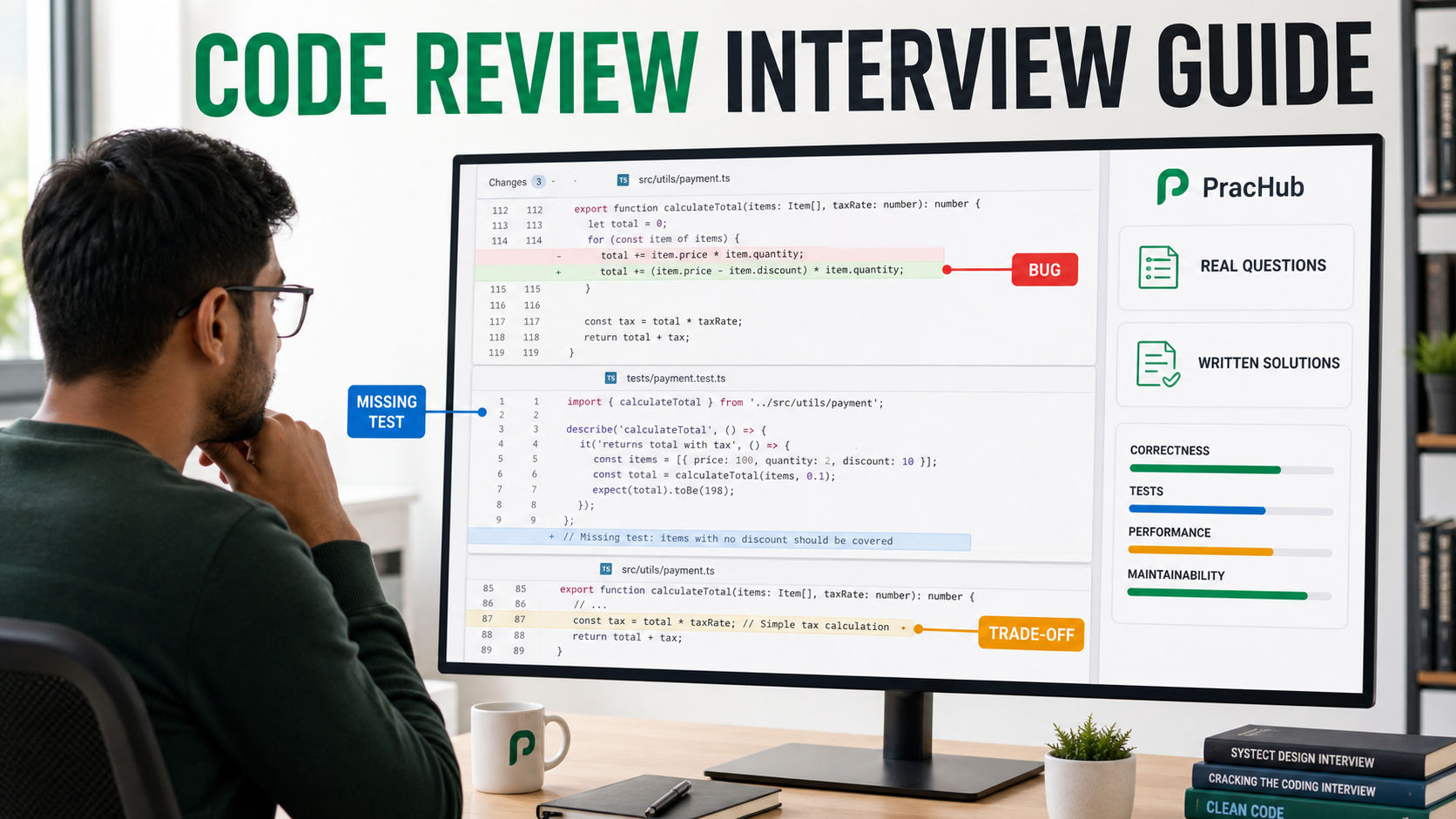
In a code review interview, finding one obvious bug is rarely enough. The interviewer wants to see whether you can understand unfamiliar code, separate production risks from personal preferences, propose useful tests, and explain a better approach without turning the review into a rewrite.
The fastest way to improve is to review real code under time pressure. Start with PracHub's real interview questions with written solutions, attempt the problem yourself, and then review a second solution as if it were a pull request. This trains both implementation and engineering judgment.
Quick Answer: How Do You Pass a Code Review Interview?
Use a repeatable sequence: understand the change, trace the main data flow, find correctness and reliability risks, propose tests, explain trade-offs, and prioritize your comments. Think aloud so the interviewer can follow your reasoning, and connect every important comment to user impact or code health.
A strong reviewer does not try to mention everything. They identify the highest-risk issue first, explain why it matters, suggest a practical direction, and distinguish a blocker from an optional improvement or nit.
What Is a Code Review Interview?
A code review interview gives you existing code, a diff, or a small repository and asks you to assess it. Depending on the company, you may review silently and discuss afterward, annotate a pull request, debug with an interviewer, or propose changes and tests live.
The format varies, but the signals are familiar. Google's official guidance covers design, functionality, complexity, tests, naming, comments, style, documentation, and overall code health. GitHub reviews similarly distinguish commenting, approving, and requesting changes.
What Interviewers Evaluate
| Signal | What Strong Candidates Demonstrate |
|---|---|
| Comprehension | Restate the change and identify the main execution path. |
| Correctness | Find bugs, invalid assumptions, and broken edge cases. |
| Testing | Propose tests that would fail before the fix and pass afterward. |
| Risk judgment | Prioritize security, data loss, crashes, and user impact. |
| Trade-offs | Compare alternatives without pretending one choice is universally best. |
| Communication | Explain why a change matters and keep feedback respectful. |
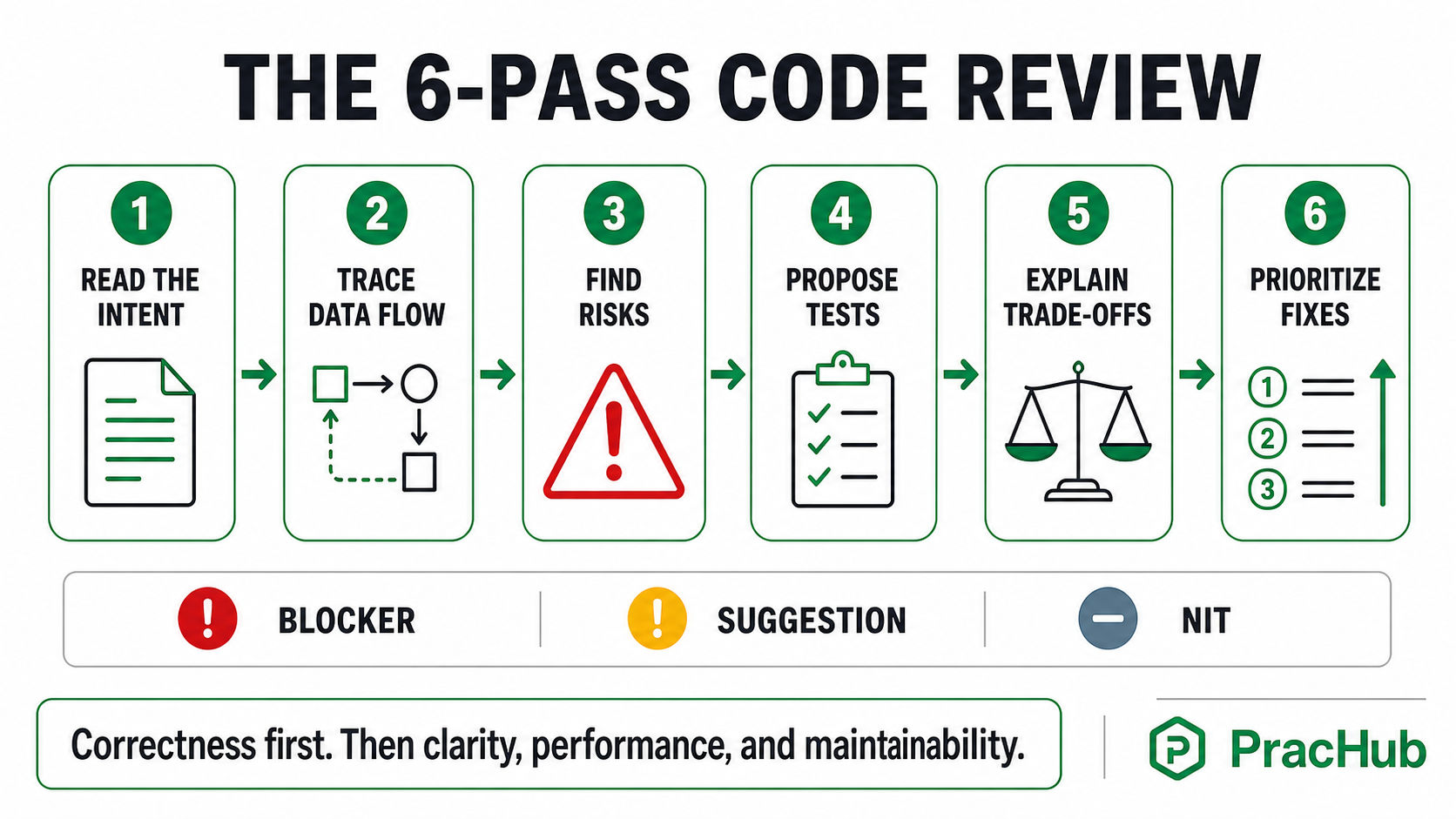
The Six-Pass Code Review Framework
1. Read the Intent
Start with the task description, function signature, tests, and surrounding code. State what the change appears to do and ask about missing context. Do not begin with line-level style comments before you understand whether the overall change makes sense.
2. Trace the Data Flow
Follow inputs through validation, transformation, storage, and output. Track null values, empty collections, errors, permissions, external calls, and state changes. Data-flow tracing finds more real bugs than scanning each line in isolation.
3. Find Risks
Review correctness first, then security, reliability, concurrency, performance, maintainability, and readability. Ask what can fail, who is affected, whether the failure is recoverable, and whether the code leaves the system in a valid state.
4. Propose Tests
A useful test proves the issue. Cover the normal path, empty and boundary inputs, malformed data, repeated calls, dependency failures, and important state transitions. Google specifically advises reviewers to verify that tests would actually fail when production code is broken.
5. Explain Trade-Offs
Avoid vague comments such as "this is inefficient." Name the current choice, its benefit, its cost, the relevant constraint, and your recommendation. A simple solution may be correct at today's scale; a more complex design may be justified only when latency, memory, or throughput requirements demand it.
6. Prioritize Fixes
Label the outcome. A blocker affects correctness, security, or a required behavior. A suggestion improves design but may not be required now. A nit is minor. Google's guidance recommends making comment severity explicit so authors can prioritize correctly.
Worked Example: Find the Bugs Before Suggesting a Rewrite
Imagine the candidate receives this function:
def average_latency(samples):
    total = 0
    for sample in samples:
        if sample["ok"]:
            total += sample["latency_ms"]
    return total / len(samples)
First, state the intent. The function appears to calculate average latency for successful samples. That interpretation should be confirmed because the name alone does not say whether failed requests belong in the denominator.
Then identify the correctness issues. An empty list causes division by zero. Failed samples are excluded from the total but still included in the denominator, which understates the successful-request average. Missing keys or nonnumeric latency values can also raise exceptions.
Propose tests before redesigning. Test an empty input, all failed samples, a mix of successful and failed samples, one successful sample, and malformed data if the caller does not guarantee schema validation.
Explain the trade-off. Returning None makes absence explicit, while zero is convenient but can look like a real measurement. An exception fits when empty input represents a caller bug. Ask for the API contract before declaring one answer correct.
How to Explain a Review Comment
Use this structure: observation, impact, evidence, recommendation, trade-off.
For example: "This denominator includes failed requests even though their latency is excluded from the total. With one success at 100 ms and one failure, the function returns 50 ms instead of 100 ms. I would count successful samples separately. If the intended metric includes failures, we should define how their missing latency is represented."
This is stronger than "wrong average" because it proves the bug, shows impact, proposes a fix, and leaves room for missing requirements. Keep comments about the code, explain your reasoning, and let the author choose the implementation when several solutions are valid.
A Practical Interview Pacing Plan
Use this as a practice template rather than a universal company format. Adjust to the time and instructions you receive.
| Practice Time | Focus | Output |
|---|---|---|
| First 5 minutes | Read the prompt, diff, and tests | One-sentence intent and key assumptions |
| Next 10 minutes | Trace the main data and control flow | Inputs, outputs, state changes, dependencies |
| Next 15 minutes | Find and prove high-impact risks | Concrete examples and failing cases |
| Next 10 minutes | Review tests, design, and performance | Missing coverage and alternatives |
| Final minutes | Prioritize and summarize | Blockers, suggestions, nits, merge decision |
Common Code Review Interview Mistakes
Starting with style, rewriting everything, or claiming a bug without an input that proves it all signal weak judgment. Think aloud, review the tests, separate blockers from nits, and avoid optimizing without scale requirements. When context is missing, state the assumption and explain how another answer would change your recommendation.
How to Practice With PracHub
Choose an unfamiliar problem from PracHub and solve it. The next day, review a different solution without running it first. Write three comments: one correctness or reliability issue, one missing test, and one trade-off.
Then compare with the written solution and explain your review aloud. Use company-specific interview prep to target the employers in your pipeline. Senior candidates should add system design questions, where boundaries, failure modes, and operational trade-offs become more important.
FAQ
Do I need to fix the code during a code review interview?
Sometimes, but many formats prioritize diagnosis and communication. Ask whether the interviewer wants comments, a patch, tests, or all three. Even when you edit code, explain the issue and expected behavior before changing implementation.
What bugs should I look for first?
Prioritize data loss, security, crashes, incorrect outputs, broken authorization, concurrency errors, and unrecoverable state. Then review validation, error handling, performance, maintainability, readability, and style.
How should I discuss performance?
Describe the current complexity and the input size at which it matters. Compare the simpler implementation with an optimized alternative, including memory and maintenance costs. Avoid optimizing for hypothetical scale without evidence.
Should I comment on naming and style?
Yes, after higher-impact issues. Label minor feedback as a nit and avoid blocking on personal preference. Good naming matters when it prevents misunderstanding, while automated formatting should usually be handled by tools.
Final Takeaway
A code review interview is a judgment and communication exercise disguised as a debugging task. Understand the intent, trace the flow, prove the risks, propose tests, explain the trade-offs, and prioritize what must change.
Build that habit with real interview questions on PracHub. The goal is not to produce the longest list of comments. It is to show that you can help a team ship correct, understandable, and maintainable software.
Comments (0)