Roblox Robots Assessment: How to Practice Problem Solving and Iteration
Quick Overview
A practical guide to Roblox Robots assessment preparation, separating official Kaiju Cats guidance from community reports and original iteration exercises.
The hardest moment in a robot-building task is often the second attempt. Your first design failed, but you do not yet know why. Changing everything might produce a better run; it might also leave you unable to explain what improved. Preparing for the Roblox Robots assessment means practicing that distinction: making progress while learning from each attempt.
Official guidance: Roblox links to Kaiju Cats as preparation for the basic interface and strategic tactics used in Robots and Factories. Coding Cookies serves a different purpose: familiarizing applicants with the block-coding interface of Outpost: Mars. Start with the practice that matches the section you are preparing for. Roblox Early Career
This guide separates published guidance, community reports, and original practice advice. It does not provide a leaked robot design or a guaranteed score. For the coding and interview side of preparation, PracHub’s Roblox Software Engineer question collection is a separate resource; ordinary coding questions do not reproduce the game.

What the Robots assessment is—and what remains unknown
Official fact: Roblox describes robot-building and factory tasks as opportunities to demonstrate systems thinking and creative problem solving in a changing environment. Its assessment-design article emphasizes that candidates can show ability in different ways. That establishes the purpose of the exercise, not a public formula for maximizing a score. Roblox’s Fair Play article
Community report: An August 2026 InterviewDB post describes assembling a small vehicle from parts to negotiate obstacles. Treat that as a community account of an assessment experience, rather than a verified specification for every applicant. The post’s interpretation of what earns credit is not an official scoring rule. Community assessment account
The public sources reviewed for this guide do not establish a universal Robots time limit, required configuration, scoring weight, or passing threshold. Your invitation and the instructions inside your assigned assessment determine those details. Read them before importing a strategy from somebody else’s experience.
A useful preparation goal is therefore narrower and achievable: become comfortable observing a system, testing an explanation, and choosing the next action under constraints. You can practice those skills without knowing a hidden map or memorizing a parts recipe.
Use Kaiju Cats to learn the interaction before chasing performance
Official fact: Roblox says its practice games are untimed and fully replayable. The linked Kaiju Cats listing also states that practice performance does not directly affect hiring outcomes. Repeating practice is a chance to learn, not a separate application score to optimize. Early Career guidance, officially linked Kaiju Cats experience
Original practice advice: Give successive sessions different jobs. On the first pass, learn the controls, where instructions appear, and how outcomes are shown. On the next, make a prediction before acting. On a later pass, revisit a decision that disappointed you and identify what information you missed.
Do not assume that the practice game reproduces every assessed mechanic. Its value includes reducing the attention spent finding controls and interpreting feedback. That leaves more attention available for the actual problem when the task changes.
Keep notes about your own behavior: Did you act before understanding the objective? Did you overlook a constraint? Did you continue repeating a failing approach because you had already invested time in it? Those observations are more portable than a memorized sequence of clicks. The official practice link was checked for this guide; your assigned assessment version was not playtested.
Turn a failed run into a testable question
The following method is original preparation advice, not a description of Roblox’s scoring system. Use it in a permitted practice environment, adapting it to the controls and feedback available.
First, state the success condition in observable terms. “Build a good robot” is too vague. “Reach the marked endpoint without stopping” is a testable objective in a fictional obstacle exercise. Check whether the actual task specifies additional conditions; reaching a destination alone may not define success.
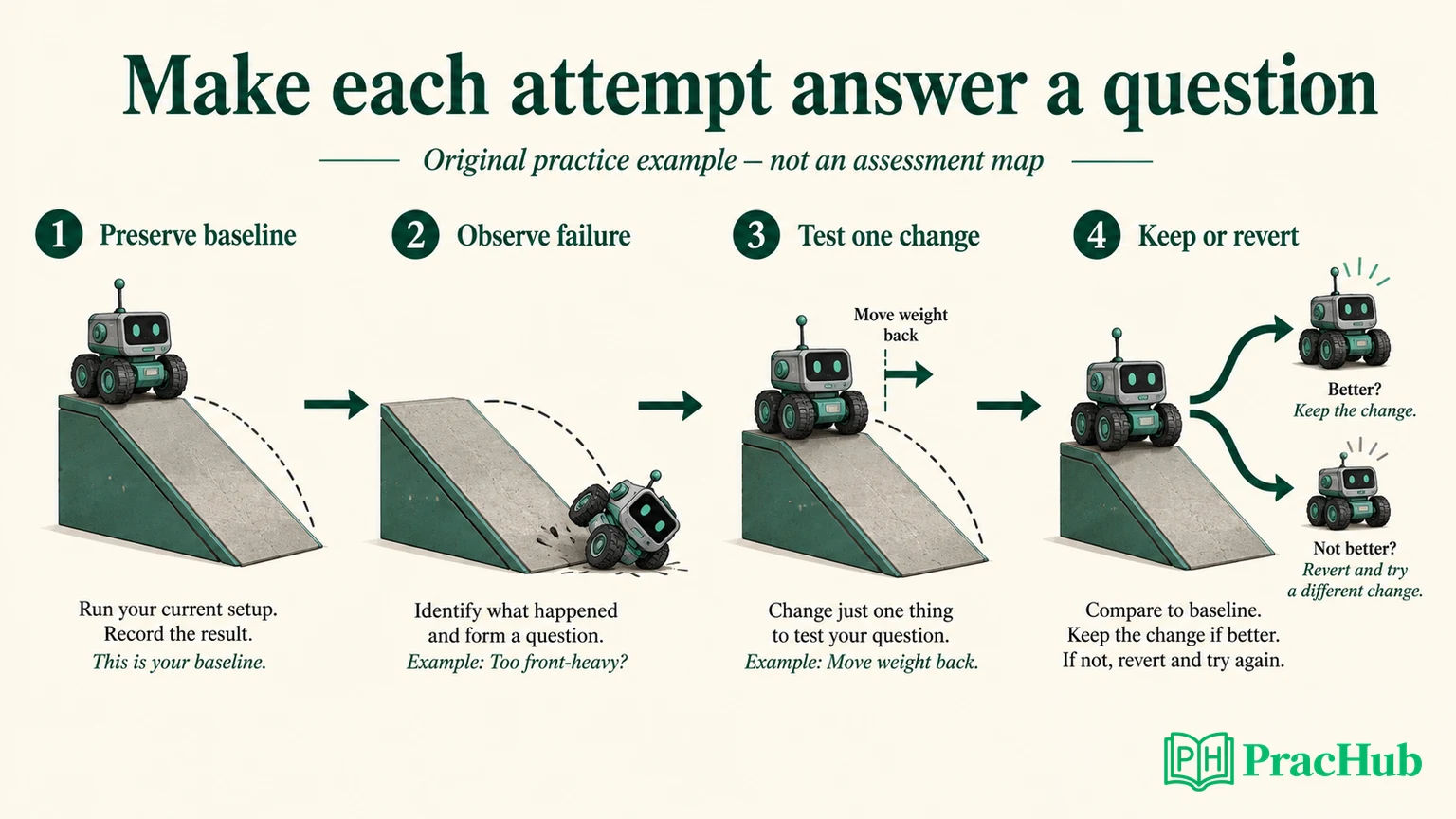
Next, save or remember a baseline configuration if the interface allows it. Observe the earliest meaningful failure rather than only the final result. A robot that stops before a ramp presents a different question from one that climbs and then tips. Describe what you saw before explaining why it happened.
| Observation in a fictional practice task | Hypothesis to investigate | Useful next experiment | What to avoid concluding |
|---|---|---|---|
| Movement stops at the first obstacle | The current configuration cannot clear that contact point | Change one relevant geometric feature, if available, and repeat the same route | “The entire design is useless” |
| The vehicle climbs, then tips | Balance may become unstable during the climb | Alter one balance-related choice while preserving other settings | “More speed will definitely fix it” |
| Identical-looking attempts end differently | A starting condition or input may have changed | Repeat the baseline and check the setup | “The game is random” |
| One obstacle improves but a later one fails | The change introduced a tradeoff | Compare whole-route results against the baseline | “The new version is better everywhere” |
These are illustrative physical hypotheses, not claims about which parts or simulation rules Roblox provides. The important habit is moving from observation to a question that another attempt can answer.
A worked iteration: preserve the baseline, isolate the change
Consider an invented practice scenario: a small vehicle must cross a ramp. Version A reaches the slope but tips halfway up. You suspect that weight placement contributes to the failure. That is a hypothesis, not yet a conclusion.
For version B, change only weight placement, assuming your practice tool supports it. Keep the route, starting position, and other configuration choices consistent. Before running, write a prediction: “If this change improves stability, the vehicle should remain upright farther along the slope.”
| Version | Deliberate change | Fictional observation | Decision |
|---|---|---|---|
| A | Baseline | Tips halfway up the ramp | Preserve configuration and record failure point |
| B | Weight placement only | Passes the ramp, stops at the next obstacle | Keep as a promising branch; inspect the new failure |
| B repeat | No intentional change | Passes the ramp again | Confidence improves, without proving universal reliability |
| C | One further adjustment | Tips earlier than B | Revert to B and reject this adjustment for now |
The gain is not merely that B traveled farther. You now have a reason to prefer it and a way to recover it. If you had changed several settings between A and B, you would know less about which change helped.
One-factor experiments are a starting discipline, not a law. Some components interact, and an isolated change may achieve nothing until another feature also changes. Test a combined hypothesis when simpler experiments suggest an interaction. Label it honestly: the result supports the combination, not an individual component’s effect.
Manage attempts without confusing activity with progress
A long sequence of edits can feel productive even when it produces little information. Before another attempt, ask: “What result would make me keep this change, and what result would make me undo it?” If neither answer is clear, sharpen the hypothesis first.
Original time-management advice: Use the actual section’s displayed limits to decide how much experimentation remains sensible. Early attempts can clarify basic behavior. Later attempts should favor changes with a clear purpose and a recoverable baseline. Avoid importing a fixed minute-by-minute schedule from a different candidate’s assessment.
When progress stalls, distinguish three situations. You may not understand the objective; reread the relevant instruction. You may understand the objective but lack a useful hypothesis; inspect the earliest failure again. Or you may have a plausible hypothesis but insufficient time to test it responsibly; preserving a known working configuration may be the better decision.
A compact practice log can contain just five fields: configuration label, prediction, observed failure point, change made, and keep-or-revert decision. You do not need polished documentation during every run. The log is a training aid for making reasoning visible, not a claim that Roblox expects an uploaded worksheet.
Separate an unsuccessful design from a technical problem
Historical candidate report: A January 2026 post describes frustration when configurations that seemed logical did not work on the terrain. That is evidence of one person’s experience, not proof of a defective simulation or a universal source of randomness. Robots and Factory discussion
An unexpected outcome should first prompt inspection: what did the task actually show? A browser failing to load, disconnected controls, or an explicit error message presents a different problem from a vehicle behaving differently than you predicted. Do not assume that every surprising result is technical failure.
Official guidance: Roblox lists an assessment-support contact on its Early Career page. Use that route for access or technical issues, describing the symptom and relevant timing without distributing confidential task material. The same page says assessment sections can be completed together or spread across a week; this does not establish permission to pause a running section. Assessment guidance and support
What community scores can—and cannot—tell you
Candidate reports: An August 2026 score discussion includes people reporting different section outcomes and different hiring results. These accounts are self-reported and do not control for applicant background, role, hiring needs, or how results were evaluated. They cannot establish a reliable Robots cutoff. Community score discussion
Avoid turning a visible metric into an imagined hiring formula. Completing more of a task may be desirable under its instructions, but “more attempts always earns more credit” and “one failed robot ends the application” require evidence the public sources do not provide.
Likewise, practice reflection is useful even without an official requirement to submit an explanation. After a session, describe the objective, your first hypothesis, the observation that changed your mind, and the tradeoff in your final choice. Do not prepare a canned story claiming success you did not achieve.
Five complementary questions for reasoning and communication
These PracHub records provide broader interview practice, not replicas of Robots or predictions of your assigned questions. Use the first two to make state and reachability precise, the middle question to practice measurement, and the final two to explain decisions and respond to feedback.
| PracHub question | Transfer exercise |
|---|---|
| Simulate robot path and detect boundedness | Track position and direction explicitly; distinguish observed progress from a claim about repeated behavior. |
| Can the character reach the destination? | Define legal transitions and a success condition before testing examples. |
| Most Frequent Call Stack from Profiler Samples | Explain what a measurement captures and which conclusions the samples cannot justify. |
| Present Your Background, Project, and Role Expectations | Describe an actual project iteration with a concrete observation and decision. |
| Handle Difficult Feedback and Manager Disagreement | Practice updating a position when evidence or feedback challenges your initial explanation. |
Keep the priorities straight: start with Roblox’s official practice experience for interface familiarity. Use broader questions to strengthen reasoning and communication alongside it. The most useful habit to carry into Robots is a disciplined next attempt: know what you observed, what you are changing, and what the result would teach you.
Sources and Further Reading
- Roblox Early Career: current assessment and practice guidance — official preparation links and support information.
- Fair Play: Roblox’s Game-Based Talent Assessment — official assessment-design discussion, July 2025.
- Kaiju Cats, by AssessmentTools — practice experience linked from Roblox’s careers page.
- August 2026 community assessment account — unverified community process description.
- August 2026 candidate score discussion — self-reported outcomes, not a scoring standard.
- January 2026 Robots and Factory discussion — historical individual experience.
Comments (0)