IBM Competency Assessment 2027: Video Questions, Work Preferences, and How to Prepare
Quick Overview
Prepare for IBM competency assessments with clearly labeled candidate reports, a worked video-answer example, honest work-preference guidance, and current AI-use rules.
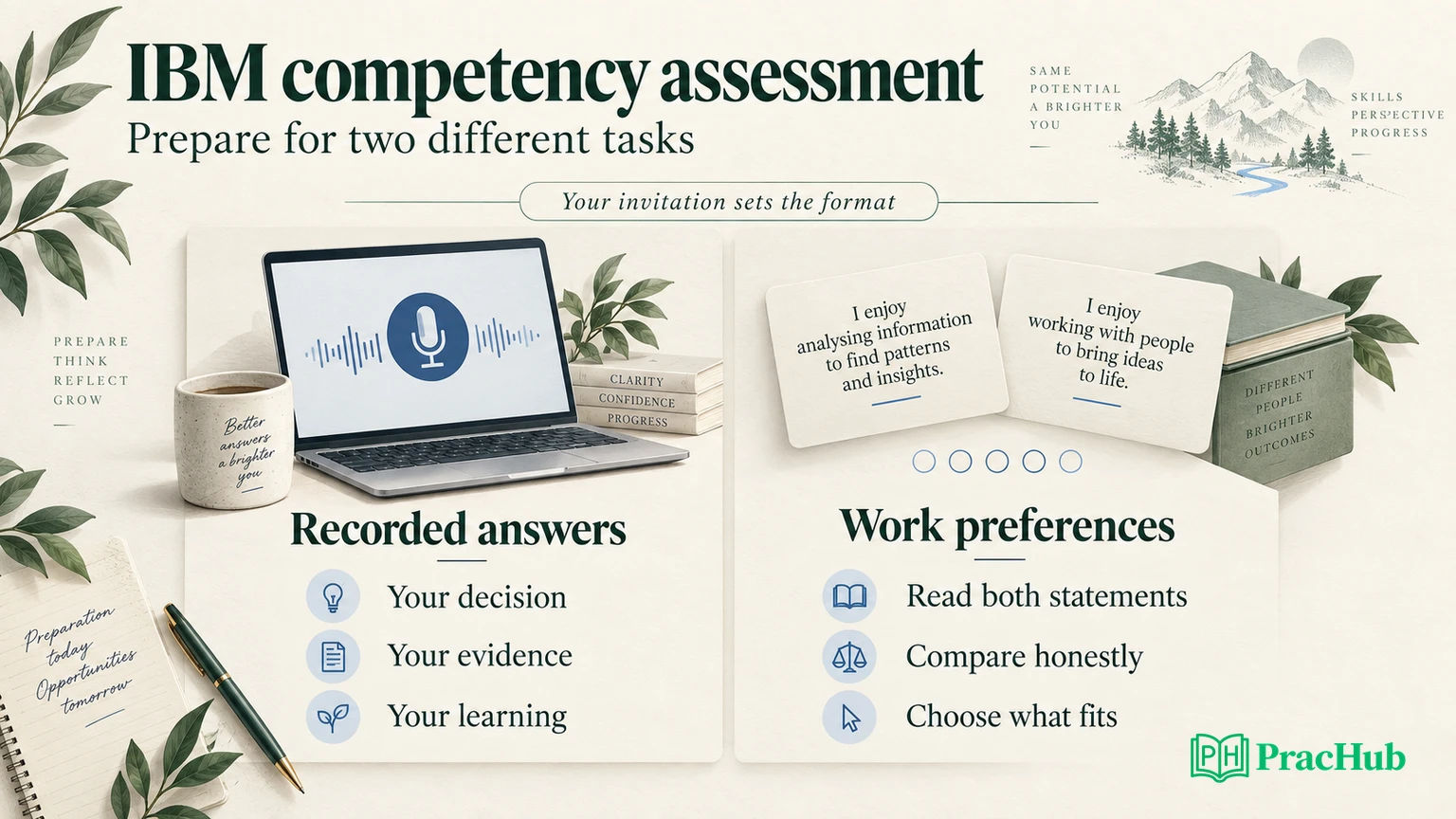
The IBM Competency Assessment 2027 can require preparation beyond coding: recorded answers about your experience and a questionnaire about working preferences. IBM confirms that assessment types vary by role. Candidates in the 2027 recruiting discussion describe six video questions followed by roughly 60 preference items, but those numbers are reports, not an IBM-wide specification.
Your best preparation is to make your own decisions easy to explain: what happened, what you did, how you checked the result, and what changed afterward. For preference questions, the task is different: compare the statements honestly rather than rehearse a persuasive story.
Use IBM Software Engineer questions to find relevant practice themes. This article focuses on the competency stage; the separate IBM Software Developer Intern OA article covers technical preparation.
IBM competency assessment format: confirmed versus reported
Official guidance: IBM describes video assessment questions answered through a webcam and microphone. Its assessment FAQ lists video and work-behaviour assessments among several role-dependent possibilities. It does not specify a universal question count, recording limit, or retry policy for every 2027 applicant.
Candidate reports: In an August 16, 2026 discussion, one respondent described six videos, approximately 60 paired preference items, a five-point scale, one minute to prepare each recording, three minutes to respond, and no retries. On August 23, a different commenter identifying their application as a 2027 Data Scientist internship described similar counts and timing, with setback and disagreement prompts.
These are separate candidate accounts within the same discussion, not independent verification of IBM's configuration. Their role and location coverage is limited. Treat the reported timing as a rehearsal option until your invitation provides the actual rules.
Before starting, resolve four details from your own instructions:
- Sections: Does the invitation include video, work preferences, or separate assessment links?
- Timing: What are the preparation time, response limit, deadline, and time zone?
- Controls: Is there a practice recording, a retry, or an automatic transition?
- Completion: What confirmation should appear after all required sections are submitted?
IBM's FAQ gives general seven-day completion guidance. Read the deadline in your invitation immediately; do not calculate a new deadline from a blog or another candidate's email.
Choose experiences that show a decision
Preparation guidance: Build a small set of true experiences with different decisions at their center. You might choose a disagreement over project scope, a mistake you corrected, a task with unclear requirements, and a tool whose output you needed to verify. These are practice themes, not a predicted question list.
IBM's interview guidance emphasizes examples, outcomes, and your individual contribution. A useful selection test is: could someone identify what you personally changed after hearing the story? “Our group delivered an application” gives less evidence than explaining why you reduced scope, which feature you protected, and how you gained agreement.
For each experience, make five short notes: the goal, the constraint, your decision, the observable outcome, and the lesson. Use project records to check your memory. A merged change, accepted demo, corrected analysis, or documented handoff can be an outcome even when you have no revenue figure. Do not invent a percentage to make a student project sound commercial.
Keep an alternative example for a different kind of challenge. A debugging success cannot automatically answer a question about handling criticism. The strongest story is the one that addresses the prompt, even if another experience sounds more impressive.
Turn a vague video answer into concrete evidence
The August 16 candidate report mentions a possible question about AI tools, their capabilities, and verification. That makes output checking a useful rehearsal theme. The following is an invented practice example, not a reported IBM question or an experience you should claim as your own.
Suppose your practice prompt asks: “Describe a time you used an AI tool, assessed its limitations, and checked its output.”
A vague answer might be:
I used AI to write tests for our project. It improved productivity, and I checked everything carefully. The project went well, and I learned that AI is useful when used responsibly.
The answer leaves the listener guessing what you checked, which limitation you found, and which judgment remained yours.
A more useful answer would explain:
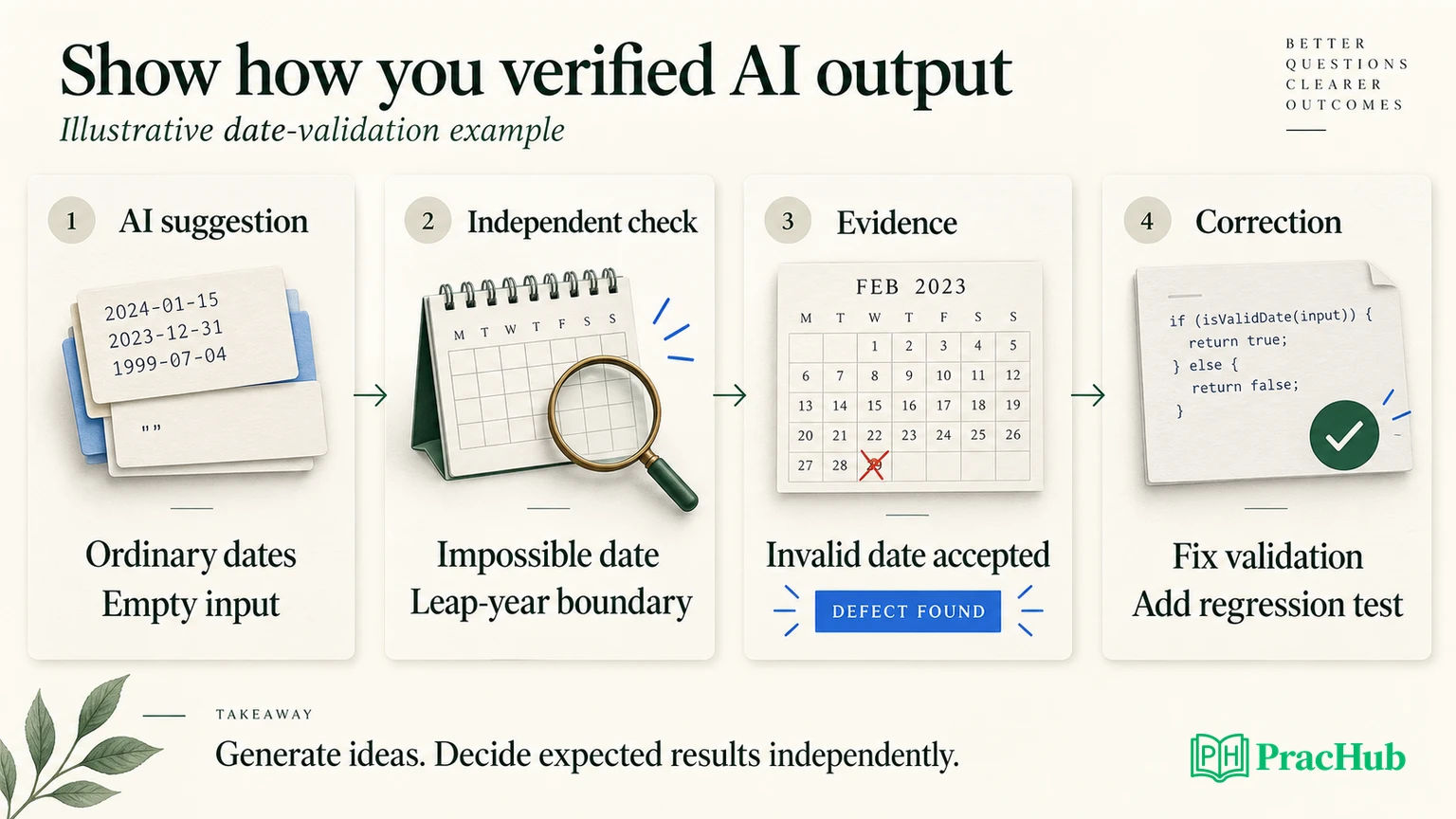
In a class project, I was responsible for validating dates submitted through a booking form. I used an AI assistant to suggest test cases using a simplified example without private data. Its suggestions covered ordinary dates and empty input, but they missed dates that matched the expected format and could not exist on the calendar.
I went back to our requirements and wrote the expected outcomes independently. I added an impossible date and a leap-year boundary, then ran those checks against the parser. The impossible date was accepted, so I corrected the validation and kept the failing case as a regression test. I also asked a teammate to review the expected behavior.
The change stopped that invalid input from being accepted in our test suite. I learned to separate generating test ideas from deciding what the correct result should be. Next time, I would write the boundary checklist before asking the tool for suggestions.
The stronger version establishes a limitation, an independent check, a correction, and a bounded outcome. It does not claim that a few tests prove the entire application correct. That distinction makes the result more credible.
For a data project, the equivalent might be checking generated analysis against a manually calculated sample. For a writing task, it might be tracing claims to original documents. Use the verification method you actually performed, and be clear about anything you did not verify.
Rehearse the recording without memorizing a script
Editorial practice method: Use Situation, Task, Action, Result, and Learning as an organizing aid. This is not an official IBM scoring formula. Keep background short enough that the listener can follow your actions, and end with the outcome before adding a lesson.
If you rehearse the candidate-reported one-minute preparation and three-minute response format, use the preparation minute to select a story and identify every part of the prompt. Think in anchors, not sentences: “booking form; missed calendar boundary; independent expected result; regression test; earlier checklist.” In the assessment itself, follow any rules about notes.
Record one unfamiliar practice prompt and listen back once. Check whether your first sentence answers the question, whether your personal action is identifiable, and whether the result appears before the recording ends. These checks are more useful than counting filler words while ignoring an unanswered question.
If an answer runs long, cut the project history first. If it sounds thin, add a decision and its reason. Speaking faster usually makes the missing structure harder to hear. You do not need to fill every available second after you have answered the prompt.
Try the same experience against a second prompt. For a learning question, emphasize what changed afterward. For a collaboration question, explain the teammate's contribution and how you reached agreement. If the experience cannot support that angle honestly, choose another one.
Work preferences: compare the statements as written
Official advice: When asked to choose between two statements, IBM's FAQ recommends selecting the one you agree with slightly more. It does not publish a preferred personality profile or an answer key.
Consider this original illustration, unrelated to any live assessment item:
A: I prefer to start an unfamiliar task independently.
B: I prefer to agree on an approach with teammates first.
Both can describe useful working habits. Think about your usual behavior, read any qualifications in the actual wording, and choose the closer fit. If the interface asks for strength of preference, distinguish a slight tendency from a strong one. This example has no recommended answer.
Avoid rewriting the question in your head. “Independently” does not necessarily mean refusing help, and “agree first” does not necessarily mean requiring permission for every action. Answer the statement presented, not a more extreme version of it.
Likewise, do not try to remember earlier responses and manufacture a perfectly consistent persona. The public sources reviewed do not establish IBM's scoring logic. Honest, careful reading is a preparation principle; claims about hidden consistency scores, ideal scale positions, or pass thresholds would be speculation.
AI preparation rules, equipment, and submission
Official AI boundary: IBM currently permits AI for preparation, including practice questions and role-play. Its candidate AI-use policy prohibits using AI to complete assessments or during real-time assessments unless permission is stated. Preparing an authentic example about AI is different from having a tool generate your assessed response.
As a practical equipment check, record a short sample with the device and microphone you plan to use. Listen for distorted or inaudible audio. Check power, connectivity, camera framing, and interruptions, then use the provider's equipment check if available. An elaborate background will not fix an answer nobody can hear.
For an accommodation, follow the email or form specified in the invitation before beginning. IBM's privacy notice says assessment videos may be stored and supplemental notice will be provided where processing involves AI capabilities. Read the notice supplied for your assessment; this does not establish a particular facial-analysis method or scoring system.
After submission, save the confirmation and time of completion. A 2027 Software Intern candidate reported that the portal still requested an assessment after they had completed the digital interview. That observation is not proof of either failure or successful synchronization.
If completion is unclear, check that you finished every required section and contact the support route in your invitation with the job reference, timestamp, and error message. Avoid resubmitting merely to force a portal change. IBM publishes no universal hiring turnaround; the separate IBM recruiter-review status article explains that follow-up intent in more detail.
Five PracHub prompts for focused rehearsal
These are practice records, not predictions of your exact IBM competency assessment. The first two are IBM-tagged; the remaining three are general behavioral practice from other companies. Use them to test your examples rather than memorize another person's response.
| Practice question | What to rehearse |
|---|---|
| How would you use generative AI at work? | IBM: identify one useful application, its limits, and an independent check. |
| Describe open-source contribution experience | IBM: distinguish your contribution from the team's and explain feedback you acted on. |
| Responding to a Difficult Engineering Challenge | Amazon-tagged supplemental practice: connect an obstacle to your next decision. |
| Resolve a Workplace Conflict | DoorDash-tagged supplemental practice: explain both perspectives and how the working relationship changed. |
| Make a Difficult Decision Under Competing Constraints | Amazon-tagged supplemental practice: name an alternative you rejected and why. |
Start with one IBM Software Engineer practice question. Record an answer from your own experience, identify the weakest evidence, and revise that part once. Move on when you can explain your decisions and result clearly without a script.
Sources and Further Reading
- IBM Application Steps and FAQs: official video-assessment description, interview guidance, candidate AI-use policy, and hiring timeline caveat.
- IBM Assessment FAQ: assessment types, general completion guidance, preference statements, and adjustments.
- IBM Talent Acquisition Privacy Notice: official recording and recruitment-data information.
- IBM Competency OA 2027 discussion: candidate accounts dated August 16 and August 23, 2026; format and prompt themes remain anecdotal.
- IBM Software Intern 2027 completion discussion: candidate-reported portal mismatch after a digital interview.
Evidence reviewed September 9, 2026. The 2027 label refers to the recruiting cycle discussed by candidates; your invitation controls your assessment's requirements.
Comments (0)