Stripe SWE Intern OA 2027: One Long Coding Problem, Input Parsing, and Clean Code
Quick Overview
An evidence-led guide to the reported Stripe SWE Intern OA format for 2027, including the one-long-problem pattern, input parsing, state modeling, hidden tests, clean code, real Stripe practice questions, and likely next rounds.
A Stripe online assessment can look deceptively simple on the invitation: one coding problem and roughly an hour to finish it. The trap is assuming that “one problem” means one short algorithm.
Recent Stripe university-recruiting reports describe something closer to a small production task compressed into a timed editor: structured input, several rules, state that changes over time, and follow-up requirements that must fit into the same implementation. The hard part is often not finding an exotic algorithm. It is reading precisely, modeling the data cleanly, and keeping the code correct as the specification grows.
As of August 15, 2026, detailed public reports for the Summer 2027 intern assessment are still limited. The strongest preparation baseline comes from consistent 2025–26 intern and new-grad reports: HackerRank, about 60 minutes, and one long practical problem with parsing, maps, state transitions, and hidden edge cases. Treat that as a current candidate-reported pattern, not an official guarantee. Your invitation remains the authority for format, timing, languages, and integrity rules.
Start with real Stripe interview questions on PracHub, then use the workflow below to practice the style of engineering the assessment appears to reward.
Quick Answer: What Should You Expect?
The most credible recent reports describe one 60-minute HackerRank problem, sometimes divided into multiple parts that build on the same code. Candidates report practical data-processing or system-simulation tasks rather than a sequence of unrelated LeetCode questions.
The common signals are remarkably consistent:
| Reported feature | What it means for your preparation | Evidence status |
|---|---|---|
| One long coding problem | Budget time for reading, implementation, testing, and later requirements | Repeated candidate reports |
| Structured input or command parsing | Practice CSV, line-based commands, records, and exact output formatting | Repeated candidate reports |
| Maps, sets, and state | Model entities and transitions explicitly | Repeated candidate reports |
| Multiple parts in one solution | Extend working code without breaking earlier behavior | Reported in several 2025–26 experiences |
| Hidden test cases | Test invalid operations, duplicates, ordering, boundaries, and reversals | Standard OA behavior plus candidate reports |
| Clean, maintainable code | Use small helpers, clear names, and controlled mutation | Candidate reports; Stripe job expectations align |
Stripe has not published a universal Summer 2027 OA specification. The official emerging-talent page says internship scheduling follows local academic calendars, while the intern job description emphasizes production software, testing, code review, and technical feedback. Those official signals support the preparation strategy, but they do not confirm a fixed question count.
Practice with Real Stripe Questions from PracHub
These are real Stripe question-bank records stored by PracHub. They are not predictions of your exact 2027 OA prompt. They are useful because they train the same parsing, state-management, aggregation, and change-friendly implementation skills reported in Stripe coding rounds.
| PracHub question | Stored round | Level | Practice focus |
|---|---|---|---|
| Calculate Transaction Fees | Technical Screen | Medium | Composite-key lookups, integer money math, aggregation |
| Generate Account Email Notifications | Technical Screen | Medium | Rule evaluation, ordering, scalable filtering |
| Compute Transaction Fees from a CSV String | Technical Screen | Hard | CSV parsing, decimal handling, fallbacks, exact output |
| Build an Account Transfer Ledger | Onsite | Medium | State transitions, validation, balances, rejected operations |
Attempt each question before opening the solution. Give yourself 60 minutes, keep everything in one runnable file, and write at least six adversarial tests. Then browse the wider Stripe coding question bank for another timed rep.
Is the Stripe SWE Intern OA Really One Long Coding Problem?
That is the best-supported recent pattern, but it is not a promise for every geography, role, or hiring cycle.
A 2025–26 Stripe intern report described one 60-minute problem involving merchant fraud thresholds, transaction and dispute events, and state updates. Another university-recruiting report described one main problem with sequential commands, valid and invalid state transitions, final aggregation, and careful output. A separate 2026 report described three parts built on one string-parsing solution.
The important commonality is not the exact story. It is the shape of the work:
- Parse records or commands.
- Store entities in maps or sets.
- Apply rules in a defined order.
- Preserve or update state.
- Produce deterministic output.
- Add later requirements without breaking earlier tests.
That shape is closer to implementing a small backend component than solving a single mathematical puzzle. Traditional DSA still matters, but arrays, strings, hash maps, sorting, and complexity analysis are usually tools inside a larger implementation.
Why Input Parsing Becomes Part of the Interview
Parsing is not clerical work in this format. It is where your assumptions become executable.
If an input line represents event_type,merchant_id,transaction_id,amount, your code must decide what makes a row valid, whether whitespace matters, whether duplicate IDs replace or reject earlier data, and what happens when an event references an unknown transaction. Hidden tests often live inside those decisions.
Build a Boundary Between Text and Business Logic
Do not scatter string splitting throughout the solution. Parse once into a typed record or a small internal structure, validate what the prompt requires, and pass that structure to the state-transition logic.
For example, a clean design might have:
parseCommand(line)for syntax and conversionapplyCommand(state, command)for business rulesformatResult(state)for deterministic output
This separation makes failures diagnosable. If the wrong merchant is flagged, you can determine whether the record was parsed incorrectly or the rule was applied incorrectly. It also makes later parts easier: a new command type should extend one boundary instead of forcing edits across the entire program.
Use Real Parsers When the Format Requires Them
If the prompt truly provides CSV, a language's CSV library is safer than a raw split(',') when quoted fields or embedded commas are possible. If the format is explicitly simple and guarantees no quoting, a split may be appropriate. State the assumption in a short comment or in your reasoning.
For money, avoid casual floating-point arithmetic when exact cents or rounding rules matter. Prefer integer minor units or a decimal type. Stripe-style domains make numeric representation an observable correctness decision, not an implementation footnote.
A Six-Step Workflow for the Stripe OA
The following process is designed for a long prompt that may reveal complexity in stages.
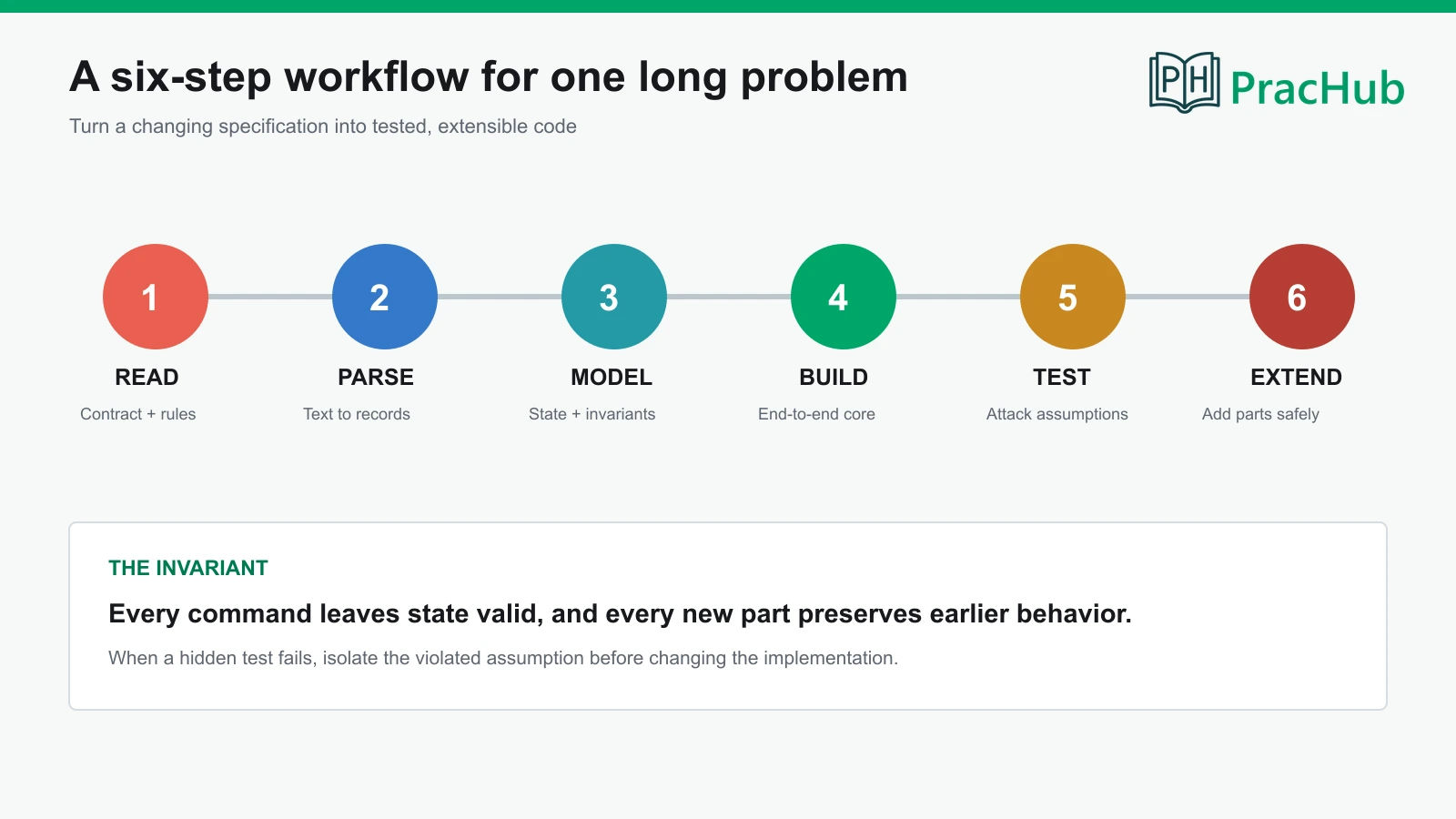
1. Read for Contracts, Not Story Details
Write down the entities, operations, required output, ordering rule, and invalid-operation behavior. Circle words such as “ignore,” “replace,” “at least,” “strictly greater,” and “in input order.” These words frequently determine hidden tests.
Before coding, construct one tiny example by hand. If you cannot predict the result confidently, the model is not ready.
2. Choose State That Mirrors the Domain
Use names that make the invariant visible: transactionsById, disputedIds, merchantTotals, or accountBalances. Avoid one giant dictionary whose values change meaning between parts.
Ask one question: what must I know to process the next command correctly? Store exactly that information. Derived output can often be computed later, which reduces inconsistent duplicate state.
3. Get the Simplest End-to-End Version Running
Parse one record, apply one rule, and produce one valid output before polishing. A complete narrow path gives you something testable. An elaborate class hierarchy with no working output does not.
The goal is not minimal code. It is minimal uncertainty.
4. Attack the State Transitions
Test create-before-update, update-before-create, duplicate commands, repeated reversals, unknown IDs, empty input, zero values, ties, and commands at threshold boundaries. If events are said to arrive chronologically, do not invent out-of-order behavior; if order is unspecified, ask or handle it deliberately.
Write a test for every branch in applyCommand. This catches more OA failures than repeatedly rereading the happy path.
5. Add New Parts Through Stable Seams
When Part 2 arrives, resist rewriting Part 1 unless the original model is genuinely wrong. Add a command handler, a rule table, or a formatting option while preserving the tested core.
This is where clean code becomes a speed advantage. Small functions and explicit state let you extend behavior under time pressure. They are not decorative style points.
6. Reserve the Final Minutes for Submission Risk
Re-run every provided test, then check empty input, a single record, duplicates, boundaries, sorting, rounding, and output formatting. Remove debugging output. Confirm the submitted function name and return type.
If one obscure case still fails, make the smallest evidence-based change. Random late rewrites usually create more failures than they fix.
What “Clean Code” Means Under a 60-Minute Timer
Clean code does not mean enterprise architecture. It means another engineer can verify and change the solution quickly.
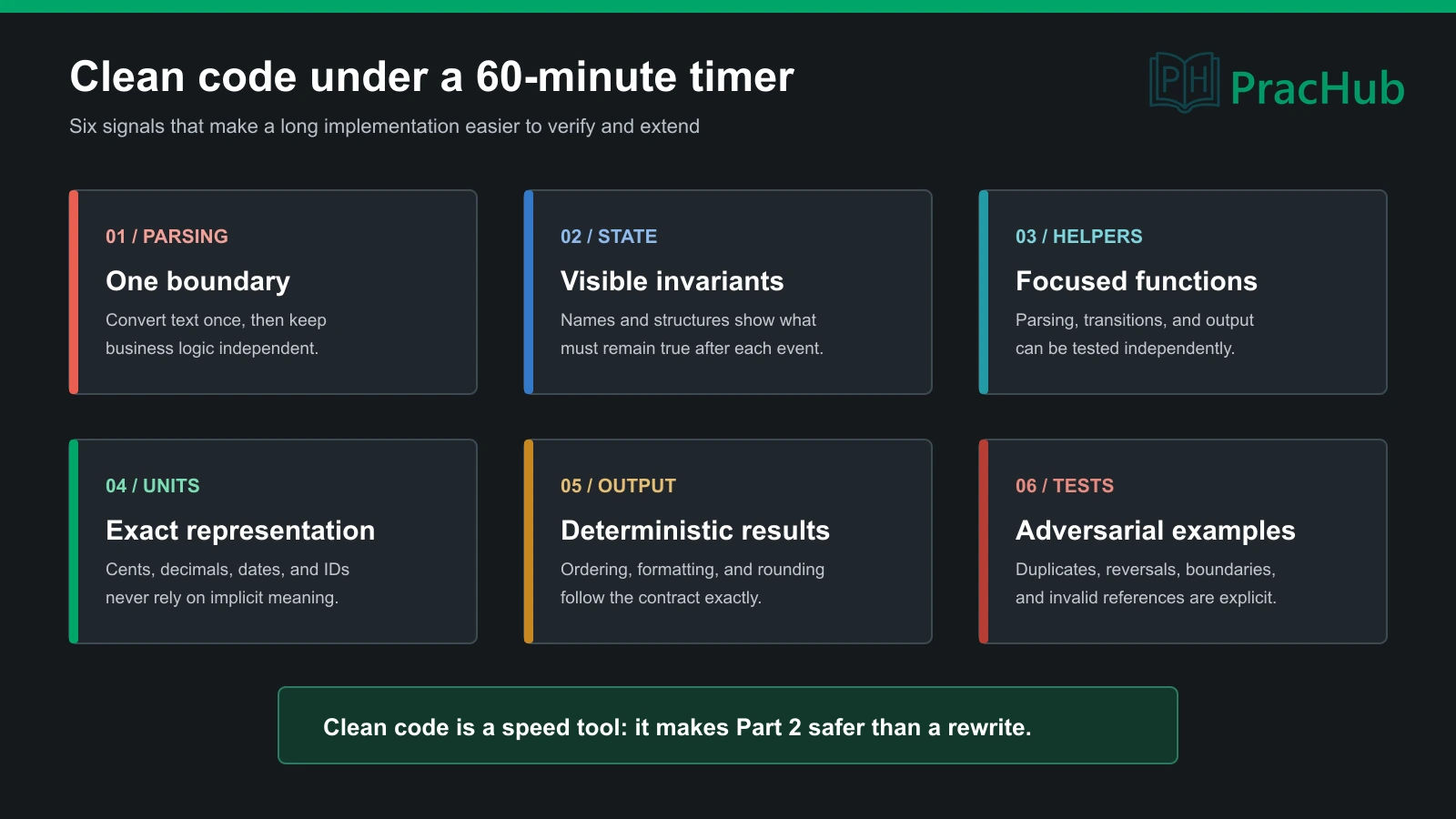
| Signal | Strong timed implementation | Common failure |
|---|---|---|
| Naming | Names reveal entities, units, and state | data, temp, and x hide meaning |
| Functions | Helpers isolate parsing, transitions, and formatting | One long function mixes every concern |
| Mutation | State changes happen in controlled handlers | Multiple branches update the same counters differently |
| Money and units | Cents, decimals, dates, and IDs are explicit | Floats and implicit conversions create drift |
| Output | Sorting and formatting are deterministic | Correct records appear in the wrong order |
| Tests | Each rule and boundary gets a counterexample | Only the sample input is tested |
Three to six focused helpers are often enough. Avoid both extremes: a 150-line function is hard to debug, while twelve tiny classes can consume the whole assessment.
Comments should explain a non-obvious invariant or a prompt-specific assumption. They should not narrate obvious syntax. The code itself should show what happens; the comment should explain why the choice is safe.
Hidden Test Cases Most Candidates Miss
Hidden tests are usually not random tricks. They expose an unstated assumption in the implementation.
For a Stripe-style simulation, build a checklist around these categories:
| Category | Example questions to test |
|---|---|
| Empty and minimal | What happens with no records, one entity, or one no-op command? |
| Identity | Are IDs unique? What happens when the same ID appears twice? |
| Ordering | Must output preserve input order or sort by an explicit key? |
| Thresholds | Is the comparison > or >=? Is a ratio computed before or after a reversal? |
| Reversals | Can an event undo an earlier count? Can the same event be reversed twice? |
| Invalid references | Is an unknown account ignored, rejected, or created? |
| Numeric precision | When does rounding happen? Can totals overflow a narrow integer? |
| Performance | Does a nested scan turn 100,000 records into quadratic work? |
Do not silently choose behavior when the prompt states it. When the prompt is ambiguous and no interviewer is present, select the narrowest reasonable interpretation, keep it consistent, and avoid adding unsupported business rules.
Time Management for One Long Problem
A useful 60-minute budget is 10 minutes to understand and model, 30 minutes to implement the core, 12 minutes for later parts, and 8 minutes for adversarial testing and cleanup. Adjust when the assessment exposes parts sequentially, but protect testing time.
If you are stuck, classify the problem before acting:
- Parsing failure: inspect one raw record and the parsed structure.
- Model failure: write the expected state after each command.
- Rule failure: isolate the smallest counterexample.
- Performance failure: identify repeated work and add the appropriate index or aggregate.
- Formatting failure: compare exact types, order, whitespace, and rounding.
This turns “the code does not work” into a bounded diagnosis. It also prevents the common mistake of optimizing an algorithm when the real problem is a misread rule.
How This OA Differs from Stripe’s Later Rounds
The OA is an early screen. It should not be confused with Stripe's better-known Integration or Bug Squash interviews.
| Stage | Primary task | Best preparation |
|---|---|---|
| Online assessment | Implement one practical, stateful problem under time | Parsing, maps, state transitions, hidden tests |
| Technical screen | Live multi-part implementation and explanation | Coding aloud, follow-ups, requirement changes |
| Integration round | Work with documentation, APIs, requests, and an existing setup | Use the Stripe Integration Round guide |
| Bug Squash round | Diagnose and repair an unfamiliar codebase | Use the Stripe Bug Squash guide |
| Behavioral or manager round | Ownership, collaboration, judgment, and motivation | Practice behavioral and leadership questions |
Candidate reports show that passing all OA tests can lead to a technical screen, but Stripe does not publish a universal score cutoff or response time. A perfect score is valuable evidence, not a guaranteed interview. Resume fit, location, headcount, and application timing can still matter.
For a one-week sprint, alternate three focused reps—parsing and exact output, state machines and reversals, and money or ledger logic—then finish with one full 60-minute simulation. Use the Stripe Software Engineer interview guide to prepare beyond the OA, and review the HackerRank assessment guide before test day.
Frequently Asked Questions
Is the Stripe SWE Intern OA one question?
Several recent intern and university-recruiting reports describe one main problem in about 60 minutes, sometimes with multiple connected parts. Stripe has not published a universal 2027 format, so verify the count and duration in your own invitation.
Is the Stripe OA LeetCode-style?
Recent reports describe practical parsing, simulation, state management, and aggregation rather than a standard sequence of isolated DSA questions. DSA fundamentals still matter, especially hash maps, strings, sorting, and complexity, but implementation discipline is often the larger challenge.
Which language should I use?
Use an allowed language in which you can parse input, model state, test quickly, and avoid numeric mistakes. Familiar standard-library support matters more than choosing the theoretically fastest language. Confirm the available languages in the assessment before starting.
Do I need to pass every hidden test?
No public source confirms a universal cutoff. Candidate anecdotes include both progression after strong performance and rejection despite high scores. Aim for full correctness, but keep code readable and submit the strongest tested solution instead of making a risky final rewrite.
Does Stripe care about clean code in the OA?
Candidate reports repeatedly mention readable, modular, maintainable code, and Stripe's intern job description emphasizes production software, testing, code review, and feedback. Under a timer, clean code means clear names, stable state, focused helpers, deterministic output, and tests—not an elaborate architecture.
What happens after the Stripe OA?
Recent reports commonly mention a live technical screen followed by a virtual loop that may include coding, Integration, Bug Squash, system design depending on level, and behavioral or manager conversations. The exact sequence varies by role, location, and team.
Final Take: Prepare for a Small System, Not a Small Question
The best way to prepare for the Stripe SWE Intern OA 2027 is to stop measuring difficulty by question count. One long problem can test reading, parsing, state design, business rules, precision, extensibility, performance, and hidden-test judgment at the same time.
Practice with real Stripe questions on PracHub, keep each attempt timed, and review every failure as an assumption that the test exposed. You do not need to predict the exact story. You need a reliable way to turn an unfamiliar specification into clean, correct code before the clock expires.
Comments (0)