How to Prepare for a HackerRank Online Assessment in 2026
Quick Overview
How to Prepare for a HackerRank Online Assessment in 2026 now pairs its existing format and process guidance with a clearly sourced PracHub practice set. The added section shows each question's actual company, stored round, difficulty, prompt shape, and a timed workflow without claiming guaranteed assessment reuse.
A HackerRank online assessment can feel strangely high pressure.
It is not a live interview, but it can decide whether you get one. You are alone, timed, watched by hidden test cases, and sometimes monitored by proctoring tools. One small edge case can be the difference between passing and never hearing back.
That is why the wrong prep strategy hurts.
Solving a few random coding problems is not enough. You need to prepare for the actual OA format: timed execution, role-specific questions, input/output handling, hidden test cases, browser rules, and integrity settings.
If you are preparing for a real company screen, start with real interview questions with written solutions and company-specific interview prep. Then use this guide to turn those reps into a HackerRank-ready strategy.

Quick Answer: What Is a HackerRank Online Assessment?
A HackerRank online assessment is a company-administered technical test used to screen candidates before later interview rounds. According to HackerRank's candidate support, these tests are online assessments that evaluate skills required for different roles and include a built-in code execution environment.
In practice, a HackerRank OA may include:
-
Coding questions
-
SQL or database questions
-
Multiple-choice technical questions
-
Frontend, backend, or full-stack questions
-
Debugging tasks
-
Role-specific technical concepts
-
Time limits
-
Hidden test cases
-
Proctoring or integrity monitoring
The exact format depends on the company, role, and test settings.
What Happens Before the HackerRank Test?
Most candidates receive a test invitation from the hiring company.
HackerRank says candidates should open the invitation, log in, and attempt the questions within the time limit. The invitation or login page may show the test window, deadline, instructions, and whether the assessment is proctored.
Before you start, check:
-
The test deadline
-
Whether the test has a fixed start time
-
Whether webcam access is required
-
Whether secure mode or desktop app mode is required
-
Which browsers are supported
-
Whether you need a HackerRank account
-
Whether your recruiter gave special login credentials
-
Whether AI tools, documentation, or IDEs are allowed
Do this early. Do not discover setup requirements five minutes before the deadline.
HackerRank Test Format in 2026
HackerRank tests are customizable, so there is no single universal format.
Still, most candidate-facing tests follow the same basic pattern:
-
You receive a test link.
-
You log in with your HackerRank account or company-provided credentials.
-
You read the test instructions.
-
You may complete system checks, camera checks, or sample questions.
-
You start the timed assessment.
-
You solve role-specific questions.
-
You submit before time expires.
-
The hiring company reviews the score, code, and integrity signals.
HackerRank candidate support says the question types are based on the role and skills required by the company. For example, a frontend developer assessment may include coding and technical questions related to frontend development frameworks.
That means the right prep depends on the target role.
Common HackerRank Question Types
Coding Questions
Coding questions are the classic HackerRank OA format.
You may need to:
-
Read input
-
Produce exact output
-
Implement an algorithm
-
Optimize for time and memory limits
-
Handle edge cases
-
Pass hidden test cases
Common categories include arrays, strings, hash maps, sorting, greedy algorithms, dynamic programming, graphs, trees, intervals, parsing, and simulation.
Use real interview questions with written solutions to practice the pattern, then re-solve without looking.
SQL Questions
Many data analyst, data engineer, backend, and product analytics roles include SQL.
You may need to write queries involving:
-
Joins
-
Aggregation
-
Window functions
-
Filtering
-
Grouping
-
Date logic
-
Null handling
-
Ranking
-
Business metrics
If your role may include SQL, add SQL interview practice early. SQL OA mistakes are often not syntax mistakes. They are usually edge-case and business-logic mistakes.
Multiple-Choice Technical Questions
Some HackerRank assessments include MCQs or concept questions.
These may cover:
-
Time complexity
-
Data structures
-
Language behavior
-
APIs
-
Databases
-
Networking
-
Testing
-
Frontend or backend fundamentals
Do not treat MCQs as filler. A few missed concept questions can lower your score even if your code is decent.
Frontend, Backend, and Full-Stack Tasks
Depending on the role, you may see role-specific questions.
Frontend assessments can include JavaScript, React, Angular, UI logic, or browser behavior. Backend assessments can include APIs, data structures, system behavior, or database reasoning. Full-stack assessments may combine both.
If your loop is more senior or backend-heavy, pair coding prep with system design questions so you can reason beyond syntax.
Debugging or Code Review Tasks
Some assessments test whether you can find and fix issues in existing code.
This is different from writing a solution from scratch. You need to read quickly, form a hypothesis, test it, and make the smallest correct change.
Practice this by taking your old solutions and intentionally reviewing:
-
Off-by-one errors
-
Empty input cases
-
Duplicate values
-
Overflow risk
-
Wrong loop boundaries
-
Incorrect assumptions about sorted data
-
Performance bottlenecks
How HackerRank Scoring Usually Works
HackerRank scoring depends on the test configuration, but coding questions usually reward passing test cases.
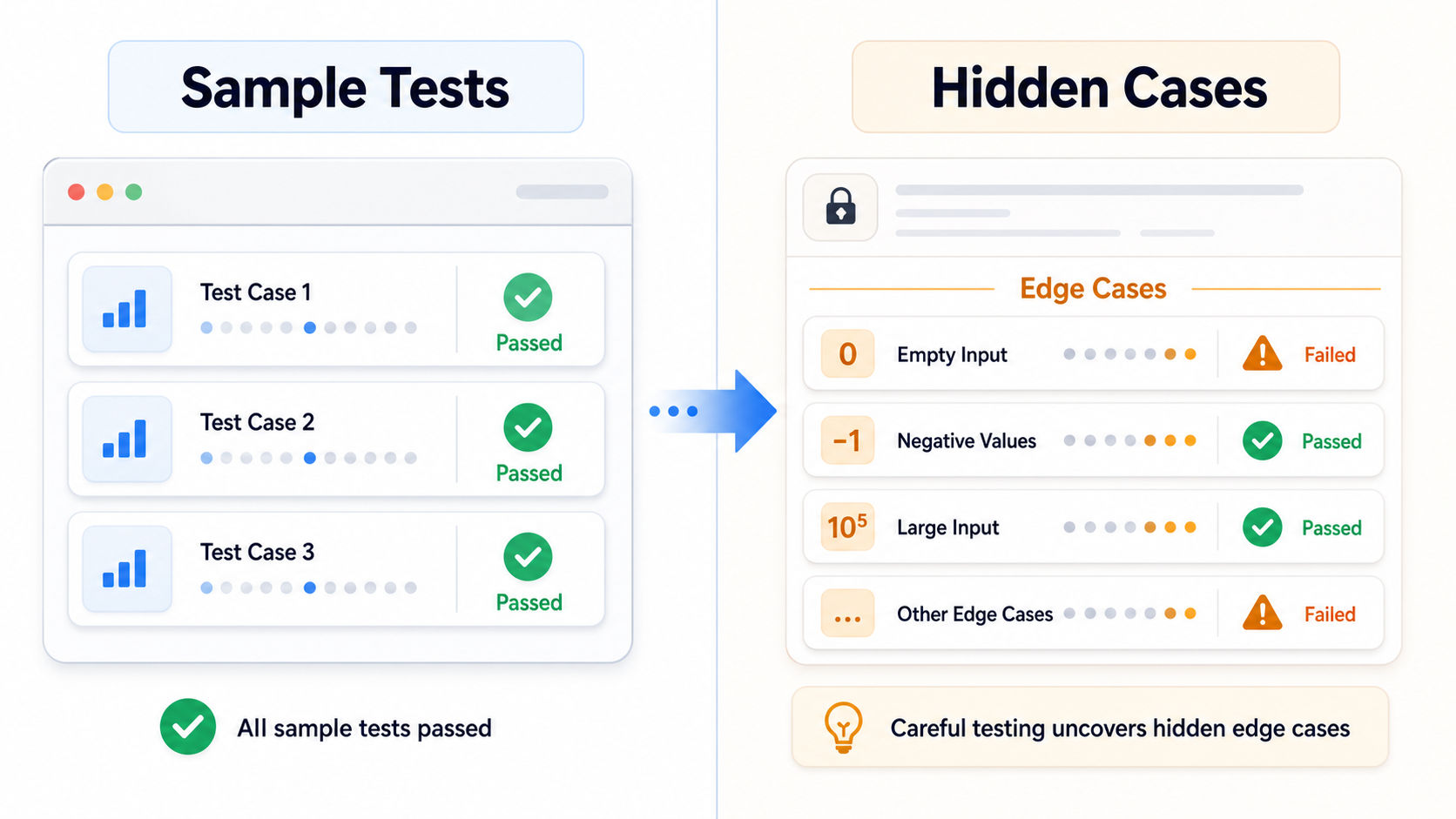
You may see visible sample tests while hidden tests remain invisible. Passing samples does not mean your solution is correct.
Hidden tests often check:
-
Empty input
-
Single element
-
Maximum input size
-
Duplicate values
-
Negative numbers
-
Sorted and reverse-sorted data
-
Large constraints
-
Invalid or tricky formatting
-
Performance limits
That is why your goal is not "make the sample pass."
Your goal is "make the general solution correct."
HackerRank Proctoring and Integrity Rules
HackerRank assessments may include integrity features depending on the hiring company's settings.
HackerRank's test integrity documentation describes several modes and features:
-
Secure Mode: controlled browser environment, full-screen enforcement, copy/paste blocking, multiple-monitor prevention, and tab-switch alerts.
-
Proctor Mode: includes Secure Mode capabilities plus AI-powered screenshot analysis, plagiarism detection, and webcam anomaly detection.
-
Desktop App Mode: adds operating-system-level monitoring through a HackerRank desktop app.
-
Copy/paste tracking: records copy and paste activity in the candidate report.
-
Tab proctoring: tracks when and how long candidates leave the test window.
-
Image proctoring or photo ID: may require webcam access or candidate identity checks.
The most important candidate rule is simple:
Follow the instructions in your test invite and test screen exactly.
If AI tools are allowed, use them only within the stated rules. If the test says AI or outside help is not allowed, do not use it.
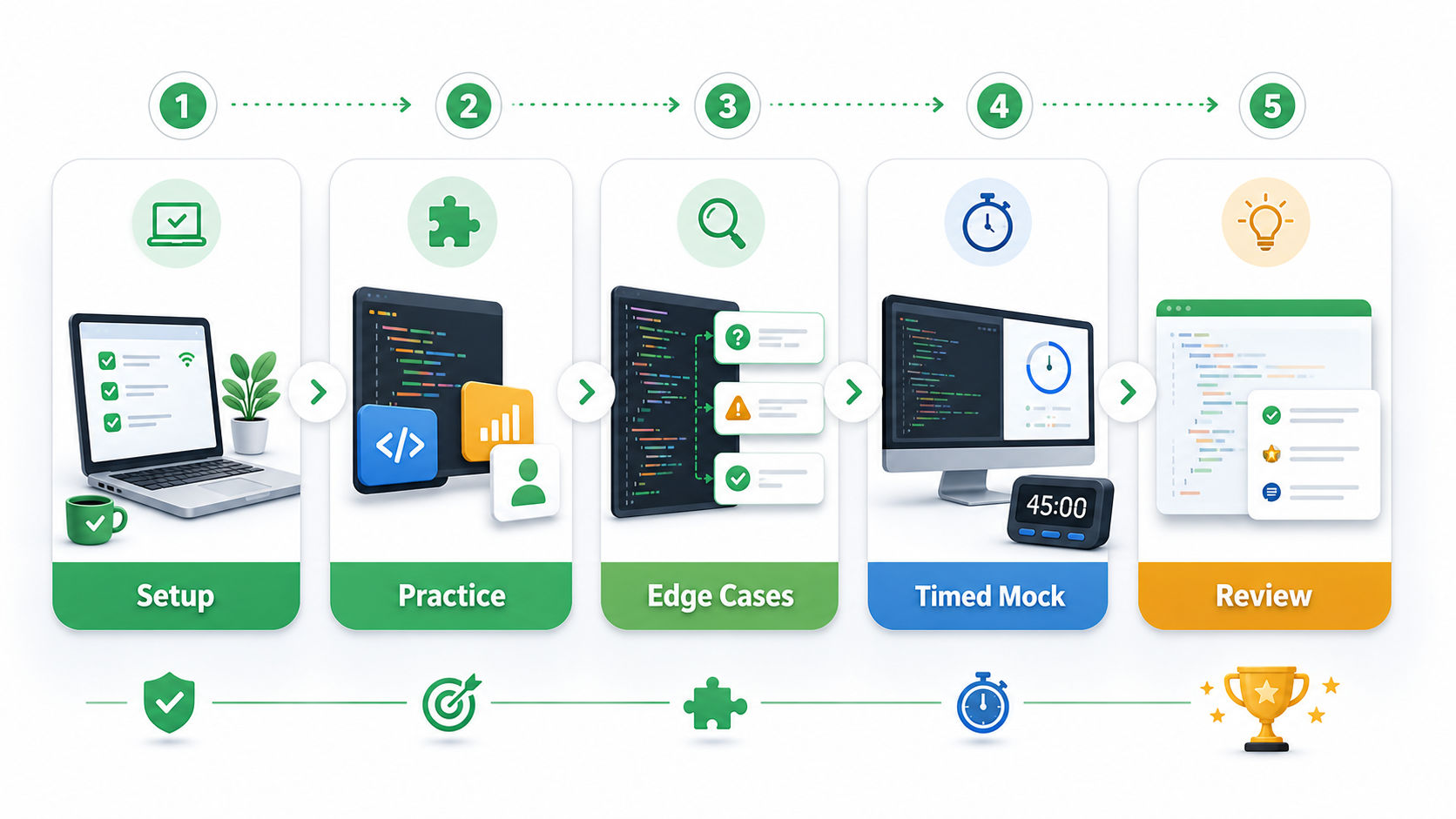
What to Do Before Test Day
1. Take the Sample Test
HackerRank candidate support says candidates can access a sample test from the instructions section of the test login page.
Use it.
The goal is not to learn a new algorithm. The goal is to make the interface feel boring before the real test starts.
Check:
-
How input is provided
-
How output is expected
-
Where custom test cases go
-
How to run code
-
How to submit
-
Where the timer appears
-
Whether the editor shortcuts feel comfortable
2. Prepare Your Environment
HackerRank recommends using a PC or laptop, not a phone or tablet. Candidate support also recommends current versions of major browsers such as Chrome, Edge, Safari, or Firefox, and notes that proctored tests may require a webcam-enabled computer.
Before test day:
-
Charge your laptop.
-
Use stable Wi-Fi.
-
Close unnecessary apps.
-
Disable notifications.
-
Use a quiet room.
-
Test your webcam if proctoring is required.
-
Keep your ID nearby if identity verification is required.
-
Read all instructions before starting.
3. Clarify Rules With the Recruiter
If anything is unclear, ask before the test.
Good questions include:
-
Can I use my own IDE?
-
Can I use language documentation?
-
Is AI assistance allowed?
-
Is the test proctored?
-
Are there multiple questions?
-
Is there a deadline or fixed window?
-
What language should I use?
-
Is SQL included?
Do not assume every HackerRank test has the same rules.
How to Prepare for a HackerRank Online Assessment
Step 1: Identify the Role and Company
Start with the target role.
A backend SWE HackerRank, frontend HackerRank, data analyst HackerRank, and ML engineer HackerRank can feel completely different.
Use company-specific interview prep to understand the likely company loop, then choose your practice topics.
Step 2: Practice Real Questions With Solutions
Start with real interview questions with written solutions.
Do not open the solution immediately.
Attempt the problem first. Then read the written solution and compare:
-
Did you choose the right data structure?
-
Did you miss an edge case?
-
Was your time complexity good enough?
-
Did your code handle input correctly?
-
Did you test large constraints?
Step 3: Train Hidden-Test-Case Thinking
After every question, write your own hidden tests.
For coding questions, test:
-
Empty input
-
One element
-
Duplicate values
-
Negative values
-
Very large input
-
Already sorted data
-
Reverse-sorted data
-
Multiple valid answers
-
Boundary conditions
For SQL questions, test:
-
Nulls
-
Duplicate rows
-
Missing joins
-
Ties
-
Users with zero activity
-
Same-day events
-
Date boundaries
-
Multiple records per entity
This is the habit that turns HackerRank prep from "I passed samples" into "I can survive hidden tests."
Step 4: Practice Under Time
HackerRank OAs are timed.
Practice in timed blocks:
-
10 minutes: read and plan
-
25-35 minutes: implement
-
10 minutes: test and optimize
-
5 minutes: final cleanup
If the problem is easy, move faster. If the problem is hard, at least get a correct brute-force solution before optimizing.
Step 5: Build a Role-Specific Prep Mix
Your prep should match the job.
For SWE roles:
-
Arrays and strings
-
Hash maps
-
Sorting
-
Trees
-
Graphs
-
Dynamic programming
-
Complexity analysis
For data roles:
-
Aggregation
-
Joins
-
Window functions
-
Python basics
-
Product metrics
For senior roles:
-
Coding fundamentals
-
Debugging
-
Tradeoff explanation
-
Communication
For full-loop prep:
-
Ownership stories
-
Conflict stories
-
Debugging stories
-
Project impact
7-Day HackerRank Prep Plan
Day 1: Setup and Baseline
Take the sample test, learn the interface, and solve one easy coding question under time.
Day 2: Arrays, Strings, and Hash Maps
Practice core implementation problems. Focus on clean input handling and edge cases.
Day 3: Sorting, Greedy, and Intervals
Practice problems where the main challenge is choosing the right ordering or merge logic.
Day 4: Trees, Graphs, or Role-Specific Topics
Pick based on your role. For frontend or backend roles, include relevant framework or API fundamentals.
Day 5: SQL or Data Practice
If your role may include data questions, practice SQL joins, aggregation, window functions, and null handling.
Day 6: Timed Mock OA
Run a full timed session. Use no hints. Simulate test conditions.
Day 7: Review and Stabilize
Review missed patterns, re-solve two old questions cold, test your environment, and sleep.
Common HackerRank Mistakes to Avoid
Mistake 1: Only Passing Sample Tests
Sample tests are not enough.
Always write additional custom tests. Hidden cases are where many candidates lose points.
Mistake 2: Starting With the Hardest Question
Scan the test first if allowed.
If there are multiple questions, secure points on easier ones before spending all your time on one hard problem.
Mistake 3: Ignoring Input Format
Many OA failures come from bad parsing, not bad algorithms.
Read input/output instructions carefully. Match output exactly.
Mistake 4: Over-Optimizing Too Early
A correct brute-force solution can earn partial credit or guide your optimized solution.
Do not spend 30 minutes chasing elegance before you have anything working.
Mistake 5: Breaking Integrity Rules
Do not use AI tools, external help, multiple monitors, copy/paste sources, or browser tabs if the assessment forbids them.
HackerRank can track many integrity signals, and the hiring company can review them.
Mistake 6: Practicing Without Company Context
Random coding practice is better than no practice, but company-specific prep is stronger.
Use company-specific interview prep before the OA so your practice matches the company and role.
Practice with real questions from PracHub
A platform or process article cannot honestly attribute one company's question to every employer that uses the format. This set therefore uses real cross-company PracHub questions to rehearse common OA patterns. Each row shows its actual company and stored round; none is claimed to be supplied by this platform.
| Question | Evidence | Difficulty | Main pattern |
|---|---|---|---|
| Q1: Compute Nearest Destination Distances | DoorDash · Technical Screen | Easy | Graphs |
| Q2: Solve two interview coding problems | Uber · Technical Screen | Medium | Strings |
| Q3: Count Special Index Pairs | Google · Technical Screen | Medium | Arrays and hashing |
| Q4: Solve scheduling and collision problems | J.P. Morgan · Technical Screen | Medium | Intervals |
What the prompts actually ask
Q1. Compute Nearest Destination Distances
Bank evidence: DoorDash, Technical Screen, Easy. You are given an m x n grid representing a city map. Each cell contains one of the following characters: - D: a destination - X: an obstacle - .: an open cell For every cell in the grid, compute the length of the shortest path from that cell to the nearest destination.
Q2. Solve two interview coding problems
Bank evidence: Uber, Technical Screen, Medium. The interview included two coding problems. Problem 1: Find valid robot locations in a grid You are given a 2D grid containing empty cells and obstacles. A robot may be placed on any empty cell.
Q3. Count Special Index Pairs
Bank evidence: Google, Technical Screen, Medium. Given an integer array nums of length n, count the number of index pairs (i, j) such that: - 0 <= i < j < n - nums[i] nums[j] is even - j - i is odd Return the total number of special pairs. Constraints & Assumptions - A product is even if at least one of the two numbers is even.
Q4. Solve scheduling and collision problems
Bank evidence: J.P. Morgan, Technical Screen, Medium. The interview included multiple algorithm questions in the same category: 1. Minimum concurrent resources for intervals You are given a list of time intervals, where each interval represents a meeting or a CPU task with a start time and an end time.
Run the set like an assessment
- Read all four prompts first. Give each a difficulty estimate and choose an order before coding.
- Hide the solution. Write the invariant, complexity target, and three edge cases before opening the editor.
- Use one timer. Preserve five minutes at the end for boundary, tie, scale, and output-format tests.
- Log the failure mode. Record the broken invariant or missed edge case, not merely the question title.
FAQ
What is a HackerRank online assessment?
A HackerRank online assessment is a timed technical test sent by a hiring company to evaluate role-specific skills before later interview rounds. It may include coding, SQL, technical multiple-choice questions, debugging, or role-specific tasks. The exact format depends on the company and test configuration.
Is HackerRank proctored?
Some HackerRank tests are proctored, but not all. If your test is proctored, HackerRank says you will be notified in the test invitation email. Proctoring may include webcam checks, tab tracking, copy/paste tracking, secure mode, screenshot analysis, plagiarism detection, or desktop app monitoring.
Can I use ChatGPT or AI during a HackerRank test?
Only use AI if the test instructions explicitly allow it. HackerRank Screen lets companies define when candidates can or cannot use AI, and unauthorized AI use can be flagged as suspicious activity. Always follow the instructions from the hiring company and the test screen.
What questions are on HackerRank assessments?
HackerRank says test questions are based on the role and skills required by the company. Candidates may see coding questions, SQL, frontend or backend questions, technical MCQs, debugging tasks, or other role-specific formats. Open the test link early enough to review instructions and question types if available.
How do I pass hidden test cases on HackerRank?
To pass hidden test cases, practice edge-case thinking. Test empty input, single elements, duplicates, negative values, maximum constraints, sorted and reverse-sorted data, boundary conditions, and performance limits. Do not stop when sample tests pass. Samples only prove the basic format works.
What should I practice before a HackerRank OA?
Practice the topics most likely for your role. Software engineering candidates should practice DSA patterns and implementation. Data candidates should add SQL. Senior candidates may need system design thinking. Use PracHub's real interview questions with written solutions and company-specific prep to make practice more targeted.
Related Resources
-
HackerRank candidate FAQ: https://candidatesupport.hackerrank.com/articles/6145743949-frequently-asked-questions-before-the-test
-
HackerRank test integrity documentation: https://support.hackerrank.com/articles/1079706165-proctoring-hackerrank-tests
-
HackerRank Screen product page: https://www.hackerrank.com/products/screen
-
HackerRank Interview Preparation Kit: https://www.hackerrank.com/interview/interview-preparation-kit
-
PracHub questions: /questions
-
PracHub companies: /companies
Final Verdict: Prepare for the OA Format, Not Just the Algorithm
A HackerRank online assessment is not just a coding problem.
It is a timed, role-specific, rule-bound screening environment. You need algorithm skill, input/output discipline, hidden-test-case thinking, and clean test-day setup.
Start with PracHub.
Use real interview questions with written solutions to build core reps. Use company-specific interview prep to target the company. Add SQL interview practice, system design questions, and behavioral interview practice if your role needs them.
Then simulate the actual HackerRank environment:
-
Timed practice
-
No hints
-
Custom edge cases
-
Clean input parsing
-
Exact output formatting
-
Test-day setup
-
Strict rule compliance
That is how you turn practice into OA performance.
Comments (0)