Stripe AI Coding Interview: How the Round Works and How to Prepare
Quick Overview
Stripe's AI coding round is a multi-part coding problem solved with the interview platform's built-in AI assistant while an interviewer watches. Drawing on the Stripe interview experience posts of nine candidates in our bank (about April to October 2026) and four shorter reports, this guide explains where the round sits in the Stripe loop, which tool candidates used, the transaction rule-engine task most of them describe, the signals interviewers reportedly look for, what happened after the round, and which real Stripe questions to practise. It links the Stripe Integration and Bug Squash round guides and the experience posts it draws on.
Stripe's AI coding round is a multi-part coding problem that you solve with the AI assistant built into the interview platform while an interviewer watches. In most reports in our bank the problem is a small rule engine: transactions are checked against accept or block rules, and the rule language grows with each part. The assistant can type most of the code. Candidates say the marks go to the person who designs the pieces, checks what the assistant wrote and tests it.
Nine candidates describe this round in the 63 Stripe interview experience posts in our bank (counted November 2, 2026). They interviewed between about April and October 2026. Four shorter Stripe reports in our bank, which we turned into practice questions, add three technical screens and an onsite round from a loop with front-end questions. Candidates call the round AI coding, AI programming, AI-assisted coding or agent coding. Stripe has not published a description of the round, so treat what follows as reported, not official, and check your own invitation.
The short version
- Use AI only where your invitation allows it. The reports describe it in this one round, and one candidate was called out for leaving Copilot autocomplete on in an Integration round.
- Practise a transaction rule engine in parts: equality rules first, then AND and OR, then parentheses. Five of the nine candidates and three of the four shorter reports describe rules like these.
- Decide the design yourself and give the assistant one small piece at a time. A staff candidate concluded the interviewer wanted modular code, not one block the agent wrote alone.
- Write your own tests, and keep the earlier parts passing when a new part arrives.
- Prepare the rest of the loop as well. In two reports the feedback blamed other rounds, not the AI round.
What is confirmed and what is only reported
| Source | What it says | What it means for you |
|---|---|---|
| Stripe's careers page | Most hiring processes have a recruiter screen, a technical or skills-based assessment and interviews with the team; timelines vary by role, level and location | Nothing about AI in interviews, and no rubric |
| HackerRank's documentation on its AI assistant in interviews | The interviewer sees your prompts and the assistant's replies as they happen, and the interview report keeps the whole conversation | Every prompt is part of your answer |
| Reports in our bank | An AI round in the phone screen or the onsite, run on the platform's assistant, usually a rule engine in parts | Good evidence of the current format, not a promise |
| Your invitation and recruiter | The tools, language and setup for your loop | The only source that binds |
Where the round sits in the loop
For most candidates in our bank, the AI round is one of the onsite rounds, next to Integration, Bug Squash and a behavioral or hiring-manager conversation. Two candidates at senior level or above met it earlier. One had two phone screens coded with AI, and a staff candidate had it as one of two 60-minute "mini onsite" rounds right after the recruiter screen, paired with system design. Three of the shorter reports put it in a technical screen next to a system design round, two of them at staff level. One loop asked front-end questions, though the candidate calls its phone screen an FDE (forward deployed engineer) screen. Its first onsite round was 90 minutes with AI and built on a React interface the candidate had written in an earlier screen round.
The format can change late. One candidate heard from the recruiter a few days before the onsite that one round had been switched to an AI round. In the new-grad report, the AI coding round had a day to itself, with Integration and Bug Squash the next day. Recruiters told the candidate in that front-end/FDE loop that its questions were new and still being calibrated.
The other rounds have their own guides: the Stripe Integration round guide and the Stripe Bug Squash guide. The Stripe software engineer interview guide covers the whole process, and our AI coding interview guide covers AI-assisted rounds in general.
Is AI allowed, and which tool?
In this round, yes, and the tool is the assistant inside the interview platform. One report describes an AI chat box in HackerRank where you write prompts to get the code written. Another says the exercise used the AI built into the platform, in Python. A third candidate used an Opus model. A staff candidate on HackerRank's assistant advises picking Gemini Flash, because the other models took more than a minute to return code. A senior candidate described the round as using a Codex agent to write code that passes the tests. No report in our bank describes bringing your own assistant.
HackerRank's documentation explains the setup. The company picks which models candidates may use. Your prompts and the assistant's replies appear on the interviewer's screen as they happen, and the interview report keeps the whole conversation. In HackerRank's current interview interface, a plain coding question gets a guarded assistant, which helps with syntax and concepts but does not write complete solutions. A code-repository question gets an unguarded assistant with Plan and Agent modes that can write and edit files. No report names the mode, but an assistant that writes most of the code sounds like the unguarded setup. Ask your recruiter which one you will have. Our guide to HackerRank's AI assistant covers both modes in more detail.
Outside this round, assume no AI. A senior candidate described the round after the AI round as coding without AI, and another candidate was called out for forgetting to turn off Copilot autocomplete during an Integration round. AI can also come up as a topic: one recruiter screen asked whether the candidate had used AI in their work and what that looked like.
The task: a rule engine that grows each part
Five of the nine candidates describe a rule parser or rule evaluator, and so do three of the four shorter reports. Two experience posts list the parts in detail, and they agree:
- Part 1. You get one transaction (a set of fields) and an ordered list of rules. Each rule checks string equality, such as a merchant name equal to a given value, and says accept or block. The first rule that matches decides. If none matches, the answer is accept. The field and the constant can sit on either side of the equals sign.
- Part 2. Boolean fields arrive, and conditions can be joined with AND and OR. In the staff candidate's version, this part ignored precedence.
- Part 3. Conditions can be nested with parentheses.
The staff candidate finished three parts and was told there were many more and that they would not finish them all. A third report, from a senior candidate, describes similar inputs (rules written as strings and a list of transaction records) and says you had to write the test cases as well as pass them. In the most detailed report, the interviewer asked what happens when a merchant name itself contains the word "and" or "or".
A staff phone screen framed the same idea as access control. Part 1 rules read like "BLOCK if fraud_flag" or "ACCEPT if trusted_partner". Part 2 added boolean expressions such as amount > 10000, joined with AND or OR. Rules ran in the order they were added, and the first one to accept or block decided.
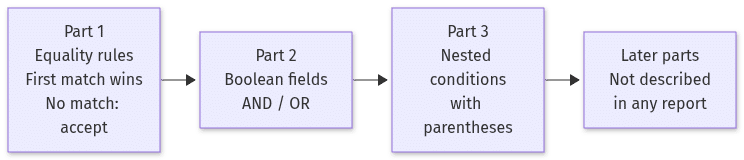
Not every report names the problem. One says the round looked like the earlier multi-part coding rounds with an assistant added, and others remember only the format. The front-end/FDE loop is the exception: its AI round extended a React interface, with UI design and API caching.
Asked at Stripe: Evaluate Ordered Accept/Block Transaction Rules with AND, OR and Parentheses and Build a Transaction Rule Engine with AND/OR Chains and Nested Parentheses are this task as two candidates reported it. Design a String-Rule Validator for Transaction Records is the senior candidate's version, and Evaluate Ordered Access-Control Rules is the staff phone-screen variant.
Tests worth writing as you go
The rule syntax below is made up for illustration. Use whatever format your prompt gives.
| What it checks | Rules, in order | Transaction | Expected |
|---|---|---|---|
| First match wins | 1: merchant == "acme" → block; 2: merchant == "acme" → accept | merchant = acme | block |
| Default when nothing matches | card == "visa" → block | card = amex | accept |
| Constant on the left | "acme" == merchant → block | merchant = acme | block |
| An operator word inside a value | merchant == "salt and pepper" → block | merchant = salt and pepper | block |
| Precedence (ask before coding) | a == "x" OR b == "y" AND c == "z" → block | a = x, b = n, c = n | left to right: accept; AND before OR: block |
| Parentheses | (a == "x" OR b == "y") AND c == "z" → block | a = x, b = n, c = z | block |
The precedence row is the one to settle with the interviewer. Read left to right, the rule is (true OR false) AND false, so it does not match and the default accept applies. With AND binding tighter, it is true OR (false AND false), which matches and blocks.
How it is scored, as candidates report it
There is no public rubric for this round, and candidates read the interviewer's goals differently. These are the signals they named:
| Signal | What the candidate said | Report |
|---|---|---|
| Catching the assistant's mistakes | The main test is whether you spot and fix the AI's errors instead of accepting what it produces | AI pair-coding onsite |
| Directing, then reviewing | Ask the AI for the algorithm and for the function and class design, let it write the code, then say what is wrong with it | AI phone screens |
| Owning the design | Looking back, the interviewer wanted the candidate to lead the design and write modular code rather than let the agent produce one monolithic solution | Staff mini onsite |
| Explaining your thinking | The candidate explained all of the generated code and wrote tests, yet the feedback said the reasoning was not explained enough | Five-round onsite |
| Your own tests | Writing the test cases was part of the task | Senior onsite |
| Showing your own skill | Letting the assistant read the README and produce the answer shows nothing of your ability, yet dictating the whole solution defeats the point of the AI. Keep talking while you review and while the assistant works | A staff phone-screen report in our bank |
| The workflow | Do not one-shot it: plan, break the task down, run agents in parallel, have the work reviewed, then check it yourself. The problem is easy; the round tests how you work with AI | A front-end/FDE onsite report in our bank |
| Speed | About 30 minutes of real coding time; one candidate guessed that writing it by hand would most likely run out the clock | Five-round onsite, Java-track onsite |
Two reports point the other way. One candidate admits not following all of the model's code and says the interviewer told them there was no need to keep writing because he trusted the model to handle the requirements. The candidate with two AI phone screens felt that letting the AI write everything was fine. Both still discussed the code with the interviewer. Two other candidates said they could not tell what the round was judging, and a third was unsure how much to lean on the AI.
Taken together, the reports suggest letting the assistant do the typing while you keep the decisions, the checking and the explanation.
Stripe has not said why it added the round, but its engineering blog shows that reviewing machine-written code is ordinary work there. A February 2026 Stripe.dev post on Minions, its internal coding agents, says more than a thousand pull requests merged each week are produced entirely by the agents, and that people review them. Stripe's careers page links to that post.
How to work the round
- Read the prompt and pin down the rule grammar before you prompt anything. Ask about precedence, letter case, spaces, quoting and what to do with an unknown field.
- If you can choose the model, check early how fast it answers. One candidate advises Gemini Flash; the other models took more than a minute to return code.
- Say the design out loud: a tokenizer, a parser that builds a condition tree, an evaluator, and a loop that applies the rules in order. Each new part then changes one piece.
- Prompt for one piece at a time, with its input, its output and the constraint that existing tests keep passing.
- Read every change before you run it. Then run your tests, including the ones from earlier parts.
- When a test fails, say what you think is wrong before you ask the assistant to fix it.
- Keep talking. The interviewer can read the chat but not why you accepted a change.
| Weak prompt | Stronger prompt |
|---|---|
| "Solve this problem." | "Write a tokenizer for these rules. A quoted string stays one token even if it contains 'and'. Return the list of tokens and do not evaluate anything yet." |
| "Add AND and OR." | "Extend the parser so a condition can be two conditions joined by AND or OR, evaluated left to right. Keep the Part 1 tests passing." |
| "Fix the bug." | "The test with the constant on the left fails because the parser expects a field name first. Change only the comparison parser so it accepts either order." |
What candidates report
| Report | Level | Where the AI round was | What they said | Outcome |
|---|---|---|---|---|
| Five onsite rounds | Software engineer | Onsite, first round, switched to AI a few days before | A rule parser in several parts and about 30 minutes of real coding; the feedback said the reasoning was not explained enough | Rejected |
| OA to onsite with AI pair coding | Software engineer | Onsite | Like the earlier multi-part rounds, with an assistant; the point is catching its mistakes | Not stated |
| AI-assisted phone screens | Senior or above | Two phone screens | Let the AI write the code, review it, and ask it about the algorithm and the design | Rejected after the onsite, on the behavioral rounds |
| New AI coding, debug and integration questions | Software engineer, Java track | Onsite | HackerRank's AI chat box; by hand you would probably run out of time | Not stated |
| Bug hunt, AI pairing and map drawing | Senior | Onsite, second round | String rules checked against transaction records, and you write the tests | Rejected |
| AI coding, reconciliation and a debugger that would not run | Software engineer | Onsite | The rule parser, solved with an Opus model; the interviewer said there was no need to keep writing | Rejected, on Bug Squash and Integration |
| Reconciliation, a requests 307 bug, BikeMap and an AI exercise | Software engineer | Onsite | The platform's AI, in Python; ordered accept or block rules over three parts | Rejected |
| Feature flag design and an AI coding round | Staff | Mini onsite after the recruiter screen | Transactions and rules; finished three of many parts and wished they had led the design | Rejected |
| New-grad onsite | New grad | Onsite, on its own day | Few details on the AI task itself | Rejected |
None of the nine candidates reports an offer: seven were rejected and two do not say. The four shorter reports behind Stripe practice questions in our bank:
| Level | Where the AI round was | What they said | Outcome |
|---|---|---|---|
| Staff | Phone screen, before a system design round | The rule parser. Feeding the README to the assistant gives an answer but shows nothing of you; keep talking while it works | Failed, told three business days later |
| Staff | Phone screen, next to a system design round | Access-control rules on HackerRank's assistant; pick a fast model; unclear what was judged | Not stated |
| Software engineer | Technical screen, next to a system design round | Fraud rules on transactions; AI could write the code | Not stated |
| Not stated | Front-end/FDE loop, onsite, first round, 90 minutes | Extend a React interface; plan and split the work instead of one-shotting it | Failed the round |
Thirteen accounts cannot tell you a pass rate, so read them for what went wrong.
Practice with real Stripe questions from our bank
These questions come from reports by Stripe candidates. Use them as practice, not as a prediction of your prompt.
The AI round's task
- Evaluate Ordered Accept/Block Transaction Rules with AND, OR and Parentheses: first-match rules, then AND and OR, then parentheses.
- Build a Transaction Rule Engine with AND/OR Chains and Nested Parentheses: the staff candidate's version, built one part at a time.
- Design a String-Rule Validator for Transaction Records: string rules applied to a list of transaction records, with your own tests.
- Evaluate Ordered Access-Control Rules: the staff phone-screen variant, with flag rules first and then AND and OR over expressions such as amount > 10000.
Rule questions from earlier Stripe screens
Do these by hand first. They train the same parsing and ordering logic without an assistant.
- Process auth requests with fraud rules: approve or reject card authorizations once a fraud rule on a field takes effect.
- Validate transactions with risk rules and reporting: parse CSV input and flag transactions with rule-based fraud checks.
The rest of the loop
- Render a GeoJSON Bike Ride with Markers and Alternating Paths via a Map API (Integration)
- Match Payments to Invoices by Memo ID, Exact Amount, then Amount Tolerance (Integration)
- Fix Seekable POST Body Replay After a 307 Redirect in Python requests (Bug Squash)
- Background, AI use at work, misalignment with a company Stripe works with, why Stripe (recruiter screen)
- Build and Optimize a React Interface Against an Undocumented API (front-end/FDE loop; the AI onsite round extended it)
A five-day prep plan
| Day | What to do |
|---|---|
| 1 | Build Part 1 of the rule engine by hand in your interview language, using the test table above. Time yourself. |
| 2 | Redo Parts 1 to 3 with an AI assistant. Plan the modules first, then prompt for one piece at a time. Save the chat and read it back the way an interviewer would. |
| 3 | Practise review. Take the assistant's first answer, or ask for code with a planted bug, and find the fault from the tests before you read the whole diff. How to review AI-generated code in an interview ends with a checklist. |
| 4 | Turn the assistant off and do one Integration and one Bug Squash question from the list above. |
| 5 | Prepare two project stories and a short answer on how you use AI at work. Confirm the platform, language and allowed tools with your recruiter, and set up your IDE if the invitation asks for it. |
What happens after the round
The AI round is judged together with the rest of the loop. Candidates in our bank heard back within a few days to a week:
- The senior candidate learned two to three days after the onsite that they had been rejected.
- The new-grad candidate was rejected on October 15, two days after the last onsite day. Their whole process took about six weeks: the role opened on September 3, the online assessment arrived on September 4, the technical screen took place on September 25 after one reschedule, and the onsite ran on October 12 and 13.
- One candidate got a recruiter call a week later. Overall performance was positive, but Bug Squash and Integration fell short of the bar. The recruiter encouraged them to reapply early the next year, and the candidate notes that the usual wait is a year.
- The candidate with two AI phone screens was told the technical side was fine but the behavioral answers did not show staff-level scope.
- A staff candidate heard three business days after an AI phone screen that they had failed.
Stripe's careers page says timelines vary by role, level and location, and that the company tries to give clear feedback at every stage.
Sources
- Stripe careers page: the FAQ on what to expect during the hiring process.
- Minions: Stripe's one-shot, end-to-end coding agents, Stripe.dev, February 9, 2026.
- HackerRank: AI Assistant in Interviews: the current interview interface, guarded and unguarded modes by question type, model choice and the saved conversation.
- HackerRank: AI-Assisted Interviews: the legacy interface, what the interviewer sees and the chat transcript.
- Reports in our bank: the Stripe interview experience posts linked above, from nine candidates, and the four shorter reports behind Stripe practice questions, read in full on November 2, 2026.
Checked November 2, 2026. Interview formats change, so your invitation and your recruiter have the final word.
Comments (0)