Stripe Bug Squash Interview Guide: How to Debug an Unfamiliar Codebase
Quick Overview
The Stripe Bug Squash interview tests how software engineers debug an unfamiliar codebase under time pressure. This guide explains the likely format, what interviewers evaluate, how to reproduce and localize failures, use hypothesis-driven debugging, choose effective tools, make a minimal safe patch, add regression coverage, and practice with realistic repositories. It also links to PracHub’s company-specific Stripe questions and full-loop preparation resources.
A failing test tells you where the system noticed a problem, not necessarily where the bug lives. That distinction is the heart of Stripe’s Bug Squash interview.
Candidate reports commonly describe a practical debugging round involving an unfamiliar repository and broken behavior. Your goal is not to understand every file, but to reproduce, isolate, fix, and validate the failure.
Start with real Stripe interview questions on PracHub and use the Stripe Software Engineer Interview Guide to see how debugging fits beside coding, integration, system design, and behavioral rounds. Exact interview mechanics vary by role and team, so confirm the environment and allowed tools with your recruiter.
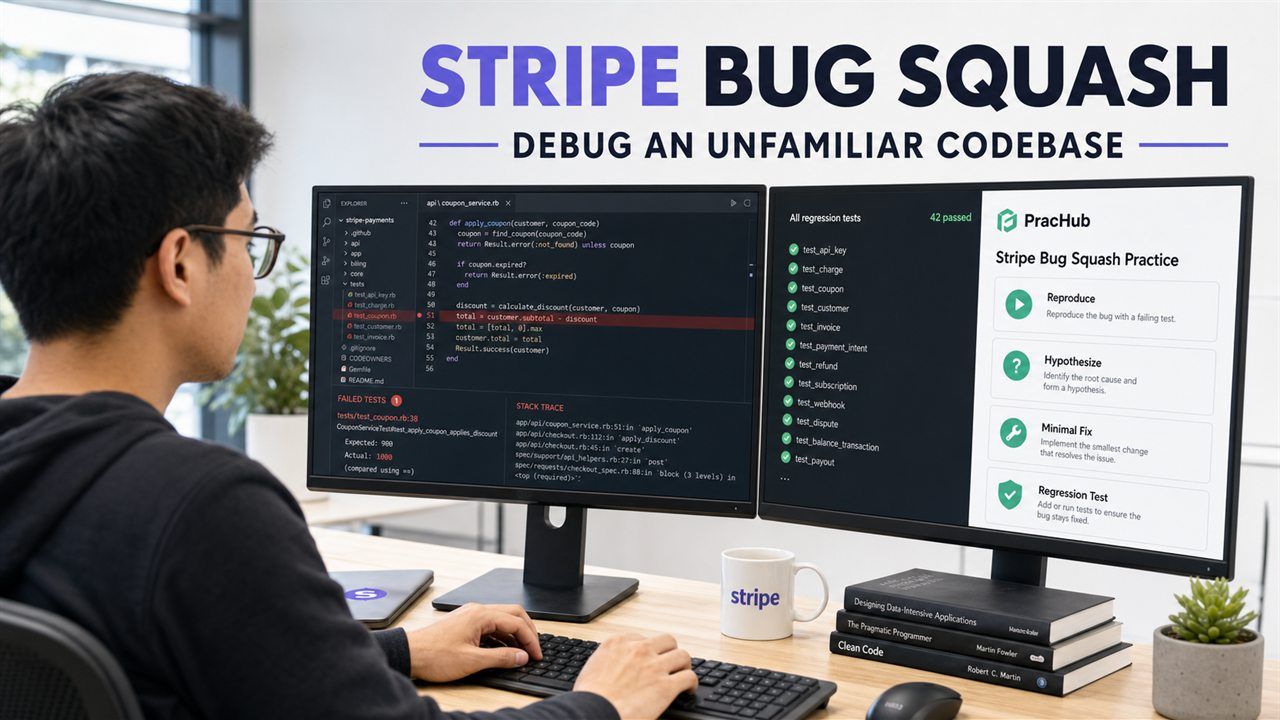
Bug Squash tests how you investigate unfamiliar code, not how quickly you guess a patch.
Quick Verdict
The best Bug Squash strategy is scientific, not heroic. Reproduce the problem, follow the failing path, state a specific hypothesis, run the cheapest experiment that could disprove it, and change only what the evidence supports.
Make progress visible. Even before the fix, the interviewer should know what you observed, ruled out, and plan to test next.
What Is the Stripe Bug Squash Round?
PracHub’s Stripe guide and recent candidate-focused guides describe Bug Squash, sometimes called Bug Bash, as an unfamiliar-code debugging exercise involving a failing test, open issue, or broken behavior.
This is different from the Integration Round. Integration asks you to implement behavior against an API or existing structure. Bug Squash begins with something already wrong and evaluates how efficiently you locate the cause and repair it without damaging unrelated behavior.
| Signal | Strong Evidence | Weak Evidence |
|---|---|---|
| Orientation | Finds the test command, entry point, and failing path | Reads the repository from top to bottom |
| Reasoning | Connects each action to a hypothesis | Changes code to see what happens |
| Tool use | Uses focused tests, search, logs, or breakpoints deliberately | Uses tools without narrowing the question |
| Fix quality | Makes the smallest change that addresses the root cause | Rewrites adjacent code unnecessarily |
| Validation | Adds or runs a regression test | Stops when the original test turns green |
Your First Ten Minutes in an Unfamiliar Codebase
Reproduce Before You Repair
Run the documented test before editing. Capture the exact error, assertion, stack trace, and triggering input. If it does not reproduce, investigate setup or environment before touching business logic.
Read from the Symptom Inward
Begin with the failing test. Trace only the call path and data needed to explain the symptom. Search for the relevant symbol, error, route, or field instead of opening every directory.
State a Narrow Hypothesis
“The parser is broken” is too broad. A useful hypothesis predicts what you will observe in one focused test, log statement, breakpoint, or tiny input.
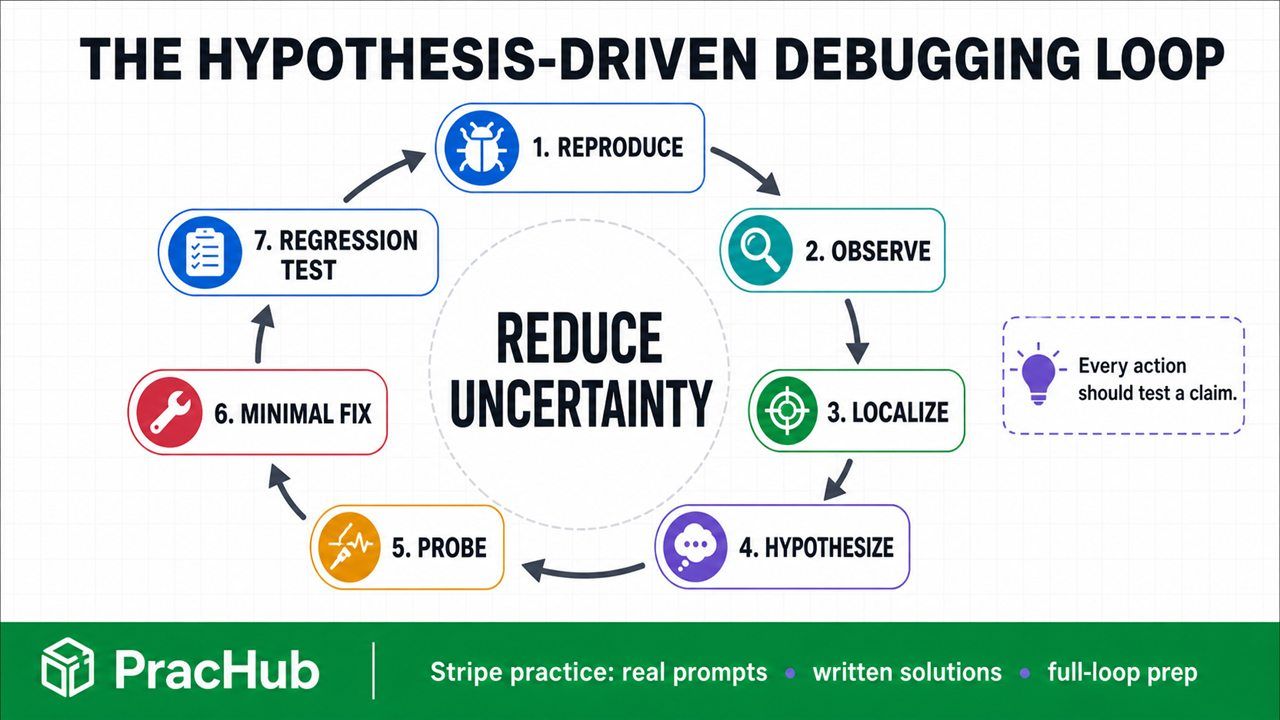
Every debugging action should reduce uncertainty, not merely produce activity.
The Debugging Loop That Works Under Pressure
- Observe. Record the smallest reproducible symptom and the expected behavior.
- Localize. Trace the relevant data and control path until the suspicious surface is small.
- Hypothesize. Name one cause that predicts the evidence you already have.
- Probe. Run the cheapest test that could prove the hypothesis wrong.
- Patch. Change the minimum code required to correct the root cause.
- Validate. Run a focused regression test, then the relevant broader suite.
Narrate transitions rather than every keystroke. Say, “The value is correct before normalization and wrong afterward, so I’m narrowing to these two functions.” That gives the interviewer a useful view of your reasoning without slowing you down.
Choose the Right Debugging Tool
Use the cheapest tool that answers the current question. Search locates symbols, tests isolate boundaries, logs reveal data flow, and breakpoints expose changing state.
Stripe’s Workbench article emphasizes building context and using inspection tools to reach root cause. The interview analogue is simple: collect narrowing evidence, then act.
Use the Existing Tests as Documentation
Tests reveal public behavior, naming conventions, fixtures, and expected edge cases. Read neighboring passing tests to learn the contract. Add the smallest failing example that captures the bug before or alongside the fix when time allows.
Common Bug Shapes to Practice
| Bug Shape | Typical Clue | Focused Probe |
|---|---|---|
| Boundary error | Fails only for empty, first, last, or single item | Minimal boundary inputs |
| Parsing mismatch | One format or optional field breaks | Small fixture with the missing field |
| State mutation | Order-dependent or repeated-call failure | Run twice or reverse test order |
| Async timing | Intermittent result or missing update | Control scheduling or await completion |
| Configuration path | Works locally but not in the test setup | Inspect environment and resolved path |
Practice categories, not leaked prompts. You want the ability to recognize evidence patterns in any repository, language, or framework.
Make the Smallest Safe Fix
A minimal patch is easier to reason about, easier to validate, and less likely to create a second bug. Keep formatting changes, refactors, dependency upgrades, and unrelated cleanup out of the fix unless they are necessary for correctness.
After the focused test passes, run the nearby suite. Review the diff as if it were a pull request: does the change match the hypothesis, preserve existing behavior, and communicate intent? If you found only the symptom, keep investigating rather than adding a special case that hides it.
A Time-Boxed Bug Squash Practice Run
Use an unfamiliar small repository and one hour as a practice constraint, not an official Stripe duration. Start by reproducing the issue and mapping its path.
Use the middle to test hypotheses and land the smallest fix. Reserve the end for regression coverage, diff review, and a concise root-cause explanation.
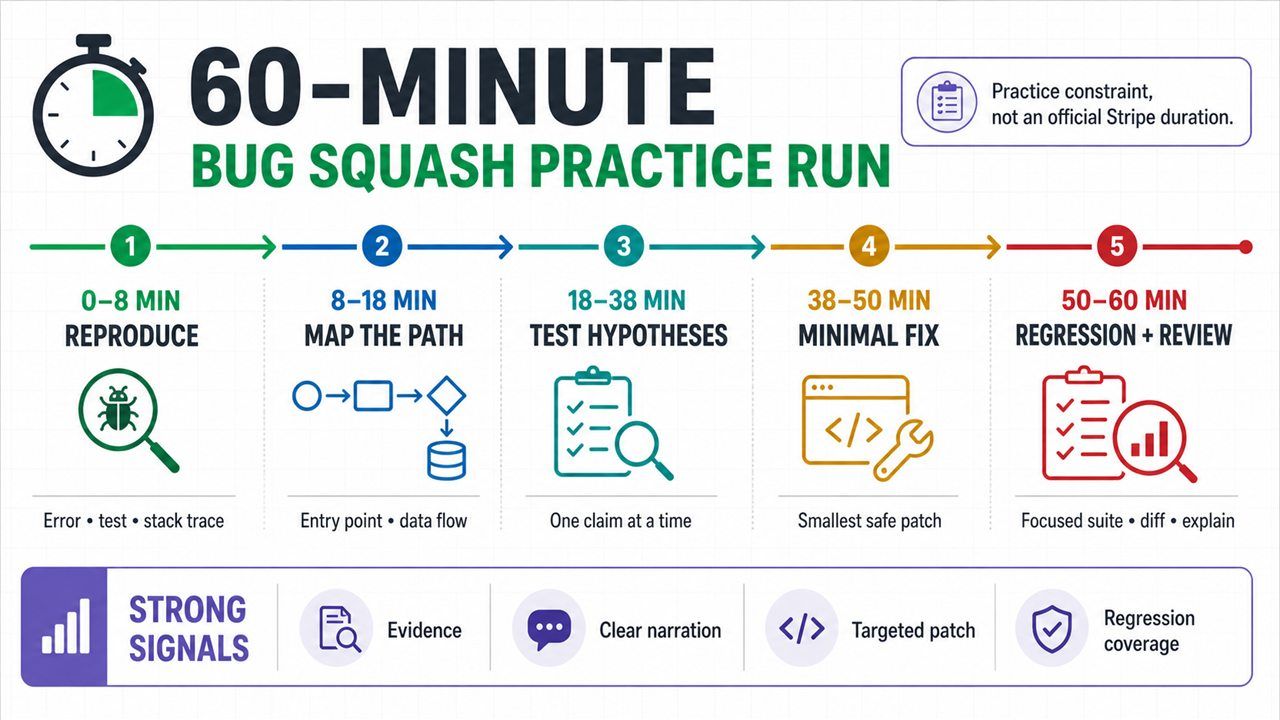
A good practice run measures evidence gained, not files opened.
A Mock Exercise You Can Run Today
Choose a small open-source project in your strongest language, check out a version with a known fixed issue, and hide the patch. Start only from the issue description or failing regression test. Record your screen or explain each hypothesis aloud.
Work without viewing the original commit, then compare diffs. Score unnecessary files opened, unsupported edits, time to first hypothesis, regression coverage, and narration.
Use PracHub’s real interview question bank for Stripe-style implementation and debugging context. Senior candidates should also practice system design questions so they can discuss the reliability or maintainability implications after fixing the immediate defect.
What Senior Candidates Should Add
Senior and staff candidates should still prioritize the immediate fix. After validation, briefly identify blast radius, observability gaps, related paths that deserve audit, and how the regression test belongs in CI. Separate what you would do now from a longer-term refactor.
Show that you can repair today’s bug and prevent its return without turning a timed exercise into an architecture lecture.
Frequently Asked Questions
Do I need to understand the whole repository?
No. Model only the failing path: input, entry point, transformation, state change, and output. Expand scope only when evidence shows the boundary is incomplete.
Should I add logs or use a debugger?
Use whichever tool answers the hypothesis fastest. Explain what it will prove, and remove noisy temporary instrumentation from the final patch.
What if I cannot finish the fix?
Keep reasoning visible. State the smallest confirmed facts, the leading hypothesis, the next experiment, and the risk of an unverified patch. A disciplined investigation provides a stronger signal than rushing into a broad change that happens to make one test pass.
Can I use AI coding tools?
Do not assume so. Tool policies can change by team and interview format. Ask your recruiter what editors, documentation, search, debuggers, and assistants are allowed. Prepare to debug independently so your performance does not depend on a tool that may be prohibited.
Final Checklist
Before the interview, practice reproducing failures, searching unfamiliar repositories, tracing stack frames, writing focused tests, testing one hypothesis at a time, making minimal patches, and reviewing diffs. Rehearse concise narration until it feels natural.
Then connect the round to the full Stripe loop. Use PracHub for company-specific Stripe preparation, written solutions, and realistic coding prompts. Add behavioral and leadership practice so you are ready to explain not only how you fixed a bug, but how you handled incidents, ambiguity, and collaboration in real work.
Sources
PracHub Stripe SWE interview guide · Stripe software engineering role · Stripe engineering blog · Stripe Workbench debugging article
Comments (0)