AI Engineer Interview Questions 2026: RAG, Agents, Evals, and Production Systems
Quick Overview
A role-level AI Engineer interview guide covering project deep dives, model API contracts, RAG and agent debugging, evaluation, security, latency, cost, incidents, and production ownership.
AI Engineer Interview Questions 2026: RAG, Agents, Evals, and Production Systems
Quick answer: AI Engineer interviews in 2026 often test whether you can turn a model capability into a dependable product. Expect role-level questions about API contracts, coding and debugging, retrieval, tool-using agents, evaluation, security, latency, cost, and production recovery. RAG (retrieval-augmented generation) grounds responses in selected external data; an agent dynamically chooses tools or steps; evals are structured tests of behavior and outcomes. A strong answer defines success, isolates failure modes, proposes evidence, and explains what should happen when the AI system is wrong.
Use the PracHub interview question bank to practice that reasoning aloud. The records are practice material, not leaked questions or predictions of your exact interview. Formats vary by employer and level, so prepare for a mix of technical discussion, implementation, system design, project deep dives, and behavioral judgment rather than memorizing one universal sequence.
What AI Engineer interviewers are trying to learn
The role sits between software engineering, applied AI, data, and operations. Interviewers may probe whether you can integrate a model behind a typed contract, debug a retrieval or tool trace, design an evaluation that matches user value, and operate the result under real latency and cost limits.
That is broader than a single architecture round. For a complete ingestion-to-serving design, use the Generative AI system design interview guide. This article stays at the role level: representative questions, concise answer rubrics, and the production judgment each question reveals.
Interview formats vary, but these are common ways teams can test that role-wide judgment:
| Interview surface | Evidence to demonstrate |
|---|---|
| Project deep dive | Personal ownership, measurable outcome, and learning after launch |
| Build or debugging task | Typed contracts, tests, traces, and disciplined failure isolation |
| Architecture discussion | The smallest system that meets quality, safety, latency, and cost constraints |
| Production or behavioral scenario | Release judgment, incident recovery, communication, and explicit trade-offs |
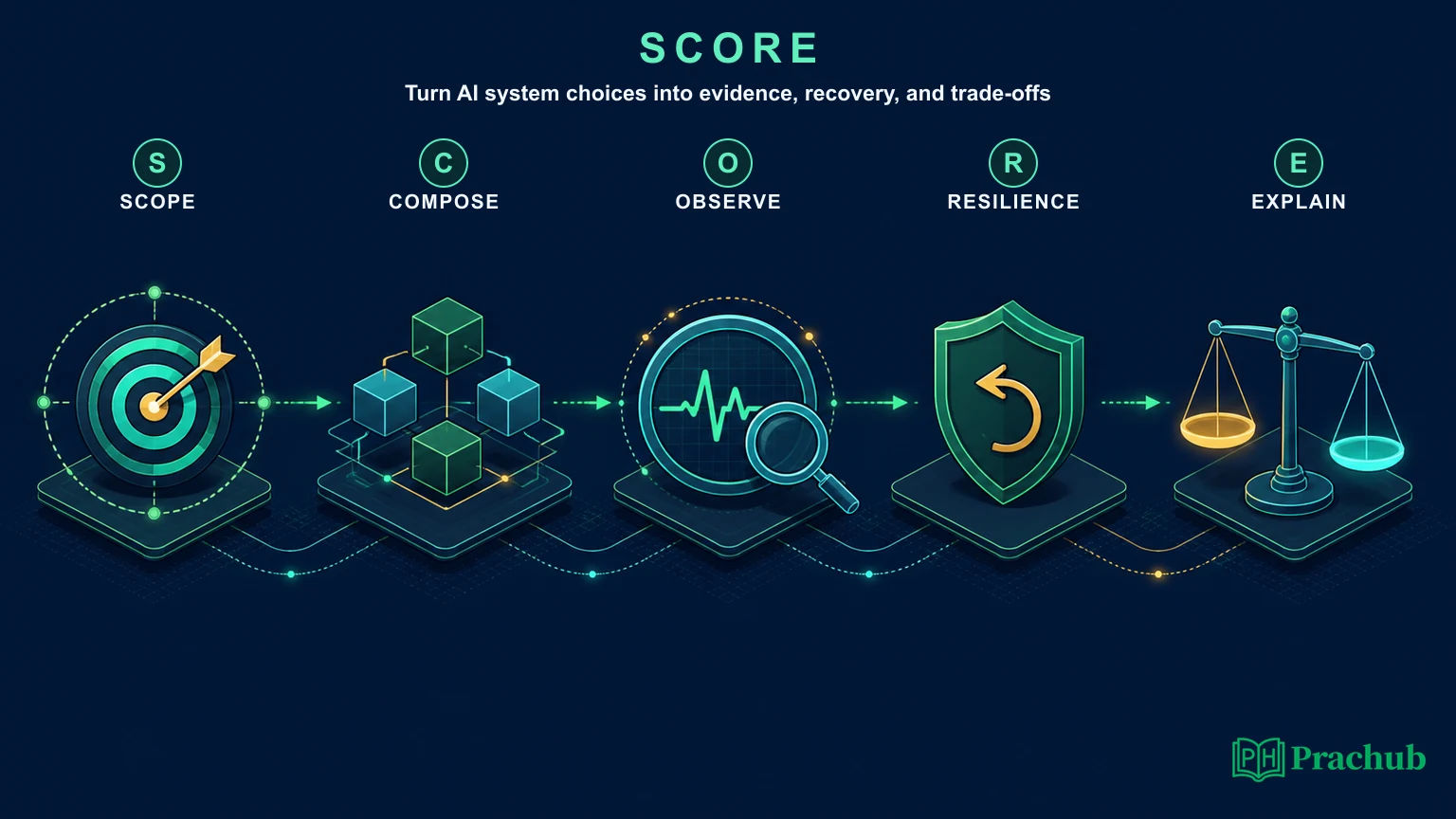
Use SCORE to structure AI Engineer answers
SCORE is a PracHub synthesis for interview practice, not an employer's official rubric or a universal scoring model.
| Step | What to state | What it prevents |
|---|---|---|
| S — Scope | User, task, constraints, risk, and measurable success | Solving an impressive but irrelevant problem |
| C — Compose | The smallest useful combination of model, retrieval, tools, data, and service contracts | Adding autonomy or infrastructure without a defined purpose |
| O — Observe | Offline evals, online metrics, traces, and user impact | Shipping on a few convincing demos |
| R — Resilience | Failure paths, permissions, fallbacks, rollback, and recovery | Ignoring partial failure or unsafe actions |
| E — Explain | Quality, latency, cost, complexity, evolution, and the experiment that resolves uncertainty | Hiding the decision behind a list of components |
You do not need to recite the acronym in every answer. Use it as a silent checklist. Start with the user outcome, make interfaces explicit, define evidence, cover failure recovery, and close with the trade-off you would accept.
1. Walk me through an AI system you shipped
Strong answer signals: Choose one system you understand end to end. Explain the user problem, your exact responsibility, baseline, architecture decision, evaluation method, launch guardrail, and a change you made after real feedback. Separate team outcomes from your contribution.
Use concrete evidence without inventing false precision: task-success movement, latency percentile, cost per completed task, escalation rate, or a failure category you reduced. The best ending is not “the model worked.” It is what surprised you, how you found it, and what you would redesign now.
2. How would you integrate an LLM behind a reliable application contract?
Strong answer signals: Define a schema, validate every response, handle refusals and missing fields, set timeouts and bounded retries, and preserve an explicit error path. Version the prompt, model, schema, and relevant parameters together so an incident can be reproduced.
Structured-output features can improve conformance, but do not prove factual correctness, authorization, or business validity. Test malformed and semantically invalid cases independently. If the model produces an order total, for example, application code should still verify the calculation and permissions before committing a side effect.
3. A RAG answer is wrong even though the expected document exists. How do you debug it?
Strong answer signals: Split the pipeline before changing prompts. Confirm ingestion and freshness, access filters, chunk boundaries, query transformation, retrieval candidates, reranking, context assembly, and final generation. Capture the retrieved document IDs and scores for the failing query.
Then classify the failure: the right passage was never indexed, was filtered out, ranked too low, truncated from context, or supplied correctly but misused by the model. Measure retrieval and generation separately, add the incident to a regression set, and change one component at a time. For deeper design choices, see Designing RAG Architecture at Scale.
4. When would you use an agent instead of a deterministic workflow?
Strong answer signals: Anthropic's engineering guidance distinguishes code-defined workflows from agents that dynamically direct their process and tool use. Prefer a workflow when the steps and branches are known. Consider an agent when the task requires flexible planning or tool selection and the additional latency, cost, and uncertainty are justified. Define tool schemas, least-privilege credentials, state ownership, stop conditions, budgets, and approval points for consequential actions.
If an agent loops or calls the wrong tool, inspect the trace: instructions, available tools, arguments, tool results, state transitions, retry logic, and final environment state. Do not accept the agent's claim that it completed the task; verify the outcome in the system of record.
5. How would you build an eval set and decide whether a change can ship?
Strong answer signals: Begin with the product decision. Current evaluation guidance recommends task-specific tests, continuous evaluation, production-like data, and human calibration. Build tasks from requirements, production failures, common usage, edge cases, and high-impact harms. Use deterministic graders for verifiable outcomes, model-based rubrics for subjective qualities, and human review to calibrate ambiguous judgments.
Run repeated trials when outputs vary, inspect traces rather than trusting one aggregate, and report failure slices as well as an average. Define a regression gate plus explicit latency, cost, and safety constraints. A release decision should name which metrics must not regress and which improvement justifies the change. The LLM evaluation interview guide covers grader design in more depth.
6. Can an LLM-as-judge be trusted?
Strong answer signals: Treat a judge as a measurement instrument, not ground truth. Write a task-specific rubric, blind it to irrelevant labels when possible, test order and verbosity effects, and compare its decisions with domain experts on a representative sample. Investigate disagreement by slice.
Combine the judge with executable or state-based checks whenever the outcome is verifiable. For agents, trace grading can help inspect tool choices and trajectories, but it still needs a defined rubric and calibrated labels. Recalibrate after model, prompt, product, or traffic changes. A candidate who names a judge model without discussing bias, leakage, variance, and human calibration has not completed the evaluation design.
7. Quality improved, but latency and cost became unacceptable. What do you do?
Strong answer signals: First define the user-facing latency objective and cost unit, such as cost per resolved task rather than cost per token. Break the trace into retrieval, model, tool, queue, and network time; examine tail latency, not only the mean.
Then test the smallest interventions: a smaller routed model, shorter context, better retrieval, caching where semantics permit it, parallel independent calls, streaming, fewer agent turns, or asynchronous processing. Compare candidates on the same eval set. State the acceptable quality loss, the traffic segment affected, and how you would observe the trade-off after rollout.
8. How would you respond to a production incident after a model or prompt change?
Strong answer signals: Protect users first. Pause or roll back the change, disable a risky capability, route to a safe fallback, or require human review according to impact. Preserve traces and version identifiers while respecting privacy controls, then reproduce the failure against the exact prompt, model, retrieval snapshot, tool configuration, and code release.
Identify the smallest failing slice, add it to the regression suite, fix the cause, and canary the revision with clear abort thresholds. Close with ownership: incident timeline, affected users, remediation, and a monitoring or release-control change that reduces recurrence. This is consistent with NIST's lifecycle guidance to connect post-deployment monitoring with incident response, recovery, and change management.
9. How do you secure a RAG or tool-using agent?
Strong answer signals: Draw trust boundaries around users, retrieved content, models, tools, data stores, and side effects. Treat retrieved pages and tool outputs as untrusted data, enforce authorization at retrieval and action time, minimize tool permissions, validate arguments, isolate execution, protect secrets, and require approval for high-impact actions.
Prompt instructions alone are not an authorization system. The OWASP Top 10 for Agentic Applications is one current threat-model reference for goal hijacking, tool misuse, privilege abuse, memory poisoning, and cascading failures. Test indirect prompt injection, cross-tenant retrieval, data exfiltration, tool misuse, excessive agency, and unsafe retry behavior. Log enough to investigate without storing unnecessary sensitive content. Use the AI Security interview guide for a deeper threat-model drill.
10. A stakeholder wants to ship, but your evidence is weak. What do you say?
Strong answer signals: Translate uncertainty into a decision, not a vague objection. State what has been demonstrated, the highest-impact unknown, the cheapest test that would reduce it, and a bounded launch option. For example: shadow traffic, a small cohort, read-only mode, human approval, or a rollback threshold.
Explain the residual risk in product terms and name the decision owner. If the team proceeds, document the assumption and monitoring plan. This shows judgment and collaboration without pretending that every risk can be eliminated before release.
Verified PracHub practice questions
Use these five unlocked records to rehearse implementation and system reasoning. They are verified PracHub practice questions, not guarantees that any employer will reuse the prompt.
| Practice question | What to rehearse |
|---|---|
| Design a production RAG system | Retrieval, freshness, permissions, evaluation, and scale |
| Build a Small Agent or RAG Tool with the Mistral API | Hands-on integration, failures, retrieval, and streaming |
| Design an Enterprise Tool-Using Agent | Tool contracts, state, permissions, and long-running work |
| Design an Agent Harness and Evaluation System | Repeatable trials, traces, graders, and diagnosis |
| Design a Scalable and Safe Agentic System | Concurrency, trust boundaries, loops, and production controls |
How to prepare without memorizing answers
Build one evidence-rich project story and three failure drills: a wrong RAG answer, a bad agent action, and a quality regression after release. For each, practice a two-minute SCORE answer and a deeper version with metrics, tests, and trade-offs.
Also complete one small implementation exercise with a model API, structured output, timeouts, retries, tests, and observability. Review standard software and ML operations topics in the Machine Learning Engineering interview guide. AI Engineer interviews still reward clean code, debugging discipline, API design, data judgment, and operational ownership.
Frequently asked questions
What is asked in an AI Engineer interview?
Expect a role-dependent mix of coding or implementation, model and API integration, RAG or agent debugging, evaluation, system design, production operations, project deep dives, and behavioral judgment. No single round order or question set applies to every employer.
Do AI Engineer interviews include coding or LeetCode?
Some roles include general algorithms; others use practical API, data, debugging, or take-home tasks. Read the job description and recruiter guidance. Prepare core coding fundamentals, but also practice building and testing a small AI feature rather than assuming the interview is only model theory.
How should I answer a RAG interview question?
Define the user and success metric, separate retrieval from generation, discuss freshness and authorization, name evaluation slices, and cover latency, cost, observability, and failure recovery. For a debugging question, classify the failing stage before proposing a new architecture.
How are agents evaluated in production?
Use outcome checks, trace or trajectory analysis, repeated trials, regression tasks, safety tests, and product metrics. Combine automated evals with production monitoring, user feedback, and calibrated human review; no single judge or offline score captures every failure.
What makes a senior-level AI Engineer answer different?
A senior answer makes assumptions explicit, connects architecture to user and business outcomes, anticipates partial failures and abuse, quantifies operational trade-offs, and defines ownership for rollout and recovery. It also knows when a deterministic workflow is safer and simpler than an agent.
Final interview checklist
Before you finish an answer, confirm that you defined the outcome, interfaces, evidence, failure recovery, security boundary, latency and cost trade-off, rollout plan, and remaining uncertainty. That complete engineering loop is more persuasive than a long list of AI terminology.
Last reviewed: August 30, 2026. Platform capabilities and interview formats can change.
Sources and Further Reading
- OpenAI API: Evaluation best practices
- OpenAI API: Evaluate agent workflows
- OpenAI API: Structured model outputs
- Anthropic Engineering: Building Effective AI Agents
- Anthropic Engineering: Demystifying evals for AI agents
- Anthropic Engineering: Writing effective tools for AI agents
- Google Cloud Architecture Center: Deploy and operate generative AI applications
- OWASP GenAI Security Project: Top 10 for Agentic Applications for 2026
- NIST AI 600-1: Artificial Intelligence Risk Management Framework—Generative Artificial Intelligence Profile
Comments (0)