JPMorgan HireVue Interview Questions 2027: Video Prompts, Coding Explanations, and Timeline
Quick Overview
Prepare for JPMorgan HireVue interviews in 2027 with current video-prompt themes, coding-explanation frameworks, realistic timelines, and linked PracHub practice questions.
Updated August 24, 2026.
A JPMorgan HireVue invitation can arrive quickly, yet the hardest question often appears after you submit: Was that a meaningful screening step, an automated checkpoint, or the start of a much longer wait? The answer depends on the program, region, and exact assessment named in your invitation.
JPMorganChase officially says it uses on-demand recorded interviews to evaluate abilities such as verbal presentation and technical skills. Its current early-careers handbook also describes a first-round virtual assessment hosted through HireVue and, for technology roles, HackerRank. That does not mean every applicant receives the same questions or sequence.
Before recording, practice with J.P. Morgan Software Engineer questions and behavioral and leadership questions on PracHub. Answer aloud before reading the solution, then check whether your response made your role, decision, evidence, and result easy to follow.
Quick answer: what should you expect?
Prepare for short recorded responses that test communication, motivation, judgment, and evidence from your experience. Recent Summer 2027 candidates have reported behavioral prompts about compromise, fit for the program, long-term goals, and how they evaluated an unreliable AI-generated answer. Treat those as useful themes, not a guaranteed script.
Technology candidates may also encounter a coding assessment and, in some funnels, a recorded explanation of their approach. The official material supports both recorded interviews and technical assessments, but JPMorganChase does not publish one universal 2027 question count, preparation timer, retry policy, or response deadline.
| Candidate question | Best evidence-based answer |
|---|---|
| Is the HireVue behavioral? | Often, but the exact mix can include motivation, judgment, verbal presentation, or technical abilities. |
| Will I explain code on video? | Some technology assessment flows use a recorded explanation after coding, but it is not confirmed for every 2027 role. |
| How many questions are there? | No universal count is published. Candidate reports vary by program and region. |
| Does receiving HireVue guarantee a later interview? | No. It is an assessment stage, not an offer or guaranteed live interview. |
| How long will JPMorgan take to respond? | There is no public service-level agreement. Current reports range from days to several weeks or longer. |
First identify which JPMorgan assessment you received
Candidates often use "HireVue" to describe several different experiences. Read the invitation line by line before copying another person's preparation plan.
An on-demand video interview presents prompts and records your spoken answers. JPMorganChase says a camera and microphone are required and recommends a distraction-free setting and professional attire. This is different from a live Zoom or in-person interview because no interviewer is present during the recording.
A technical assessment evaluates job-relevant skills through an online test or technical interview. For software roles, that can mean HackerRank coding. Some assessment configurations pair a coding response with a recorded explanation so recruiters can understand how the candidate reasoned, tested, and communicated.
A live interview or Superday is a later conversation with interviewers. JPMorganChase's current handbook says this stage may contain multiple virtual or in-person interviews, depending on the program. Passing a recorded assessment does not establish the number or format of those later rounds.
JPMorgan HireVue questions reported for the 2027 cycle
A July 2026 Summer 2027 candidate described four broad prompt themes: compromising while working with others, explaining why their experience fit the job, connecting the program's training or rotations to long-term goals, and evaluating an AI answer they did not trust. These reports are timely, but they still represent one application path.
Teamwork and compromise
Choose a disagreement where both positions were reasonable. Explain the shared goal, what evidence changed the conversation, what you personally did, and what the team decided. A strong answer demonstrates collaboration without pretending that conflict disappeared instantly.
Avoid stories where the entire lesson is that another person was wrong. JPMorganChase's values emphasize Heart, Service, and Excellence, while its business principles stress respect, honest communication, teamwork, and disciplined decisions. Your example should make those behaviors visible without reciting corporate language.
Why this role and program?
Connect three points: the work, your evidence, and your next growth step. For a software engineering role, you might discuss building reliable systems, working across the development lifecycle, or learning to operate technology at financial scale. Then connect that interest to a project, internship, or course where you already demonstrated relevant effort.
Do not give a generic answer about JPMorganChase being a famous bank. Name the engineering or business problem that attracts you and explain why the program's structure helps you become more capable of solving it.
AI judgment and verification
The reported AI prompt is especially revealing because it tests more than whether you have used an AI tool. It asks whether you can notice weak output, verify it independently, correct the result, and improve your process.
A credible answer might involve code that compiled but violated an edge case, a generated research summary that cited an unsupported claim, or a model recommendation that leaked future data. State the warning signal, the verification method, the correction, and the safeguard you added afterward. Do not frame blind trust in AI as speed.
Build recorded answers that sound structured, not memorized
JPMorganChase's handbook recommends using examples from your actual academic or work experience. It offers both a Context-Action-Result structure and a SHER model: Situation, Hurdle, Endgame, and Reflection. Either works if the answer reveals your contribution.
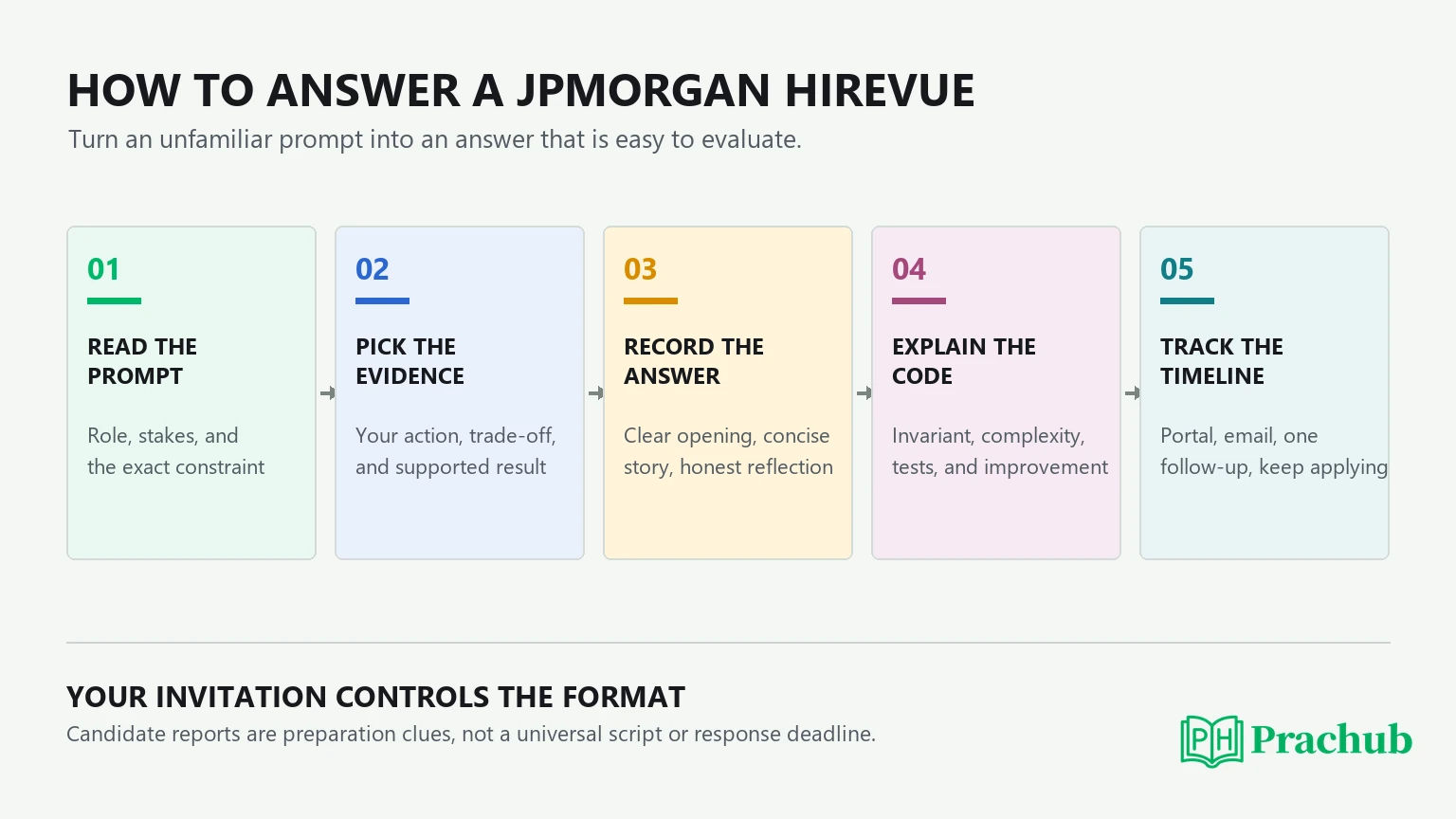
Use this five-part recording structure:
- Answer the question immediately. Start with one sentence naming the experience and outcome.
- Set only the necessary context. Identify the project, stakes, and your responsibility.
- Describe two or three specific actions. Explain decisions, trade-offs, and communication rather than listing tasks.
- Prove the result. Use a supported metric, delivery outcome, quality improvement, or stakeholder decision.
- Add reflection. State what you learned and how it changed your next action.
Record a first attempt without a script. On review, ask whether a listener can distinguish what you did from what the team did. Replace broad claims such as "I communicated well" with observable actions such as summarizing options, running a small test, escalating a risk, or documenting a decision.
How to explain a coding solution on video
A coding explanation is not a second attempt to narrate every line. It is a compact technical review that proves you understand the problem and the code you submitted. HireVue itself recommends using an "explain your answer" follow-up when evaluating technical skills, and historical JPMorgan candidate reports describe video explanations attached to coding tasks.
Use this sequence:
- Restate the contract. Name the input, output, and one important constraint.
- State the main idea. Identify the data structure or invariant that makes the solution work.
- Walk through one representative case. Choose an example that demonstrates the key branch, not just the easiest sample.
- Give time and space complexity. Tie the complexity to the operations in your implementation.
- Name edge cases and tests. Mention empty input, duplicates, boundaries, overflow, or invalid states when relevant.
- Discuss improvement honestly. If time remained, say what you would refactor, optimize, or validate. Do not invent a flaw merely to sound reflective.
For a hash-map solution to group anagrams, a concise explanation might say that each word is converted to a canonical signature, words sharing the signature are grouped, and the total work depends on whether the signature is built by sorting or counting characters. Then explain empty strings, duplicates, deterministic output, and the memory cost of storing groups.
What your recording communicates beyond the words
The goal is not studio production. It is a response that can be evaluated without distraction. Test the camera, microphone, internet connection, lighting, and framing before starting. Close notifications and put the device at a stable height.
Look near the camera while speaking, but do not force unbroken eye contact. Pause briefly before an important decision and use signposts such as "The main risk was..." or "I considered two options..." These choices make a technical explanation easier to score.
The official handbook advises candidates not to read from prewritten material, use examples that are not their own, fabricate results, or use software to generate answers during the interview unless explicitly invited. Prepare anchors, not a teleprompter. Honest specifics are more persuasive than polished generalities.
What happens after the JPMorgan HireVue?
JPMorganChase does not publish a fixed response time. Its handbook says applications are considered on a rolling basis and that candidates receive an email after a decision. The hiring FAQ recommends checking the application portal for status updates.
Current candidate reports show why one universal estimate would be misleading. Some applicants report movement within days or weeks, while others wait much longer after a recorded interview. Timing can depend on business line, location, event capacity, recruiter workload, and whether applications are reviewed in batches.
| Stage | Productive next action | What not to infer |
|---|---|---|
| Immediately after submission | Save confirmation, verify portal status, and write down the prompts while fresh. | Silence in the first few days is not a rejection. |
| While under review | Prepare for a live interview, keep applying, and monitor email and spam. | Another candidate's invitation does not define your outcome. |
| A stated deadline passes | Send one concise inquiry using the contact in the invitation. | Repeated messages will not create a faster decision. |
| No deadline was provided | Use the portal as the primary status source and follow up only after a meaningful interval. | HireVue completion does not guarantee a Superday. |
Practice with JPMorgan questions from PracHub
These JPMorgan question-bank records train the communication and implementation skills relevant to recorded interviews. They are not predictions of your exact 2027 prompts. Each complete title in the first column opens the question and written solution.
| PracHub question | Practice focus | Why it helps |
|---|---|---|
| Describe a Proud Project and Conflict | Project impact, teamwork, and reflection | Builds two common video-answer themes with clear personal evidence. |
| Answer Common Behavioral Prompts | Motivation, failure, conflict, and ownership | Pressure-tests a flexible story bank before recording. |
| Minimize Operations to Balance Shipments | Arrays, invariants, and edge cases | Gives you a concrete solution to explain from contract through complexity. |
| Group Strings That Are Anagrams | Hash maps, signatures, and duplicates | Trains a concise explanation of data structures, tests, and trade-offs. |
A seven-day preparation plan
| Day | Focus | What to do |
|---|---|---|
| Day 1 | Confirm the format | Read the invitation, identify whether the stage is video, coding, or both, and test the required device. |
| Day 2 | Story bank | Build six stories covering teamwork, conflict, ownership, failure, learning, and judgment. |
| Day 3 | Motivation | Research the program and write short anchors for why JPMorganChase, why the role, and why now. |
| Day 4 | Video practice | Record four answers, review them once, and remove vague context or repeated conclusions. |
| Day 5 | Coding explanation | Solve two medium problems and give a two-minute explanation after each submission. |
| Day 6 | Mixed simulation | Alternate behavioral and technical prompts without reading from notes. |
| Day 7 | Final review | Check equipment, attire, deadline, support contact, and environment; stop heavy preparation early. |
Frequently asked questions
Does everyone who applies to JPMorgan get a HireVue?
JPMorganChase does not publicly say that every applicant receives one. Some candidates report fast invitations, but speed alone does not prove the assessment is universal or that a human has completed a full resume review.
How many JPMorgan HireVue questions are there in 2027?
There is no confirmed universal number. Reports differ across programs, countries, and assessment types. Use the question count, preparation time, response time, and retry rules shown in your own invitation.
Can I retry a recorded answer?
Do not assume so. JPMorganChase says many assessments may not be retaken for a designated period, and HireVue settings can vary by employer. Check the on-screen instructions before beginning each response.
Is the JPMorgan HireVue behavioral or technical?
It can evaluate verbal presentation, motivation, behavioral evidence, judgment, or technical abilities. Technology candidates may also receive HackerRank or a coding explanation. Your program and invitation determine the actual mix.
Should I memorize an answer script?
No. Memorized wording becomes brittle when the prompt changes and can sound disconnected from the question. Memorize facts and story anchors, then answer naturally using a clear structure.
How long after HireVue does JPMorgan respond?
No official fixed window is published. Current reports range from relatively quick movement to waits of several weeks or longer. Monitor the portal, follow any stated timeline, and continue other applications while you wait.
Final takeaway
The strongest JPMorgan HireVue preparation covers two skills: evidence-based video answers and clear technical explanation. Build a small story bank, connect your motivation to the actual program, rehearse how you verify uncertain AI output, and practice explaining code through constraints, invariants, complexity, and tests.
Use J.P. Morgan Software Engineer questions to practice the linked prompts before you record. The goal is not to predict an exact 2027 script. It is to make your judgment and contribution easy to evaluate under whatever prompt appears.
Sources and Further Reading
- JPMorganChase How We Hire FAQs
- JPMorganChase Digital Handbook
- JPMorganChase Work With Us and Company Values
- JPMorganChase How We Hire
- Current Summer 2027 Candidate Discussion: Video Prompts and Timeline
- Current Candidate Discussion: Response Timing After JPMorgan Interviews
- HireVue Guidance on Explain-Your-Answer Follow-Ups
Research note: This guide was checked on August 24, 2026. JPMorganChase can change assessment vendors, prompts, timers, retries, and regional recruiting steps. Your invitation and application portal are the source of truth.
Comments (0)