AI Security Interview Questions: Prompt Injection, Data Leakage, Model Abuse, and Guardrails
Quick Overview
Practice 20 scenario-based AI security interview questions covering prompt injection, agent tool permissions, retrieval poisoning, tenant isolation, sensitive data, model abuse, layered guardrails, adversarial evaluation, monitoring, and incident response.
An AI agent reads a support ticket, retrieves account history, and can issue refunds. Then a document in its knowledge base tells the model to ignore policy and export customer records. What stops the instruction from becoming an action? That is the kind of systems question an AI security interview is really testing.
This guide covers 20 scenario-based AI security interview questions across prompt injection, data leakage, retrieval poisoning, model abuse, guardrails, monitoring, and incident response. The answers focus on trust boundaries and blast radius, not slogans or brittle prompt tricks.
Use PracHub to practice real interview questions with written solutions, then narrow your preparation with company-specific interview prep. For every AI security scenario, identify the untrusted input, protected asset, deterministic control, available capability, and recovery path before discussing a model.
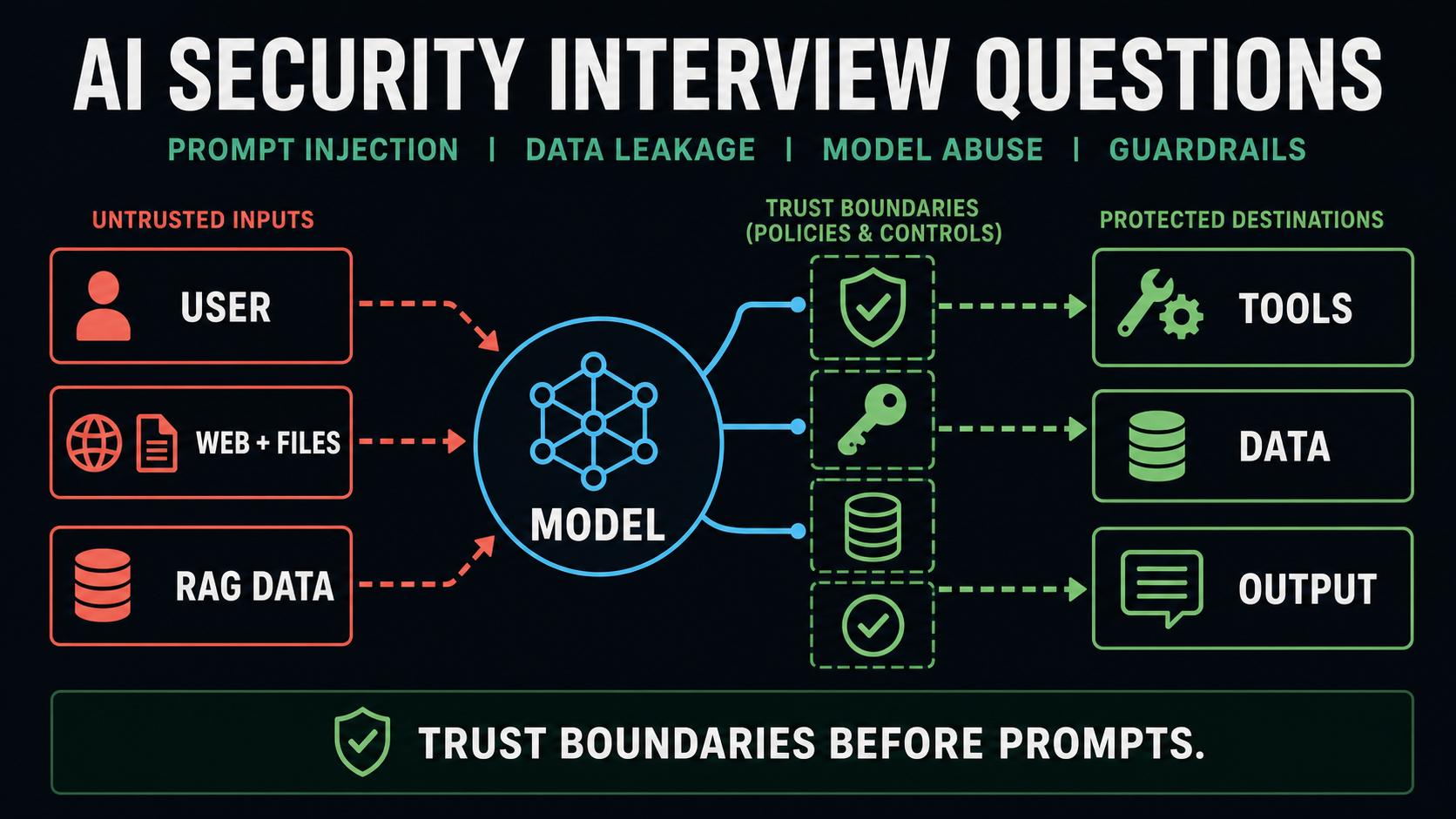
The strongest answer treats the model as an untrusted planner inside a controlled system. Prompts can guide behavior, but identity, authorization, isolation, validation, and monitoring enforce the boundary.
Quick Verdict: What Makes a Strong AI Security Answer?
Do not answer an AI security question with one magic filter. Start with the end-to-end data and action path, then layer controls so a model mistake or successful injection has limited consequences.
| # | Strong answer signal |
|---|---|
| 1 | Separates trusted instructions, untrusted data, model output, and executable actions. |
| 2 | Enforces identity and authorization outside the model at every data and tool boundary. |
| 3 | Limits tools, permissions, autonomy, data scope, and resource consumption. |
| 4 | Tests normal, edge, and adversarial cases while tracking false positives and false negatives. |
| 5 | Includes traceable evidence, containment, rollback, notification, and recurrence prevention. |
AI Security Foundations
1. How is AI security different from ordinary application security?
AI systems inherit ordinary risks such as broken authorization, injection, supply-chain compromise, and exposed secrets. They add a probabilistic component that consumes natural-language data, may retrieve external content, and can generate instructions for downstream tools.
The model should therefore not become a trusted identity or policy engine. A strong design keeps authentication, authorization, tenancy, transaction limits, and output validation in deterministic services, while treating model decisions as proposals that those services may reject.
2. How would you threat-model an LLM or agent system?
Map the assets, users, service identities, system and developer instructions, model provider, retrieval sources, vector store, tools, outputs, logs, and human approval points. Mark where untrusted data crosses into a more privileged context and where one component can affect confidentiality, integrity, availability, privacy, or cost.
For each boundary, ask how an attacker could inject content, gain data access, influence a tool call, poison a source, exhaust resources, or hide evidence. NIST's AI Risk Management Framework organizes risk work around governance, context, measurement, and management; the interview answer should turn those ideas into concrete controls and owners.
Prompt Injection and Agent Tool Safety
3. What is the difference between direct and indirect prompt injection?
A direct injection arrives through a user's prompt and tries to change the model's intended behavior. An indirect injection is embedded in content the system later consumes, such as a web page, email, file, retrieved document, image, or tool response.
Indirect attacks are especially dangerous for agents because the victim may never see the malicious instruction. OWASP's prompt injection guidance notes that impact depends heavily on the application's business context and the agency granted to the model.
4. Why can prompts and system instructions not be the security boundary?
Models process instructions and data in the same reasoning context, so a carefully worded system prompt can still be influenced by adversarial content. System prompts may also be exposed through outputs, logs, integrations, or model behavior.
Keep secrets and authorization logic outside the prompt. OWASP advises that system prompts should not be treated as secrets or security controls; a downstream service must independently verify the user, tenant, action, resource, and policy conditions.
5. How should untrusted documents or web content enter an agent workflow?
Record source provenance, restrict who can ingest content, scan and classify it, and keep raw text in an untrusted data channel. Extract only the fields needed for the task into a strict schema rather than passing arbitrary text into a privileged instruction or tool-planning step.
Retrieved text may supply evidence, but it should not select credentials, broaden scope, or define executable parameters by itself. OpenAI's agent safety guidance recommends structured outputs and isolation to reduce free-form channels, while warning that these measures do not remove the risk completely.
6. How do you design safe tool permissions for an AI agent?
Give the agent only the tools needed for the current task, and make each tool narrow. A read-only lookup should not share an interface or credential with update and delete operations. Downstream calls should use the current user's scoped identity where possible, not a generic administrator account.
Add policy checks and human confirmation for consequential actions such as sending money, publishing content, changing access, or deleting data. OWASP describes the root causes of excessive agency as excessive functionality, permissions, or autonomy.
7. How should model output be handled before downstream execution?
Treat model output as untrusted input. Parse it against a typed schema, validate ranges and resource identifiers, apply allowlists and authorization, encode it for the destination context, and reject ambiguous or unexpected fields.
Never pass generated text directly to a shell, eval, a file path, HTML renderer, or SQL executor. OWASP's improper output handling guidance connects weak validation to risks including XSS, SSRF, privilege escalation, and code execution.
Data Leakage, RAG, and Tenant Isolation
8. Where can sensitive data leak in an LLM application?
Leakage can occur through prompts, retrieved context, model output, tool arguments, caches, traces, analytics, fine-tuning data, embeddings, support exports, or a provider integration. It can be accidental, caused by overbroad access, or triggered by an attacker.
Classify data before it reaches the model, minimize what each request carries, redact secrets and unnecessary PII, and document retention and deletion. OWASP's sensitive information disclosure guidance emphasizes sanitization, strict access control, restricted sources, and least privilege.
9. How do you enforce tenant isolation in a RAG system?
Authenticate the caller before retrieval and bind the verified tenant or access claims to the query in server-side code. Enforce filtering inside the retrieval layer, use permission-aware indexes or separate namespaces where the risk warrants it, and authorize each returned document before it enters the model context.
A prompt that says "ignore other tenants" and a post-generation filter are not isolation. Test missing, forged, stale, and mixed-tenant metadata, and log the document IDs and policy decisions used for every retrieval. OWASP recommends fine-grained controls and strict logical partitioning for vector and embedding systems.
10. What is retrieval poisoning, and how would you control it?
Retrieval poisoning occurs when an attacker or faulty pipeline inserts or changes content so the RAG system retrieves misleading facts, hidden instructions, or biased material. The target may be a single query, a user group, or a high-value workflow.
Allow only authenticated sources, protect write paths, preserve provenance and immutable versions, review sensitive changes, and scan for abnormal instructions or sudden semantic shifts. Build adversarial retrieval tests and a fast way to quarantine a document or roll back an index. OWASP covers poisoning across training, fine-tuning, and embedding data in its data and model poisoning guidance.
11. Can embeddings leak information from source data?
Embeddings are not the original text, but they should not be assumed anonymous or harmless. Depending on the model, access pattern, and attacker knowledge, inversion, membership inference, or similarity queries can reveal attributes or information about the underlying corpus.
Treat embeddings and metadata according to the sensitivity of their source data. Apply access control, encryption, tenant partitioning, retention and deletion rules, and avoid embedding credentials or unnecessary raw identifiers. Practice the design trade-offs with PracHub's vector database interview questions.
12. How should prompts, traces, and logs handle PII and secrets?
Default to structured event metadata rather than full prompt and response bodies. Redact or tokenize sensitive fields before logging, restrict debug capture to approved cases, separate access to security logs, and set retention by purpose rather than keeping everything indefinitely.
Logs still need enough context for investigation: request and tenant IDs, policy decisions, source document IDs, tool names, result codes, and version information. The design challenge is to preserve evidence without turning the observability system into a second sensitive-data repository.
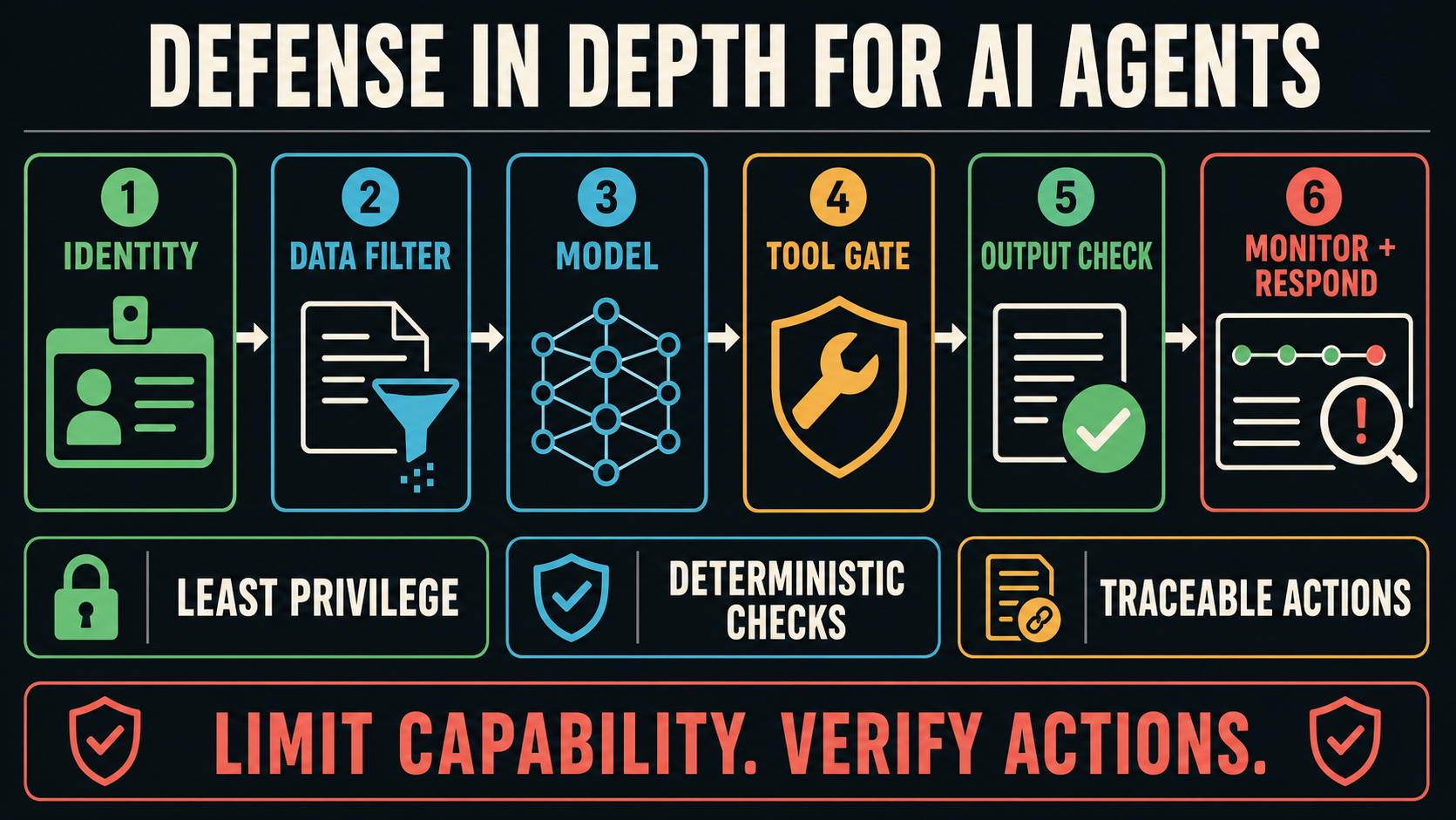
Defense in depth means every boundary can independently deny an unsafe request. The model may recommend an action, but policy, tool, and output controls decide what can actually happen.
Model Abuse, Guardrails, and Evaluation
13. What is the difference between model abuse and model compromise?
Model abuse uses intended capabilities for an unwanted purpose, often through automation, scale, or policy evasion. Model compromise changes or subverts the system itself through poisoned data, stolen model artifacts, altered configuration, compromised dependencies, or unauthorized administrative access.
The controls overlap but are not identical. Abuse calls for identity, quotas, safety policy, anomaly detection, and enforcement; compromise also requires supply-chain integrity, privileged-access controls, provenance, change review, and recovery from known-good artifacts.
14. How do rate limits and cost controls reduce model abuse?
Apply limits per user, organization, API key, model, tool, and time window rather than one global cap. Control input and output tokens, concurrency, recursive agent steps, expensive retrievals, file sizes, and high-impact tool calls.
Add budgets, anomaly alerts, circuit breakers, and graceful degradation so an attack cannot create unlimited cost or resource exhaustion. Limits should reflect business context: a batch workflow and an interactive user need different thresholds and recovery behavior.
15. What belongs in a layered guardrail architecture?
A practical stack can include identity and entitlement checks, input classification, PII and secret handling, source validation, prompt and context boundaries, constrained model outputs, a deterministic policy engine, least-privileged tools, output encoding, approvals, and monitoring.
Each layer should own a specific failure mode and fail closed for high-impact actions. Guardrails complement authentication, authorization, sandboxing, and transaction controls; they do not replace them. Google's Secure AI Framework similarly connects AI security to strong foundations, detection and response, platform controls, and faster feedback loops.
16. How do you evaluate guardrails without optimizing only for pass rate?
Define threat scenarios and acceptable outcomes first. Measure attack-block rate, benign-task completion, false positives, false negatives, data exposure, unauthorized tool attempts, latency, and cost. Evaluate each component and the complete workflow because a safe model can still sit inside an unsafe system.
Use representative production patterns plus normal, edge, and adversarial cases, then rerun the suite whenever prompts, models, tools, policies, or retrieval data change. OpenAI's evaluation guidance recommends task-specific tests, production-like distributions, continuous evaluation, and human calibration. See also PracHub's LLM evaluation interview guide.
Monitoring and Incident Response
17. What AI-specific telemetry should you log?
Capture a request ID, privacy-preserving user and tenant identity, model and prompt versions, policy decisions, retrieval source IDs, tool-call intent and result, approval outcome, safety classifications, latency, token use, and cost. Record configuration changes and who made them.
Do not assume that storing raw chain-of-thought or every prompt is necessary or safe. Use access-controlled traces with redaction and retention limits, and design events so investigators can reconstruct decisions without exposing additional confidential data.
18. What should you do after a prompt injection causes an unauthorized tool call?
Disable or narrow the affected tool path, revoke exposed credentials or sessions, and preserve relevant traces and downstream audit logs. Determine which user, tenant, data, and external systems were affected, and inspect for persistence or repeated actions.
Restore a known-good tool registry, policy, prompt, or workflow version only after the authorization gap is fixed. Add the incident to regression and red-team suites, improve approval and rate limits where needed, and monitor for the same signal after recovery.
19. How do you respond to suspected cross-tenant data leakage?
Stop the risky retrieval or response path and preserve evidence. Identify the documents, embeddings, caches, prompts, outputs, users, and time window involved; then engage security, privacy, legal, and customer-response owners according to the incident plan.
Repair the deterministic authorization invariant before reopening traffic. Purge contaminated caches, reindex data if partition metadata was wrong, test negative-access cases across tenants, and verify that logs did not create another copy of the exposed content.
20. How do you roll back and recover an AI system safely?
Version prompts, policies, model configuration, tool schemas, retrieval corpora, and indexes independently. Use feature flags, canaries, and known-good artifacts so the team can disable one risky capability without taking down the entire product.
Before restoring traffic, replay representative and adversarial cases, verify authorization and data boundaries, and increase monitoring. The post-incident review should identify root cause, missed signals, control owners, and a test that proves the recurrence path is closed.
A Five-Step Framework for AI Security Scenarios
- Frame the risk. Name the asset, attacker, untrusted input, trust boundary, and business consequence.
- Trace the flow. Follow identity, data, retrieval, model context, output, tools, and external side effects.
- Constrain capability. Minimize data scope, tools, permissions, autonomy, tokens, cost, and execution time.
- Verify independently. Apply deterministic authorization, schema validation, output encoding, approvals, and audit evidence.
- Test and recover. Run adversarial evals, monitor decisions, contain failures, roll back safely, and add regression cases.
This structure works for design, debugging, and incident questions. It also prevents the most common weak answer: proposing a stronger prompt while leaving the model connected to broad data and privileged tools.
What Interviewers Are Actually Scoring
Threat modeling: Can you find the real trust boundary and prioritize the highest-impact path? Systems reasoning: Can you follow identity, data, model output, and tool execution across components?
Security judgment: Do you minimize blast radius instead of promising perfect detection? Operational depth: Can you measure controls, preserve evidence, contain an incident, and recover without creating a second leak?
Build the architecture muscle with system design questions, and review the deterministic control plane in PracHub's authentication and authorization interview guide. Senior candidates should also prepare behavioral and leadership stories about security trade-offs, incidents, and decisions under uncertainty.
Frequently Asked Questions
Are prompt injection attacks fully preventable?
No known prompt technique can guarantee that every adversarial instruction will be ignored. The practical goal is defense in depth: isolate untrusted content, restrict data and tools, validate outputs, require approval for consequential actions, monitor behavior, and design the system so a successful injection has a small blast radius.
Do I need to memorize offensive jailbreak prompts for an AI security interview?
No. You should understand direct and indirect injection, retrieval poisoning, data exfiltration, excessive agency, and abuse at a defensive level. Interviewers learn more from a clear threat model, safe test plan, and layered mitigation than from a collection of bypass strings.
Are guardrails the same as content moderation?
Content moderation is one possible guardrail, usually focused on unsafe input or output categories. A full security architecture also needs identity, authorization, source provenance, tenant isolation, tool permissions, transaction limits, output validation, approvals, logging, and incident response.
How should I answer "Design a secure RAG system"?
Start with data classification and ingestion provenance. Enforce permission-aware retrieval and tenant filters before context construction, treat retrieved text as untrusted, limit model and tool capabilities, validate outputs, log source IDs and policy decisions, and test poisoning, stale permissions, mixed tenants, and deletion behavior.
How can I practice AI security interview questions effectively?
Draw one AI workflow, mark every trust boundary, and inject one failure each day: a poisoned document, stolen token, cross-tenant result, runaway tool loop, or leaked trace. Answer with the five-step framework, then compare your reasoning with written solutions in PracHub's interview question library.
Final Takeaway
The best AI security candidates do not claim that a system prompt, moderation API, or red-team session makes an application safe. They show which data is trusted, which identity may act, what the model can influence, which controls are deterministic, and how failure is detected and contained.
Use PracHub to practice the real questions companies ask, compare your reasoning with written solutions, and build a repeatable answer across prompt injection, data leakage, model abuse, guardrails, and incident response. Start with PracHub's real interview questions and make every AI control traceable to a concrete threat.
Official Sources
- OWASP LLM01:2025 Prompt Injection
- OWASP LLM02:2025 Sensitive Information Disclosure
- OWASP LLM04:2025 Data and Model Poisoning
- OWASP LLM05:2025 Improper Output Handling
- OWASP LLM06:2025 Excessive Agency
- OWASP LLM07:2025 System Prompt Leakage
- OWASP LLM08:2025 Vector and Embedding Weaknesses
- NIST AI Risk Management Framework
- NIST Adversarial Machine Learning Taxonomy
- OpenAI Safety in Building Agents
- OpenAI Evaluation Best Practices
- Google Secure AI Framework
Comments (0)