How to Review AI-Generated Code in a Technical Interview: Bugs, Tests, Security, and Trade-Offs
Quick Overview
A tactical interview guide to reviewing AI-generated code as an untrusted patch: reconstruct the contract, prove bugs, audit tests and security, explain trade-offs, and make an accept, revise, or reject decision.
How to Review AI-Generated Code in a Technical Interview: Bugs, Tests, Security, and Trade-Offs
Review AI-generated code as an untrusted patch, not as a finished answer. First reconstruct the intended contract, then inspect every changed file for unsupported assumptions, prove important bugs with independent tests, check security and dependency changes, and finish with an accept, revise, or reject verdict. The strongest review connects each finding to evidence and business impact instead of listing style preferences.
Use the PracHub interview question bank to rehearse that sequence aloud. The goal is not to show that AI is always wrong. It is to show that you can remain accountable for a patch whose confident appearance may hide scope drift, invented APIs, weak tests, or unsafe defaults.

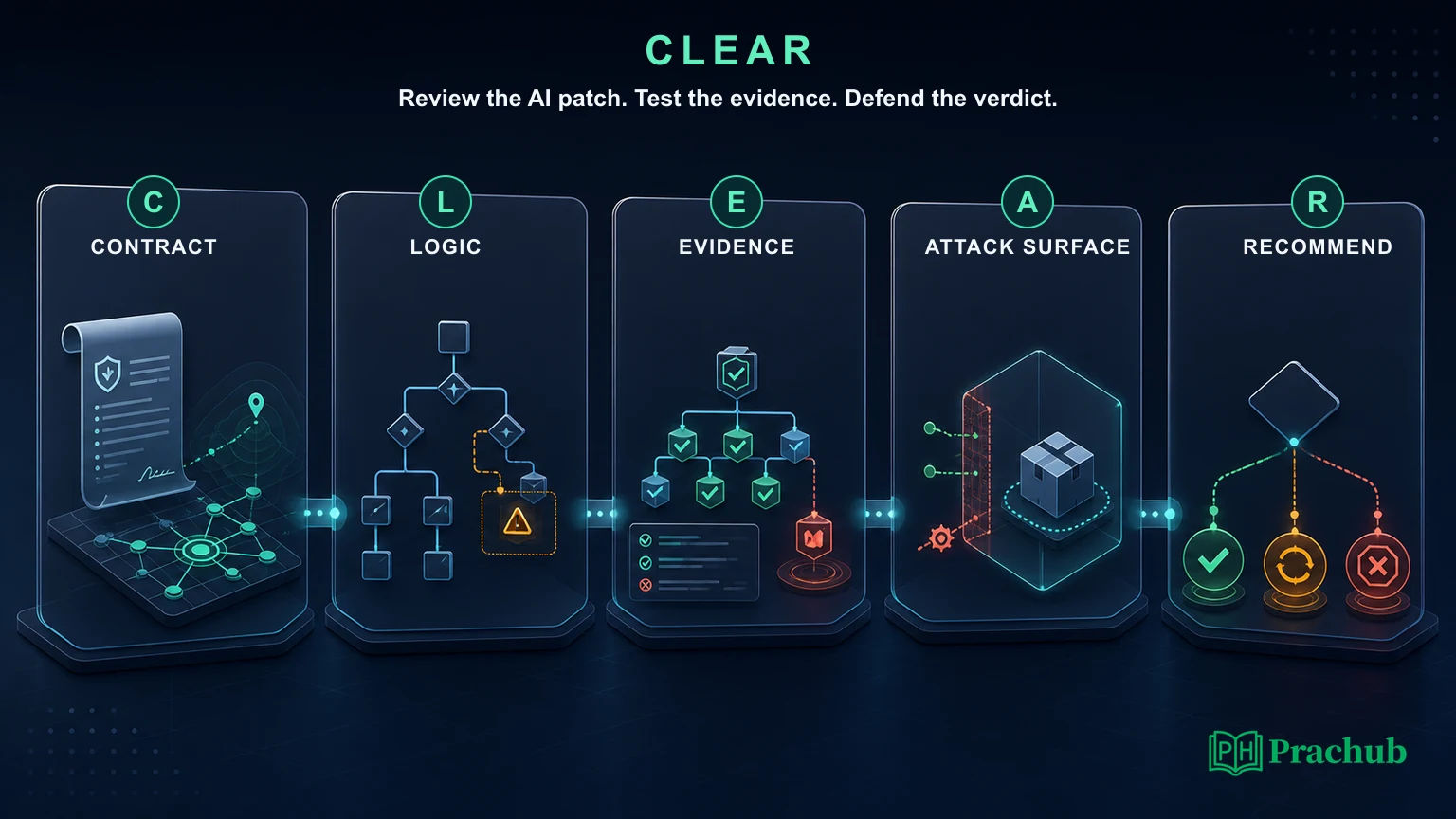
The CLEAR framework for reviewing an AI-generated patch
Use CLEAR to keep the review ordered:
| Step | Review question | Evidence to produce |
|---|---|---|
| C — Contract and context | What was requested, and what was explicitly out of scope? | Restated requirements, invariants, and allowed files |
| L — Logic and failure modes | Where can the generated logic be wrong despite looking plausible? | A concrete counterexample or traced execution path |
| E — Evidence and tests | Which independent checks would prove or disprove the behavior? | Focused regression, boundary, and failure-path tests |
| A — Attack surface and artifacts | What security boundaries, dependencies, logs, or generated files changed? | Threat scenario, dependency check, or unsafe data-flow trace |
| R — Risks, trade-offs, and recommendation | What must change before this patch should ship? | Prioritized findings and an accept, revise, or reject decision |
CLEAR is a PracHub synthesis for interview practice, not a published scoring model or a universal interview format. It extends ordinary code review with checks that are especially useful when code was produced from prompts and repository context.
Why AI-generated code needs a different review lens
Human- and AI-written code can contain the same classes of defects. The difference is the pattern of uncertainty. A generated patch can be syntactically polished while misunderstanding a requirement, calling an API that does not exist, selecting an outdated dependency, or changing more files than the prompt justified.
GitHub's official review guidance highlights AI-specific problems such as hallucinated APIs, ignored constraints, incorrect logic, and deleted or skipped tests. That does not mean origin alone proves a defect. It means the reviewer should demand evidence that is independent of the same generation process.
If you need a baseline for ordinary correctness, readability, and prioritization, use the general code review interview guide. If the task is about directing AI while building a solution, the AI-assisted coding interviews guide is the closer starting point. This guide focuses narrowly on deciding whether an already generated patch deserves trust.
C — Reconstruct the contract before reading the implementation
Begin by translating the prompt into observable behavior. Identify inputs, outputs, authorization rules, error semantics, persistence effects, performance constraints, and files the task allowed you to change. Then compare that contract with the diff.
Suppose the request was: "Add retry-safe checkout confirmation for the authenticated user's cart." Before reviewing code, state the implied invariants:
- A user can confirm only a cart they are authorized to access.
- Repeating the same request must not create a second charge or order.
- Sensitive payment or personal data must not enter logs.
- An upstream timeout must have defined behavior.
- Existing checkout behavior outside this path should remain unchanged.
This exposes scope drift quickly. An AI-generated patch may add a generic workflow engine, rewrite unrelated repository classes, or introduce configuration nobody requested. Flag the mismatch as risk, not merely aesthetic preference: a larger change increases review surface, regression potential, and rollback difficulty.
Also inspect prompt-to-code translation. If a requirement is ambiguous, say which interpretation the patch chose and whether that choice is safe. Do not invent certainty on the model's behalf.
L — Trace logic and look for plausible-looking failure modes
Read the highest-risk path end to end. Follow user input through validation, authorization, state changes, external calls, and returned errors. Ask what happens on null, empty, duplicate, stale, malformed, very large, and concurrently changed inputs.
AI-specific warning signs include:
- a method or SDK option that resembles a real API but is absent from the locked version;
- a helpful-looking fallback that silently changes the requirement;
- a new abstraction used once, with hidden state or unclear ownership;
- copied validation that checks format but not authorization;
- retry logic around a non-idempotent side effect;
- broad exception handling that turns failures into apparent success;
- comments that assert guarantees the implementation never establishes.
When you find something, prove it. Instead of saying, "The retry may duplicate an order," trace one scenario: the payment provider succeeds, the response times out, the client retries, and the handler creates a second order because the idempotency key is generated inside each request. A concrete execution path is more persuasive than generalized suspicion.
Google's engineering guidance recommends reviewing functionality in the context of the wider system, not only whether each changed line looks locally reasonable. In an interview, demonstrate that system view without pretending you have repository knowledge that was never provided.
E — Test the patch, then review the tests themselves
Passing tests are evidence, not proof. Run the existing suite when the environment permits, but first ask whether the tests exercise the contract. A generated test can simply mirror the implementation's mistake.
Build a small evidence matrix:
| Test class | Checkout example | What it can expose |
|---|---|---|
| Happy path | Authorized user confirms a valid cart once | Basic integration and response shape |
| Boundary | Empty cart, maximum item count, expired cart | Off-by-one and invalid-state behavior |
| Failure path | Payment timeout after provider success | Incorrect recovery and partial commits |
| Adversarial | User submits another user's cart ID | Missing object-level authorization |
| Regression | Retry the same request with the same key | Duplicate charge or order creation |
Then audit generated tests for weakened assertions, deleted cases, excessive mocking, and fixtures that avoid the risky branch. OWASP's guidance for secure coding with AI specifically calls for human review when AI changes tests, including deleted tests, weaker assertions, or mocks that replace real dependencies.
Prefer one precise regression test that fails on the patch and passes after the fix. If execution is unavailable, describe the setup, action, and expected result clearly. Also separate what you verified from what remains uncertain: "I traced the duplicate-order path, but I would still run the provider sandbox test before approval."
A — Audit security boundaries and generated artifacts
Prioritize exploitable impact over an exhaustive checklist. For an API patch, start with authentication versus authorization, validation at trust boundaries, injection, secrets, privacy, unsafe logging, and side effects. For file or agentic repository tasks, include path traversal, command execution, and untrusted instructions embedded in repository content.
Inspect more than source files. Review dependency manifests and lockfiles, generated configuration, migrations, permissions, and CI changes. AI may suggest a plausible package name or version that is nonexistent, obsolete, maliciously named, or newly vulnerable. GitHub's dependency-review documentation recommends examining dependency changes and their vulnerability information before merge. OWASP similarly advises auditing AI-generated dependency lists rather than accepting suggested versions on confidence alone.
For agent-assisted work, repository text can also become input. OWASP warns that issues, pull-request descriptions, comments, READMEs, logs, and dependency content can carry indirect prompt-injection instructions. In an interview, note whether the tool was allowed to act on untrusted context and whether the resulting diff contains surprising changes. Do not claim prompt injection merely because a change is odd; identify the untrusted source and the unauthorized action you would investigate.
R — Explain trade-offs and make a recommendation
A useful review ends in a decision. Group findings by consequence:
- Blocker: can cause unauthorized access, data loss, duplicate side effects, secret exposure, or contract failure.
- Required revision: materially harms reliability or maintainability but has a bounded fix.
- Follow-up: worthwhile improvement that does not need to block this change.
Use this speaking pattern:
Observation: the cart lookup uses a caller-supplied ID without checking ownership. Impact: an authenticated user may confirm another user's cart. Evidence: the handler calls
findByIdand the tests cover only the owner's cart. Smallest safe change: query by both cart ID and authenticated user ID, then add a cross-user denial test. Trade-off: this adds one indexed predicate but preserves the endpoint design. Recommendation: reject the current patch until authorization and retry idempotency are fixed.
"Accept" means the available evidence supports the contract and no blocking risk remains. "Revise" means the approach is salvageable but needs specific changes and re-verification. "Reject" means a foundational assumption, security boundary, or design choice makes incremental edits unsafe or disproportionately costly.
Worked example: an AI-generated checkout endpoint
Imagine the generated endpoint retrieves a cart by ID, logs the entire payment request, calls the provider, and retries the handler on timeout. Its unit tests mock the provider to return success and assert only a 200 response.
A CLEAR review would say:
- Contract: authenticated ownership, privacy, and retry safety are required but not demonstrated.
- Logic: a provider success followed by a network timeout can execute the charge again. The retry wrapper lacks a stable idempotency key.
- Evidence: add cross-user, timeout-after-success, duplicate-request, and redacted-log tests. Keep the happy-path test, but assert order count and payment-call count, not only status.
- Attack surface: the ownership gap can expose another user's checkout; full request logging may reveal personal or payment-related data. Inspect the logging sink and retention context before stating the exact exposure.
- Recommendation: reject the patch in its current form. A narrow revision can bind lookup to the authenticated user, persist an idempotency record around the side effect, redact logs, and prove the behavior with failure-path tests.
Notice that "the tests are green" does not survive review: the tests never challenged the generated assumptions.
Practice questions for AI code-review interviews
The following PracHub records are practice material, not predictions of your exact assessment or interview. Use each one to rehearse CLEAR and a concise verdict.
| Practice question | Primary review skill |
|---|---|
| Validate AI-Generated Code Safely | Independent correctness, maintainability, and safety checks |
| How would you improve AI-generated code? | Structured revision and pre-ship judgment |
| Review checkout code for defects and privacy | Correctness, privacy, and data-flow risk |
| Validate Unit-Test Coverage and Identify Missing Scenarios | Assertion quality and missing negative paths |
| Review getEvents endpoint for readability, performance, scalability, security | Cross-cutting trade-offs and prioritization |
For a self-directed drill, spend a short first pass on the contract and diff, a longer pass proving the two highest-impact findings, and the final minutes presenting your decision. Adjust the timing to the prompt rather than treating that practice split as a universal interview format.
Frequently asked questions
Is reviewing AI-generated code different from reviewing human-written code?
The core standards are the same: correctness, security, tests, clarity, and maintainability. Add checks for AI-origin failure patterns such as prompt-to-code scope drift, hallucinated APIs or dependencies, confident unsupported comments, unrequested abstractions, and tests weakened to fit the implementation.
What should I inspect first in an AI code-review interview?
Restate the contract before reading deeply. Then inspect the full diff and trace the highest-risk path through authorization, state changes, external calls, and errors. This prevents polished implementation details from defining the requirement after the fact.
Are passing tests enough to approve AI-generated code?
No. Check whether the tests would fail if the contract were broken. Add boundary, failure-path, adversarial, and regression cases independent of the generated implementation. Review deleted tests, weakened assertions, and over-mocked dependencies.
Which security risks should I prioritize under time pressure?
Start with high-impact trust boundaries: authorization, injection, secrets, privacy, unsafe execution, non-idempotent side effects, and dependency changes. State what you confirmed, what you inferred, and what would require another tool or specialist review.
How should I explain trade-offs and make a ship-or-block decision?
For each important finding, give the observation, impact, evidence, smallest safe change, and trade-off. Finish with accept, revise, or reject, naming the blockers and remaining uncertainty. Avoid burying a security defect beneath stylistic comments.
Final checklist
Before ending the review, confirm that you have restated the requirement, inspected the whole diff, proved the most important bug, challenged the tests, checked security and dependencies, separated facts from uncertainty, and issued a clear recommendation. That is the evidence-centered judgment an AI-assisted interview can reveal.
Sources and Further Reading
- GitHub Docs: Reviewing AI-generated code
- GitHub Docs: GitHub Copilot Agents application card
- GitHub Docs: About dependency review
- OWASP Cheat Sheet Series: Secure Coding with AI
- OWASP Cheat Sheet Series: Secure Code Review
- NIST SP 800-218: Secure Software Development Framework Version 1.1
- NIST NCCoE: DevSecOps and the Role of AI
- Google Engineering Practices: What to look for in a code review
Comments (0)