Stripe Integration Round Guide: APIs, Edge Cases, and Clean Code
Quick Overview
The Stripe Integration Round tests practical engineering judgment: reading unfamiliar API documentation, building a working vertical slice, handling pagination and failures, writing clean code, and explaining trade-offs under time pressure. This guide covers the likely format, evaluation signals, edge cases such as retries and idempotency, a time-boxed workflow, a realistic practice prompt, and PracHub resources for company-specific Stripe preparation.
The hardest part of Stripe’s Integration Round is rarely the API call itself. It is deciding what the documentation actually guarantees, what can fail, and how to keep your code understandable while the clock is running.
Unlike a classic algorithm interview, this round is commonly described as practical engineering work: read an unfamiliar contract, connect to an API-like interface, produce correct output, and explain your decisions. Formats vary, so confirm logistics with your recruiter.
Before practicing generic API exercises, review real Stripe interview questions on PracHub and map the full loop with the Stripe Software Engineer Interview Guide. That company context helps you practice the right balance of implementation, debugging, integration, system design, and communication.
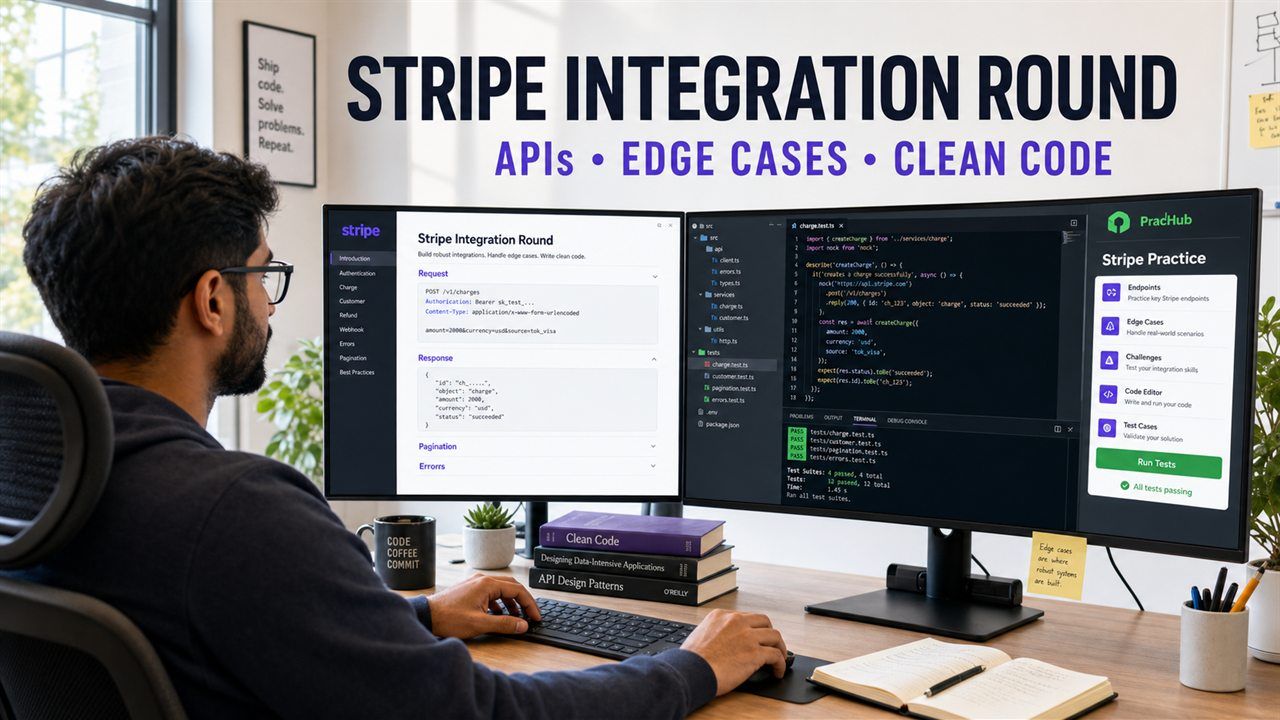
The Integration Round rewards careful contract reading, reliable behavior, and clean implementation.
Quick Verdict
Treat the Stripe Integration Round as a small production task, not a disguised LeetCode problem. A strong solution reaches a working happy path, but it also makes failure behavior explicit, handles the most important edge cases, and remains easy for another engineer to extend.
You need a thin API boundary, clear data flow, disciplined error handling, and focused tests. Understand the contract, build a vertical slice, verify it, then harden risky boundaries.
What to Expect in the Stripe Integration Round
Candidate-facing guides and PracHub’s Stripe interview coverage describe an exercise involving documentation, an unfamiliar API or repository, response parsing, and incremental requirements. You may need to retrieve multiple pages, transform data, call another endpoint, or repair behavior when a dependency fails.
The prompt may be split into stages. Finish each stage cleanly. A small working program with good reasoning beats an ambitious abstraction that never runs.
| Signal | What Strong Work Shows | Common Miss |
|---|---|---|
| Documentation | Confirms inputs, output shape, pagination, and errors | Guesses the contract |
| Correctness | Handles empty, duplicate, partial, and invalid data | Tests only the happy path |
| Reliability | Separates retryable failures from bad requests | Retries everything blindly |
| Code quality | Uses narrow functions and descriptive names | Builds one large procedure |
| Communication | Names assumptions and trade-offs while coding | Works silently until time expires |
Read the API Contract Before You Code
Spend the first few minutes turning documentation into a compact checklist. Identify required parameters, authentication, response fields, ordering, pagination, error forms, and any operation that can create side effects.
Say what you are checking. If the documentation is ambiguous, state a reasonable assumption and isolate it so the implementation is easy to change.
Build a Small Vertical Slice
Start with one valid request flowing all the way to the required output. Avoid designing every class before confirming that the API client, parser, and domain logic work together. Once the slice runs, add pagination, validation, and failure handling in risk order.
Keep External Details at the Boundary
Do not spread raw response dictionaries throughout the program. Convert external data into a small internal model near the client boundary. That keeps field names, null handling, and API-specific errors away from the core transformation logic.
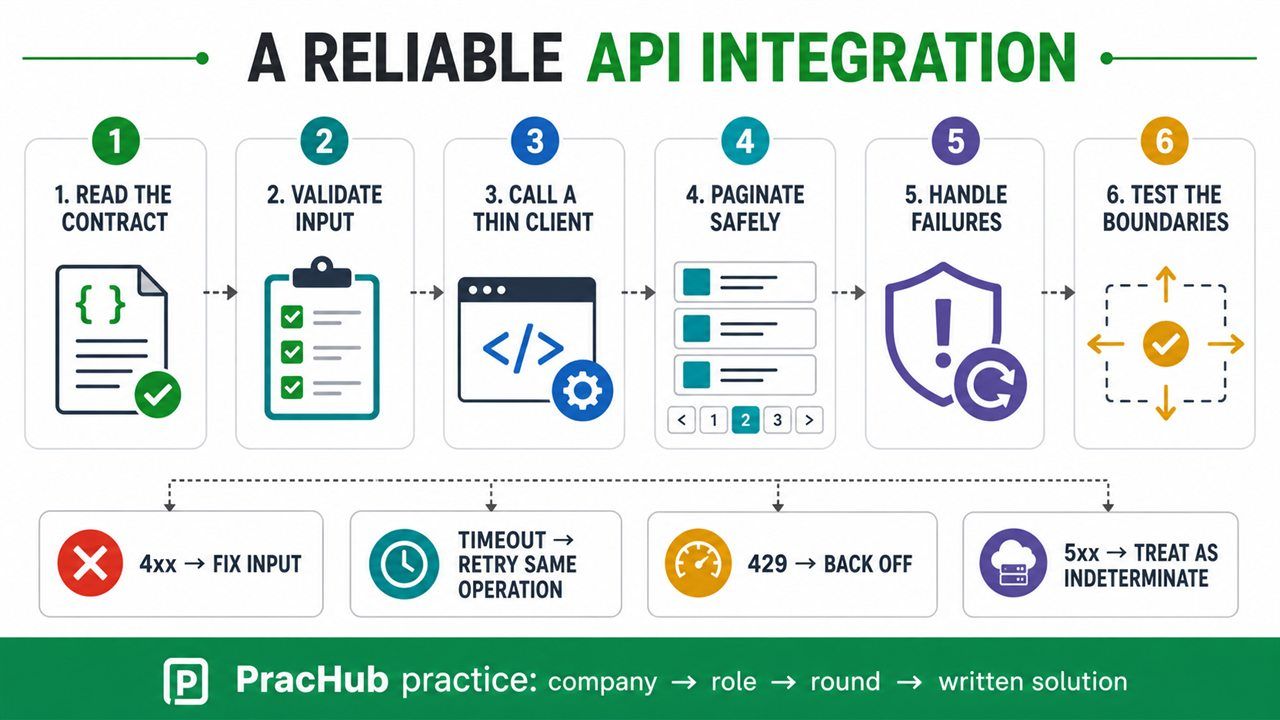
A thin boundary makes the happy path easy to read and failure behavior easy to test.
The Edge Cases That Matter Most
Pagination and Termination
Stripe’s current API documentation uses cursor-based pagination for v1 list endpoints, with fields such as starting_after and has_more. A safe loop must advance the cursor, stop when no page remains, and handle an empty page without indexing the last element.
If the interview provides a mock API, follow its contract rather than assuming it matches Stripe exactly. Still test the same failure shapes: one page, many pages, zero items, a repeated cursor, and a malformed response.
Retries, Idempotency, and Partial Success
Retries are not automatically safe. Stripe’s official guidance distinguishes content errors, network errors, and server errors. Network failures can leave the client unsure whether a mutation succeeded, which is why idempotency keys matter for retryable POST operations.
Explain your policy before writing a generic retry loop. A timeout may be retried with the same operation identity; a validation error usually requires corrected input; a rate limit should back off; and an indeterminate server failure deserves caution rather than a fresh duplicate mutation.
Rate Limits and Observability
Stripe documents 429 Too Many Requests responses and recommends exponential backoff with randomness. In an interview-sized solution, a bounded retry helper is enough. Mentioning a retry cap, jitter, and cancellation shows that you understand the operational consequence.
Preserve diagnostics without logging secrets. Stripe attaches a Request-Id to API requests, a useful correlation identifier for structured errors or logs.
How to Write Clean Code Under Time Pressure
Clean code in this round means visible control flow, not maximal abstraction. A reader should quickly find where requests are made, where responses are validated, where domain rules live, and how failures become output.
| Component | Responsibility | Useful Test |
|---|---|---|
| API client | Requests, auth, timeout, error translation | Timeout or 429 |
| Paginator | Cursor advancement and termination | Two pages then empty |
| Parser | Schema checks and normalization | Missing required field |
| Domain function | Pure business transformation | Duplicate and boundary inputs |
| Coordinator | Readable end-to-end sequence | Partial failure |
Prefer names such as fetch_all_customers or parse_invoice over generic helpers. Pass dependencies into functions when practical so you can test without a real network. Add abstractions only after you see repetition or a clear boundary.
A Time-Boxed Interview Workflow
Adapt this practice template to the duration your recruiter gives you. First restate the goal, inspect the repository, and write down the contract. Then complete one end-to-end happy path.
Use the middle for the highest-risk requirement: pagination, mutation safety, error mapping, or validation. Reserve the final block for tests, cleanup, and a concise summary.
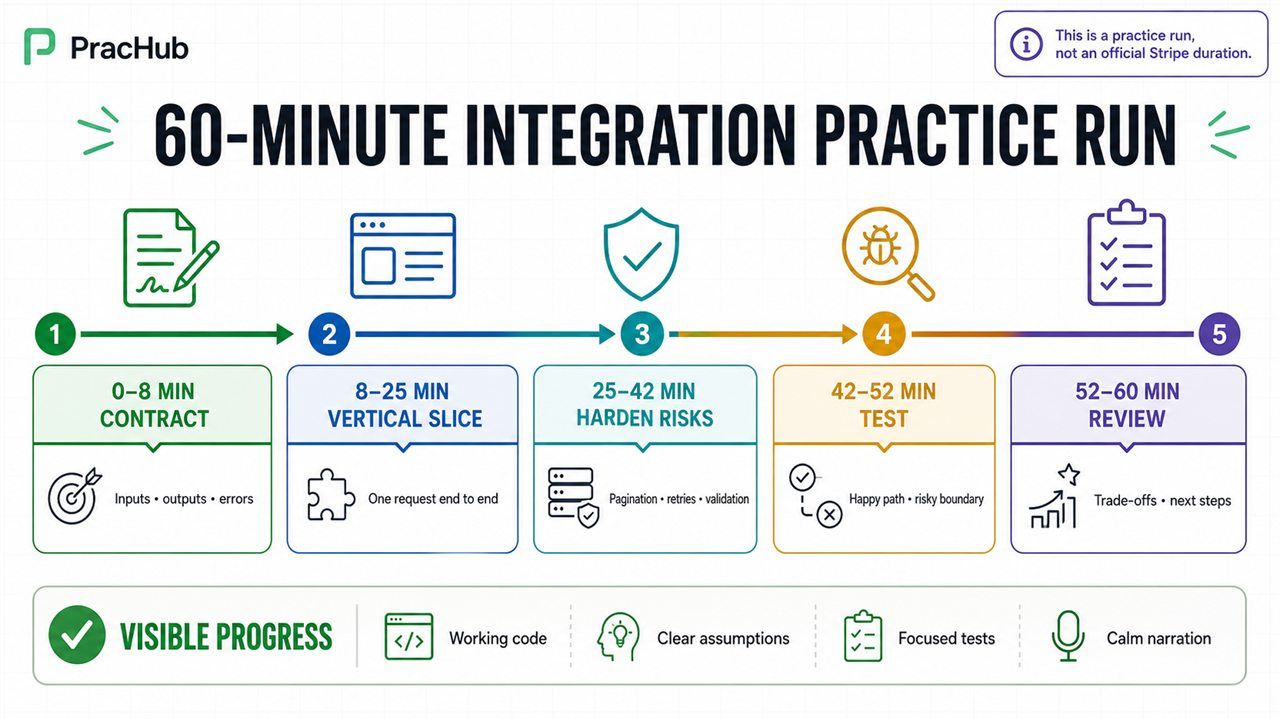
Make progress visible: contract, vertical slice, hardening, tests, and review.
A Practice Prompt You Can Run Today
Build a small program that retrieves paginated merchant transactions, validates each record, converts amounts into a normalized representation, and writes a summary grouped by merchant. The mock API occasionally returns a timeout, a 429, a duplicate transaction, or a response missing one required field.
Before coding, decide which failures stop the run and which become structured warnings. Then implement the happy path, add a fake client, and test empty data, multiple pages, duplicate IDs, malformed records, and a retryable failure. Finish by explaining how you would make mutations idempotent.
Use PracHub’s real interview question bank to find more company-tagged implementation prompts. For senior roles, combine this practice with system design questions that cover API reliability, consistency, and failure modes.
Common Mistakes to Avoid
The most damaging mistake is coding from memory instead of reading the supplied contract. Close behind it are over-engineering before the first request works, retrying every error, hiding assumptions, and postponing all tests until the final minute.
Do not “clean up” so aggressively that the main flow disappears. Keep the coordinator readable, isolate genuine boundaries, and narrate trade-offs.
Frequently Asked Questions
Do I need to memorize the Stripe API?
No. The transferable skill is reading unfamiliar documentation accurately and using the provided contract. Knowing HTTP, JSON, pagination, retries, and idempotency is more valuable than memorizing endpoint names. Review Stripe’s public docs to practice contract reading, not to predict a private prompt.
Which programming language should I use?
Use the language in which you can parse data, make requests, test edge cases, and explain code most fluently, subject to the recruiter’s instructions. Stripe job postings describe the engineering interview process as language-agnostic, but the exact environment can vary.
How much testing is enough?
Start with one happy-path test and then cover the riskiest boundary. For a paginated read, that may be termination and an empty response. For a mutation, it may be duplicate submission or an indeterminate network failure. A few intentional tests beat many shallow ones.
Is this the same as Stripe’s Bug Squash round?
No. Integration practice emphasizes building against a contract or external interface. Bug Squash emphasizes understanding and repairing an unfamiliar existing codebase. Both reward methodical reading, runnable tests, clear communication, and production-minded judgment.
Final Checklist
Before the interview, make sure you can read an API contract, build a thin client, paginate safely, distinguish error classes, explain retry and idempotency decisions, and test without depending on a live service. Practice speaking while you work so assumptions and trade-offs remain visible.
Then move from generic drills to the actual target. Use PracHub for Stripe-specific interview prep, written solutions, and realistic prompts across the full loop. Add behavioral and leadership practice so the Integration Round is one prepared signal rather than your entire plan.
Sources
Stripe API pagination · Stripe advanced error handling · Stripe rate limits · Stripe request IDs · PracHub Stripe interview guide
Comments (0)