IBM Software Developer Intern OA 2027: Repository Debugging, Django/Node/Spring Boot, and Hidden Tests
Quick Overview
A current, evidence-backed guide to the IBM Software Developer Intern OA for 2027 applicants. Learn how the reported coding-plus-repository format works, how to choose between Django, Node.js, and Spring Boot, how HackerRank hidden tests score project work, and how to prepare with a practical seven-day plan and IBM questions from PracHub.
You prepared for two short algorithm problems, opened the IBM assessment, and found an unfamiliar web application instead. The task was not to start from an empty editor. It was to read someone else's repository, add validation, preserve existing behavior, and survive tests you could not see.
That is the change candidates are reporting for some IBM Software Developer Intern 2027 assessments. The strongest preparation is no longer "do more LeetCode" alone. You need to combine algorithm speed with the everyday engineering skill of making a small, correct change inside an existing codebase.
Start with IBM Software Engineer questions to practice the company's coding and behavioral signals, then use the repository workflow in this guide to train for the new project-style task.
Quick verdict
Prepare for two different technical modes: one conventional coding problem and one repository-based debugging or feature task. In a current candidate report, the repository task involved adding validation to a web application and offered Django, Node.js, or Spring Boot variants. Another backend applicant reported seeing a Django-specific task, so do not assume every invitation offers the same choice.
IBM's public application guidance confirms that assessments can include coding challenges and video questions, but IBM does not publish one universal 2027 intern format. The detailed structure below therefore separates official platform capability from candidate-reported experience. Your invitation remains the authority for timing, frameworks, proctoring, and permitted tools.
| Claim | Evidence level | How to use it |
|---|---|---|
| IBM may use coding and video assessments | Published by IBM | Prepare for both technical execution and concise spoken answers. |
| A 2027 SWE assessment included one coding problem plus a repository task | Recent candidate report | Practice both formats, but expect role and location differences. |
| Django, Node.js, and Spring Boot variants may be available | Reported for one current assessment | Choose your strongest stack if the test actually offers a choice. |
| Hidden tests can score project submissions | Documented HackerRank capability | Write defensive validation and test behavior beyond the visible examples. |
What changed in the IBM 2027 OA?
Older IBM preparation threads often describe two relatively direct HackerRank coding questions. That history created a simple playbook: review arrays, strings, hash maps, graphs, and dynamic programming, then complete a timed set.
On August 14, 2026, candidates began discussing a different experience. One report described one LeetCode-style question plus a repository debugging or coding task. A follow-up account said the project required adding validation features to an existing web app. The same discussion described Django, Node.js, and Spring Boot options.
This does not prove IBM changed every Software Developer Intern assessment worldwide. IBM hires across teams, locations, and job families, and assessment variants can differ. It does show that preparing only in a single-function editor now leaves a meaningful gap.
Why a repository task is a different test
An algorithm question gives you a narrow contract and asks you to create a solution. A repository task gives you existing assumptions, dependencies, routes, models, tests, and conventions. Your first job is to discover the contract before changing it.
HackerRank's documentation says code-repository questions can ask candidates to fix a bug, build a feature, or modify a specific part of an application. Its project environments can run automated tests and support hidden files that are added during scoring. That makes the format well suited to measuring how safely you work in code you did not design.
What the assessment may look like
| Part | Current evidence | Best preparation |
|---|---|---|
| Algorithm question | One candidate reported a graph-oriented, roughly medium-level problem. | Practice common patterns and finish with explicit edge-case tests. |
| Repository task | Candidates reported adding validation or debugging a web application. | Read an unfamiliar project, reproduce the failure, and make a minimal patch. |
| Framework | One report offered Django, Node.js, or Spring Boot; another appeared Django-specific. | Follow the invitation rather than assuming you can switch stacks. |
| Scoring | HackerRank project questions can use automated, manual, or custom scoring. | Pass tests, keep the change readable, and avoid unrelated refactors. |
| Competency assessment | Current candidates separately report recorded video and work-preference questions. | Build a short story bank and verify the exact format in your email. |
Do not overfit to the reported graph question
A single candidate receiving a graph problem does not make graphs a guaranteed topic. Keep your algorithm preparation balanced across arrays, strings, hash maps, intervals, stacks, queues, trees, graph traversal, and basic dynamic programming.
The transferable skill is turning requirements into invariants, writing a correct baseline, and testing boundaries. Those habits matter in both the standalone coding question and the repository task.
Which framework should you choose?
If your assessment genuinely offers variants, choose the stack in which you can navigate, test, and debug fastest. This is not the moment to select Spring Boot because it looks more enterprise-ready or Django because the code appears shorter. Familiarity with conventions beats theoretical preference under a timer.
| Framework | Review before the OA | Common validation traps |
|---|---|---|
| Django | URL routing, views, serializers or forms, models, status responses, and the test command. | Confusing blank with null, bypassing serializer validation, and returning the wrong status code. |
| Node.js / Express | Routes, middleware order, async handlers, service modules, package scripts, and test setup. | Double responses, unhandled rejected promises, missing early returns, and weak schema checks. |
| Spring Boot | Controllers, services, repositories, Bean Validation, exception handlers, and Maven or Gradle tests. | Validation annotations without @Valid, leaking internal exceptions, and putting business rules in the controller. |
If the invitation assigns a framework, do not spend the remaining preparation window trying to become an expert in the entire ecosystem. Learn the application's request path, its validation mechanism, how tests are organized, and how to run one focused test file. That narrower competence is far more useful.
A repeatable repository-debugging workflow
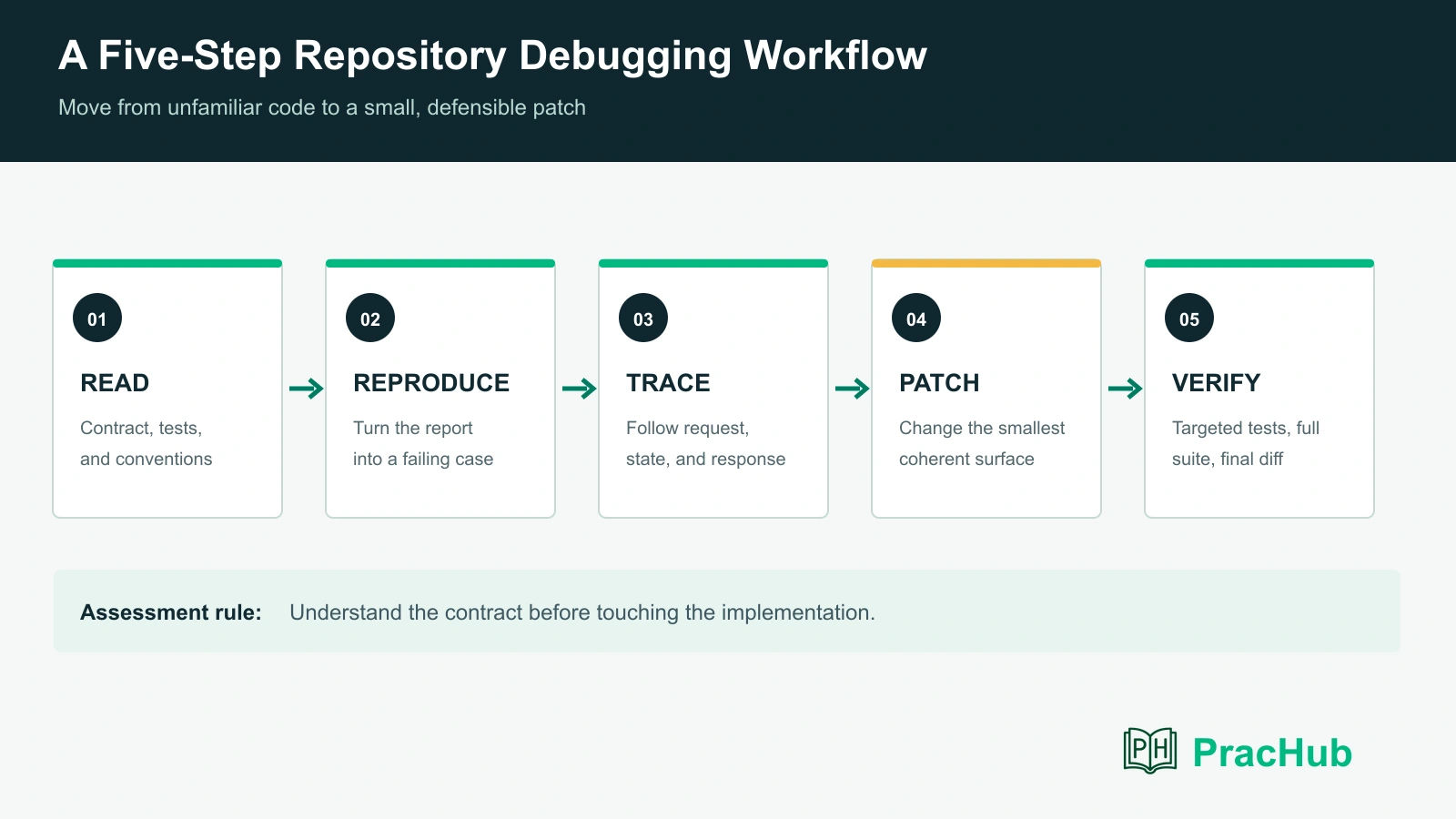
The biggest time loss in a repository assessment is editing before understanding. Use a disciplined loop: read, reproduce, trace, patch, verify. It gives you a default next action even when the project feels unfamiliar.
1. Read the task before exploring the whole repository
Extract the required behavior, invalid inputs, expected response, and files you are allowed to change. Convert each sentence into an observable example. If the task says a field is required and must be unique, you already have at least four cases: valid value, missing value, blank value, and duplicate value.
2. Find the shortest execution path
Locate the README, package or build file, test command, and entry point. Then trace only the relevant path: route to controller or view, controller to service, service to model or repository. You do not need to understand every folder before making progress.
3. Reproduce before changing code
Run the smallest relevant test or request. Capture the current failure, status code, output, and stack trace. A reproducible baseline tells you whether your patch fixed the target instead of merely changing the symptom.
4. Make the smallest coherent patch
Put validation at the layer that owns the rule. Request-shape checks belong near the API boundary; cross-record uniqueness or ownership may belong in the service or data layer. Avoid renaming unrelated functions, upgrading dependencies, or reorganizing folders while the clock is running.
5. Run targeted tests, then the full suite
Start with the failing test for fast feedback. Once it passes, run nearby tests and finally the complete command. Review your final diff for debug prints, temporary workarounds, accidental file changes, and behavior that only works for the visible example.
How to prepare for hidden tests
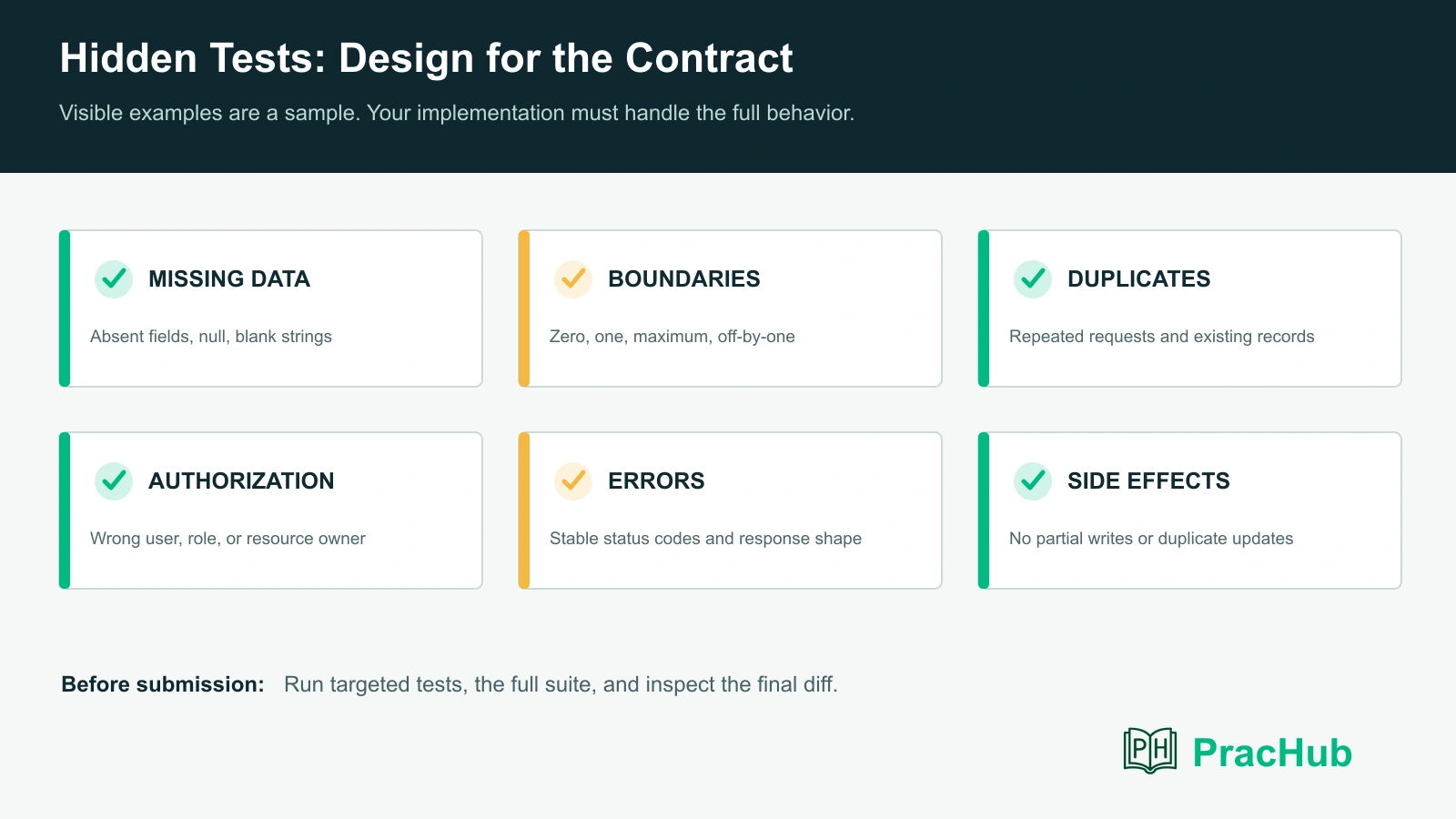
HackerRank documents that hidden test files may be withheld from the candidate workspace and added during scoring. You may not see whether those project tests pass while you work. The right response is not to guess secret inputs; it is to implement the contract completely.
| Risk area | Cases to check | What a robust solution does |
|---|---|---|
| Missing data | Absent field, null value, blank string, whitespace-only string | Uses the framework's expected validation path and response format. |
| Boundaries | Zero, one, maximum length, negative values, very large values | Applies the stated constraints without off-by-one behavior. |
| Duplicates | Repeated request, existing record, case differences | Defines uniqueness clearly and avoids inconsistent partial writes. |
| Authorization | Missing user, wrong owner, inaccessible resource | Checks permission before exposing or mutating data. |
| Error behavior | Not found, malformed input, dependency failure | Returns the expected status and does not leak an internal stack trace. |
| Side effects | Validation failure after a partial update | Validates first or uses a transaction so failure leaves consistent state. |
Do not modify files identified as read-only or hidden-test placeholders. HackerRank warns that changing protected files can invalidate scoring. Work through the public interface and application code instead.
Practice with IBM questions from PracHub
These IBM question-bank records are not predictions of your exact 2027 assessment. They train the coding, boundary analysis, technical judgment, and communication skills that transfer into both the OA and later interviews.
| PracHub question | Practice focus | Why it helps |
|---|---|---|
| Find Minimum Subarray Length With K Distinct Integers | Sliding window and exact constraints | Trains careful interpretation and boundary-focused testing. |
| Compute Shared Free Time Intervals | Intervals and input normalization | Builds the habit of defining overlap, endpoints, and empty cases precisely. |
| How Would You Use Generative AI at Work? | AI judgment and verification | Prepares a current IBM behavioral theme around safe, reviewed AI usage. |
| Describe Open-Source Contribution Experience | Working in an existing codebase | Helps you explain code review, testing, maintainability, and collaboration. |
Use the questions as drills, not answer sheets
Attempt the two coding questions under a timer before opening the written solution. For the behavioral questions, record a two-minute answer and listen for vague claims. Replace "I improved the code" with the bug, the decision you made, the test you added, and the measurable result.
A seven-day IBM OA preparation plan
| Day | Focus | What to do |
|---|---|---|
| Day 1 | Baseline | Solve one timed coding problem, then clone a small unfamiliar web app and run its tests. |
| Day 2 | Framework map | Trace one request from route to validation, service, persistence, and response. |
| Day 3 | Validation | Add one field rule and tests for missing, blank, invalid, duplicate, and valid inputs. |
| Day 4 | Debugging | Start from a failing test, form a hypothesis, make a minimal patch, and review the diff. |
| Day 5 | Algorithm balance | Practice one graph or tree problem and one array, interval, or hash-map problem. |
| Day 6 | Full simulation | Combine a coding problem with a repository task under one uninterrupted timer. |
| Day 7 | Final review | Confirm the invitation rules, test your setup, review the hidden-test checklist, and stop cramming. |
What not to do during the repository task
Do not rewrite the application. A broad refactor creates more regression risk and consumes time without proving that you understood the requested behavior.
Do not code only to the visible happy path. Validation tasks are designed to reveal what happens when inputs are missing, duplicated, malformed, unauthorized, or at a boundary.
Do not ignore the existing test style. Reuse its fixtures, naming, and setup where possible. A new testing framework or bespoke harness is rarely the best use of a timed assessment.
Do not assume AI is permitted. IBM states that candidates must not misrepresent AI-generated work as entirely their own, and your assessment may impose stricter rules. Follow the invitation and on-screen policy exactly.
What happens after the IBM assessment?
IBM's public application page explains the types of assessments it may use, but it does not promise a universal response time or a fixed next step for every intern role. Current candidates also report a recorded competency assessment with video and work-preference questions. Treat that as a possible separate stage, not part of the repository timer unless your invitation says otherwise.
After submitting, write down the coding pattern, the repository structure, the validation rule, the tests you ran, and one change you would make with more time. If a later interviewer asks about the assessment, you will be able to explain your reasoning without disclosing protected question content.
Then prepare concise examples of debugging, learning a codebase, receiving code-review feedback, and verifying AI-assisted work. Review behavioral and leadership questions while continuing company-specific coding practice.
Frequently asked questions
Is the IBM Software Developer Intern OA still two coding questions?
Do not assume so. Recent 2027 candidate reports describe one standalone coding problem plus one repository-based task. Formats can vary by role, team, location, and assessment version, so use your invitation as the source of truth.
Can I choose Django, Node.js, or Spring Boot?
One current candidate reported those three options. Another backend applicant described a Django-specific task. Prepare your strongest stack, but confirm what your own assessment actually offers before relying on a choice.
What difficulty is the algorithm question?
One candidate characterized a graph problem as around medium difficulty. That is a single report, not an official IBM level or guaranteed topic. Balanced medium-level practice is safer than targeting one pattern.
Will I see the hidden tests?
Not necessarily. HackerRank says project hidden-test files can be absent from the candidate IDE and added during scoring. Implement the full specification and add your own boundary tests instead of depending on visible feedback.
Should I learn all three frameworks?
No. Be fluent in one, understand the request-to-database path, and know how to run tests. A shallow review of three ecosystems is less useful than being able to debug one confidently.
Does passing every test guarantee an interview?
IBM does not publish such a guarantee. Assessment performance can be one part of a broader review that includes eligibility, resume fit, team demand, location, and headcount.
Prepare for engineering work, not just puzzle recognition
The reported IBM 2027 format rewards a more realistic skill set: understand a requirement, enter an unfamiliar repository, trace behavior, make a restrained change, and prove that it works. That is harder to memorize, but it is also highly trainable.
Use IBM Software Engineer questions for company-specific coding and behavioral practice. Pair those questions with one small repository drill each day, and you will be ready whether your invitation contains a classic algorithm screen, a project task, or both.
Sources and methodology
This guide was reviewed on August 17, 2026. IBM's application steps and FAQs support the general statements about coding and video assessments. HackerRank's documentation explains code repository questions, project environments and scoring, and hidden test behavior. Details about the current IBM 2027 variant come from recent candidate discussions about the repository-format change, the reported coding and competency assessments, and a Django-specific backend report. Candidate reports are anecdotal and are not presented as IBM policy.
Comments (0)