Roblox Factories Assessment: How to Reason About Workflow and Bottlenecks
Quick Overview
An evidence-aware Roblox Factories preparation guide covering queues, effective capacity, shared inputs, and finite-horizon upgrade decisions with original worked examples.
A factory can look busy while producing very little. Materials pile up before one machine, another sits idle, and a new purchase makes the layout larger without improving the result. For the Roblox Factories assessment, useful preparation starts with following the workflow: identify what limits completed output, make a targeted change, and check whether the whole line improves.
Official guidance: Roblox recommends Kaiju Cats for familiarity with the basic interface and strategic tactics used in Robots and Factories. Coding Cookies prepares the block-coding interface of Outpost: Mars. Choose the matching practice route first. Roblox Early Career
The exercises below are original preparation models, not Roblox task layouts or scoring formulas. For the separate coding and interview stages, use PracHub's Roblox Software Engineer questions alongside the official practice experience.
What is verified about the Factories assessment?
Official fact: Roblox describes factory-workflow and robot-building challenges as ways to evaluate systems thinking, creative problem solving, and applying skills in a changing environment. Its assessment-design discussion says performance has multiple dimensions. That supports deliberate reasoning; it does not reveal a formula for converting factory results into hiring decisions. Roblox's Fair Play article
Community advice: An August 2026 discussion about the 2027 internship OA recommends watching for machines that lack inputs or have backlogs. The opening poster recalls an earlier year's assessment, and comments do not establish a complete specification for the current version. Treat the thread as a source of practice hypotheses. Applicant discussion
The public material reviewed here does not establish a universal Factories timer, winning layout, machine-price list, or passing score. Read your assigned instructions for the objective, permitted actions, and time limits. A preparation model is useful only when you can recognize which of its assumptions apply.
Map the workflow before buying capacity
Original preparation method: Follow one item from its source to the point where it counts toward the objective. Identify what creates it, what transforms it, how it moves, and what accepts the finished output. This exposes dependencies that a screen full of machines can hide.
Keep three quantities separate. Capacity is how much a stage could process under suitable conditions. Throughput is how much actually completes per unit of time. Inventory is work waiting or still in progress. A large inventory is not automatically progress, especially if only completed products contribute to the objective.
For a practice sketch, draw a source, an assembly stage, and a packing stage. Mark their inputs and outputs. Then ask whether the transfer between them has a limit of its own. A fast machine connected through a slow transfer cannot deliver its advertised rate downstream.
Do not assume that every icon or animation represents useful work. Trace the output to completion. If a number rises, establish whether it represents raw material, intermediate goods, finished products, revenue, or cash. Confusing those measurements can make a costly change appear successful.
Worked example: the busiest line is not the most productive
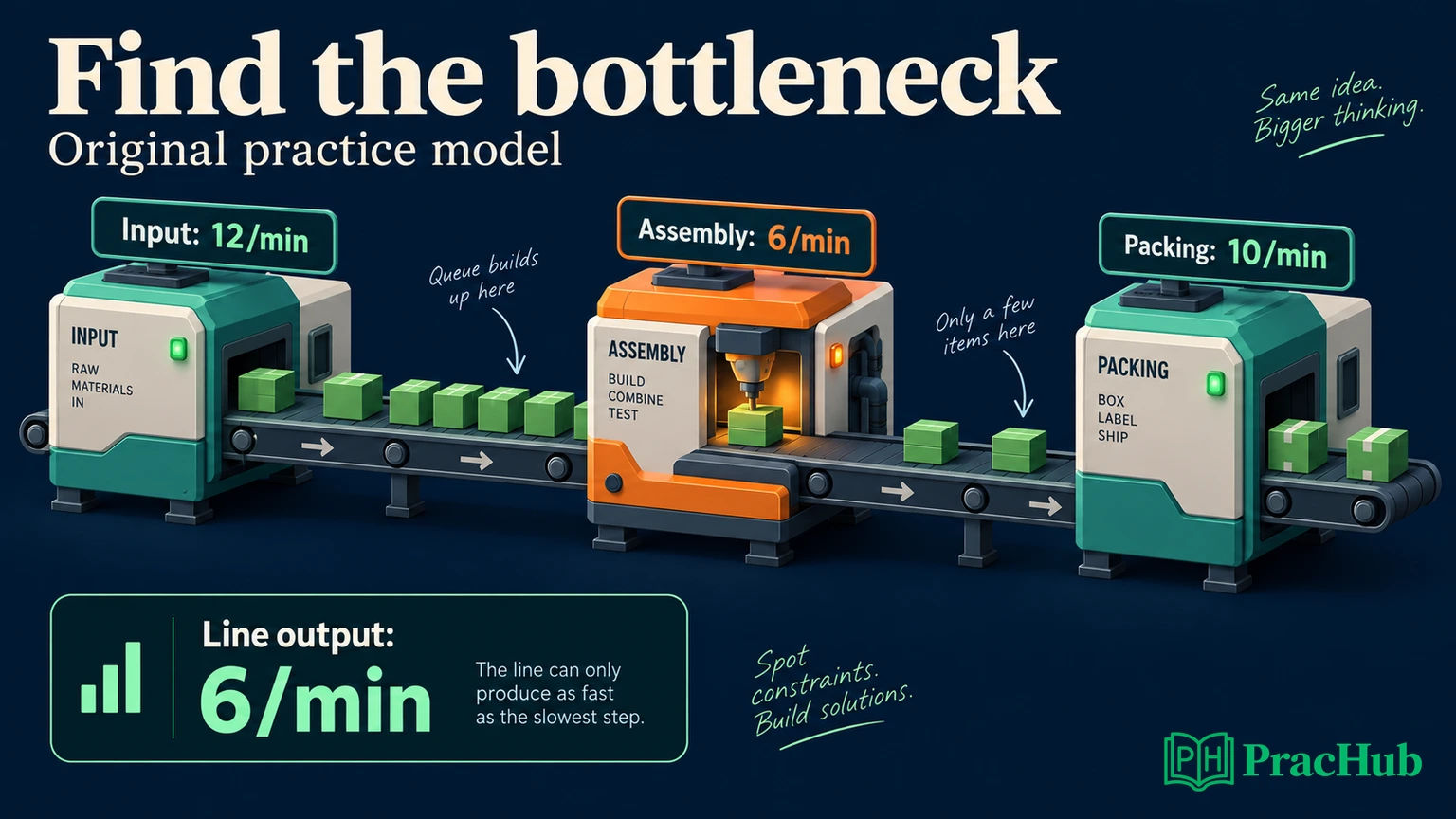
Original exercise: Suppose a simplified serial line has unlimited demand, no defects, no transfer delay, and one input item per finished product. Input supplies 12 items per minute, assembly handles 6, and packing handles 10. These invented rates illustrate reasoning; they are not Roblox machine values.
Once the line has settled into steady operation, its maximum finished output is 6 products per minute. Assembly is the constraint. If input keeps supplying 12 and buffers are unlimited, the queue before assembly grows by 6 items per minute. Packing has spare capacity because only 6 assembled items arrive.
Now compare three purchases:
| Proposed change | Effect on this practice line |
|---|---|
| Increase input from 12 to 18 per minute | Finished output stays at 6. The upstream queue grows faster. |
| Increase assembly from 6 to 9 per minute | Finished output can rise to 9, assuming the other conditions hold. |
| Increase packing from 10 to 15 per minute | Finished output stays at 6. Assembly still limits the line. |
The correct comparison is the additional completed output each purchase enables. A dramatic improvement to one machine may have no system benefit.
Next, raise assembly to 14 per minute. Output can reach only 10 because packing becomes the constraint. Bottlenecks move after successful changes. Repeating the same upgrade without rechecking the line can waste resources even when the first upgrade was useful.
These are steady-state bounds. A short run starts with empty stages, and products need time to travel through them. You should not automatically multiply the maximum rate by the entire session length and call that the exact final result.
Tell starvation, blockage, and insufficient capacity apart
An idle machine can have several explanations. Starvation means it lacks a required input. Blockage means it cannot release its output. Insufficient capacity means it receives usable work but cannot process it fast enough for the desired flow. These are diagnostic categories for the original practice model, not labels guaranteed to appear in the assessment.
Start with the queue and the direction of flow. A growing queue before a machine suggests a constraint at that stage or somewhere beyond it. It does not prove that the machine itself is slow. A downstream obstruction may prevent it from finishing or transferring work.
If a machine has no input, inspect the preceding stage and any missing ingredient. Buying another identical machine will not solve a shared supply shortage. If it has input and cannot send output onward, inspect the destination before increasing its speed.
Finite buffers change what you observe. In the example above, an unlimited queue grows continuously. With limited storage, the queue eventually fills and upstream production must stop or lose items, depending on the rules. A temporarily idle source can therefore be the consequence of a downstream bottleneck.
Observe over comparable intervals. A single snapshot may capture startup, a transfer between batches, or the moment immediately after an edit. Look for a repeated pattern, then predict what would change if your diagnosis were correct.
Normalize recipes and shared inputs
The slowest visible number is not always the bottleneck. Rates must use comparable units. If assembly consumes two input units per finished product, an input supply of 12 units per minute supports only 6 finished products per minute, even if assembly advertises capacity for 9 products.
Write the conversion explicitly: 12 input units divided by 2 units per product equals 6 products. Then compare that finished-product equivalent with the downstream rates. Otherwise, you may upgrade assembly while the recipe keeps it starved.
A second original exercise introduces a shared source. It provides 12 material units per minute. Product A uses 2 units and contributes 8 credits per completed product after variable costs. Product B uses 3 units and contributes 9 credits. Assume both lines have sufficient machine capacity and unlimited demand.
A earns 4 credits per scarce material unit; B earns 3. Allocating everything to A yields 6 products and 48 credits per minute. Allocating everything to B yields 4 products and 36 credits. The larger contribution per finished product does not identify the better use of the constrained input.
Change one assumption: demand for A is capped at 3 products per minute. A now uses 6 material units, leaving 6 for two B products. The combination contributes 42 credits per minute. Your decision changes because the constraint changes, not because one product is universally superior.
Decide whether an upgrade has time to repay its cost
Original exercise: A targeted upgrade costs 120 credits and increases net operating earnings by 40 credits per minute. Assume the increase begins immediately, persists, and requires no additional spending. Its simple payback time is 120 / 40 = 3 minutes.
With 5 minutes remaining, it generates 200 additional credits and leaves you 80 ahead after the purchase. With 2 minutes remaining, it generates only 80 and leaves you 40 behind. This comparison assumes final cash matters and the upgrade has no resale or terminal value.
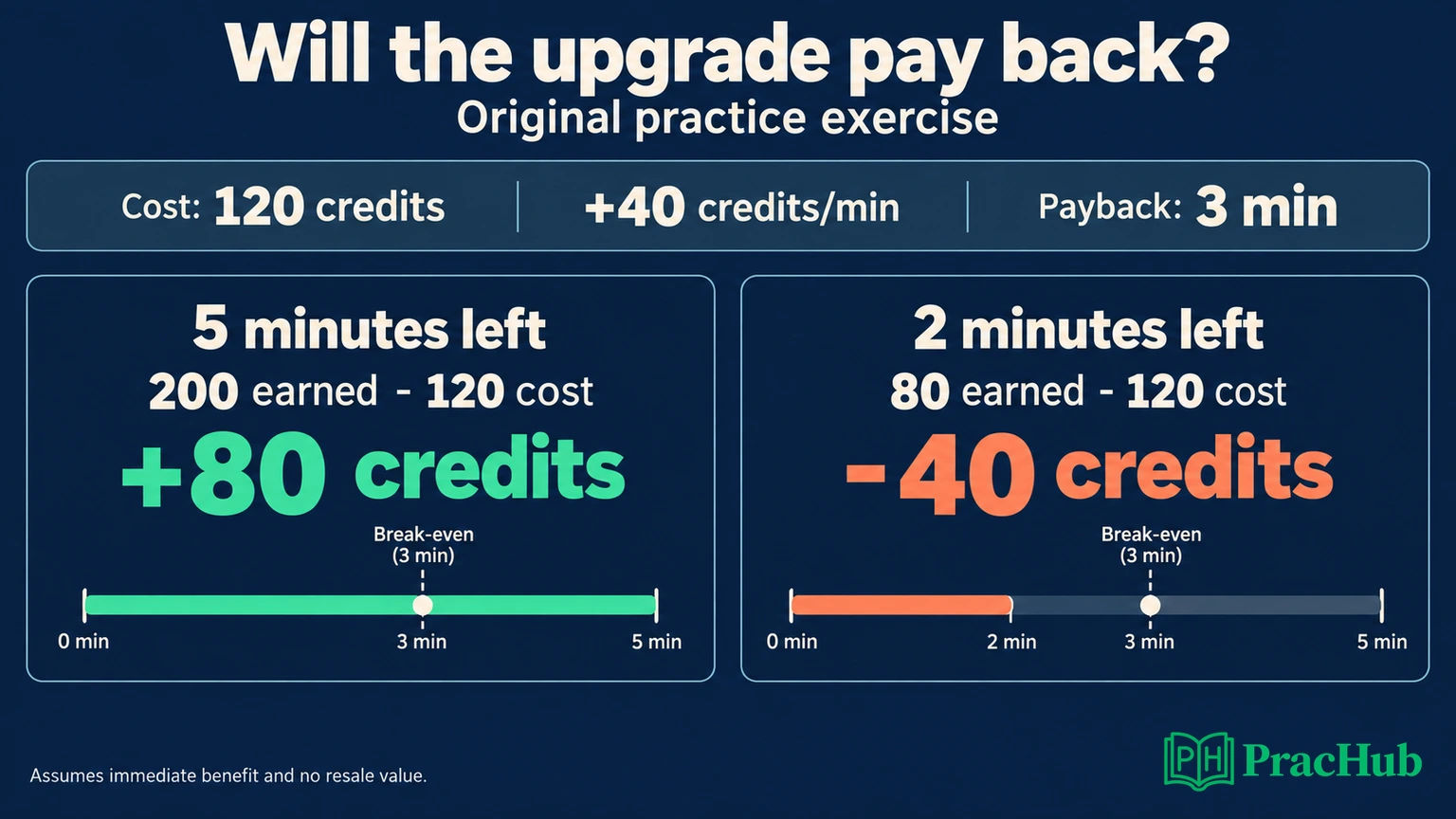
If construction takes one minute before the benefit starts, only four earning minutes remain in the first case. The additional earnings fall to 160, leaving 40 after the cost. If construction also interrupts existing production, subtract those lost earnings separately.
This is why “reinvest all available money” is an incomplete rule. Check the remaining horizon, startup delay, expected incremental benefit, and any effect on existing flow. If the actual task rewards production rather than final cash, the decision may differ. Use its stated objective instead of importing the exercise's objective.
An upgrade's nominal benefit can also depend on another purchase. If extra assembly capacity needs more supply and faster packing, evaluate the combined cost and realistic output. Do not count an isolated machine's full improvement while ignoring the additional constraints it exposes.
Run one informative experiment at a time
After identifying a likely constraint, make a prediction in plain language: “Increasing assembly should raise completed output and reduce the rate at which its input queue grows.” That gives you two observations to check instead of relying on whether the new layout looks better.
Compare the baseline and changed line using the same observation window where possible. Allow for startup effects. If input availability, product mix, or remaining demand changes between observations, record that difference before attributing the entire result to your edit.
When the predicted improvement does not appear, inspect the assumptions. Perhaps the transfer is saturated, a recipe consumes more material than expected, or the downstream stage has become limiting. A failed prediction is useful when it narrows the next inspection.
For preparation, explain each decision in four sentences: what you observed, what you believed constrained output, what you changed, and what actually happened. This is a learning exercise, not a claim that Roblox requires a written strategy submission or awards points for particular explanations.
Use official practice without chasing community cutoffs
Official preparation: Kaiju Cats is replayable and untimed, and Roblox links it specifically for Robots and Factories familiarity. Use it to learn how the interaction works, then apply the reasoning exercises here separately. It is not presented as an identical factory simulator. Play Kaiju Cats
Candidate reports: A late-August 2026 score thread includes different self-reported section results and hiring outcomes. It does not control for role, evaluation details, or hiring needs. It cannot establish that a particular factory total guarantees an interview. Community score discussion
Distinguish an unexpected production result from a technical failure. If the assessment cannot load or controls do not respond, use the support route on Roblox's Early Career page. For ordinary preparation, keep attention on the observable objective and the next testable improvement.
Five questions for complementary systems reasoning
These PracHub questions are broader engineering practice across companies, not Factories replicas or reported Roblox game prompts. Use them to practice explaining a constraint and verifying a change; you do not need to master advanced infrastructure design before opening the official practice game.
| PracHub question | Focus for this preparation |
|---|---|
| Diagnose I/O, Memory, and CPU Constraints | Separate a symptom from the resource that limits end-to-end output. |
| Most Frequent Call Stack from Profiler Samples | Explain what an observation measures before drawing a conclusion. |
| Reuse Work Across Multiprocess Image Pipelines | Trace shared work and dependencies before adding parallel capacity. |
| Data Pipeline Reliability, Backfills, and Spark Optimization | Preserve correct output while investigating a pipeline bottleneck. |
| Design a GPU inference API | Consider queues and independently constrained processing stages. |
Start with official interface practice, then explain the 12/6/10 line without looking at the answer. Change the recipe or remaining time and defend your revised choice. For additional interview preparation, select one Roblox Software Engineer question and practice making your assumptions visible.
Sources and Further Reading
- Roblox Early Career — official assessment, practice, and support guidance, checked September 8, 2026.
- Fair Play: Roblox's Game-Based Talent Assessment — official assessment-design discussion, July 29, 2025.
- Kaiju Cats — practice experience linked by Roblox.
- 2027 internship OA preparation discussion — community advice with mixed experience dates, August 2026.
- Roblox OA score discussion — self-reported results with incomplete context, August 2026.
Comments (0)