From Non-CS Major to Software Engineer: A Practical Guide to Cracking the Technical Interview
Quick Overview
This resource is a practical guide to preparing for and succeeding in technical interviews, especially for aspiring software engineers, CS students, internship candidates, career changers, and anyone transitioning into tech. It explains how to build a strong foundation in data structures and algorithms, practice coding problems with intent, use mock interviews effectively, and understand different types of technical evaluations, including DSA, system design, domain knowledge, and project-based interviews. The guide also walks through a clear live interview workflow: clarifying the problem, working through examples, planning with pseudocode, coding the solution, testing edge cases, and explaining time and space complexity. Readers will learn how to communicate their thinking, manage anxiety, turn rejection into useful feedback, and approach interviews with confidence. It is valuable because it combines technical preparation, real interview strategy, and mindset advice into a structured framework that helps candidates practice more intentionally and improve their chances of landing software engineering roles.
Editor’s Note: Transitioning into a technical field can feel like navigating an unfamiliar world, especially when faced with the infamous technical interview. In this post, I'll share how I self-taught programming, made a career switch, and decoded the technical interview process to land my first SDE offer!
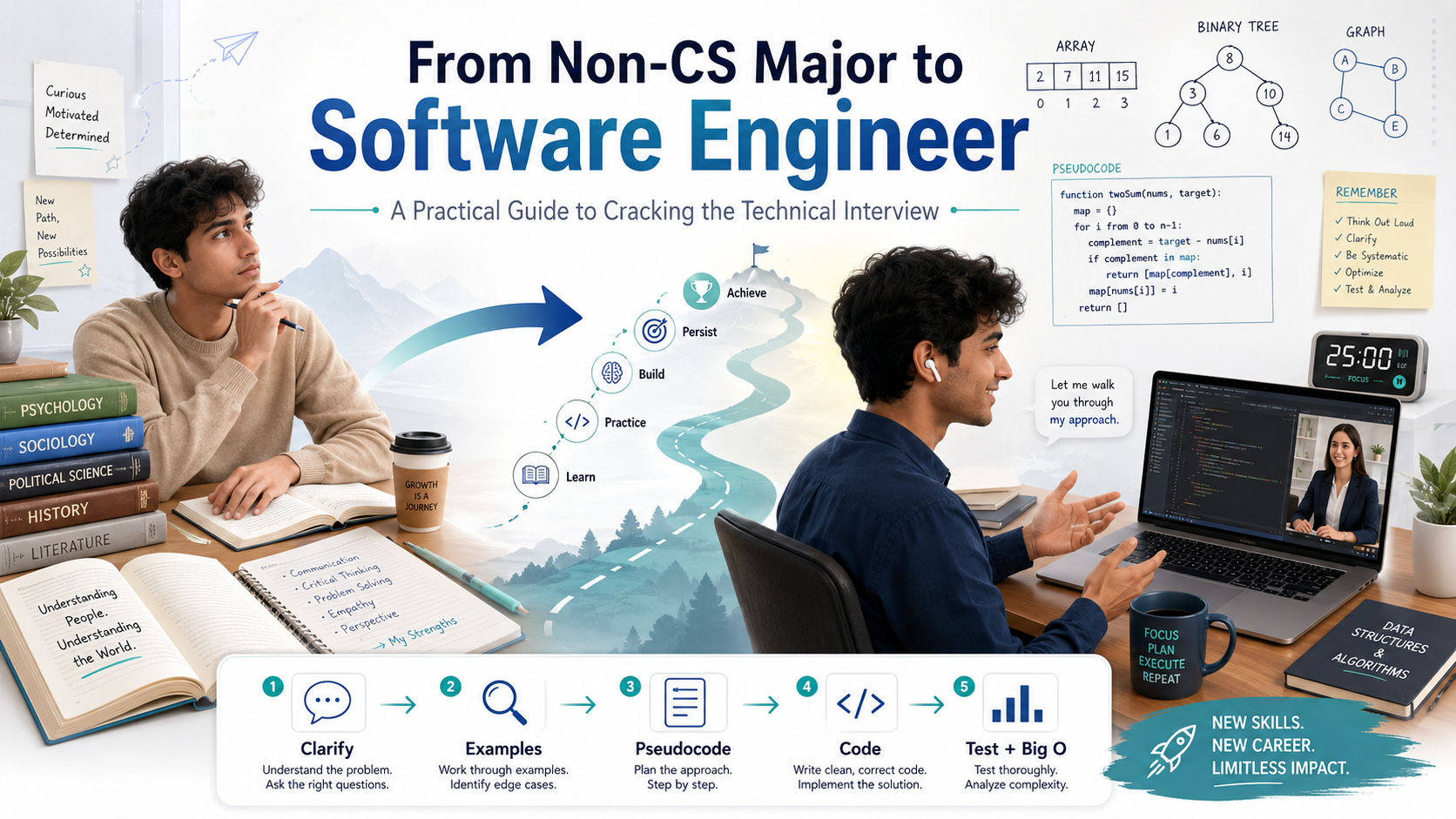
Whether you’re a Computer Science student preparing for internship or a liberal arts major considering a shift into tech, one hurdle stands tall between you and a tech job: the technical interview.
I originally came from a social sciences background. In my previous field, interviews were mostly centered around behavior, background, and soft skills. But when I transitioned into software development, I quickly realized tech interviews were a completely different beast.
In almost every hiring pipeline, you’ll be asked to solve complex algorithmic problems live while an engineer watches your every move. The first few times I tried this, I panicked, froze, and failed miserably.
However, problem-solving is a trainable skill, and technical questions tend to repeat in most tech interviews. After months of trial, error, and research, I cracked the code and secured my first full-time engineering role—and recently passed another interview cycle using the exact same framework. Here is the complete guide to preparing for, navigating, and mastering your technical interviews.
Phase 1: Preparation Is 80% of the Battle
You wouldn't take a final exam without studying, and you shouldn't go into a technical interview without targeted practice.
1. Build a Solid Theoretical Foundation
Before jumping into random coding problems, build your mental toolbox. Understanding fundamental Data Structures & Algorithms (DSA) allows you to recognize patterns rather than memorize solutions.
- Core Topics to Master: Arrays, Linked Lists, Hash Maps, Trees, Graphs, Sorting Algorithms, Time & Space Complexity (Big O Notation).
Stack Knowledge: Ensure you know the deep mechanics of your primary programming language (e.g., Python, Java, JavaScript) and associated frameworks.
2. Practice with Intent
Solving problems casually is great, but interview simulation is what builds confidence.
- Platforms: Practice on sites like LeetCode, HackerRank, or PracHub.
- Simulate Real Conditions: Once comfortable, set a timer for 30–45 minutes, turn off auto-complete, and explain your thought process out loud as you type.
3. Study Solutions & Mock Interviews
When you get stuck—or even when you successfully solve a problem—take time to review alternative approaches and understand the trade-offs behind each solution. Platforms like PracHub can help you practice company- and role-specific interview questions in a realistic coding environment, making it easier to compare approaches and identify recurring problem-solving patterns.
4. Know Your Interview Type
Not all tech interviews are algorithmic "whiteboard" tests:
- DSA / Algorithmic: Focuses on problem-solving speed and complexity analysis.
- System/Architecture & Domain Knowledge: Theoretical questions about language mechanics, databases, and APIs.
- Project / Code Review: Discussing a project you built or refactoring an existing repository.
💡 Pro-Tip: Always ask your recruiter in advance what style of technical evaluation to expect so you can tailor your prep.
Phase 2: Execution During the Live Interview
When the clock starts and the interviewer drops a prompt into the shared editor, resist the urge to start coding immediately.
   ┌─────────────────────────────────────────────────────────┐
   │                  THE INTERVIEW WORKFLOW                 │
   └─────────────────────────────────────────────────────────┘
                                │
                                ▼
                   1. Clarify & Understand
                                │
                                ▼
                   2. Work Through Examples
                                │
                                ▼
                   3. Pseudocode & Break Down
                                │
                                ▼
                   4. Code the Solution
                                │
                                ▼
                   5. Test & Analyze (Big O)
Step 1: Understand & Clarify
Read the problem twice. Repeat it back to the interviewer in your own words.
- Ask about Inputs and Outputs (e.g., “Will inputs always be integers?”).
- Identify Edge Cases (e.g., “How should the function handle
null, empty arrays, or negative values?”).
Step 2: Break Down & Visualize
Use a digital whiteboard or line comments in the code editor to outline your steps.
- If the main problem is too hard, simplify it first. Solve for a basic input, then add back the constraints.
- Draw out data structures (like arrays or tree nodes) to visually track pointer movements or iterations.
Step 3: Talk Out Loud (The Most Critical Step)
An interview is a collaborative session, not a quiet exam. The interviewer wants to evaluate how you think.
- Explain your ideas before writing code.
- If you get stuck, explain what is confusing you. Interviewers will often offer subtle hints if they see you actively reasoning through a wall.
Step 4: Write, Test, and Refactor
- Don't get hung up on syntax: If you forget a specific library method, write pseudo-code, tell the interviewer, and keep moving.
- Test manually: Walk through your code line by line with an example input. Catch your own bugs before the interviewer points them out.
- Analyze Big O: State the Time and Space complexity of your solution, and discuss potential optimizations even if you don't have time to code them.
Phase 3: Mastering the Mindset
The psychological aspect of technical interviews is often overlooked, yet it’s usually where candidates struggle most.
- Treat Interviews Like a Sport: Warm up your brain before the interview. Stretch, practice speaking out loud, and get into an active state of focus.
- Slow Down: Anxiety speeds up your heart rate and makes you rush. Take a breath. Pausing for 10 seconds to think is always better than typing 10 seconds of buggy code.
- Reframe Failure as Data: Rejection hurts, but every failed interview reveals a specific gap in your knowledge. Take notes immediately after every interview on what went wrong and study those exact topics.
- Maintain Curiosity: Shift your perspective from "I'm being judged" to "I'm solving a fun puzzle with a peer." Enthusiasm is infectious and leaves a lasting positive impression.
Final Thoughts
Career transitions and technical interviews are tough, but they are entirely manageable with the right system. You don't need to be a math genius or have coded since childhood to succeed in tech—you just need persistence, structured preparation, and strong communication skills.
Keep practicing, learn from every rejection, and enjoy the learning process. For technical interview process, PracHub offers company-specific interview questions in a realistic coding environment, helping you build confidence and prepare more intentionally for the interviews ahead.
Good luck!
Related Articles
From Non-CS Major to Software Engineer: A Practical Guide to Cracking the Technical Interview
Prepare for technical interviews with a practical guide to DSA practice, live coding, mock interviews, communication, and interview mindset.
Design WhatsApp: the presence and receipt problems most candidates ignore
Design WhatsApp-style chat with WebSockets, offline inboxes, Kafka partitions, presence TTLs, receipts, and reliable delivery.
I Pinned Our Autoscaler for a Month to See What Would Break. Nothing Did.
Learn when Kubernetes autoscaling helps, when CPU-based HPA wastes money, and how capacity planning can cut cloud costs safely.
One Line of Code Halved Our Storage. Another Stopped Us Re-Encoding Two-Hour Films.
Learn how to scale video transcoding with segment-level retries, CMAF packaging, CDN caching, and VOD system design tradeoffs.
Comments (0)