OpenAI Research Scientist Interview Guide 2026: Research Depth, Coding, and ML Systems
Quick Overview
An evidence-bounded guide to OpenAI Research Scientist interviews, covering official process guidance, recent candidate-reported coding and presentation rounds, research-depth evaluation, general and ML coding, experiment design, distributed training and evaluation systems, direct PracHub practice links, common mistakes, FAQs, and a seven-day preparation plan.
An OpenAI Research Scientist interview is not a paper-quiz followed by a generic LeetCode round. The harder challenge is showing that you can choose a worthwhile research direction, implement and debug the idea, and reason about the training and evaluation system that makes the result trustworthy.
Begin with OpenAI Machine Learning questions so your preparation reflects the company's current question bank. Then use this guide to organize those questions around the three signals that matter most: research depth, coding, and ML systems judgment.
OpenAI says interview formats vary by team, and recent candidate reports do not describe one universal Research Scientist loop. This guide therefore separates official process information from candidate-reported examples and turns both into a practical preparation plan.
Quick answer: what should you expect?
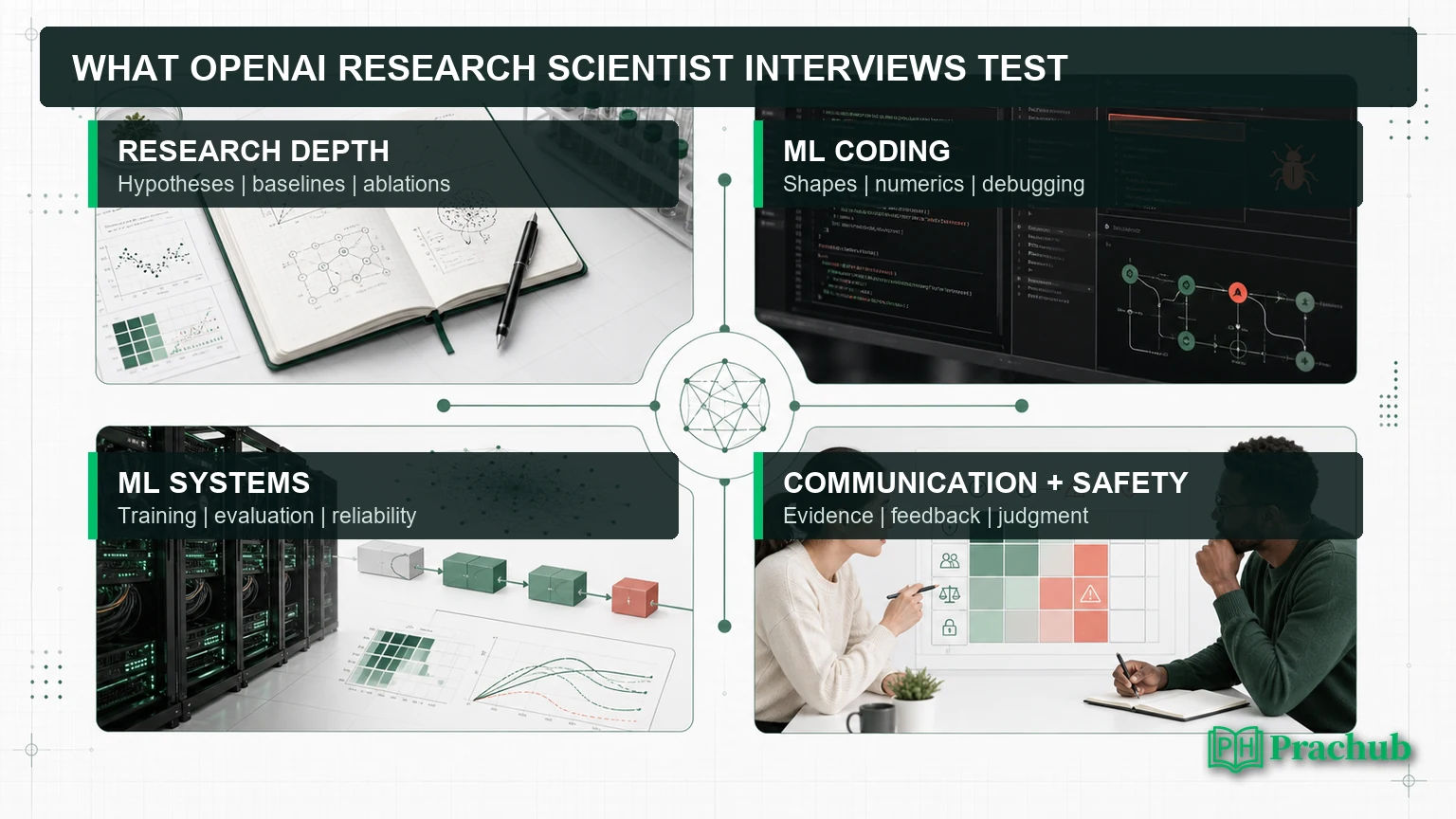
Expect a skills-based process that tests how you think, not just what appears on your publication list. OpenAI's public interview guide allows for pair coding, take-home projects, technical tests, and multiple assessments. Final interviews typically involve 4-6 hours with 4-6 people over 1-2 days, but the exact mix depends on the team.
| Signal | What a strong candidate shows | Evidence level |
|---|---|---|
| Research depth | A defensible hypothesis, meaningful baselines, decisive experiments, honest limitations, and good research taste. | Role-aligned inference from current OpenAI research positions and official preparation guidance. |
| General coding | Correct, readable, efficient code with clear invariants, edge cases, tests, and follow-up extensions. | Official skills-based assessment guidance plus recent candidate reports. |
| ML coding | Vectorized implementation, numerical reasoning, training and evaluation fluency, and systematic debugging. | Frequently described in recent Research Scientist candidate reports; team dependent. |
| ML systems | Data, training, evaluation, serving, reliability, cost, and safety considered as one system. | Strongly aligned with current OpenAI role descriptions; exact round varies. |
| Collaboration | Clear reasoning, openness to feedback, productive disagreement, and mission-aware judgment. | Explicitly stated in OpenAI's official interview guide. |
Your recruiter packet remains the source of truth. Ask whether the loop includes a research presentation, how coding is divided between general and ML tasks, which tools are allowed, and whether systems questions focus on training, evaluation, agents, or another team-specific area.
What OpenAI officially confirms
OpenAI describes a process that begins with resume review and introductory conversations about your background, motivation, and goals. The company recommends reading recent work related to the team rather than learning a generic company pitch.
The next stage is skills based. Depending on the role, it may use pair coding, a take-home project, a technical test, or more than one assessment. Rules for AI and other tools also vary by interview, so do not assume that the policy from one round applies to another.
Final interviews are designed to stretch candidates beyond their comfort zone. OpenAI says engineering work is evaluated for solution design, code quality, performance, and test coverage, while communication and collaboration are evaluated throughout the loop.
What recent Research Scientist candidates report
Recent 2026 Glassdoor reports describe a coding-heavy path. Two candidates reported combinations of general coding and machine-learning coding before a hiring-manager conversation and a possible final presentation.
These are individual experiences, not an official template. They are still useful because they challenge a common assumption: a research title does not eliminate hands-on implementation. Adjacent Research Engineer reports likewise describe practical coding that expands through follow-ups and ML debugging rather than ending after one textbook solution.
Research depth: defend the experiment, not just the result
A strong research discussion begins before the model architecture. Explain why the problem matters, what is missing from prior work, which hypothesis is falsifiable, and what evidence would change your mind. If your answer starts with a favorite method, the interviewer can reasonably ask whether you are solving the problem or searching for a use case.
Build a one-page research defense
Choose one project or paper and prepare a compact map: problem, prior approaches, hypothesis, method, baselines, metrics, result, failure analysis, and next experiment. For each design choice, be ready to answer, "Why this, and what simpler alternative did you reject?"
Your result should survive attacks on the baseline, dataset, metric, and compute budget. Explain how you tuned competing methods, prevented leakage, selected slices, estimated variance, and separated a real capability improvement from benchmark gaming.
Show research taste under constraints
Research taste is the ability to choose the next experiment that reduces the most important uncertainty. If you receive ten times more compute, do not automatically scale everything. State which uncertainty is compute-limited, which is data-limited, and which could be resolved with a cheap diagnostic.
Also practice the opposite constraint. With one-tenth of the budget, identify the minimal baseline, the smallest informative ablation, and an early stopping rule. This shows that you can produce knowledge rather than merely consume resources.
Coding: correctness first, then scientific usefulness
General coding still rewards the fundamentals: clarify the contract, state complexity, write readable code, and verify boundaries. Research-oriented ML coding adds another bar: the implementation should make it easy to determine whether an observed result is real.
General coding strategy
Before typing, name the input shape, constraints, expected output, and invalid cases. Choose a simple correct approach, articulate its invariant, and reserve time to test empty input, duplicates, numerical limits, and one adversarial case. If a follow-up changes the scale or failure model, modify the design deliberately instead of patching the first solution.
ML coding strategy
Practice NumPy and PyTorch without hiding behind high-level APIs. Be comfortable with broadcasting, tensor shapes, stable softmax, masking, sampling, vectorized distance calculations, backpropagation, and metrics. Annotate shapes as you work; many ML coding failures are dimension errors disguised as conceptual mistakes.
For training tasks, begin with sanity checks. Inspect labels and splits, overfit a tiny batch, compare against a trivial baseline, monitor gradients and activations, and make randomness reproducible. A candidate who can localize a broken experiment is more useful than one who proposes five architecture changes before proving the data path works.
ML systems: connect research quality to infrastructure
A current OpenAI role spanning Research Scientist, Research Engineer, and AI Systems Engineer emphasizes model training, evaluation, deployment, agent harnesses, synthetic data, RL environments, research infrastructure, and distributed systems. That breadth is a strong signal about the questions worth rehearsing, even though it does not define every interview loop.
Training and data systems
Be ready to trace a training example from source data to a model update. Discuss provenance, deduplication, contamination, filtering, label quality, curriculum, sharding, checkpointing, and reproducibility. At scale, explain data, tensor, pipeline, or expert parallelism only after establishing model size, sequence length, memory, interconnect, and the throughput objective.
Failure handling is part of research validity. A resumed run should restore model, optimizer, scheduler, data iterator, and random-number state. If a restart changes the loss curve, distinguish expected nondeterminism from a broken checkpoint contract.
Evaluation and safety systems
Define what the evaluation is trying to measure before choosing a benchmark. Cover holdouts, contamination, human evaluation, slice analysis, uncertainty, and regression tests. For open-ended behavior, combine task metrics with failure taxonomies and adversarial probes rather than one average score.
Safety should be integrated into the design, not appended as one final box. Explain abuse cases, data exposure, reward hacking, evaluator manipulation, access controls, staged rollout, canaries, monitoring, and rollback. A strong answer also names the trade-off: a guardrail can improve safety while adding latency, false positives, or blind spots.
Serving and research velocity
Even a research prototype needs an operating model. Discuss batching, caching, model versioning, observability, latency and cost budgets, fallback behavior, and how online feedback returns to evaluation or training. Then connect infrastructure choices to iteration speed: what lets researchers test a hypothesis faster without weakening reproducibility or safety?
Prepare a research presentation that survives interruption
Build the presentation around a claim and its evidence, not a chronological diary. Use: problem, importance, hypothesis, method, decisive experiment, result, failure, and next step. Leave half the session for questions.
Expect interruptions on baselines, metric validity, data quality, compute, and ownership. Answer the question directly, show the relevant evidence, and acknowledge uncertainty without becoming defensive. If the work was collaborative, distinguish your contribution precisely while explaining how decisions were made across the team.
Communication, mission, and collaboration
OpenAI explicitly values collaboration, effective communication, openness to feedback, and mission alignment. Prepare examples of changing your mind after new evidence, resolving a technical disagreement, responding to a failed experiment, and raising a safety or quality concern under schedule pressure.
Use concrete details: the decision, your reasoning, the opposing view, the experiment or evidence that resolved it, and the outcome. A polished story that removes uncertainty and conflict can sound less credible than an honest account of how the team learned.
Practice OpenAI research and ML questions on PracHub
The questions below cover complementary signals; they are not predictions of your exact interview. Each complete title in the first column opens the question and written solution.
| PracHub question | Practice focus | Why it helps |
|---|---|---|
| Defend a Research Direction and Experiment Design | Literature synthesis, hypothesis quality, baselines, ablations, and technical defense | Turns a project summary into a rigorous research conversation that can withstand skeptical follow-ups. |
| Debug a Transformer Training Pipeline | PyTorch, masking, optimization, numerical stability, tests, and reproducibility | Practices the methodical debugging expected when several ML failure modes overlap. |
| Train and Analyze a Classifier | Data validation, leakage-safe splits, metrics, calibration, error analysis, and deployment judgment | Tests whether implementation choices support honest conclusions instead of only a high headline metric. |
| Design a Low-Latency RAG System | Retrieval, evaluation, serving, cost, safety, freshness, and multi-tenant reliability | Forces model, data, infrastructure, and product constraints into one coherent ML systems answer. |
A seven-day preparation plan
| Schedule | Focus | What to do |
|---|---|---|
| Day 1 | Map the loop | Confirm interview types, allowed tools, presentation expectations, and team focus. Assign one preparation outcome to every round. |
| Day 2 | Research defense | Create a one-page map for two projects. Rehearse challenges to the baseline, metric, ablations, compute budget, and limitations. |
| Day 3 | General coding | Complete two timed problems. State invariants, test boundaries manually, and practice adapting the solution to one follow-up. |
| Day 4 | ML coding | Implement vectorized operations and one training task. Debug shapes, leakage, numerical stability, gradients, and reproducibility. |
| Day 5 | ML systems | Design a training or evaluation platform with data provenance, distributed execution, failure recovery, safety, and cost controls. |
| Day 6 | Mock final loop | Run a research presentation, coding round, ML systems round, and collaboration interview. Score evidence, clarity, correctness, and depth separately. |
| Day 7 | Repair and reset | Fix the weakest signal, review team-specific OpenAI work, confirm logistics, and stop adding new topics. |
Common preparation mistakes
Memorizing papers without defending experiments. Know why a method works, what evidence supports the claim, and which result would falsify it.
Treating Research Scientist as a coding-light role. Recent reports show substantial general and ML coding. Build implementation speed and debugging discipline.
Designing only the model. Include data, evaluation, distributed execution, reliability, cost, safety, and deployment where the prompt requires them.
Presenting every result as a success. Strong researchers expose failed hypotheses, confounders, and uncertainty, then choose the next informative experiment.
Using AI tools without checking the rule. OpenAI says tool permissions vary by interview. Follow the packet and ask the recruiter when the boundary is unclear.
Frequently asked questions
Does every OpenAI Research Scientist interview use the same rounds?
No. OpenAI says assessment formats vary by team and may include pair coding, take-home projects, technical tests, or multiple assessments. Candidate reports are examples, not a guaranteed sequence.
How much coding should a Research Scientist prepare?
Prepare seriously for both general and ML coding. Recent 2026 reports describe multiple coding rounds, and OpenAI's official guide evaluates engineering work for design, quality, performance, and tests.
Will I need to present my research?
Some recent Research Scientist candidates reported a final presentation, but OpenAI does not publish it as a universal requirement. Ask your recruiter and prepare one concise research talk so you are not caught unprepared.
Should I study every recent OpenAI paper?
No. Read the work most relevant to your target team, understand the research questions and trade-offs, and go deep enough to discuss follow-up experiments. Depth on a focused set is more useful than shallow summaries of everything.
Can I use AI during the interview?
It depends on the round. OpenAI says some formats intentionally allow AI tools while others assess independent problem solving. Use only what your interview instructions permit.
Build evidence across the whole research loop
The best preparation does not optimize one signal in isolation. Your research claim should be supported by reproducible code; your code should feed a trustworthy evaluation; and your system design should make the experiment reliable, safe, and economical at scale.
Use OpenAI interview questions on PracHub to practice those transitions with complete prompts and written solutions. Attempt each question before opening the solution, record the first point where your reasoning becomes vague, and use that gap to choose the next drill.
Sources and Further Reading
- OpenAI Interview Guide
- OpenAI Research Engineer / Research Scientist / AI Systems Engineer, RSI Role
- OpenAI Research Index
Research note: This guide was checked on August 24, 2026. OpenAI interview formats vary by team, level, location, and recruiting cycle. Candidate reports are examples rather than official policy; your recruiter materials take priority.
Related Articles
Model Serving Interview Questions: Batching, GPUs, Latency, Autoscaling, and Rollbacks
Prepare for model serving interviews with practical questions on batching, GPUs, p99 latency, autoscaling, observability, canaries, and rollbacks.
PEFT Interview Questions: LoRA, Adapters, Quantization, and Fine-Tuning Trade-Offs
Prepare for PEFT interview questions with LoRA math, adapter and QLoRA trade-offs, memory estimates, evaluation criteria, and a production rubric.
Generative AI System Design Interview Questions: RAG, Agents, Evals, and Guardrails
Practice generative AI system design questions covering RAG, agents, evals, guardrails, tool safety, serving, latency, cost, and production failures.
Machine Learning System Design Interview Questions: Ranking, Recommendation, Training, and Serving
Practice ML system design interview questions covering ranking, recommendation, training pipelines, serving, metrics, monitoring, and retraining.
Comments (0)