Machine Learning System Design Interview Questions: Ranking, Recommendation, Training, and Serving
Quick Overview
A question-led guide to machine learning system design interviews, covering ranking and recommendation architecture, training pipelines, online serving, metrics, monitoring, feedback loops, and targeted practice.
A machine learning system design interview is rarely won by naming the newest model. The harder task is connecting a product decision to data, training, serving, monitoring, and the feedback that changes tomorrow's model.
That is why prompts such as “design a recommendation system” or “build a ranking service” feel so open-ended. This guide gives you a reusable structure, shows where ranking, training, and serving decisions differ, and explains the follow-ups that expose weak designs.
For targeted practice, start with PracHub's ML system design interview questions. Attempt a prompt before reading its solution, then use the framework below to diagnose what your answer skipped.
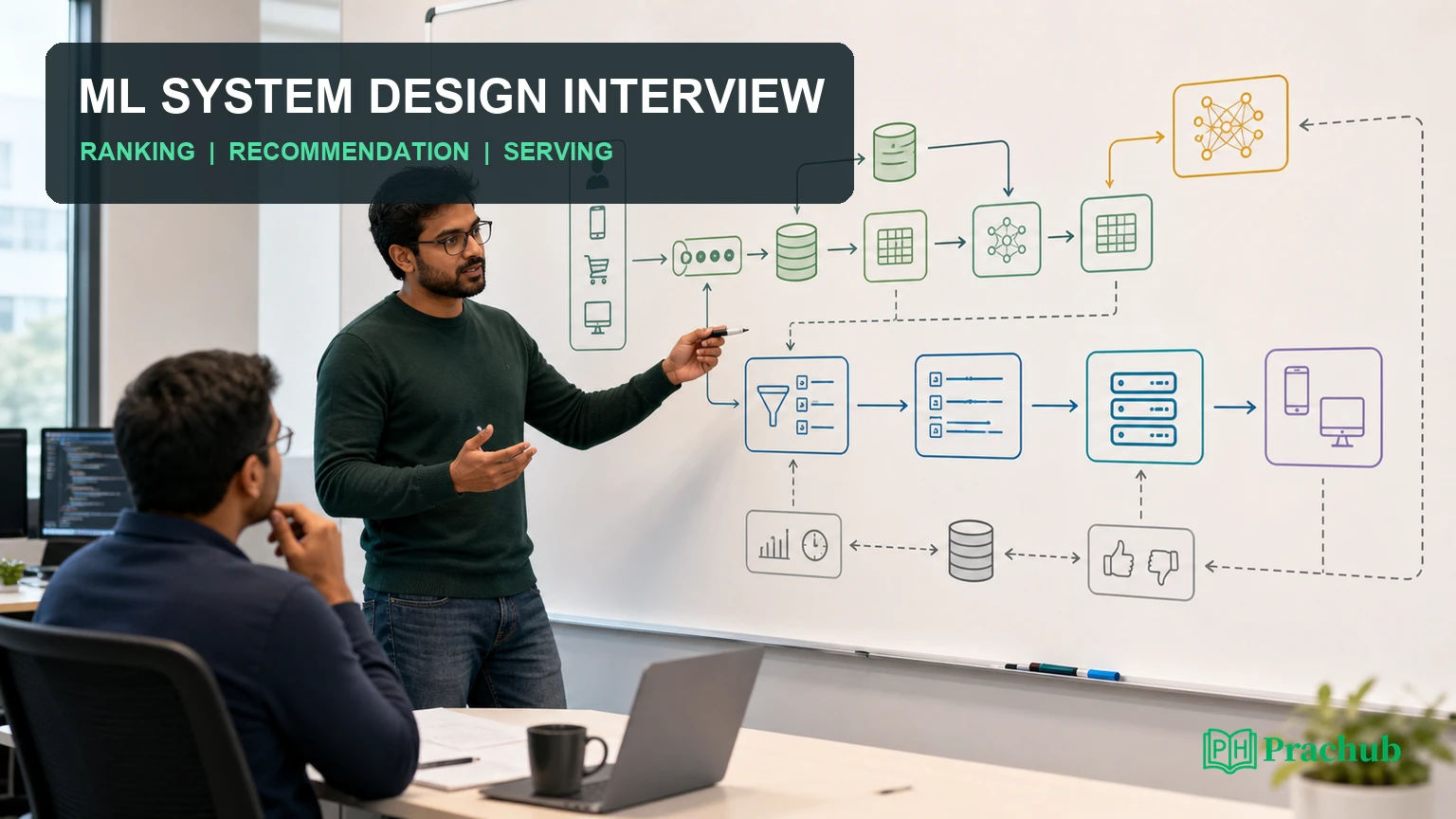
Quick answer: what is the interview testing?
A strong answer proves that you can turn an ambiguous product goal into a production system with measurable behavior. Interviewers may probe different areas by level and team, but the core signal is consistent: can you make assumptions explicit, choose sensible trade-offs, and close the loop after deployment?
| Area | Question to answer | Strong signal |
|---|---|---|
| Objective | What user or business outcome matters? | One primary metric plus guardrails |
| Data | Where do labels and features come from? | Point-in-time correctness and quality checks |
| Model | What is the simplest useful baseline? | Complexity justified by constraints |
| Evaluation | How will offline evidence predict online value? | Segmented metrics and an experiment plan |
| Serving | How are predictions delivered reliably? | Latency budget, versioning, and fallback |
| Feedback | How will the system learn and fail safely? | Monitoring, retraining, and rollback |
The model is one component, not the whole answer. If you spend most of the round debating neural architectures before defining the label, serving path, or success metric, the design will feel disconnected from the product.
Use one end-to-end framework for every prompt
Begin by clarifying the user, decision, scale, freshness requirement, latency budget, and failure cost. Then define the target action and time horizon. “Maximize clicks” is usually too shallow; a feed may care about long-term retention while guarding against hides, reports, repetitive content, and latency.
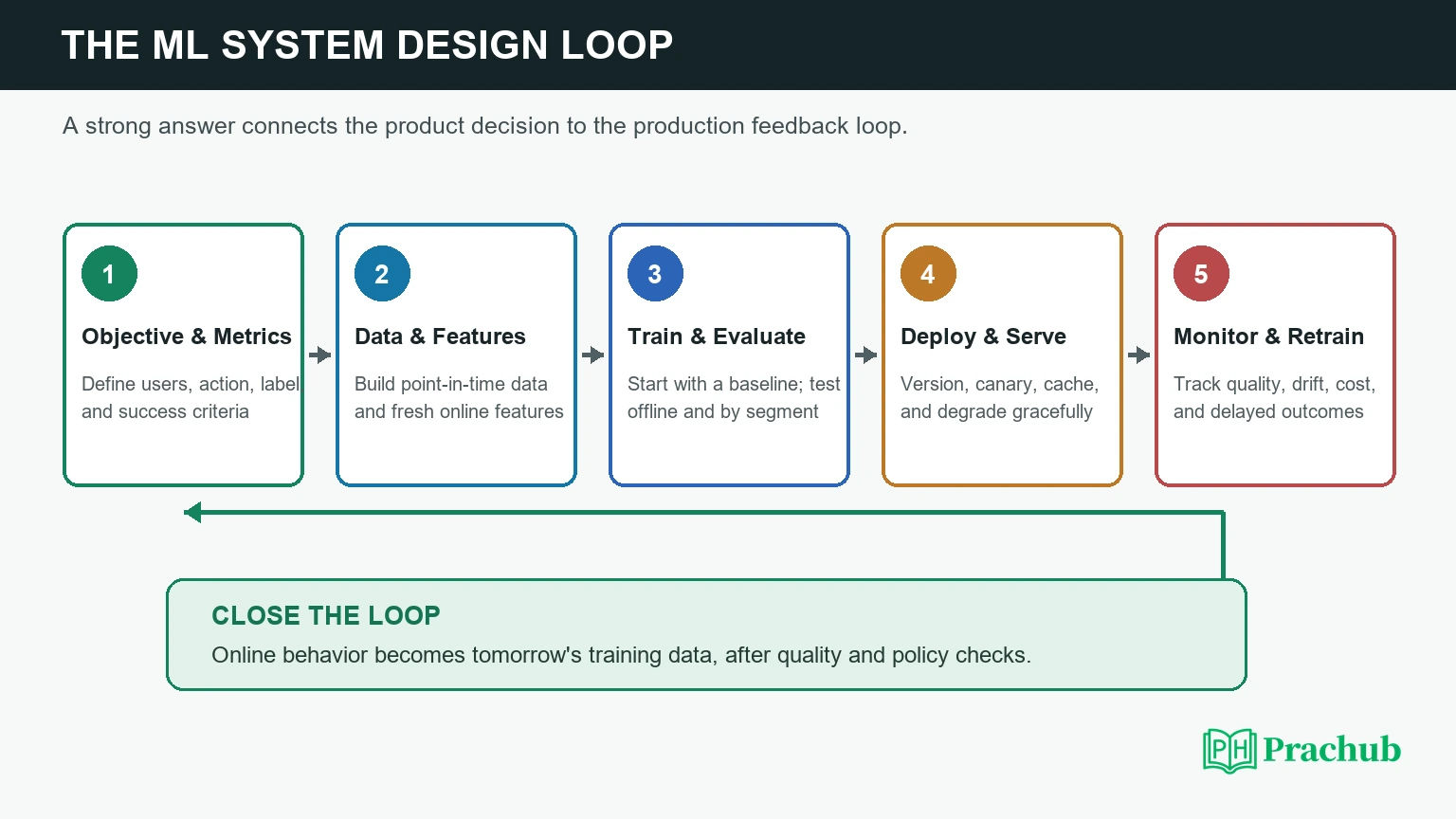
Next, map the lifecycle: event logging, label construction, feature computation, training data, baseline model, offline evaluation, registry, deployment, online features, inference, monitoring, and retraining. Draw this high-level flow before diving into one component. It gives the interviewer a map and prevents you from forgetting the production half.
Finally, state what you would launch first. A simple, observable baseline often beats an elaborate first version. Google’s Rules of ML similarly emphasizes a solid pipeline and reasonable objective before unnecessary complexity.
Ranking system interview questions
A ranking system orders a known candidate set. Start by defining the unit being ranked, the context, and the outcome: search results for a query, posts for a user, or ads for an opportunity. Explain how impressions, actions, and negative feedback become labels, including delayed outcomes and accidental exposure bias.
For offline evaluation, connect the metric to the task. Precision and recall evaluate retrieved sets; NDCG or MAP can evaluate ordering; calibration matters when scores drive downstream decisions. Do not stop there. Offline data was produced by an earlier policy, so a better offline score does not guarantee a better user experience.
At serving time, discuss feature freshness, the ranker's latency allocation, and re-ranking constraints. The final policy may enforce availability, diversity, freshness, safety, or marketplace rules. This is not “polluting” the model; it is a clear separation between predicted relevance and product policy.
Recommendation system interview questions
Recommendation usually adds retrieval before ranking because the item corpus is too large to score exhaustively. A common design uses multiple candidate generators, a heavier ranker, and a final re-ranking stage. Retrieval can combine collaborative signals, content similarity, popularity, and exploration so one source does not dominate.
Then address cold start. New users may begin with contextual, popular, or onboarding signals; new items may use content features before interaction history exists. Explain how exploration gathers information without sacrificing the experience, and how you prevent feedback loops from making popular items permanently more popular.
Online metrics should reflect product value over an appropriate horizon. Pair engagement or conversion with guardrails such as diversity, creator coverage, complaints, cancellations, fairness slices, and system latency.
Training pipeline interview questions
A credible training design begins with reproducible data. Define an event schema, stable identifiers, data retention, label windows, and time-based splits. Generate examples using only information available at prediction time; otherwise, leakage can make the offline result look excellent while the live model fails.
Separate batch and streaming needs. Historical features belong in an offline store for training and backfills, while fresh features may be materialized into a low-latency online store. Shared definitions, versioned transformations, and sampled feature logging help detect training-serving skew.
The pipeline should produce versioned data, code, features, model artifacts, and evaluation reports. Promote a candidate only after data validation, baseline comparison, slice checks, and integration tests. Distributed training is worth discussing only when the model or dataset actually requires it.
Online serving interview questions
Choose between batch prediction, dynamic inference, or a hybrid based on freshness and latency. Batch results are cheap to cache and easy to inspect but become stale. Dynamic inference handles new users, items, and context but adds dependency, compute, and tail-latency risk.
Walk one request through the system: authenticate, fetch candidates, retrieve online features, score, re-rank, log the decision, and return results. Allocate a latency budget across those stages. Mention batching, approximate retrieval, caching, autoscaling, request deadlines, and circuit breakers only where they solve a stated bottleneck.
Deployment needs versioning and reversibility. Shadow traffic validates compatibility; a canary limits blast radius; an A/B test measures product impact. If the feature store or model server fails, return a safe heuristic or cached result instead of turning the product unavailable.
Monitoring and the feedback loop
Monitor three layers. Operational metrics include latency, errors, saturation, and cost. Data metrics cover missing features, freshness, schema changes, and distribution shifts. Model and product metrics cover score distributions, calibration, delayed quality, business outcomes, and performance by important cohort.
Do not say “retrain when drift occurs” without defining the trigger. Some drift is harmless; some quality loss appears before a label arrives. Combine scheduled retraining with alerts, human review, champion-challenger evaluation, and rollback criteria. Log which model and features produced each decision so incidents are traceable.
Worked example: design a personalized feed
Suppose the goal is a useful home feed for millions of users. Clarify whether success means session depth, next-day retention, or another long-term measure, then define guardrails for hides, reports, diversity, and p95 latency.
The system logs impressions and user actions. Batch pipelines build historical user and item features; streaming pipelines update recent interactions. Multiple retrieval sources nominate followed, similar, trending, and exploratory items. A lightweight retrieval model reduces the corpus, a ranker predicts value, and a re-ranker applies availability, freshness, safety, and diversity constraints.
Offline evaluation uses time-based splits and ranking metrics by cohort. Before launch, replay logged traffic where useful, test feature parity, and shadow the serving path. Then canary the model and run an experiment against the current policy. Monitor both immediate engagement and delayed retention, while preserving a fallback feed.
If the interviewer asks what breaks first at 10x scale, choose a concrete bottleneck. Candidate retrieval, online feature fan-out, or ranker inference may dominate. Explain how you would measure it before proposing sharding, caching, batching, or a smaller model.
Follow-ups that reveal senior judgment
Expect the interviewer to change one constraint: labels arrive a week late, latency doubles, a feature disappears, or one cohort regresses. Respond by tracing the affected path, naming the metric that detects the problem, and choosing a reversible mitigation.
Senior answers also address ownership. Who defines the feature contract? How are incompatible model versions blocked? Which team owns the fallback? What requires human review? These questions turn a diagram into an operable system.
Common mistakes to avoid
- Jumping to the model: define the decision, label, and metric first.
- Using only an offline metric: connect it to an online experiment and guardrails.
- Ignoring exposure bias: logged data reflects the policy that selected what users saw.
- Hand-waving feature freshness: state which features are batch, streaming, or request-time.
- Forgetting failure behavior: include timeouts, rollback, and a safe fallback.
- Over-designing version one: earn complexity with a measured bottleneck.
Practice with PracHub ML system design questions
Use each prompt as a 45-minute mock. Spend the first few minutes clarifying requirements, sketch the full lifecycle, then let a partner pressure-test data, evaluation, serving, and failure modes.
| PracHub question | Practice focus | Why it helps |
|---|---|---|
| Design an End-to-End ML System | Full lifecycle and trade-offs | Tests whether your framework survives an open prompt. |
| Design a Real-Time Feature Store | Point-in-time data and freshness | Builds depth on training-serving consistency. |
| Design a short-video recommendation system | Retrieval, ranking, bias, and metrics | Combines ML depth with product judgment. |
| Design a Food Delivery Recommender | Cold start and marketplace constraints | Forces practical serving and business trade-offs. |
A seven-day preparation plan
| Day | Focus | Deliverable |
|---|---|---|
| Day 1 | Framework | Draw one complete lifecycle from memory. |
| Day 2 | Ranking | Define labels, offline metrics, and guardrails. |
| Day 3 | Recommendation | Compare retrieval, ranking, and re-ranking. |
| Day 4 | Training | Explain leakage, skew, lineage, and retraining. |
| Day 5 | Serving | Budget latency and design fallback behavior. |
| Day 6 | Mock interview | Complete one 45-minute PracHub prompt. |
| Day 7 | Review | Rewrite the weakest section in five minutes. |
Frequently asked questions
What is asked in an ML system design interview?
Expect an open-ended product or infrastructure prompt that covers requirements, data, labels, features, modeling, evaluation, deployment, serving, monitoring, and iteration. The depth varies by role and seniority, so clarify which area the interviewer wants to explore.
How is ML system design different from regular system design?
Both require scale, reliability, APIs, storage, and trade-offs. ML design adds uncertain predictions, training data, feature pipelines, offline evaluation, experimentation, drift, and feedback loops that can change future data.
Do I need to choose a deep learning model?
Not by default. Start with a baseline that matches the objective and constraints. Introduce a more complex model only when you can explain the expected quality gain, data requirement, latency, cost, and operational burden.
Which metrics should I know for ranking and recommendation?
Know precision, recall, MAP, NDCG, calibration, and task-specific loss at a practical level. More important, explain what each metric misses and connect offline evidence to online product metrics and guardrails.
How should I discuss training-serving skew?
Identify how training and live feature computation can diverge. Reuse definitions where possible, log served features for comparison, test point-in-time datasets, monitor parity, and version transformations with models.
How much coding appears in this round?
The system design round is usually architectural and conversational, though a loop may include separate ML coding or data-manipulation rounds. Practice drawing, estimating, and explaining clearly rather than memorizing one canonical diagram.
Final takeaway
The best machine learning system design answers form a closed loop: objective, data, training, evaluation, serving, monitoring, and learning. Use a simple baseline, quantify the constraint you are solving, and make every launch reversible.
Build that reflex with PracHub's ML system design question bank. A timed attempt followed by a written postmortem will improve interview performance far more than passively rereading one perfect architecture.
Sources and Further Reading
- Google: Rules of Machine Learning
- Google: Recommendation Systems Overview
- Google: Candidate Generation Overview
- Google: Re-ranking, Freshness, Diversity, and Fairness
- Google: Static vs. Dynamic Inference
- Google: Production ML Deployment Testing
- AWS Well-Architected: Machine Learning Lifecycle
- AWS Well-Architected: ML Monitoring
- TensorFlow Serving Configuration
Research note: This guide was checked on August 24, 2026. Interview emphasis varies by company, team, role, and seniority; use the prompt and interviewer guidance as the source of truth.
Related Articles
Model Serving Interview Questions: Batching, GPUs, Latency, Autoscaling, and Rollbacks
Prepare for model serving interviews with practical questions on batching, GPUs, p99 latency, autoscaling, observability, canaries, and rollbacks.
PEFT Interview Questions: LoRA, Adapters, Quantization, and Fine-Tuning Trade-Offs
Prepare for PEFT interview questions with LoRA math, adapter and QLoRA trade-offs, memory estimates, evaluation criteria, and a production rubric.
OpenAI Research Scientist Interview Guide 2026: Research Depth, Coding, and ML Systems
Prepare for OpenAI Research Scientist interviews with research depth, ML coding, experiment design, ML systems, presentation tips, and a 7-day plan.
Generative AI System Design Interview Questions: RAG, Agents, Evals, and Guardrails
Practice generative AI system design questions covering RAG, agents, evals, guardrails, tool safety, serving, latency, cost, and production failures.
Comments (0)