Staff-Level System Design Interviews: How to Show Judgment, Depth, and Technical Leadership
Quick Overview
This resource explains how to approach staff-level system design interviews with the judgment, ownership, and technical depth expected from senior technical leaders. It breaks down what makes staff interviews different from mid-level and senior interviews, including problem framing, architectural trade-off reasoning, prioritization, simplicity, technical depth, failure planning, and collaborative decision-making. Designed for staff software engineer candidates, senior engineers preparing for promotion, and experienced interviewers, this guide provides a practical 50-minute interview framework, examples of strong architectural reasoning, common mistakes to avoid, and modern system design topics such as distributed systems, internal platforms, product infrastructure, and AI infrastructure. Readers will learn how to turn ambiguous prompts into clear design goals, identify the highest-risk parts of a system, defend technical decisions, and demonstrate the leadership signal interviewers look for at the staff level.
A staff-level system design interview is not simply a senior-level interview with more components, more traffic, or a more complicated diagram.
The real difference is ownership.
At the staff level, you are expected to turn an ambiguous prompt into a well-defined problem, identify the decisions that matter most, choose a direction, and guide the conversation with limited help from the interviewer. Your architecture still needs to work, but the interview is also testing whether other engineers could trust you to lead a difficult technical decision in the real world.
That changes how you should prepare—and how you should spend every minute of the interview.

What Makes a Staff-Level System Design Interview Different?
In a typical mid-level interview, asking relevant questions and producing a reasonable high-level design may be enough to demonstrate competence. A senior candidate is usually expected to go further by discussing scalability, reliability, and architectural trade-offs.
A staff candidate must do all of that while providing direction.
The interviewer should not need to repeatedly remind you to consider failure scenarios, data consistency, operational complexity, or the limits of your design. You should surface those issues yourself, prioritize them, and decide which ones deserve a deeper discussion.
Think of the interview as a compressed version of a real architecture meeting. The interviewer is less like an examiner waiting for a correct answer and more like an experienced collaborator evaluating whether you can:
- Create clarity from an incomplete problem
- Separate routine engineering from the true technical risk
- Make decisions without waiting for permission
- Explain trade-offs in language appropriate for experienced peers
- Connect architecture choices to product and business constraints
- Anticipate failure, recovery, observability, security, and cost
- Adjust your plan when a requirement changes
The signal is not how many technologies you can name. It is the quality of the decisions you make.
Six Signals Interviewers Are Looking For
1. Problem framing
System design prompts are intentionally broad. “Design a notification platform” could describe a small internal tool or a global service sending billions of time-sensitive messages.
Before designing anything, establish the operating environment:
- Who are the users?
- What are the essential use cases?
- Which use cases are out of scope?
- What is the expected request volume?
- Is the workload read-heavy, write-heavy, bursty, or predictable?
- What latency and availability targets matter?
- Where is strong consistency required?
- Are there regulatory, privacy, security, or geographic constraints?
Strong candidates do more than collect requirements. They use the answers to narrow the problem and state what they will prioritize.
For example:
“I’ll optimize first for reliable delivery of transactional notifications. Marketing messages can tolerate delay, so I’ll treat them as a lower-priority workload.”
That statement creates a design direction. It also gives the interviewer something concrete to confirm or challenge.
2. Architectural judgment
Most candidates know the standard building blocks: load balancers, services, databases, caches, queues, object storage, and CDNs. Staff candidates are evaluated on why and when they use them.
Compare these two answers:
“I’ll use Kafka for the event pipeline.”
“I’ll use a durable event log because consumers need independent replay and ordering within a customer’s event stream. I’ll partition by customer ID, accept ordering only within each partition, and make consumers idempotent so retries do not duplicate side effects.”
The second answer demonstrates a chain of reasoning. The technology is a consequence of the requirements rather than a decoration on the diagram.
3. Prioritization
You cannot fully design a global product in 45 to 60 minutes. Trying to cover everything usually produces a shallow answer.
Staff-level performance requires deciding what not to discuss.
Move quickly through conventional parts of the architecture, then spend time on the part that determines whether the system succeeds. Depending on the prompt, that might be:
- Conflict resolution in a collaborative editor
- Idempotency and reconciliation in a payment system
- Fan-out strategy in a social feed
- Partitioning and delivery semantics in a message queue
- Hot-key protection in a cache
- Capacity management and graceful degradation in an AI inference service
Name the hard part early:
“The API layer is relatively standard. The main risk is maintaining correctness when the same payment event is delivered more than once, so I want to spend most of the deep dive on idempotency and reconciliation.”
This shows that you can distinguish architectural substance from routine implementation.
4. Simplicity
Complexity is not evidence of seniority. Often, the most experienced answer is the one that avoids a distributed solution until the requirements justify it.
Start with the smallest design that satisfies the confirmed constraints. Then evolve it at specific pressure points:
- Describe the simplest working version.
- Identify where it will fail or become insufficient.
- Introduce only the mechanism needed to address that limitation.
- State the cost created by the added complexity.
If 10,000 mostly static records fit comfortably in memory, a search cluster may be unnecessary. If a single-region deployment satisfies the availability target, active-active multi-region replication may create more risk than value.
A useful staff-level question is:
“Which parts of this system do not need to scale yet?”
Every cache, queue, replica, index, and service boundary should earn its place in the design.
5. Technical depth
Starting simple does not mean staying shallow. Once the high-level design is aligned, the interviewer will usually push into one or two components.
This is where you should move from boxes and arrows into concrete behavior:
- Data model and access patterns
- Partition key and rebalancing strategy
- Cache invalidation and hot-key handling
- Queue ordering and delivery guarantees
- Retry, timeout, and idempotency behavior
- Replication and failover
- API contracts and versioning
- Backpressure and overload protection
- Monitoring, alerting, and recovery
At staff level, high-level and low-level design are connected. You should be able to explain both the overall architecture and how a critical request behaves during a race condition, retry, partial outage, or regional failure.
Your past experience can strengthen the answer, but it should support the design rather than replace reasoning. A short production example—what failed, why it failed, and what you changed—can demonstrate depth more effectively than a long list of theoretical alternatives.
6. Decisiveness and collaboration
Listing every possible option is not the same as making a decision.
If you say, “We could use SQL or NoSQL,” the interviewer still does not know what you would build. Choose an approach, explain the requirement that drove it, and acknowledge the most important downside:
“I’ll start with PostgreSQL because transactions and auditability matter more than horizontal write scale for this workload. If write volume becomes the bottleneck, we can revisit partitioning, but I would not pay that operational cost on day one.”
Being decisive does not mean ignoring the interviewer. Check for alignment after major choices and treat pushback as new information:
- “Does that scope match what you want to evaluate?”
- “I see two risks here; I suggest going deeper on consistency first.”
- “That new latency target changes the design. I would move this computation off the request path.”
The goal is a collaborative discussion that you are clearly capable of leading.
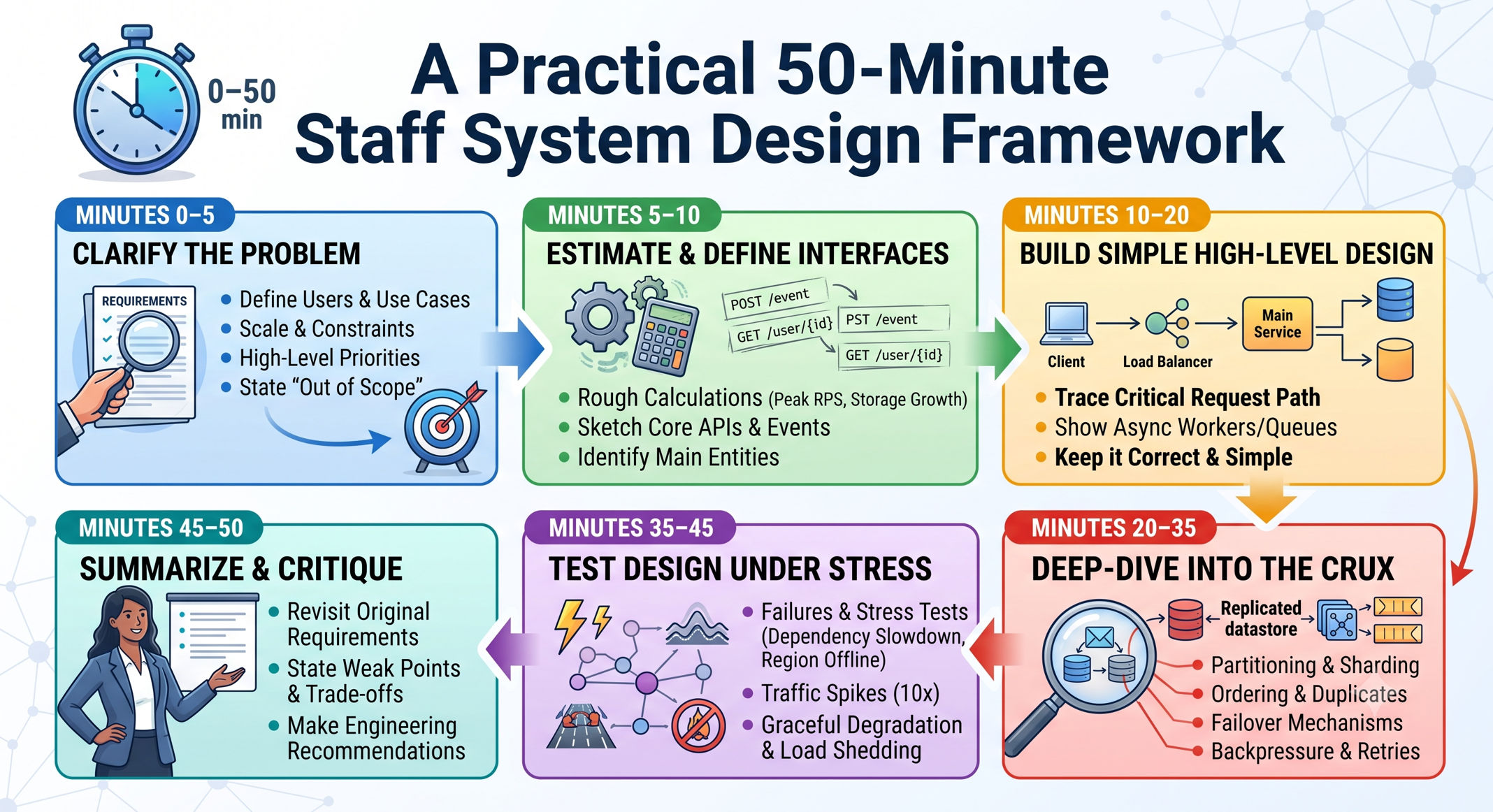
A Practical 50-Minute Staff System Design Framework
A framework should prevent major omissions without turning your answer into a memorized script. The timing below is a useful default, not a rigid formula.
Minutes 0–5: Clarify the problem
Define the primary users, core use cases, scale, latency, availability, consistency, and domain constraints. Explicitly state what is out of scope.
End this phase with a prioritized design goal:
“I’ll focus on the write path, delivery guarantees, and behavior during provider failures.”
Minutes 5–10: Estimate and define interfaces
Use rough calculations only when they affect the architecture. Estimate peak requests per second, storage growth, payload size, bandwidth, or read-to-write ratio.
Sketch the core APIs or events and identify the main data entities. This creates a shared model before you draw infrastructure.
Minutes 10–20: Build the simplest high-level design
Trace the critical request from the client through the system. Cover the service, storage, caching, and asynchronous paths that are necessary for the requirements.
Do not start by drawing every supporting component. First make the main path correct and understandable.
Minutes 20–35: Deep-dive into the crux
Choose the highest-risk area—or follow the interviewer’s preference—and go several levels deeper.
Discuss actual mechanics, such as:
- How data is partitioned
- What ordering is guaranteed
- How duplicates are handled
- What happens during failover
- How stale data is detected or tolerated
- How backpressure reaches upstream services
This is usually the most important part of the interview.
Minutes 35–45: Test the design under stress
Walk through failure and change:
- A dependency becomes slow
- A region goes offline
- Traffic rises by 10x
- The hottest cache key disappears
- A message is delivered twice
- The budget is cut in half
- A stronger consistency requirement is introduced
Explain graceful degradation, load shedding, retry limits, circuit breaking, recovery, and observability where relevant. Include security, compliance, and cost when the domain makes them material.
Minutes 45–50: Summarize and critique
Return to the original requirements. State what the design satisfies, its weakest point, and what you would improve with more time.
A strong ending sounds like an engineering recommendation, not a recap of component names.
Trade-Offs: The Center of the Interview
Architecture is the visible output of system design. Trade-off reasoning is the skill underneath it.
For each important decision, use a simple structure:
- Constraint: What requirement matters most?
- Decision: What are you choosing?
- Benefit: What does the choice optimize?
- Cost: What becomes harder or weaker?
- Trigger: What future condition would make you reconsider?
For example:
“Because the redirect path has a strict latency target and reads greatly outnumber writes, I’ll cache active mappings close to the application. This reduces database load, but deletions can temporarily serve stale data. I’ll use explicit invalidation for deletes and a short TTL as a safety net. If deletion must be globally immediate, we would need a stronger invalidation mechanism and accept additional coordination cost.”
This is much stronger than saying, “We can use a cache to improve performance.”
The same method applies to common decisions:
- Strong vs. eventual consistency
- Fan-out on write vs. fan-out on read
- Synchronous vs. asynchronous processing
- Relational vs. non-relational storage
- Centralized vs. distributed rate limiting
- Active-passive vs. active-active deployment
- Precomputed vs. on-demand results
- Higher reliability vs. lower cost
There is rarely one universally correct choice. The correct choice is the one you can defend against the stated constraints.
Modern Staff-Level Topics Worth Practicing
Classic distributed systems remain essential, but current interviews also apply those fundamentals to platform and AI workloads.
Prepare across several categories:
Large-scale distributed systems
- Design a global rate limiter
- Design a distributed cache
- Design a notification platform
- Design a message queue
- Design a CDN
Product and transactional systems
- Design a payment platform
- Design a ride-sharing service
- Design a social feed
- Design a collaborative document editor
- Design an e-commerce search service
Internal platforms
- Design a feature flag service
- Design an API gateway
- Design a deployment pipeline
- Design a monitoring and alerting system
- Design an event streaming platform
AI infrastructure
- Design an LLM inference API
- Design a real-time recommendation platform
- Design an enterprise semantic search service
- Design a model-serving system with versioning and rollback
For AI infrastructure questions, focus on system behavior rather than model theory: request queues, streaming responses, batching, latency budgets, GPU capacity, model versioning, fallbacks, feature freshness, and graceful degradation.
Common Mistakes That Make a Staff Candidate Look More Junior
Jumping into architecture too early
Choosing a database before understanding the workload signals solution-first thinking.
Naming tools instead of explaining decisions
“Kafka, Redis, and Elasticsearch” is a technology list, not an architecture argument.
Overexplaining fundamentals
Your interviewer probably does not need a tutorial on load balancers. Use shared technical language and save time for insights specific to the problem.
Overengineering from the beginning
Designing for global scale before confirming the scale creates unnecessary failure modes and operational cost.
Ignoring the unhappy path
A design that works only when every dependency is healthy is not production-ready.
Waiting for prompts
If the interviewer must repeatedly ask about consistency, failure, security, or scaling, you are reacting rather than leading.
Memorizing complete architectures
Memorized diagrams break when the interviewer changes one constraint. Learn reusable patterns and derive the design from requirements.
Treating the interview like a presentation
Talking for 20 minutes without checking alignment makes it difficult for the interviewer to collaborate and suggests weak stakeholder awareness.
How to Prepare Effectively
Build a strong foundation
Understand the behavior and trade-offs of databases, caching, partitioning, replication, queues, networking, load balancing, consistency models, and observability. You do not need encyclopedic knowledge, but you must know how components behave under pressure.
Practice categories, not scripts
Develop mental models for transactional systems, real-time communication, content delivery, data pipelines, internal platforms, and AI serving. This makes it easier to adapt when the prompt changes.
Practice out loud
Silent reading creates familiarity, not interview performance. Complete full 45- to 60-minute sessions while speaking, drawing, and making decisions in real time.
Record yourself or practice with another person. Ask them to interrupt you, change a requirement, question your database choice, or introduce a failure. The ability to adapt under pressure is part of what the interview measures.
Review your decision quality
After every mock interview, ask:
- Did I define a clear scope?
- Did I identify the hardest problem early?
- Did each major component have a reason to exist?
- Did I choose a direction or merely list options?
- Did I discuss the most relevant failure modes?
- Did I connect technical choices to product, domain, and cost?
- Did I leave enough time for a deep dive and final summary?
Research the target company
The reasoning process transfers across companies, but assumptions about scale, tooling, domain, and interview format do not. Review the company’s engineering blog, product architecture, role expectations, and recent interview prompts.
Use PracHub to find company- and role-specific interview questions, then practice applying the same reasoning framework across different prompts. The goal is not to memorize one “correct” architecture. It is to become comfortable making defensible decisions when the question changes.
Final Takeaway
A strong staff-level system design answer does not try to impress the interviewer with the largest architecture.
It creates clarity. It finds the hardest problem. It chooses the simplest design that meets the requirements, then adds complexity only where the constraints demand it. It makes trade-offs explicit, anticipates failure, and connects technical decisions to real operational and business consequences.
Most importantly, it shows that you can lead.
If the interviewer leaves the session thinking, “I could trust this person to guide a high-stakes architecture discussion with engineers and stakeholders,” you have demonstrated the signal the staff-level round is designed to find.
Related Articles
PracHub is the free DarkInterview alternative when your search spans 40 companies
Compare DarkInterview vs PracHub for tech interview prep, including pricing, company coverage, worked solutions, roles, and when each tool is worth it.
PracHub Is a Way Better Alternative to GothamLoop!
Compare PracHub vs GothamLoop for free interview questions, written solutions, coding, SQL, ML, system design, and company-specific prep.
When PracHub Is the Smarter Free Alternative to HelloInterview
Compare PracHub vs HelloInterview for system design, coding, SQL, ML, behavioral prep, and free company-tagged interview questions.
PracHub Is a Better Free Alternative to InterviewDB
Compare PracHub vs InterviewDB and learn why free, solution-backed interview questions beat points-gated prep for SWE, SQL, ML, and system design.
Comments (0)