When PracHub Is the Smarter Free Alternative to HelloInterview
Quick Overview
This comparison guide evaluates HelloInterview versus PracHub across product purpose, content coverage, pricing tiers, company-specific question availability, and alignment with different interview rounds while noting recent changes such as the winding down of human mock interviews.
You are comparing HelloInterview and PracHub because you have a real loop on the calendar, a budget that may not stretch to a $47-a-month course, and a nagging suspicion that one course does not cover every round you are about to face. That suspicion is correct, and this page will show you exactly where the gap is. You get a straight answer on what each tool is built to do, a side-by-side comparison across the dimensions that decide the purchase, an honest read on the narrow case where HelloInterview is the better buy, and a plan for using PracHub's free tier to cover the rest. Work through the decision tree first, then the comparison table, then the week-before checklist at the end.
Key Takeaways
- HelloInterview is a course. PracHub is a searchable bank of real interview questions with written solutions. They are not substitutes, and comparing them as though they were is why people buy the wrong one.
- The sharpest catch: HelloInterview's own premium page lists the Interview Question Library among the things a paid plan buys you. On PracHub, most of the company-tagged bank sits on the free tier. If what you actually want is "what did this company ask last month," check carefully how much of that you can read elsewhere before you pay for it.
- The human mock interviews with a real engineer were wound down at the end of May 2026. If that was your reason to reach for a card, it is a dead end — and it is a fair warning about paying $279 up front for a roadmap you do not control.
- If system design is the single round standing between you and an offer, and you have budget, a structured course is the faster fix. That is a genuine win for HelloInterview and this page will not pretend otherwise.
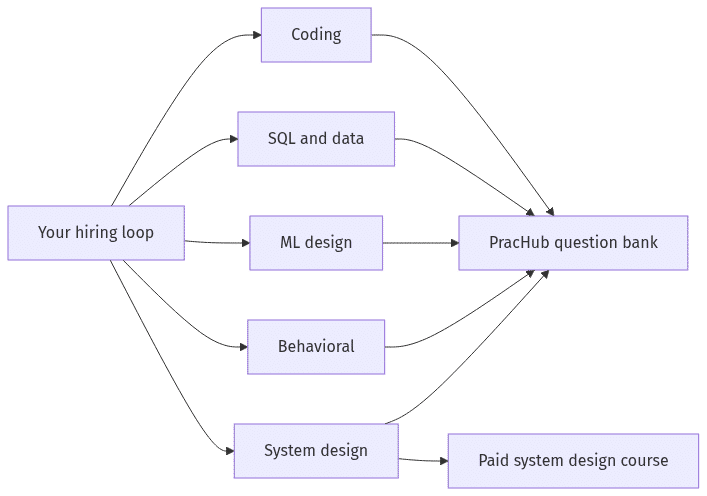
- Most loops contain three to five different rounds. A course built around system design leaves most of them uncovered, and the round you leave uncovered is the one that ends the loop.

The decision you're actually making
The decision tree above hides one assumption worth making explicit: these two products are answering different questions, and only one of them is the question you typed into Google.
HelloInterview is a course you enroll in. It teaches system design step by step, in a deliberate order, with the reasoning laid out by people who have run hiring loops. A genuinely fair chunk of it is readable for free, and that is to their credit.
But a course is a fixed syllabus, and a fixed syllabus has a structural limit: it cannot tell you what your target company asked a candidate three weeks ago. HelloInterview's answer to that is a question library, and as of this writing, per their own premium page, that library is listed as part of what a paid plan buys. So the thing most people are actually shopping for — recent, company-specific questions — is on the far side of a payment. That is the trade you are being offered. Before you take it, look at what the alternatives put in front of you for nothing.
There is a second thing to know before you pay. The human mock interviews, the ones with a real engineer on the other end, were discontinued at the end of May 2026. If you found this page while shopping for that specific feature, stop: it is gone. The broader lesson matters more than the feature. Their lifetime tier asks for $279 today against a content roadmap you have no say in, and a product line that existed last spring does not exist now. Concentrating your whole prep budget in one up-front bet on one vendor is a worse deal than it looks on the pricing page.
PracHub is closer to a filing cabinet. You do not enroll in it. You open it, filter to the company and role you are interviewing for, read the real questions candidates reported, work the written solution, and move on. Less "teach me this subject from scratch," more "show me exactly what is coming and let me practice it."
That distinction sounds pedantic until it decides where your money goes. A candidate with a Meta E5 loop who is already comfortable with distributed systems does not need another architecture course. What they need is to see the specific questions Meta tends to ask across coding, design, and behavioral, so nothing in the loop is a surprise. A course cannot give them that. A tagged question bank can. Reverse the situation, and a candidate who has never drawn a system diagram will flounder in a question bank, because a bank shows you past papers and a course teaches you how to write the answer.
HelloInterview vs PracHub, side by side
Here is the comparison across the dimensions candidates actually ask about.
| Dimension | HelloInterview | PracHub |
|---|---|---|
| Format | Structured course with guided practice | Searchable question bank with written solutions |
| Primary strength | Teaching system design from first principles | Breadth of real, company-tagged questions |
| System design | Its core product, taught in sequence | Question and solution practice, not a taught course |
| Coding and algorithms | Adjacent to its system design focus | Large category (3,091-plus questions) with an in-browser coding console |
| SQL and data | Not the focus | Dedicated SQL questions with an in-browser SQL console |
| ML and ML system design | Not the focus | Dedicated categories for both |
| Behavioral | Taught as a course | Question sets plus written guidance |
| Filtering | Company-oriented lists | Filters by company, role, category, and seniority |
| Recent company-reported questions | Listed on their own premium page as part of what a paid plan buys | Most of the company-tagged bank sits on the free tier |
| Access duration | Monthly and annual plans are dated and expire; only the $279 lifetime tier does not | Free tier does not expire; Premium is a subscription that renews until you cancel |
| Pricing model | Paid subscription, listed at $47/month, $79/year, or $279 lifetime, with a free readable portion | Freemium: most of the bank is free, Premium unlocks the rest (see current pricing) |
| Best for | Fixing one weak round properly | Covering every round in a real loop |
Two notes on that table. Those prices are what each site listed at the time this page was written; pricing and packaging on both sides change, so check the current pricing page before you enter a card number rather than trusting any comparison article, including this one. And "freemium" means exactly that: most questions and their written solutions sit on the free tier, but some questions and some solution sections are Premium. No prep site is completely free, and anyone who tells you otherwise is selling something.
The access-duration row deserves a sentence of its own, because it is the line people skim past and regret. To their credit, HelloInterview's monthly and annual plans do not auto-renew, which is more honest than most of this industry. The flip side is that those plans are dated: the clock runs whether you study or not. Recruiters reschedule loops constantly. If yours slips three weeks — and it will — a one-month plan can expire before the interview it was bought for.
Where HelloInterview is the better fit
One case genuinely goes their way, and pretending otherwise would waste your time.
If system design is specifically where you are weak, PracHub's system design questions and solutions will not teach you the way a real course does. Reading a strong solution to a rate limiter design tells you what good looks like. It does not walk you through why you would reach for a token bucket over a sliding window, what the interviewer is probing when they ask about the failure mode, or how to sequence the conversation over 45 minutes. A course does that. A question bank assumes you already can.
The right call looks like this: three weeks out, one onsite, and your last two rejections both cited the design round. You can already pass coding. Buy the course, work it end to end, and use a question bank only for the last-week company-specific cram. Spending those three weeks browsing questions you cannot yet answer well is how people arrive at the same rejection twice.
The mistake to avoid is confusing exposure with instruction. Reading fifty design questions feels productive and teaches you very little if you never learn the underlying method. If your notes after an hour are a list of question titles rather than a repeatable approach, you needed a course.
Note the shape of that case, though. It is one round, for one kind of candidate, in one situation. That is a narrow target, and most people reading this page are not standing on it.
What PracHub's free tier actually covers
If the previous section did not describe you, the calculation flips hard, because most candidates are not one-round-away.
PracHub is built around real interview questions reported by candidates, each with a written solution, and most of that bank, listed at 9,168-plus questions with 5,621 tagged to a specific company, sits on the free tier. Practically, that means:
- Real questions, not invented ones. The bank is organized by what companies actually asked, tagged to a company and a role, so you can see the shape of your specific loop rather than a generic list.
- Working consoles, not just reading. Coding questions come with an in-browser editor so you can run your solution against test cases, and SQL questions run against a real database rather than a toy parser. Reading a solution and passing test cases are different skills, and only one of them is the interview.
- Filters that map to your loop. Narrow by company, by role such as software engineer, by category, and by seniority, so a staff-level candidate is not grinding new-grad questions. Before you commit money anywhere else, check that you can slice the material the same way.
- Coverage across rounds. Coding and algorithms (3,091-plus questions), SQL and data manipulation, machine learning (583 questions plus 225 on ML system design), system design, and behavioral all live in the same bank, alongside 74 company guides.
Here is how that plays out. A data-heavy candidate with an analytics loop filters to their target company, finds the SQL questions reported for that company, solves each one in the console until they pass, then reads the behavioral questions from the same company hub. That is a complete prep plan built in one sitting, almost entirely on the free tier, and no system design course covers any of it.
Start from the full question bank, or from a company hub such as Google if you already know where you are interviewing.
The round you skip is the round that sinks you
The real risk is not the round you are worried about. It is the one you stopped worrying about too early.
Candidates lose offers on the round they forgot existed. Someone spends a month deep in distributed systems, walks in sharp on read replicas and cache invalidation, and then gets handed a SQL screen they have not touched in eight months. No architecture course saves you there, because the problem was never architecture. It was coverage.
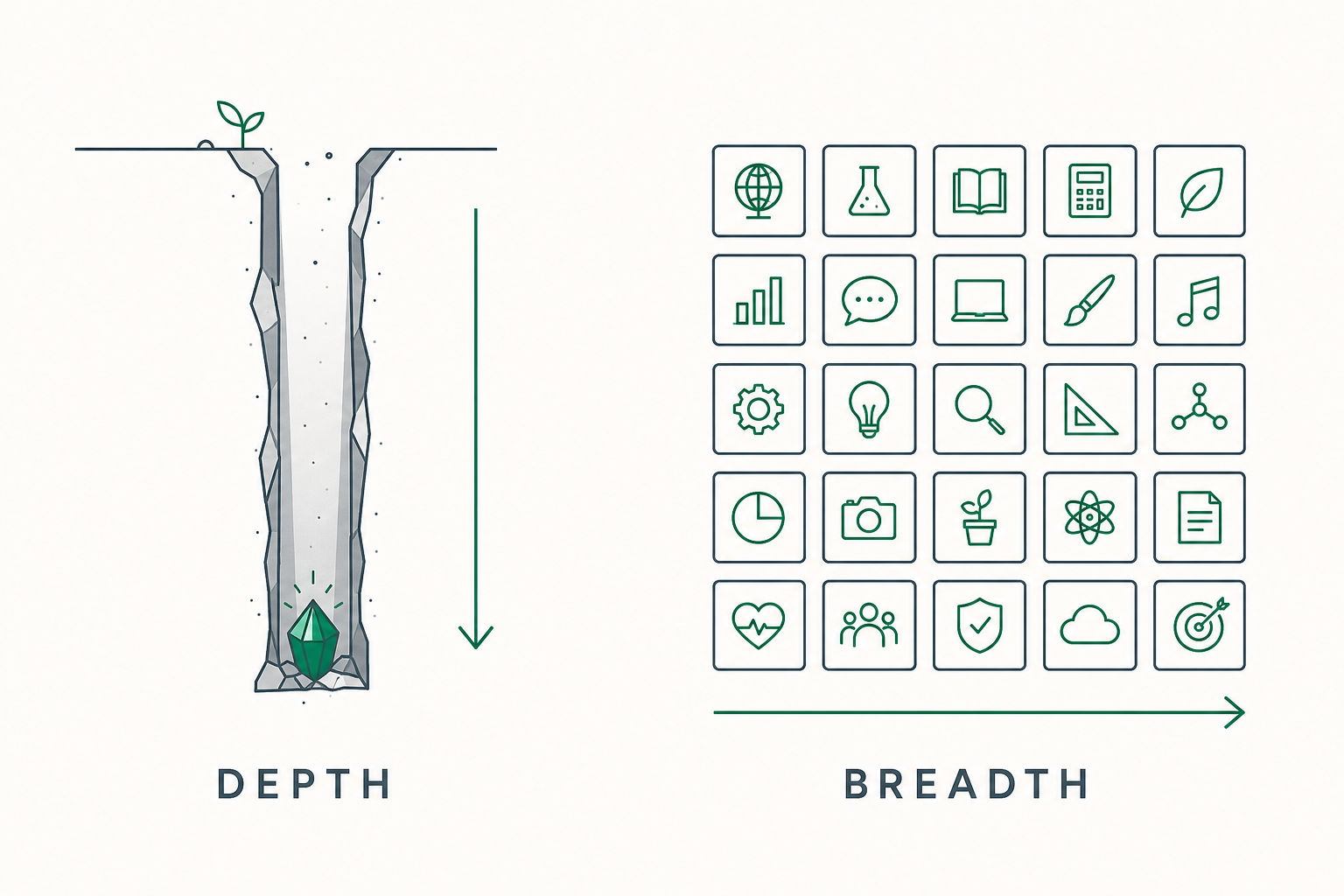
This is the honest bill for depth-first prep. A course built around one subject is excellent at that subject and structurally silent on four other rounds. That is a defensible product decision on their side. It is a bad fit for the buyer whose loop has five rounds and one weekend of prep time left, and that buyer is most of the market.
This is also where memorization quietly fails. A candidate who memorized the answer to "find the second highest salary" freezes the moment the interviewer adds "per department," because the memorized query returns one global number and the fix is not a small edit. A candidate who learned the underlying ranking-and-partitioning pattern just changes what they group by and keeps talking. Practicing patterns against varied real questions is what produces the second candidate. Rereading a solution you already agree with produces the first.
The mistake with breadth is treating it as optional until the recruiter confirms the schedule. By then you have days, not weeks.
Build the plan around your actual loop
Once you stop planning around preference and start planning around the schedule, the plan writes itself.
- Open the recruiter's email and list the rounds. Write down every one, including the screen you think is easy.
- Rank them by risk, not by enjoyment. Risk is the product of how likely the round is and how weak you are at it.
- Assign each round a resource using the table below.
- Spend the last week on company-specific questions only. Filter to your company and role and read the real reported questions for every round on your list.
| Round | Where to prep it | What "ready" looks like |
|---|---|---|
| Coding and algorithms | PracHub coding questions with the console | You pass test cases without looking at the solution first |
| SQL and data | PracHub SQL questions with the SQL console | You can adapt a query when the requirement changes |
| System design, and it is your weak round | A structured course such as HelloInterview | You can drive the conversation, not just name components |
| System design, and you are already decent | PracHub system design questions | You can produce a defensible design and name its tradeoffs |
| ML and ML system design | PracHub ML categories | You can justify model, data, and evaluation choices |
| Behavioral | PracHub behavioral questions and written guides | You have three to five stories that flex to most prompts |
A finished plan looks like this: a five-round loop, weak at design, three weeks out. Week one and two, the design course, plus 30 minutes of coding console practice a day to stay warm. Week three, filter PracHub to their company and role, read every reported question across all five rounds, and rehearse behavioral stories out loud. Nothing in that plan is exotic. It just refuses to leave a round uncovered.
Our verdict, stated plainly: do not pay for a system design course until you have worked the free material for every round on your list and confirmed that design is the one that beats you. Most people who buy first are buying reassurance about the round they fear, not insurance against the round that fails them.
Practice this week
Before the FAQ, the one action worth taking today.
Pick the round you have been avoiding, open the question bank filtered to your company and role, and work three real questions end to end, in the console where one exists. Not read. Work. If you want structured reading alongside it, the resource library covers the fundamentals per round. Exposure to the round you were about to ignore beats another hour on the round you already own.
Related: Hello Interview pricing explained
Related: Hello Interview review 2026
FAQ
Is PracHub free?
PracHub is freemium. Most of the question bank, including written solutions, is available on the free tier, and on the free tier you can practice most coding and SQL questions in the browser without paying. Some questions and some solution sections are reserved for Premium (see current pricing; no figure is quoted here because plans change). So: most questions are free, not everything.
How much does HelloInterview cost?
As of this writing, per HelloInterview's own premium page: $47 for one month, $79 for one year, or $279 for lifetime, with a meaningful portion of the system design material readable for free. The monthly and annual plans do not auto-renew, which is fair of them, but they are dated — access ends on a specific date whether or not your loop has happened yet. Only the $279 lifetime tier is permanent, and $279 up front is a large bet on a single vendor. Prep-site pricing and packaging change often, so confirm the current numbers on their own pricing page before you buy rather than trusting any comparison page.
Are the recent company interview questions included for free?
As of this writing, HelloInterview's premium page lists the Interview Question Library among the features you get with a paid plan. If recent company-specific questions are the reason you are shopping, that is the single most important line on their pricing page — read it yourself before you buy. On PracHub, most of the company-tagged bank, including written solutions, is on the free tier.
What happened to HelloInterview's human mock interviews?
They were wound down at the end of May 2026. If a live engineer on the other end was what you were paying for, that option is closed, and you should re-evaluate the purchase from scratch rather than assuming the rest of the product substitutes for it.
Does PracHub teach system design?
PracHub has a system design category with real questions and written solutions, which is strong practice if you already understand the fundamentals. If you are learning system design from scratch, a structured course will get you there faster, and HelloInterview is good at exactly that.
Should I use both?
Often, yes. If system design is your weak round and the budget exists, use the course to learn that one hard thing properly, and use PracHub's free tier to cover coding, SQL, ML, and behavioral, plus company-specific cramming in the final week. That is not a fence-sit. It is using each tool for the job it is good at — and it is a much better use of money than buying the course first and discovering in week three that four of your five rounds are still uncovered.
Which is better for non-SWE roles like ML, data, or analytics?
PracHub, and it is not close, because those loops are mostly not system design. Machine learning, ML system design, and SQL each have their own categories rather than being footnotes under "coding," and the question bank is tagged by role so you are practicing what your loop actually contains. If you are an analytics or ML candidate weighing a system-design-first course, you are considering paying for the one round you are least likely to be tested on.
Can I actually practice on PracHub, or only read?
You can practice, on the free tier, for most of the bank. Coding questions run in an in-browser console against test cases, and SQL questions execute against a real database, so you find out whether your answer works instead of assuming it does. Reading a solution you nod along to is the most common way candidates overestimate their readiness.
Comments (0)