Two Sigma First-Year SWE Internship 2027: OA, Interviews, and Preparation
Quick Overview
A research-backed guide to the Two Sigma First-Year SWE Internship 2027, covering eligibility, expected application timing, historical OA and live interview evidence, and a focused preparation plan for early-college candidates.
Most first-year students discover competitive internships after the application has already opened. The Two Sigma First-Year SWE Internship is especially easy to miss because its most recent verified cycle opened in late January, months after many large-company summer roles began recruiting.
This guide explains what the program is, who qualified in the latest published cycle, when the 2027 application may appear, and how the online assessment and live interviews have worked historically. It also separates confirmed Two Sigma information from candidate reports so you can prepare without turning an old process into a false promise.
Start with Two Sigma Software Engineer questions. First-year applicants may have fewer internships on their resumes, so a company-specific diagnostic is one of the fastest ways to show whether your current gap is algorithms, implementation, testing, or explaining your reasoning.
Quick answer: what should 2027 applicants know?
Two Sigma runs a distinct Software Engineering First-Year Internship for students enrolled in the first year of a four-year bachelor's program. The verified Summer 2026 role was a 10-week New York City internship with a mentor, one primary project, a final presentation, and team matching two to three months before the start date.
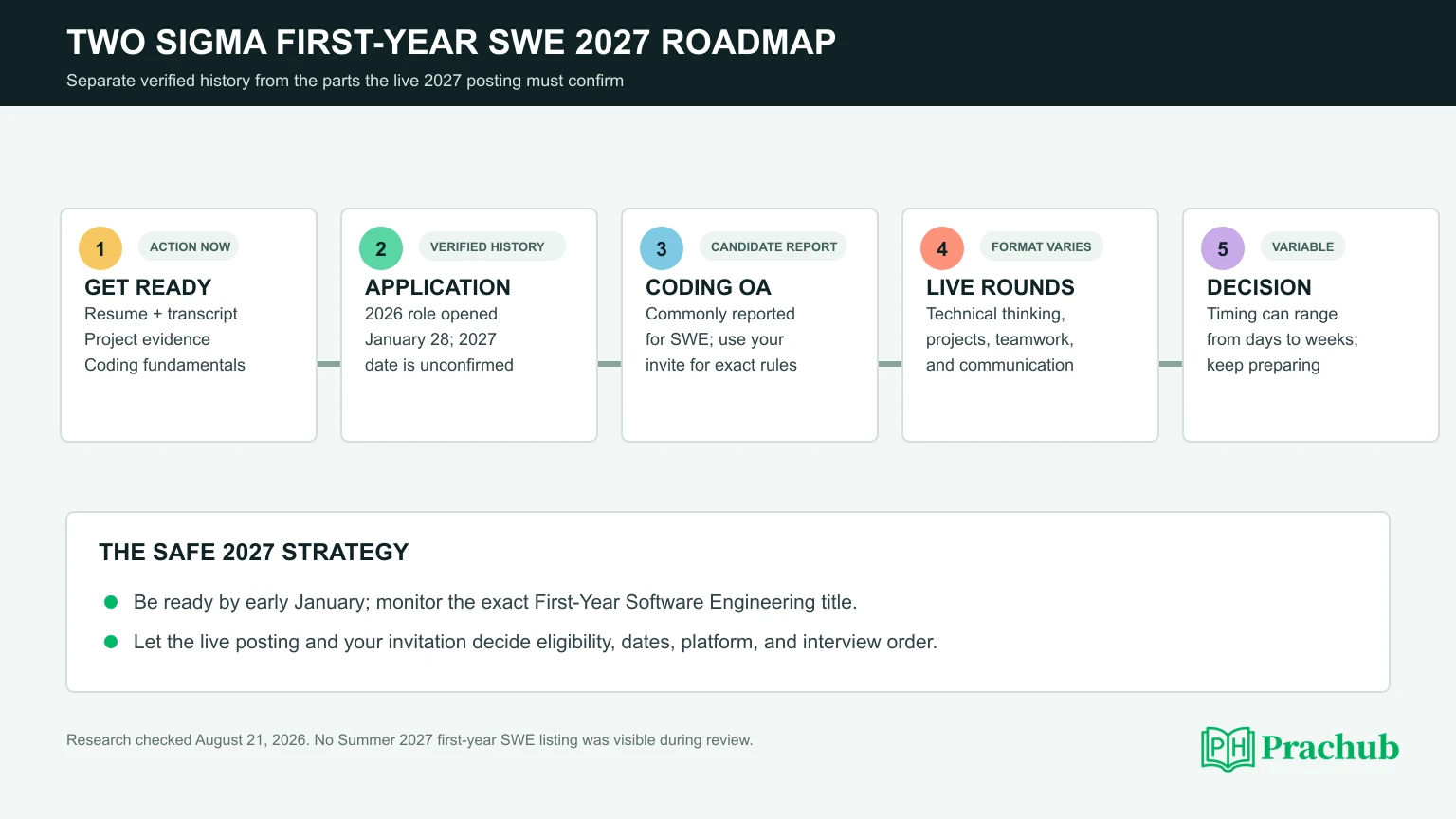
As of August 21, 2026, Two Sigma's official internship page lists some Summer 2027 roles but does not show a 2027 First-Year Software Engineering posting. The prior role began recruiting on January 28, 2026 and was scheduled to expire March 31. That history makes early January 2027 a sensible readiness deadline, but it does not confirm the next opening date.
| Question | Best current answer | Evidence level |
|---|---|---|
| Is the 2027 first-year role open? | No first-year SWE listing was visible on the official internship page during this review. | Current official status |
| Who is the program for? | The 2026 role was open to students currently in year one of a four-year bachelor's program. | Prior verified listing |
| When could it open? | The 2026 role began recruiting January 28. Monitor from early January 2027, but wait for the live posting to confirm. | Historical timing |
| Is there an OA? | First-year and general SWE candidates have reported coding assessments, but no universal 2027 format is published. | Candidate-reported |
| What follows the OA? | Historical reports describe live technical and behavioral interviews. The number and order have changed across cycles. | Candidate-reported |
What is the Two Sigma First-Year SWE Internship?
This is not merely the regular software engineering internship with a lower class-year requirement. The role creates an entry point for students who are still early in their undergraduate education and may not yet have a conventional internship history.
The Summer 2026 description said interns would spend 10 weeks in Two Sigma's Soho office, work with an assigned mentor, own one project, and finish with a presentation. Students were hired into a general Software Engineering role, then matched to a specific team two to three months before the internship.
The work could touch distributed storage, cloud environments, reliability, trading infrastructure, data ingestion, or internal tools. Two Sigma also said financial experience was not required; the common thread was strong programming, curiosity, and an interest in reliable software.
How it differs from the regular SWE internship
The clearest difference is eligibility. The verified 2026 first-year role explicitly targeted students in the first year of a four-year bachelor's program. A regular SWE internship can serve students farther along in undergraduate or graduate study and may recruit on a different calendar.
The first-year label does not mean the technical bar is trivial. It means the company can evaluate potential through coursework, projects, reasoning, learning speed, and communication rather than expecting a conventional internship history.
PracHub already has a separate Two Sigma SWE Intern OA 2027 guide focused on coding difficulty, scoring, and response times for the broader internship funnel. This article stays centered on the first-year program, application timing, eligibility, and full interview preparation.
When will the Summer 2027 application open?
The most reliable recent benchmark is January 28, 2026, when the verified Summer 2026 first-year role began recruiting. Its stated expiration date was March 31, although competitive postings can close early when applicant volume is high.
A June 2026 community discussion predicted a February opening. Treat that as a monitoring signal, not an official schedule. The absence of the first-year listing does not prove it was canceled or already closed.
Be ready by the first week of January 2027. Check the official internships page and careers search weekly, save the exact job description when it appears, and apply promptly after confirming the class-year requirement and location. Do not submit to a similarly named regular SWE role unless you qualify for that posting too.
Eligibility and application checklist
The Summer 2026 role required current enrollment in the first year of a four-year bachelor's program. It also sought coursework toward a technical or quantitative degree, experience with languages such as Java, C, C++, Python, Ruby, Perl, or another JVM-targeting language, and strong analytical, organizational, and interpersonal skills.
Requirements such as large-scale systems experience can sound intimidating. Do not invent professional scale: a course project, game server, data pipeline, or personal app can still demonstrate interfaces, failure cases, performance, and testing.
Build a first-year resume around evidence
Use one page and make technical ownership visible. A strong project bullet names what you built, the decision you made, and the measurable or verifiable result. “Built a course scheduling tool in Python with a graph-based prerequisite checker and 40 automated tests” is more useful than “worked on a scheduling app.”
Include relevant coursework even if the transcript is short. Competitive programming, robotics, research, open-source work, and teaching can add evidence when you lack formal employment.
The likely interview process
Two Sigma says every interview can differ because the company tailors the experience to the candidate and role. Its general interview page describes remote interviewing, a recruiting coordinator, and next-step communication after the interview day. It does not publish a fixed 2027 first-year sequence.
A reasonable preparation model is application review, a coding assessment, one or more live technical interviews, behavioral or final conversations, and a decision. Historical first-year candidates have described an OA followed by multiple coding and behavioral sessions, while general SWE interns have reported different counts and durations.
Use old schedules only to identify preparation categories. Your invitation controls the platform, timer, permitted resources, and meeting itinerary.
Online assessment
Historical reports mention HackerRank-style algorithmic questions, but current first-year details are not standardized publicly. Prepare to implement correct solutions under a timer and pass hidden tests. Arrays, strings, hash maps, sorting, intervals, trees, graph traversal, and careful state management are higher-value targets than obscure tricks.
An OA may not be the only screen. Resume fit, timing, capacity, and implementation quality can matter, and no reliable public score guarantees advancement.
Live technical interviews
Two Sigma's own mock-interview material emphasizes how candidates reach an answer, not only the final code. Interviewers can evaluate how you clarify a prompt, propose a first-pass solution, improve it, respond to hints, and communicate complexity.
Practice aloud. State the input model, identify one invariant, compare two approaches, then code. Test a minimum case, duplicates or ties, and a normal example before declaring the solution complete. If you get stuck, explain the missing piece instead of going silent.
Behavioral and project conversations
Course teams, clubs, research, part-time work, and personal projects are valid behavioral evidence. Prepare examples of learning quickly, resolving disagreement, receiving feedback, debugging a failure, and taking ownership.
Use behavioral and leadership questions to rehearse follow-ups. Interviewers often care more about what you personally decided and learned than the prestige of the project.
Practice with Two Sigma questions from PracHub
These question-bank records build skills relevant to Two Sigma software interviews; they are not predictions of the exact first-year 2027 assessment. Each complete title in the first column opens the question and written solution.
| PracHub question | Practice focus | Why it helps |
|---|---|---|
| All Subsequences After Deleting One Character | Strings, deduplication, complexity | Builds careful modeling of a compact prompt and exposes unnecessary brute force. |
| Implement a Hash Map With Separate Chaining and Resizing | Core data structures, collisions, resizing | Tests whether you understand a familiar abstraction beyond calling a library function. |
| Allocate IPO Shares and Split a Weighted Tree | Sorting, simulation, trees | Practices deterministic tie-breaking, preserving original order, and decomposing a multi-part prompt. |
| Match Limit Orders With Price-Time Priority | Stateful implementation, heaps, edge cases | Develops specification reading, partial-update reasoning, and test design for a longer problem. |
Attempt the first two as a diagnostic before reading the solutions. Then choose one longer problem and explain your data model before coding. Record the first incorrect assumption, not just the final score; that is the mistake most worth fixing.
A seven-day preparation plan
| Day | Focus | What to do |
|---|---|---|
| Day 1 | Application readiness | Prepare a one-page resume, transcript, graduation date, and two project explanations. |
| Day 2 | Diagnostic | Attempt two linked PracHub questions without solutions and classify every miss. |
| Day 3 | Core patterns | Practice arrays, strings, hash maps, sorting, and intervals under a timer. |
| Day 4 | Trees and graphs | Solve one traversal and one graph problem; explain the invariant and complexity aloud. |
| Day 5 | Long implementation | Complete one stateful problem and write tests for ties, repeated operations, and boundaries. |
| Day 6 | Communication | Run a live mock and prepare four flexible behavioral or project stories. |
| Day 7 | Simulation and review | Use the exact timer in your invitation, repair one failed solution, and confirm logistics. |
What happens after you apply?
Response times can vary. A March 2026 first-year applicant reported waiting at least two weeks without an OA, while other internship candidates have described movement within days or several weeks. Silence is not a dependable result signal.
Keep applying elsewhere and maintain a light practice schedule. Follow the recruiter's timeframe; without one, a single concise check-in after roughly two weeks is reasonable.
Historical candidates describe several technical and behavioral conversations, but only the itinerary sent by Two Sigma applies to you. Continue preparing until you have a written decision.
Common mistakes to avoid
Assuming “first-year” means easy. The program adjusts the experience level, not the need for strong reasoning. Build depth in fundamentals and communication.
Waiting until the role opens. The 2026 posting appeared in late January. Resume review, project cleanup, and coding practice should begin before winter break ends.
Using the regular internship's timeline as proof. The first-year program can recruit separately. Search the exact title and verify eligibility before applying.
Underselling academic work. A well-explained course project can demonstrate design, testing, collaboration, and learning. Make your own contribution specific.
Frequently asked questions
Is the Two Sigma First-Year SWE Internship 2027 open?
No 2027 first-year SWE listing was visible on Two Sigma's official internship page as of August 21, 2026. Selected 2027 roles are open, so monitor the official site rather than assuming one shared release date.
When did the previous first-year application open?
The verified Summer 2026 role began recruiting January 28, 2026 and listed March 31 as its expiration date. That makes January a useful monitoring window, not a confirmed 2027 schedule.
Who is eligible?
The 2026 posting was open to students currently enrolled in the first year of a four-year bachelor's program. The live 2027 posting must confirm whether the definition, graduation window, work authorization, or location requirements change.
Does the first-year internship have an OA?
Historical candidates have reported coding assessments, but Two Sigma has not published a universal 2027 first-year format. Prepare for timed algorithmic coding and use your invitation as the authority.
Are the questions easier than the regular SWE internship?
There is no reliable official difficulty comparison. Historical accounts range from medium-style OA problems to difficult live questions. Prioritize fundamentals, readable implementation, testing, and communication instead of chasing a label.
Do I need finance experience?
No. The prior first-year listing explicitly said financial experience was not required. Strong programming, analytical thinking, curiosity, and evidence that you build quality software are more relevant.
Where was the latest verified program located?
The 2026 role was based in Two Sigma's Soho New York City office for 10 weeks. Earlier summaries sometimes mention Houston, but the live posting should decide the 2027 location.
Final takeaway
The Two Sigma First-Year SWE Internship can be a valuable early entry point, but it rewards preparation that begins before the application appears. Build a clear first-year resume, strengthen algorithmic fundamentals, practice explaining decisions, and monitor the exact job title from early January 2027.
Do not turn a previous schedule into a prediction. Use official 2027 instructions when they arrive, and use Two Sigma Software Engineer questions now to convert research into focused coding and communication practice.
Sources and Further Reading
- Two Sigma: Official Internship Programs and Current 2027 Openings
- Two Sigma: Engineering Teams and Early-Career Support
- Two Sigma: Official Interviewing Guidance
- Two Sigma: Software Engineering Technical Interview Demonstration
- Archived First-Year Software Engineering Internship 2026 Listing
- Current Candidate Discussion: First-Year Internship Timing and Screening
- Summer 2026 Candidate Discussion: Application-to-OA Timing
- Historical Candidate Discussion: First-Year Technical and Behavioral Rounds
Research note: This guide was checked on August 21, 2026. Two Sigma can change the first-year program's eligibility, application dates, location, compensation, assessment platform, interview sequence, and hiring timeline. The live 2027 posting and your recruiter instructions take priority.
Related Articles
Duolingo Thrive Internship 2027: Application, Technical Interview, and Timeline
Duolingo Thrive Internship 2027 guide: expected application timing, eligibility, technical interview format, timeline, and a seven-day prep plan.
Amazon Propel Program 2027: Application, OA, and Interview Guide
Amazon Propel Program 2027 guide: application routes, eligibility, SDE online assessment, interview expectations, and a focused preparation plan.
Uber STAR Internship 2027: Eligibility, Coding Interviews, and Timeline
Uber STAR Internship 2027 guide: eligibility, application timing, CodeSignal reports, coding interviews, preparation, and the expected hiring timeline.
Citadel Launch Internship 2027: Assessment, Interviews, and How to Prepare
Citadel Launch Internship 2027 guide: eligibility, assessment evidence, interview stages, response timelines, and a focused seven-day prep plan.
Comments (0)