Citadel Launch Internship 2027: Assessment, Interviews, and How to Prepare
Quick Overview
A research-backed guide to the Citadel Launch Internship 2027, covering sophomore eligibility, the reported HackerRank assessment, technical interviews, timelines, and a focused preparation plan.
Citadel Launch attracts a difficult kind of search traffic: ambitious sophomore engineers want to know whether the assessment is automatic, how hard the coding questions are, and whether the program follows the same process as Citadel's regular software engineering internship. The internet often answers those questions by mixing several recruiting cycles together.
This guide separates what Citadel currently confirms from what Launch candidates have reported. You will learn how the program differs from the standard SWE internship, what the assessment and interviews may include, and how to prepare without treating an old HackerRank format as a guaranteed 2027 rule.
Start with Citadel Software Engineer questions. A company-specific diagnostic quickly shows whether your biggest gap is algorithms, implementation, concurrency, statistics, or explaining a project under pressure.

Quick answer: what should 2027 applicants know?
Citadel Launch is a distinct, paid engineering internship historically designed for sophomores. The latest program descriptions consistently present it as an 11-week experience combining mentorship, finance exposure, engineering projects, peer networking, and access to senior leaders at Citadel or Citadel Securities.
As of August 21, 2026, Citadel's official referral page still names the Launch Internship Program as a separate software engineering track. However, a public 2027 Launch job description was not visible during this review. That means the live posting must confirm the graduation window, locations, application dates, compensation, and any eligibility language.
| Question | Best current answer | Evidence |
|---|---|---|
| Is Launch separate from the regular SWE internship? | Yes. Citadel's official referral page lists both programs separately. | Current official page |
| Who is it for? | Recent descriptions target sophomore engineering students; verify the exact 2027 graduation window. | Verified prior listings |
| How long is it? | Recent Launch descriptions specify an 11-week paid internship. | Verified prior listings |
| Is there an OA? | Many candidates report a Software Engineering Campus Assessment or HackerRank-style OA, but delivery is not universal. | Candidate-reported |
| Does a perfect OA guarantee an interview? | No. Historical candidates report delays or rejection even after passing every visible test. | Candidate-reported |
What is the Citadel Launch Internship?
Launch is an early-college pathway for students who want to become engineers and learn how technology supports finance. Archived descriptions say interns work with experienced engineers on projects that affect the firms and global capital markets. The program also includes structured learning, mentorship, networking, and contact with senior leaders.
The engineering setting matters. Citadel describes its engineers as small teams building high-performing, resilient technology with short development cycles. Work can include system architecture, platforms, web frameworks, distributed computing, large-scale data systems, machine learning, or infrastructure that supports investment and trading decisions.
Launch is therefore not a classroom-only exploration program. It is an internship with an intentionally supportive structure for students earlier in college, but candidates should still expect a competitive technical selection process.
Who is eligible for Citadel Launch 2027?
The clearest historical requirement is sophomore status while pursuing a bachelor's degree in computer science, computer engineering, or another STEM field. Prior descriptions also emphasized programming and design ability, analytical thinking, probability or statistics familiarity, communication, intellectual curiosity, and interest in solving challenging problems with technology.
Do not rely on the word “sophomore” alone. Employers sometimes define eligibility through a graduation-date window rather than credits completed. An accelerated student, transfer student, international student, or student taking a leave should read the live 2027 posting and ask recruiting if the requirement is unclear.
What if you have no previous internship?
That is not automatically disqualifying for an underclassman program. Your resume still needs evidence. Strong evidence can come from a course project, research, competitive programming, robotics, open source, a student organization, or a personal system that users can actually run.
Write bullets around technical decisions and outcomes. “Built a multithreaded event processor in C++ and used property-based tests to find three race conditions” gives an interviewer more to evaluate than “worked on a finance application.”
How Launch differs from the regular Citadel SWE internship
The regular software engineering internship is a broad 11-week program for students across bachelor's, master's, and PhD programs. Launch has historically focused on sophomores and adds an explicit learning-and-mentorship frame for engineers entering the finance industry earlier in college.
The recruiting signals can still overlap. Candidates have reported receiving a general Software Engineering Campus Assessment after applying to Launch. Others say a recruiter redirected them to Launch after reviewing an application for the standard SWE internship. This explains why searching “Citadel Launch OA” can surface experiences that look almost identical to standard SWE reports.
For a deeper analysis of the general coding screen, use the separate Citadel SWE OA 2027 guide. This article stays focused on Launch eligibility, the early-college context, and the complete preparation workflow.
What is the Citadel Launch assessment?
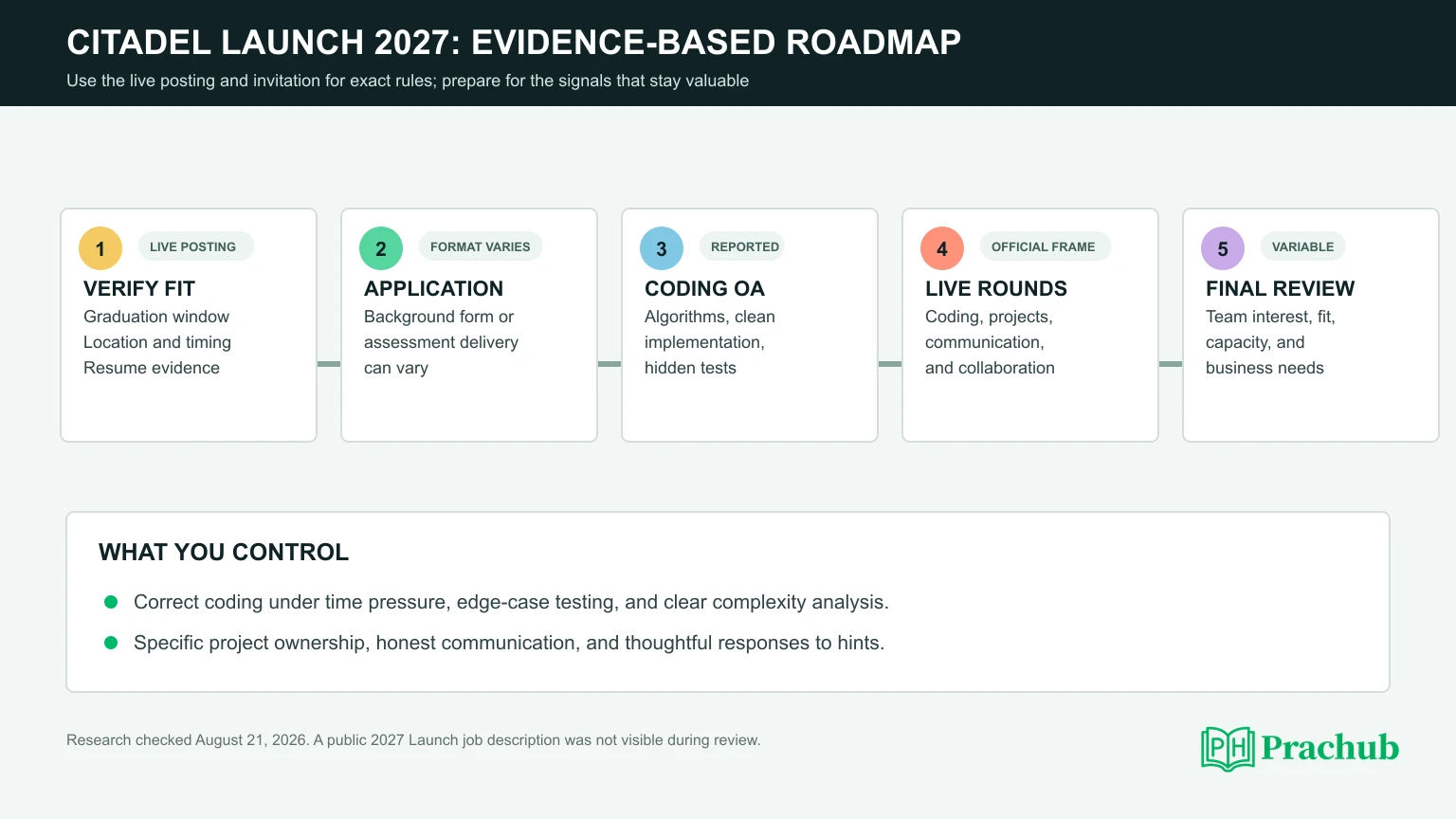
Citadel does not publish one permanent Launch assessment specification. Recent candidate reports describe a timed HackerRank or Software Engineering Campus Assessment, often received soon after applying. Some candidates instead report a background-information request covering location preferences, test scores, and experience before any OA or interview invitation.
A widely discussed 2026 experience described two coding problems and a 75-minute window. Another candidate reported two problems completed in roughly 60 minutes. These reports are useful for practicing pace, but they do not prove that every 2027 applicant will receive two questions, the same duration, or the same platform.
What the coding screen is likely to reward
Prepare for arrays, strings, hash maps, sorting, binary search, trees, graphs, heaps, and dynamic programming. The differentiator is not only recognizing a pattern. You need to translate the prompt correctly, choose a data model, implement without unnecessary complexity, and test edge cases under time pressure.
Hidden tests commonly expose duplicate handling, empty inputs, disconnected graphs, integer overflow, off-by-one boundaries, and solutions that are correct but too slow. Keep five minutes at the end for adversarial tests and remove debug output before submitting.
Is the assessment automatic?
Candidate experiences conflict. Some people received an OA within hours, while others received only a background form or waited without an assessment. The safest conclusion is that fast delivery may be automated for some applicants, but receiving an OA does not reveal whether a resume review already occurred or guarantee later consideration.
Likewise, a perfect visible-test score is not a promise. Citadel can still consider resume strength, eligibility, code quality, hiring capacity, location, and performance across other application signals.
What happens after the OA?
Citadel's official engineering interview guide describes a four-stage process for software engineers: a 45-minute first round, a second round usually containing three 45-minute interviews, a leadership or team-specific interview, and final review. Citadel says the overall process typically takes about eight weeks. Launch may be shorter or adapted for underclassmen, so use this as the broad engineering framework rather than a fixed Launch itinerary.
First technical interview
The official first round combines technical and behavioral evaluation. Expect coding, data structures, algorithms, and problem solving, plus questions about technical interests, school projects, previous experience, and motivation for Citadel.
Practice as a conversation. Clarify the requirements, state a baseline, explain the invariant, code in small testable steps, and respond constructively to hints. Citadel explicitly encourages candidates to share their thought process and acknowledge setbacks instead of hiding uncertainty.
Later technical interviews
If Launch follows the broader engineering structure, later interviews can test consistency across several sessions. Underclassman candidates should be ready for additional algorithms, implementation design, debugging, or fundamentals such as concurrency and data modeling. Do not assume a sophomore track eliminates difficult follow-ups.
Your school and personal projects may also become technical prompts. Be able to explain architecture, your individual contribution, one failed approach, how you tested the system, and what you would redesign with more time.
Behavioral and team signals
Citadel publicly emphasizes technical strength, collaboration, impact, judgment, and comfort in a fast-paced environment. Prepare concise examples of learning a difficult concept, resolving disagreement, accepting feedback, recovering from failure, and making a decision with incomplete information.
Use behavioral and leadership questions to rehearse follow-ups. A credible answer should identify what you personally did, what changed, and what you learned rather than relying on a polished but generic story.
Practice with Citadel questions from PracHub
These question-bank records train skills relevant to Citadel engineering interviews; they are not predictions of your exact Launch 2027 assessment. Each complete title in the first column opens the question and written solution.
| PracHub question | Practice focus | Why it helps |
|---|---|---|
| Return a Valid Dependency Order for Named Tasks | Graphs, topological sorting, cycle detection | Builds deterministic implementation and edge-case discipline for a timed technical screen. |
| Compute Statistics from a Frequency Array | Arrays, statistics, numeric precision | Tests whether you can derive several outputs without expanding the underlying data. |
| Design a Thread-Safe Shared Counter | Concurrency, atomicity, trade-offs | Connects coding fundamentals to the performance and reliability concerns in finance systems. |
| Discuss a Project You Are Proud Of and How You Work | Project depth, ownership, collaboration | Prepares the project and behavioral portion without inventing experience you do not have. |
Attempt the first question without a solution and cap yourself at 40 minutes. Then review the written solution, identify the first wrong assumption, and solve it again the next day. Use the concurrency prompt as an explanation drill even if you have not taken an operating-systems course yet.
A seven-day Citadel Launch preparation plan
| Day | Focus | What to do |
|---|---|---|
| Day 1 | Resume and eligibility | Confirm graduation timing, rewrite project bullets, and prepare a 60-second introduction. |
| Day 2 | Coding diagnostic | Attempt two timed Citadel questions and classify mistakes by pattern, implementation, or testing. |
| Day 3 | Core structures | Review arrays, strings, hash maps, sorting, binary search, heaps, and complexity. |
| Day 4 | Trees and graphs | Practice BFS, DFS, topological ordering, and one problem with a cycle or disconnected component. |
| Day 5 | Implementation quality | Solve one longer prompt; test boundaries, duplicates, invalid states, and performance limits. |
| Day 6 | Live communication | Run a 45-minute mock and rehearse two projects plus four behavioral stories. |
| Day 7 | Full simulation | Use the exact invitation timer, review logistics, and stop learning new topics. |
Application timing and response expectations
Historical Launch recruiting has not produced one reliable response clock. Some candidates received assessments within hours, while others waited weeks after a strong OA. One 2025 discussion described roughly a month between the assessment and an interview invitation.
Apply soon after the correct 2027 posting appears, but do not interpret silence as a score. Continue applying to other sophomore programs and maintain a light interview routine. If a recruiter provides a timeframe, follow it; otherwise, one concise follow-up after about two weeks is reasonable.
Frequently asked questions
Is Citadel Launch only for sophomores?
Recent program descriptions specifically identify sophomores. The live 2027 listing must define the exact graduation window and any regional differences, so do not self-reject based only on credit count.
Is Citadel Launch the same as Discover Citadel?
No. Discover Citadel is a short event for first- and second-year students to learn about roles, culture, and future opportunities. Launch is an 11-week paid engineering internship.
How hard is the Launch OA?
Historical reports range from manageable medium-style problems to combinations candidates considered difficult. Prepare for two substantial coding tasks under a tight timer, but follow the exact instructions in your 2027 invitation.
Do you need finance knowledge?
Launch is designed to introduce engineers to finance, so prior finance employment is not the central requirement. Basic curiosity about markets helps, but programming, analytical reasoning, communication, and learning speed matter more.
Does passing every OA test case guarantee an interview?
No. Candidate reports include perfect visible-test results followed by long waits or rejection. Treat the OA as one signal alongside eligibility, resume evidence, code review, capacity, and later interviews.
Can Citadel move an applicant between Launch and regular SWE?
Historical candidates report recruiters redirecting applications between the tracks based on background and class year. That is possible, but it is not a guaranteed policy. Apply only to roles whose stated requirements you meet.
Final takeaway
Citadel Launch offers an unusually substantial engineering experience for sophomore students: real projects, mentorship, and exposure to the technology behind global markets. The opportunity is competitive precisely because it combines an underclassman entry point with a serious technical environment.
Prepare for the signals that remain useful across formats: correct coding under time pressure, disciplined testing, clear project ownership, and collaborative reasoning. Watch for the exact 2027 posting, let the invitation control the rules, and use Citadel Software Engineer questions to turn broad research into focused practice.
Sources and Further Reading
- Citadel: Campus Referrals for Software Engineering and Launch
- Citadel: Official Internship Experience
- Citadel: Official Engineering Interview Process
- Citadel: Software Engineer Intern Role
- Harvard Career Services: Citadel Launch Program Description
- Candidate Discussion: Launch Campus Assessment and Timing
- Candidate Discussion: Background Information Request Before the OA
- Candidate Discussion: Two-Problem HackerRank Experience
- Candidate Discussion: Assessment-to-Interview Timeline
Research note: This guide was checked on August 21, 2026. Citadel can change Launch eligibility, locations, application dates, assessment delivery, interview sequence, and compensation. The live 2027 posting and your recruiter instructions take priority.
Comments (0)