Citadel SWE OA 2027: HackerRank Questions, Difficulty, and Interview Timeline
Quick Overview
Citadel SWE OA 2027: HackerRank Questions, Difficulty, and Interview Timeline now pairs its existing format and process guidance with a clearly sourced PracHub practice set. The added section shows each question's actual company, stored round, difficulty, prompt shape, and a timed workflow without claiming guaranteed assessment reuse.
Updated August 13, 2026: two candidates can submit the same Citadel HackerRank score and receive very different outcomes. In recent discussions, some applicants reported perfect test results without an interview, while others said a less-than-perfect OA still moved forward.
That is the first thing to understand about the Citadel SWE OA 2027: the coding test is a serious filter, but it is not the whole decision. Your resume, technical background, recruiting route, and available interview capacity can still matter after the code runs.
Before starting the timer, practice with real Citadel software engineer coding questions on PracHub. Use them to build speed across arrays, intervals, heaps, greedy methods, dynamic programming, and complexity analysis instead of memorizing one rumored prompt.
Candidate reports point to a short, difficult coding screen, but Citadel does not publish one fixed 2027 OA format.
Citadel SWE OA 2027: Quick Verdict
For software engineering internships, HackerRank is the most commonly reported online assessment platform. The strongest recent pattern is two algorithmic coding questions at roughly medium-to-hard difficulty, often under a tight timer. However, Citadel's public careers materials do not confirm the 2027 question count, duration, score cutoff, or whether every applicant receives the same assessment.
Prepare for efficient, correct implementation rather than exotic finance knowledge. Citadel's current SWE intern posting asks for exceptional programming and design skills, strong analytical ability, familiarity with probability and statistics, and clear communication. The OA may emphasize algorithms; the interviews that follow evaluate a wider engineering profile.
What Is Official and What Is Candidate-Reported?
| Topic | Best available evidence / How to interpret it |
|---|---|
| SWE internship skills | Citadel lists programming, design, analytical ability, probability and statistics, communication, and intellectual curiosity.Official role expectations, but not an OA syllabus. |
| HackerRank | Multiple SWE intern candidates report receiving a HackerRank coding assessment.Strong recurring pattern; your own invitation controls the platform. |
| Two coding questions | Recent and prior-cycle applicants commonly describe two problems.Useful preparation signal, not a guaranteed 2027 format. |
| Medium-to-hard difficulty | Reports mention greedy, arrays, dynamic programming, intervals, and math-heavy optimization.Expect performance constraints and hidden edge cases, not only pattern recognition. |
| Interview timeline | Citadel says its full engineering process typically takes about eight weeks.Official planning estimate; individual 2027 candidates have moved faster. |
Avoid mixing SWE evidence with quantitative trading or research assessments. Those roles can add probability, statistics, market reasoning, or different platforms. This guide covers the Software Engineer internship unless stated otherwise.
Citadel or Citadel Securities: Does It Change the Process?
Citadel and Citadel Securities are separate firms with separate job postings, but Citadel's official engineering interview guide says candidates may meet engineers from both. It also says the general interview process is the same, while final placement depends on skills, experience, business needs, and candidate preference.
Keep the exact entity and role from your application in your notes. Do not use a Citadel Securities quant trading report to predict a Citadel SWE HackerRank. The names are close; the assessment intent may not be.
What Questions Appear on the Citadel HackerRank?
The recurring SWE pattern is two standalone algorithmic problems. A widely discussed 2026 internship thread described one dynamic-programming or greedy-style problem and one easier array-oriented problem, while other candidates reported different combinations and math-heavy twists. That variation is the useful signal.
Build coverage across arrays and strings, hash maps, sorting, intervals, heaps, binary search, trees and graphs, greedy reasoning, and dynamic programming. Citadel questions often feel harder because you must find the efficient formulation quickly and implement it cleanly under pressure.
Do not chase exact leaked prompts
A remembered problem number is fragile preparation. The assessment can change inputs, constraints, or the optimization target while preserving the same underlying idea. Practice identifying the state, invariant, ordering rule, or monotonic property that makes the efficient solution possible.
PracHub's Citadel interview question bank contains company-specific coding, systems, probability, and behavioral material. For the OA, filter toward Software Engineer coding questions first; save deeper system design for the live rounds.
How Difficult Is the Citadel SWE OA?
A reasonable expectation is LeetCode medium to hard under stricter pacing. The hardest part is often not writing a brute-force answer. It is recognizing why that answer will time out and replacing it with an approach that satisfies hidden constraints.
In a widely discussed SWE internship OA report, one candidate passed 10 of 15 tests on the first problem before hitting time-limit errors, then passed all tests on the second. That is a classic failure mode: the visible logic is correct, but asymptotic performance is not strong enough.
| Difficulty signal | What it usually tests / How to prepare |
|---|---|
| Many visible cases pass, hidden cases time out | Complexity, duplicate work, or an inefficient data structureEstimate input scale before coding and state the target complexity. |
| A math-heavy prompt feels unfamiliar | Turning a process into a count, recurrence, or monotonic decisionTest tiny examples and derive the invariant before reaching for a formula. |
| The second problem is unfinished | Pacing and problem selectionScan both questions first and secure the more tractable score. |
| Samples pass but submission loses tests | Boundary conditions, overflow, ordering, or performanceAdd empty, singleton, duplicate, maximum-size, and adversarial cases. |
What Score Do You Need?
Citadel does not publish a SWE OA cutoff. Community claims that every candidate needs 100 percent conflict with reports of applicants advancing after partial completion. Perfect submissions also do not guarantee interviews.
The practical target is still straightforward: maximize correct and efficient test coverage. Do not stop at sample cases, and do not sacrifice a complete second answer to polish a first solution that is already asymptotically sound. After submission, accept that the score is one signal alongside the resume.
Which Programming Language Should You Use?
The current US SWE intern application asks candidates to choose two preferred interview languages from C++, Python, Java, JavaScript, and TypeScript. Your HackerRank invitation determines which languages are actually enabled for each question.
Use the language in which you can implement data structures, debug, and reason about complexity fastest. C++ can provide control and performance, while Python can reduce implementation time. Neither advantage helps if you are fighting unfamiliar syntax.
HackerRank warns that switching languages resets the code editor. Confirm the permitted language and execution environment before serious work begins.
A Better Exam-Day Strategy
Start by reading both problems and their constraints. Choose the question with the clearest path to a complete, efficient solution. A finished medium problem with edge cases is more valuable than two half-built approaches.
If your assessment is 60 minutes, a sensible starting budget is five minutes to scan, roughly 22 minutes per problem, and the final 10 minutes for optimization and adversarial tests. Scale those proportions to the duration shown in your invitation rather than assuming every Citadel OA is 60 minutes.
Before you submit each problem
Check the input bounds, time and space complexity, empty inputs, duplicates, overflow, off-by-one boundaries, and whether your output format exactly matches the contract. Remove debug prints. Run at least one case that stresses the largest source of repeated work.
What Happens After the OA?
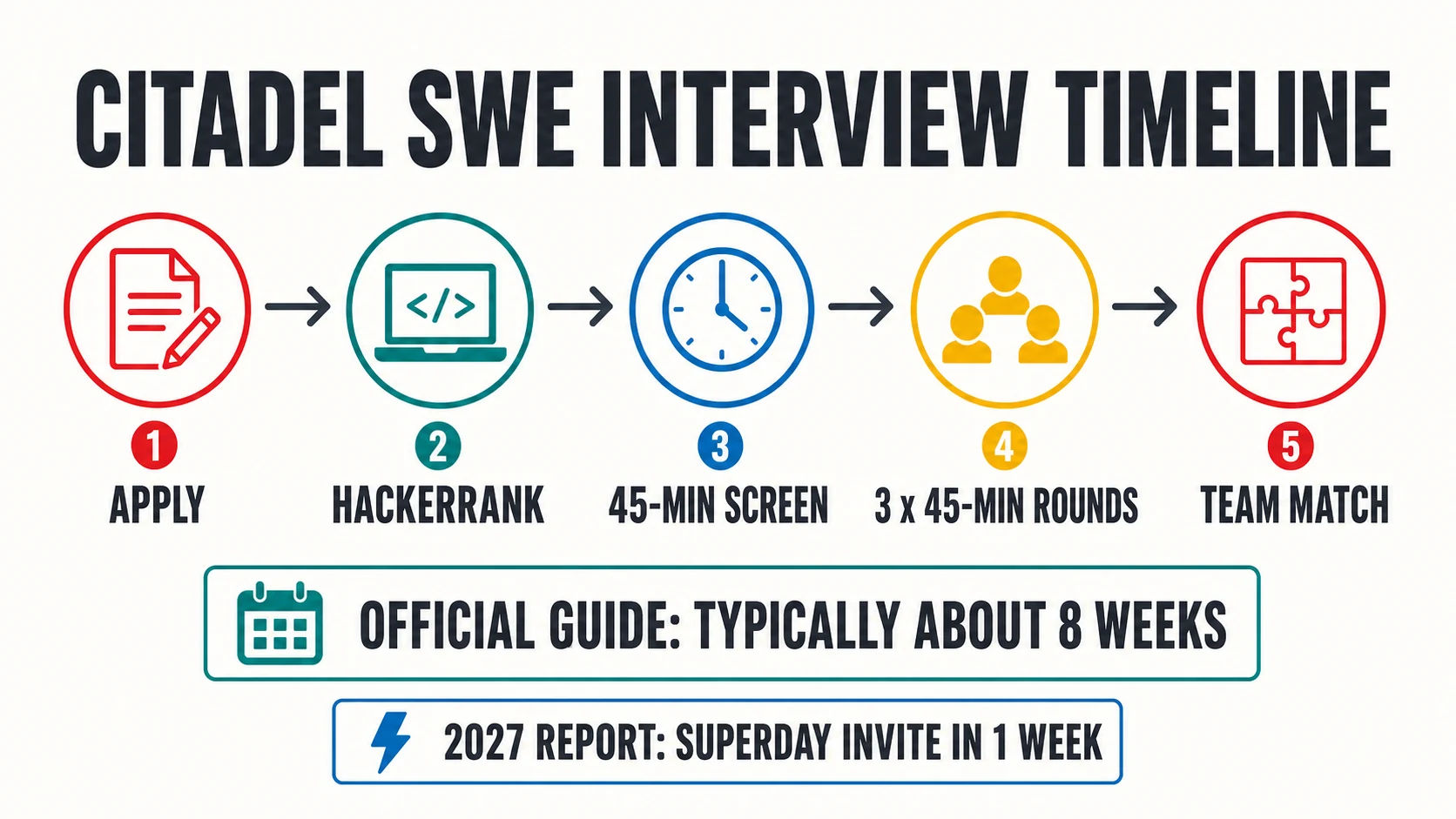
Citadel's official engineering process starts its published interview timeline with a 45-minute first-round video interview combining coding, data structures and algorithms, problem solving, and behavioral discussion. The second round usually contains three 45-minute interviews, followed by a senior engineer or team-specific conversation and final review.
Fresh Summer 2027 candidates sometimes use different labels. One candidate reported completing two technical rounds and receiving a Superday invitation about one week later. Another described early live rounds that mixed resume discussion, class or object-oriented design, CRUD-style implementation, optimization, and complexity follow-ups.
| Stage | Published or reported format / Preparation priority |
|---|---|
| Application and OA | Candidate-reported HackerRank, commonly two coding questionsEfficient algorithms, hidden tests, and strong pacing |
| First round | Officially 45 minutes, technical plus behavioralCoding aloud, projects, technical interests, and Citadel motivation |
| Second round or Superday | Officially three 45-minute interviews; candidate labels varyAlgorithms, object-oriented design, resume depth, and clear tradeoffs |
| Leadership or team match | Senior engineer discussion when a team expresses interestOwnership, engineering judgment, collaboration, and domain fit |
| Final review | Internal team and hiring decisionKeep recruiting contacts updated on competing deadlines |
Citadel says the full process typically takes about eight weeks and promises next steps within two weeks after the second round. That is a planning range, not an OA response guarantee. Current candidates have moved from technical interviews to Superday in roughly one week, while others wait longer or receive no further update.
A Five-Session Citadel OA Prep Plan
Session 1, diagnostic: solve two mixed medium problems under one timer and record where time was lost. Session 2, greedy and intervals: explain the invariant and complexity before implementing three problems.
Session 3, DP and graphs: define state, transition, base cases, and space optimization without hints. Session 4, hidden-test defense: break completed solutions with boundary and performance cases, then repair them.
Session 5, full simulation: complete two unseen problems, submit on time, and review every missed test. The review is part of the session, not optional cleanup.
After the simulation, spend one short block preparing your project walkthrough and behavioral and leadership stories. The official first round includes both, so OA-only preparation leaves an avoidable gap.
Practice with real questions from PracHub
These are real Citadel question-bank records, not a prediction of your exact assessment. We prioritize source reports that mention an OA, then use PracHub's stored Technical Screen, Onsite, and Take-home rounds. The table keeps the stored round visible so the evidence is not relabeled.
| Question | Evidence | Difficulty | Main pattern |
|---|---|---|---|
| Q1: Return nodes on a tree diameter path | Citadel · Technical Screen | Medium | Graphs |
| Q2: Design a token manager with lazy expiration | Citadel · Technical Screen | Medium | Intervals |
| Q3: Check whether a string is a palindrome | Citadel · Technical Screen | Medium | Strings |
| Q4: Top-K Largest Elements in Every Sliding Window | Citadel · Technical Screen | Medium | Sliding window |
What the prompts actually ask
Q1. Return nodes on a tree diameter path
Bank evidence: Citadel, Technical Screen, Medium. Problem You are given an undirected tree with n nodes labeled 0..n-1 (connected, no cycles). The diameter of a tree is the longest simple path between any two nodes. Return the nodes (in order) along one diameter path (if multiple diameter paths exist, returning any one of them is acceptable).
Q2. Design a token manager with lazy expiration
Bank evidence: Citadel, Technical Screen, Medium. Problem Design a token manager that tracks authentication tokens with a fixed time-to-live (TTL). Each token is valid in the half-open time interval [createdTime, createdTime + timeToLive).
Q3. Check whether a string is a palindrome
Bank evidence: Citadel, Technical Screen, Medium. Problem Given a string s consisting only of lowercase English letters (a-z), determine whether s is a palindrome. A palindrome reads the same forward and backward. Input - A single string s. Output - Return true if s is a palindrome; otherwise return false.
Q4. Top-K Largest Elements in Every Sliding Window
Bank evidence: Citadel, Technical Screen, Medium. You are given an integer array nums together with two integers W (the window size) and K. A sliding window of size W starts at the left end of nums and moves one position to the right at a time, so there are len(nums) - W + 1 windows in total.
Run the set like an assessment
- Read all four prompts first. Give each a difficulty estimate and choose an order before coding.
- Hide the solution. Write the invariant, complexity target, and three edge cases before opening the editor.
- Use one timer. Preserve five minutes at the end for boundary, tie, scale, and output-format tests.
- Log the failure mode. Record the broken invariant or missed edge case, not merely the question title.
Citadel SWE OA 2027 FAQ
Is the Citadel SWE OA always two questions?
Two questions are the strongest recurring candidate pattern, but Citadel does not publish a universal 2027 format. Follow the question count and timer shown on your own HackerRank login page.
Is probability tested on the SWE OA?
The SWE posting values probability and statistics, but current SWE OA reports focus more heavily on algorithmic coding. Quantitative research and trading assessments are more likely to emphasize math. Prepare basic probability, but do not let it replace coding practice unless your invitation signals otherwise.
Does a perfect HackerRank score guarantee an interview?
No. Multiple candidates report perfect submissions without advancement. Citadel does not publish how it combines OA performance, resume strength, recruiting route, and hiring capacity.
How long does Citadel take after the OA?
There is no official OA-specific service level. Citadel says the complete engineering process typically takes about eight weeks and that next steps follow within two weeks after the second round. OA-to-first-round timing can be shorter, longer, or silent.
What should I prepare after passing?
Practice coding aloud, object-oriented design, complexity tradeoffs, and concise project explanations. Be ready to discuss technical interests, previous internships, school projects, and why you want to work at Citadel, all of which appear in its official first-round description.
Prepare for the Filter and the Interview Behind It
The Citadel SWE OA rewards algorithmic range, fast recognition, efficient code, and disciplined testing. But its real purpose is to decide who gets a chance to demonstrate broader engineering judgment in the live process.
Start with Citadel Software Engineer questions on PracHub. Run a timed two-question diagnostic, repair the exact gaps it exposes, then prepare to explain your code and projects once the conversation moves beyond HackerRank.
Research note: This guide was checked on August 13, 2026 against Citadel's current SWE intern posting and official engineering interview process, HackerRank candidate documentation, and fresh Summer 2027 candidate discussions. OA details are candidate-reported and may change; your invitation is authoritative.
Comments (0)