Zero to Mastery Coding Interview Course Review 2026: Is It Worth It?
Quick Overview
An evidence-based 2026 review of Zero to Mastery's Master the Coding Interview: Data Structures + Algorithms course for Software Engineer candidates. It verifies the current curriculum, lesson count, update date, individual-course and membership pricing, and refund window from official ZTM pages; explains the course's strengths for DSA beginners; identifies gaps in timed execution, company-specific questions, system design, and behavioral preparation; compares ZTM's teaching-first model with PracHub's real-question practice; and provides a seven-day diagnostic before buying.
A coding interview course can feel productive for weeks. Then the real test arrives: a blank editor, an unfamiliar prompt, and an interviewer waiting for you to explain every decision.
This Zero to Mastery Coding Interview Course review for 2026 looks past the lesson count. We will examine what the core Data Structures + Algorithms course teaches, what $199 buys, where the wider ZTM interview series helps, and which interview skills still require separate practice.
Before paying, run a diagnostic with real Software Engineer interview questions on PracHub. If your problem is missing fundamentals, a structured course may help. If you understand the concepts but struggle to solve current company questions under time pressure, more lessons may not be the answer.
Quick Verdict: Is Zero to Mastery Worth It?
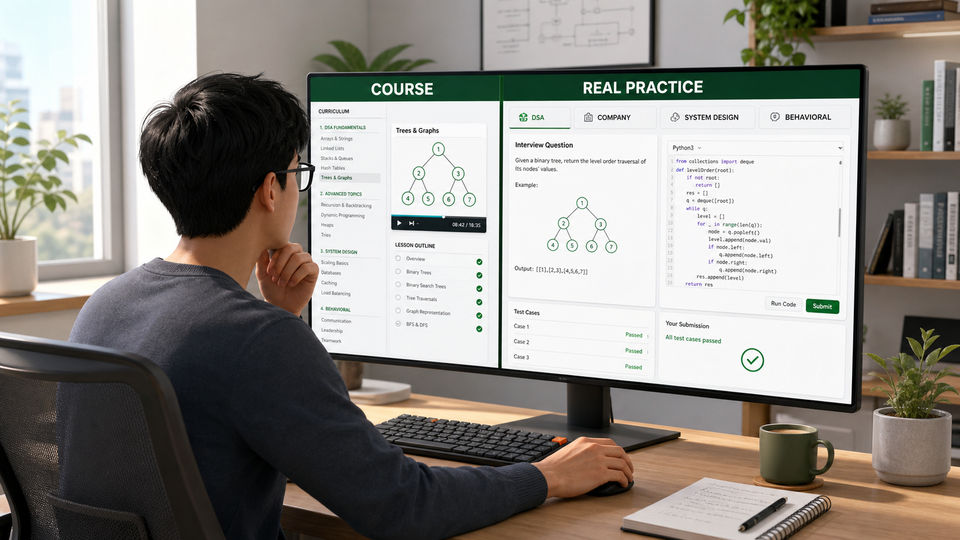
Zero to Mastery's coding interview course can be worth it for beginners and self-taught developers who want a guided DSA curriculum. The instruction moves from Big O through core data structures and algorithms, and the official course page includes career and interview guidance alongside technical material.
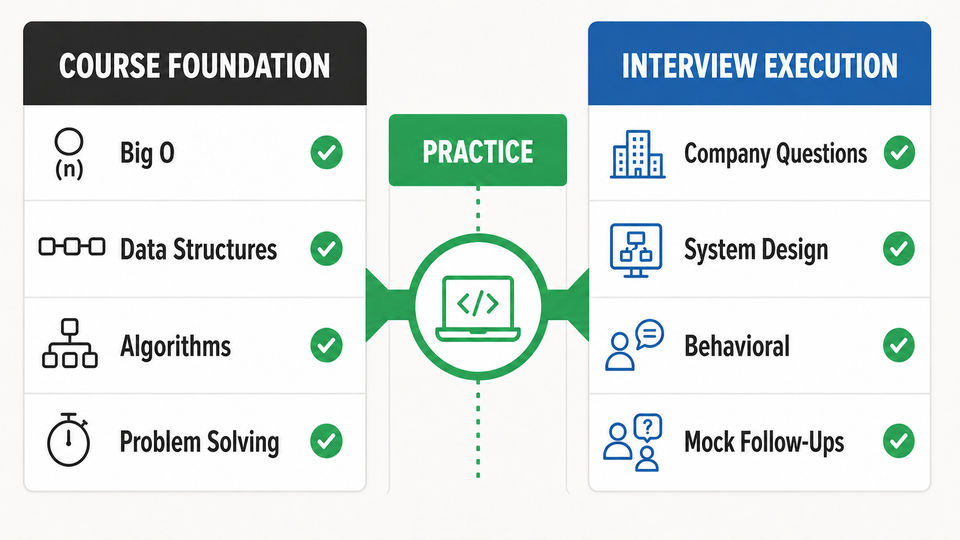
It is not a complete interview-prep system by itself. Candidates still need timed problem solving, company-specific questions, mock follow-ups, system design, and behavioral rehearsal. If an interview is already scheduled, practice should take more of your week than video.
| Your situation | Best decision |
|---|---|
| You cannot explain Big O, trees, graphs, or recursion | ZTM can provide the missing foundation |
| You know DSA but freeze on unseen questions | Prioritize timed practice and review |
| You have an interview within two weeks | Use real company questions first; study only diagnosed gaps |
| You want several ZTM courses over a year | The annual membership may be better value than one course |
| You only need one coding course | Compare the $199 lifetime course with shorter or free options |
Which Zero to Mastery Coding Interview Course Are We Reviewing?
Zero to Mastery has several similarly named interview courses. This review focuses on Master the Coding Interview: Data Structures + Algorithms, the foundational course taught by Andrei Neagoie.
According to the official page checked in August 2026, it contains 21 hours, 270+ lessons, and 21 sections. The page lists a July 2026 update and an average completion time of 40 days. It also lists zero projects, although the curriculum includes exercises and coding examples.
The companion courses are separate
ZTM also offers a 38-hour Big Tech interview course and a 4-hour System Design + Architecture course. Both were listed as updated in July 2026 when this review was prepared.
This distinction matters. Buying the core DSA course does not mean you receive every part of the wider interview series as one standalone course. A ZTM membership includes the broader catalog, while a single-course purchase covers that course.
What the Core Course Teaches Well
A structured path through DSA
The curriculum covers Big O, arrays, hash tables, linked lists, stacks, queues, trees, tries, and graphs. Algorithm sections include recursion, sorting, searching, tree traversal, breadth-first search, depth-first search, and dynamic programming.
That sequence is valuable when random practice feels chaotic. Instead of collecting isolated tricks, a beginner can build vocabulary, understand common operations, and see why one solution has better time or space complexity than another.
Interview process and career context
The course is broader than DSA lectures. Its published curriculum also includes material on getting interviews, answering questions, handling offers, and salary negotiation. That can help first-time candidates who do not yet understand the hiring process.
A course format that reduces decision fatigue
A fixed curriculum answers the daily question, "What should I learn next?" For visual learners who consistently finish video courses, that structure can be more useful than a folder of free links.
Where Zero to Mastery Falls Short for Interview Readiness
Watching a solution is not the same as producing one
Interviews measure retrieval and execution. You must clarify the problem, select a data structure, write correct code, test edge cases, analyze complexity, and respond when the interviewer changes a constraint.
After every lesson, close the video and solve a related problem from a blank editor. Then compare your reasoning with a written solution. PracHub's Software Engineer question bank lets you move from concept review into real interview-style prompts without waiting to finish the course.
Company targeting needs a separate layer
ZTM teaches durable fundamentals and uses Big Tech-style examples. It is not positioned as a continuously filtered database of questions by company, role, category, and difficulty.
Once interviews are scheduled, use company-specific interview prep to identify the rounds and question themes that matter for that employer. A graph-heavy screen, a repository exercise, and a product architecture round should not produce the same study plan.
Senior candidates need more than algorithms
Mid-level and senior loops often include architecture, project deep dives, code review, debugging, and leadership. The separate ZTM system design course can introduce useful concepts, but four published hours cannot replace repeated design interviews with follow-up pressure.
Add real system design questions and behavioral and leadership practice to prepare for the full loop.
Zero to Mastery Pricing in 2026
Pricing changes, so verify the checkout page before buying. As of August 2026, the official DSA course page showed three main options: $199 for lifetime access to the individual course, $299 per year for the Pro membership (advertised as $25 per month when billed yearly), and $1,299 for lifetime access to the full academy.
| Option | Best fit | Main caution |
|---|---|---|
| $199 individual course | You want this DSA curriculum and lifetime updates | Other interview courses are separate purchases |
| $299 annual membership | You will use multiple ZTM courses and community features | Poor value if you only finish one course |
| $1,299 lifetime academy | You expect years of broad technical learning | Large upfront cost unrelated to one interview cycle |
ZTM advertises a 30-day money-back guarantee and says subscriptions can be canceled from the account. That reduces purchase risk, but it does not recover the weeks lost if a course does not match your immediate interview gap.
Zero to Mastery vs PracHub
The two products solve different problems. ZTM is strongest when you need teaching and sequence. PracHub is strongest when you need to discover what companies ask and practice applying knowledge across a real interview loop.
| Decision factor | Zero to Mastery | PracHub |
|---|---|---|
| Primary job | Teach DSA through a structured course | Practice real interview questions with written solutions |
| Best starting user | Beginner with conceptual gaps | Candidate who needs diagnosis and interview execution |
| Company targeting | Broad interview and Big Tech guidance | Company, role, category, and difficulty filters |
| Full-loop coverage | Available across separate courses | Coding, system design, behavioral, and role-specific questions together |
| Cost to test the fit | Paid course or membership, with a refund window | Start practicing free |
The practical answer is often both, in the right order: diagnose with real questions, use ZTM only for the concepts you cannot yet explain, and return to timed practice to prove the gap is closed.
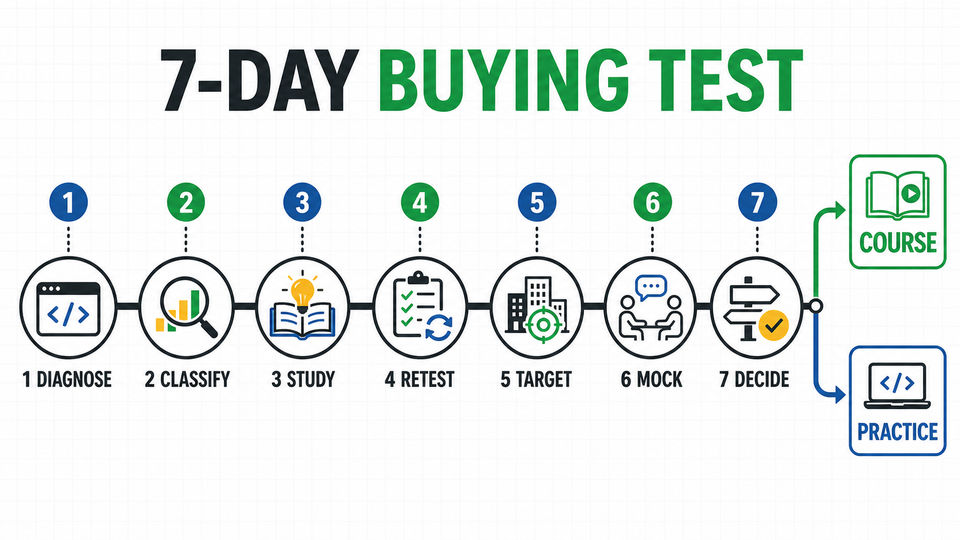
A 7-Day Test Before You Buy
Do not decide from a trailer or a lesson count. Use one week to measure your actual problem.
Days 1-2: Attempt four current coding questions without hints. Track whether failure came from missing knowledge, weak pattern recognition, implementation mistakes, or poor communication.
Days 3-4: Review only the weakest concept, then solve two new questions from the same family. Improvement after focused study is a strong signal that a course could help.
Days 5-6: Practice questions from your target company and add one system design or behavioral round if the job requires it. This exposes gaps that a DSA-only plan can hide.
Day 7: Run a timed mock. Buy ZTM if missing foundations still limit you and you prefer guided video instruction. Keep practicing if you already know the concepts but need speed, transfer, and realistic follow-ups.
Who Should Buy It, and Who Should Skip It?
Buy it if you are self-taught, need a coherent DSA foundation, learn well from long-form video, and have enough time to finish the curriculum before your interview cycle.
Skip or postpone it if your interviews begin soon, you already solve medium problems consistently, or your biggest gaps are company-specific rounds, system design, debugging, code review, or behavioral delivery.
Do not buy the annual or lifetime academy solely because the per-course math looks attractive. Membership value depends on completion, not catalog size.
Frequently Asked Questions
Is Zero to Mastery good for coding interview beginners?
Yes. Its core DSA course is best suited to candidates who need structure across Big O, data structures, and foundational algorithms. Beginners should still solve unseen questions independently after each topic; otherwise, course completion can create confidence without reliable interview performance.
Is the Zero to Mastery course enough for FAANG interviews?
No single course is enough for every FAANG-style loop. The DSA course can build foundations, while the separate Big Tech and system design courses expand coverage. You still need timed coding, current company questions, mock follow-ups, and behavioral preparation matched to your role and level.
Should I buy the $199 course or the annual membership?
Choose the $199 course when you only want the DSA curriculum and value lifetime access. The $299 annual membership makes more sense when you have a written plan to complete several ZTM courses during the year. Confirm current checkout pricing before purchasing.
Can PracHub replace Zero to Mastery?
PracHub can replace the practice and company-research layer, but it serves a different purpose from a guided beginner course. Use ZTM to learn a missing concept and PracHub to test whether you can apply it to real interview questions under realistic constraints.
Final Verdict
Zero to Mastery's Coding Interview Course is worth considering in 2026 if your main bottleneck is a weak DSA foundation. The curriculum is structured, recently updated, and broad enough to give beginners a useful path through core concepts and interview basics.
It is less compelling when your real problem is execution. Before spending $199, start with PracHub's real Software Engineer interview questions, identify the exact gap, and let that evidence decide whether you need a course, more practice, or both.
Official Sources
Course details and pricing were checked on the official Data Structures + Algorithms course page, Big Tech interview course page, System Design + Architecture course page, and ZTM Academy membership page on August 13, 2026.
Related Articles
Optiver SWE OA 2027: The Long OOD Problem, Constraints, and How to Prepare
Optiver SWE OA 2027 guide to the long OOD problem, likely constraints, hidden-test risks, and a practical 90-minute preparation strategy.
Capital One Technology Internship OA 2027: CodeSignal, Role Fit, Score Reuse, and Missing Links
Capital One TIP OA 2027 guide to CodeSignal, role fit, score reuse, proctoring, and what to do when your assessment link is missing.
Bank of America Global Technology OA 2027: Coding, Situational Judgment, and HireVue
Bank of America Global Technology OA 2027 guide to coding, situational judgment, HireVue, timelines, retakes, and focused preparation.
Millennium Management Engineering and AI OA 2027: HackerRank, Python, Data Science, and Timing
Millennium Management Engineering and AI OA 2027 guide to HackerRank, Python repository tasks, Criteria, AI tools, timing, and preparation.
Comments (0)