Optiver SWE OA 2027: The Long OOD Problem, Constraints, and How to Prepare
Quick Overview
Optiver SWE OA 2027: The Long OOD Problem, Constraints, and How to Prepare now pairs its existing format and process guidance with a clearly sourced PracHub practice set. The added section shows each question's actual company, stored round, difficulty, prompt shape, and a timed workflow without claiming guaranteed assessment reuse.
Updated August 13, 2026: Summer 2027 Optiver software engineering candidates are reporting an online assessment that feels very different from a standard two-question coding screen. Instead of a short LeetCode-style prompt, several candidates describe one long low-level design (LLD) or object-oriented design (OOD) problem with a dense specification, limited scaffolding, and little room for debugging mistakes.
The hard part is not memorizing a design pattern. It is turning unfamiliar rules into clean, working code before the clock expires. Start with real Optiver interview questions on PracHub, especially multi-operation implementation problems, and practice the entire read-model-build-test loop under time pressure.
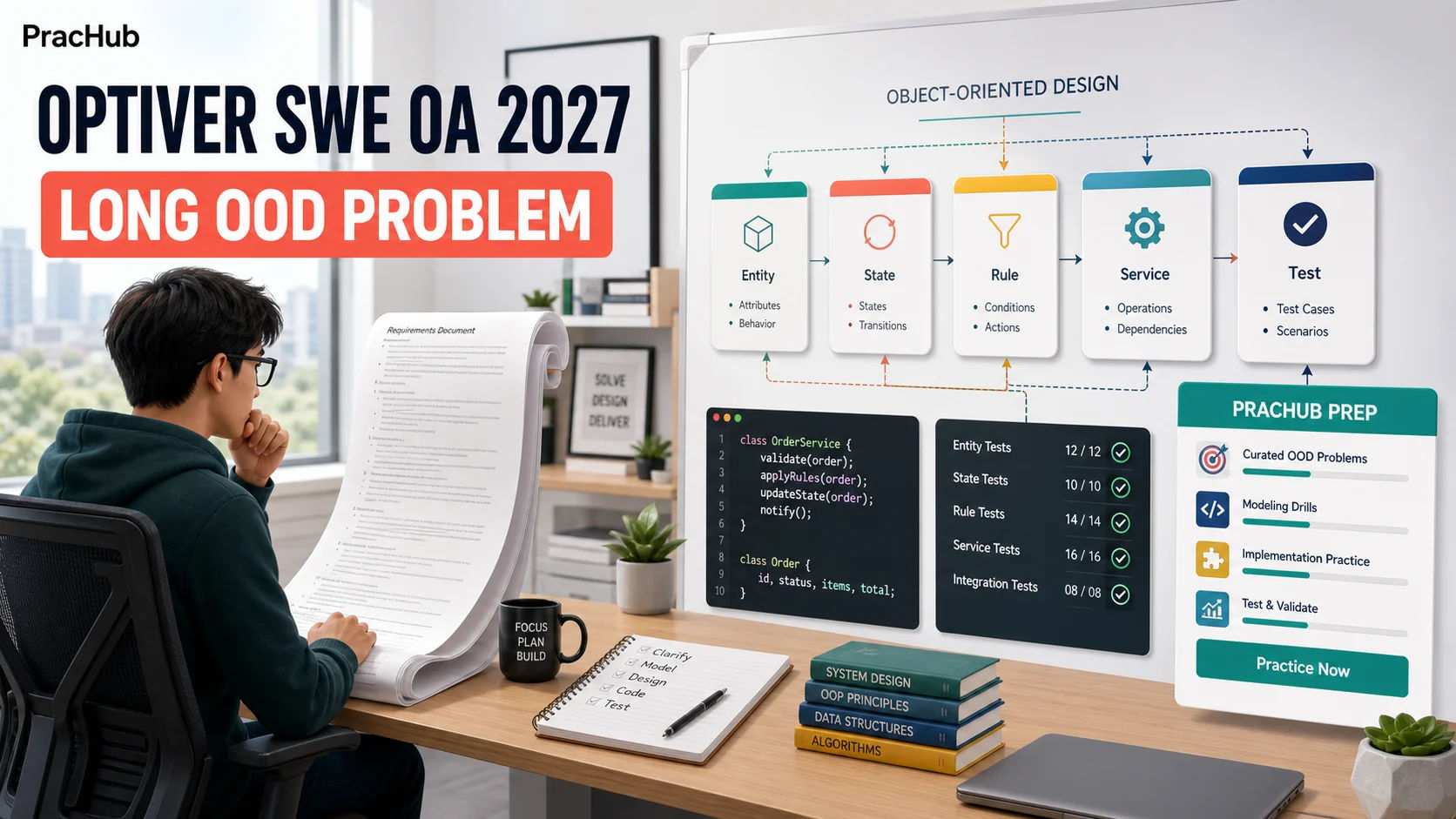
The 2027 Optiver SWE OA is being described as a long OOD implementation task, not a conventional algorithm-only screen.
Optiver SWE OA 2027: Quick Verdict
Treat the current Optiver SWE OA as a 90-minute software construction exercise. Fresh candidate reports repeatedly mention one substantial LLD/OOD problem, minimal starter code, sparse visible tests, and a need to create the abstractions yourself. Optiver has not published a universal question format, so your invitation remains the authority for timing, platform, and rules.
Your preparation should combine OOD fundamentals with implementation speed. Use PracHub's software engineering fundamentals questions to practice domain modeling, state transitions, and maintainable code, then add timed coding practice for data-structure selection and edge cases.
What Is Confirmed, and What Is Candidate-Reported?
Recent discussion is unusually consistent, but it is still anecdotal. Role, region, hiring batch, and assessment configuration can change what an individual candidate sees.
| Topic | Current evidence / How to interpret it |
|---|---|
| Summer 2027 hiring | Optiver's Austin listing confirms a Summer 2027 Software Engineer Internship.The recruiting cycle is active, but eligibility and timelines vary by office. |
| Problem format | Multiple July and August candidate reports describe one long LLD/OOD implementation problem.Use this as the best current preparation signal, not a guaranteed universal format. |
| Time limit | One widely discussed candidate report states 90 minutes.Simulate 90 minutes, then follow the timer shown in your own invitation. |
| Starter code and tests | Candidates report limited scaffolding and only a small number of visible tests.Practice defining your own classes, interfaces, and local test cases. |
| Proctoring | Some candidates report using the HackerRank Desktop App in a proctored setup.Assessment controls are configurable; read the displayed rules before starting. |
The strongest current format evidence comes from a July 2026 candidate discussion. Optiver's official Summer 2027 job page confirms the role and emphasizes building durable, real-world software, but it does not promise a specific OA question count or difficulty.
What Is the Long OOD Problem?
Here, OOD means object-oriented design, not out-of-distribution machine learning. The prompt typically describes a domain, the operations the program must support, and rules that must always remain true. You then turn that prose into classes, state, methods, and working behavior.
This is closer to implementing a small in-memory product than drawing a system design diagram. You may need to decide which objects own which data, how entities are identified, which state transitions are valid, and which data structures make repeated operations efficient.
Reading the specification is part of the test
Several candidates say the description itself consumed significant time. That is a signal: requirements parsing is not preamble. On the first pass, mark the domain nouns, the allowed actions, every "must" or "only" rule, and the expected outputs. Those four categories become your initial design.
Working abstractions matter more than pattern names
You do not need to force Factory, Strategy, or Observer into the solution. A small model with clear responsibilities is usually safer than a pattern-heavy architecture that never reaches working code. Prefer one coherent path through the requirements, then refactor only when duplication or a new rule justifies it.
A LeetCode-style prompt usually asks for one algorithmic function, while system design focuses on services, data, scale, and reliability. This OOD task sits between them: produce executable classes for one bounded domain. DSA still matters, but each data structure lives inside a larger behavioral model.
A 90-Minute OOD Execution Plan
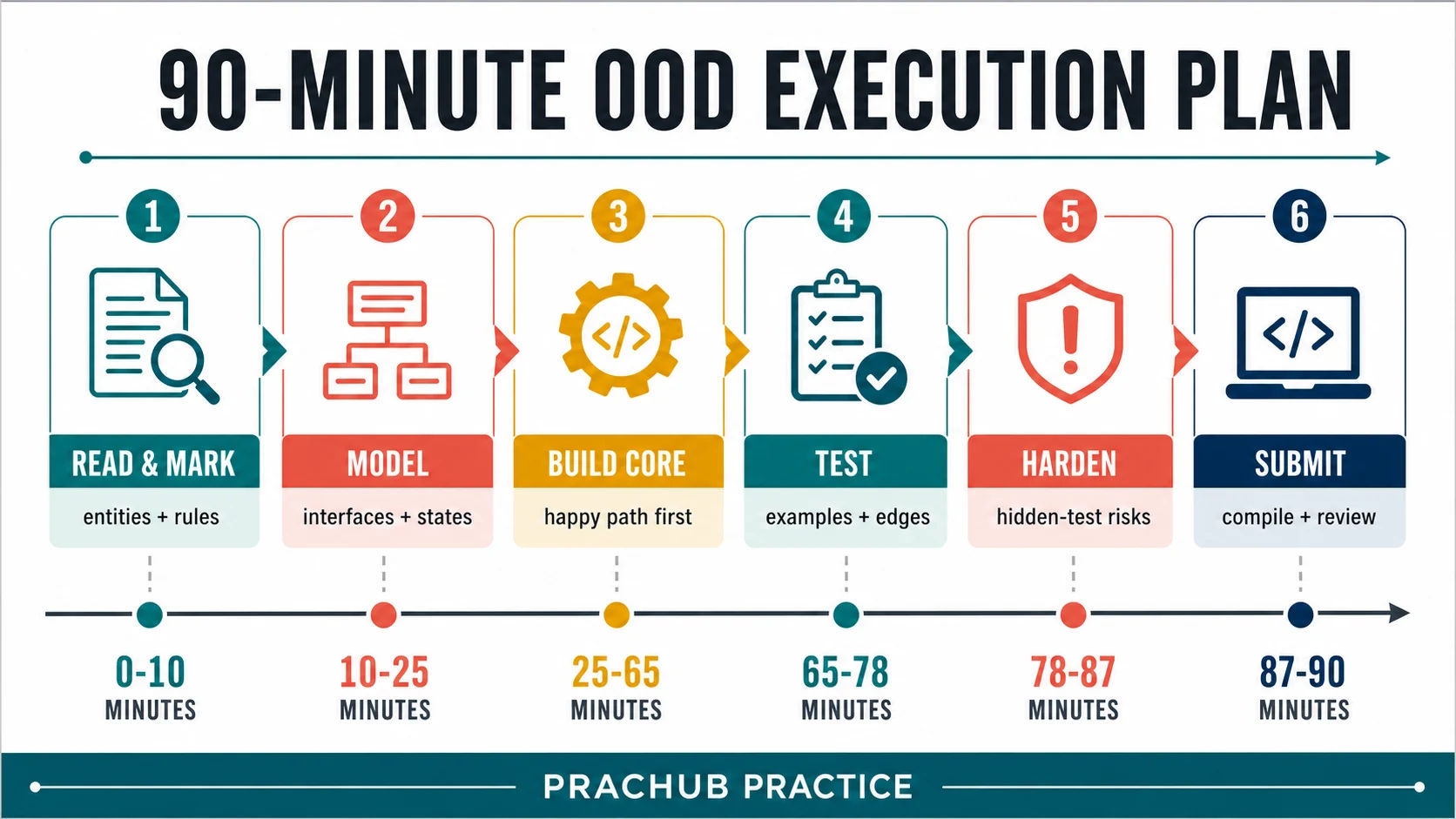
This schedule protects time for the two activities candidates most often lose: understanding the specification and testing the integrated solution.
| Time | Objective / Concrete output |
|---|---|
| 0-10 minutes | Read and markA short list of entities, operations, invariants, outputs, and unclear cases. |
| 10-25 minutes | ModelClass responsibilities, method signatures, state transitions, and core data structures. |
| 25-65 minutes | Build the coreOne complete happy path, followed by the remaining required operations. |
| 65-78 minutes | TestExamples for normal behavior, boundaries, duplicates, and invalid transitions. |
| 78-87 minutes | HardenFix hidden-test risks, output ordering, state leakage, and performance problems. |
| 87-90 minutes | Submit cleanlyCompile, remove debug output, review signatures, and submit the strongest working version. |
Build a vertical slice first
Do not write every class shell before any behavior works. Implement one end-to-end operation that creates or updates state and produces the expected output. That vertical slice tests whether your model is viable and gives you a working base if time becomes tight.
Use the specification as your test plan
For each rule, create one example that should pass and one that should fail or behave differently. If the prompt says an action depends on state, test both the allowed and disallowed state. If it defines ordering, test ties. If identifiers are unique, test duplicate insertion.
How to Turn a Long Prompt Into Classes
Start with three passes. Nouns suggest entities or value objects. Verbs suggest methods or services. Sentences containing limits, precedence, or permissions suggest invariants. You are not required to create a class for every noun; the goal is to find stable responsibilities.
Separate immutable request data from mutable entity state, and enforce each transition in one place. Let operations choose the collection: maps and sets for keyed lookup, queues for arrival order, and heaps or ordered maps for priority. Define deterministic tie-breaking.
Practice this translation on PracHub's multi-operation OOD coding example. Read the prompt, hide the solution, spend ten minutes modeling, and only then begin implementation.
Hidden-Test Risks to Check Before Submitting
Candidate reports mention sparse visible tests and frustration with integrated failures. A green sample is therefore only a starting point. The final review should target behaviors that a hidden suite can probe cheaply.
Check lifecycle boundaries: empty state, first operation, repeated operation, and operation after completion or removal. Check identity: duplicate IDs, unknown IDs, and accidental shared mutable state. Check determinism: tie-breaking, iteration order, and stable output. Finally, check whether the largest allowed input makes any repeated linear scan too expensive.
Compile and run after each vertical slice. This prevents one late, broken method from sinking an otherwise strong solution and is safer than a final debugging sprint.
How to Prepare in Five Focused Sessions
| Session | Focus / Deliverable |
|---|---|
| 1 | Optiver diagnosticAttempt two recent Optiver implementation questions and record where time was lost. |
| 2 | Prompt decompositionModel three long prompts in 12 minutes each without coding. |
| 3 | OOD implementationBuild one in-memory domain with explicit states, IDs, and invalid-operation handling. |
| 4 | Hidden-test defenseWrite boundary, duplicate, ordering, and performance tests for the same design. |
| 5 | Full simulationComplete one unseen problem in 90 minutes and spend the final 15 minutes testing. |
After the simulation, compare your approach with the written solution, but do not merely copy its class diagram. Ask whether your ownership boundaries were clear, whether invariants lived in one place, and whether your code remained easy to change when a new requirement appeared.
Platform, Language, and Proctoring
Some 2027 candidates report a proctored HackerRank Desktop App assessment. HackerRank's current Desktop App documentation says the mode can enforce full screen, block other applications and extra monitors, and request webcam and screen-sharing permissions. The employer chooses the configuration, so do not assume every Optiver assessment uses every control.
Install required software early, run the invitation's system check, use one monitor, and close unrelated applications. Choose the allowed language you can model and debug fastest. Avoid the common failure modes: coding before identifying invariants, building a deep class hierarchy, spreading effort across half-finished methods, and trusting only the sample tests.
What Happens After the Optiver OA?
The exact next stage varies by role and office. Continue preparing for technical and behavioral conversations rather than waiting for the result. PracHub's Optiver Software Engineer Interview Prep Guide covers the broader interview themes, while behavioral and leadership practice helps with project decisions, collaboration, and motivation questions.
Do not use the OA as a casual practice run. Optiver's Austin job listing states that candidates who completed an online assessment or interviewed for a technology graduate or internship role in the previous eight months are not yet eligible to reapply. Its Europe recruitment FAQ also says an assessment attempt cannot be reset or retaken within eight months once started.
Practice with real questions from PracHub
These are real Optiver question-bank records, not a prediction of your exact assessment. We prioritize source reports that mention an OA, then use PracHub's stored Technical Screen, Onsite, and Take-home rounds. The table keeps the stored round visible so the evidence is not relabeled.
| Question | Evidence | Difficulty | Main pattern |
|---|---|---|---|
| Q1: Stone Pile Doubling Game: Can One Pile Be Emptied? | Optiver · Technical Screen | Easy | Core algorithms |
| Q2: Thread-Safe Stock Inventory: Buy and Sell Without Overselling | Optiver · Technical Screen | Medium | Arrays and hashing |
| Q3: Maximum Currency Conversion Rate | Optiver · Technical Screen | Medium | Sliding window |
| Q4: Decide and implement DP/heap and approximation | Optiver · Technical Screen | Medium | Heap |
What the prompts actually ask
Q1. Stone Pile Doubling Game: Can One Pile Be Emptied?
Bank evidence: Optiver, Technical Screen, Easy. You are given two piles of stones containing a and b stones respectively (both piles start non-empty). You repeatedly apply the following move: - Let the smaller pile contain s stones. Move exactly s stones from the larger pile to the smaller pile, so the smaller pile doubles in size.
Q2. Thread-Safe Stock Inventory: Buy and Sell Without Overselling
Bank evidence: Optiver, Technical Screen, Medium. Thread-Safe Stock Inventory: Buy and Sell Without Overselling You are implementing the inventory-management core of a small brokerage service.
Q3. Maximum Currency Conversion Rate
Bank evidence: Optiver, Technical Screen, Medium. Maximum Currency Conversion Rate You are given N currency exchange rate pairs. Each pair is a triple (fromcurrency, tocurrency, rate), meaning that 1 unit of fromcurrency can be exchanged for rate units of tocurrency. All rates are strictly positive real numbers.
Q4. Decide and implement DP/heap and approximation
Bank evidence: Optiver, Technical Screen, Medium. This question evaluates dynamic programming for counting constrained subsequences, priority-heap implementation and API robustness for job scheduling, and heuristic approximation methods for NP-hard selection problems, along with algorithmic complexity analysis.
Run the set like an assessment
- Read all four prompts first. Give each a difficulty estimate and choose an order before coding.
- Hide the solution. Write the invariant, complexity target, and three edge cases before opening the editor.
- Use one timer. Preserve five minutes at the end for boundary, tie, scale, and output-format tests.
- Log the failure mode. Record the broken invariant or missed edge case, not merely the question title.
Optiver SWE OA 2027 FAQ
Is the Optiver SWE OA a LeetCode test?
Current Summer 2027 reports describe a long OOD or LLD implementation problem rather than a conventional set of short algorithm questions. Data structures and complexity still matter, but candidates must also parse requirements, design collaborating objects, manage state, and deliver working code.
Is the long OOD problem the same as system design?
No. It is closer to low-level design with implementation. System design usually focuses on services, databases, scale, and reliability. This OA appears to emphasize executable classes, method behavior, invariants, data structures, and tests inside one bounded domain.
Do I need to memorize design patterns?
No. Know basic encapsulation, composition, interfaces, state modeling, and dependency direction. Apply a named pattern only when it clearly simplifies a requirement. A small design that compiles and passes tests is stronger than an elegant pattern vocabulary attached to incomplete code.
What language should I use?
Use the strongest language among the options in your assessment. You should be comfortable defining multiple classes, using maps and sets, sorting deterministically, handling errors, and writing quick tests without documentation. Check your invitation because supported languages can vary.
Is the Optiver OA proctored?
Some current candidates report proctoring through the HackerRank Desktop App, but Optiver has not published one universal 2027 configuration. Follow the rules displayed for your attempt. Complete the system check early and assume that unapproved applications, extra monitors, and external assistance are not allowed.
Prepare for the Specification, Not a Leaked Prompt
The best response to the Optiver SWE OA is not hunting for one exact question. It is becoming fast at turning a long specification into a small, correct program. Read deliberately, model ownership and state, build one vertical slice, and reserve real time for hidden-test risks.
Practice real Optiver interview questions on PracHub, use the written solutions to review your design decisions, and run at least one full 90-minute OOD simulation before opening the assessment.
Research note: This guide was checked on August 13, 2026 against Optiver's official careers and recruitment materials, HackerRank's current Desktop App documentation, and fresh Summer 2027 candidate discussions. Candidate reports are anecdotal, and the instructions in your own assessment take priority.
Comments (0)