Account Takeover ATO Detection
Asked of: Data Scientist
Last updated
What's being tested
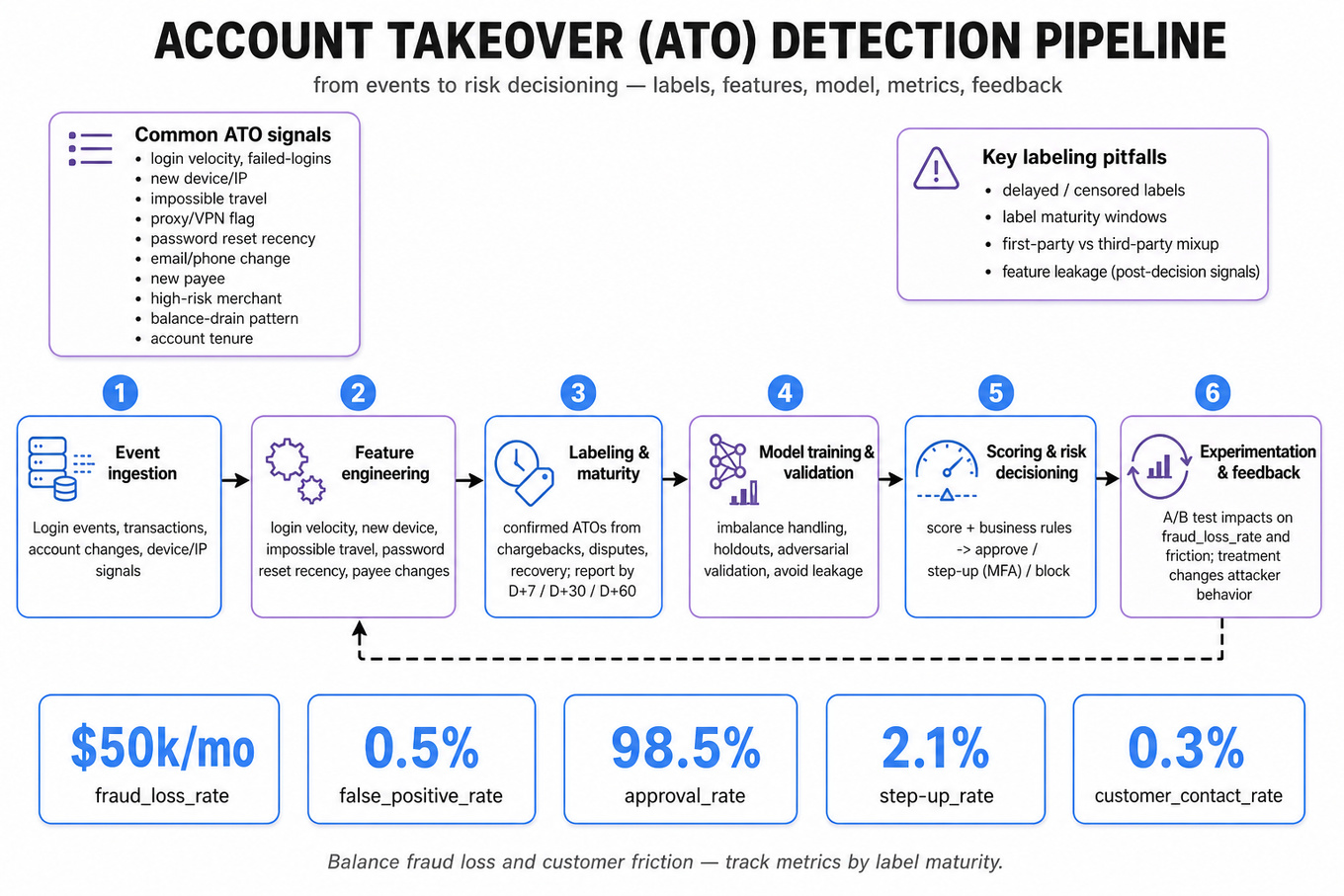
Interviewers are probing whether you can reason about account takeover detection as both a machine learning problem and a risk decisioning problem: defining labels, choosing signals, evaluating models under class imbalance, and quantifying business impact. For PayPal, the stakes are asymmetric: missed ATO creates fraud losses and customer harm, while false positives create payment friction, support contacts, and lost trust. A strong Data Scientist answer connects model quality to operational metrics like fraud_loss_rate, false_positive_rate, approval_rate, step-up_rate, and customer_contact_rate. You are also expected to understand experimentation constraints in fraud: adversarial behavior, network spillovers, delayed labels, and the fact that “treatment” may change attacker behavior.
Core knowledge
-
ATO mechanics usually involve credential compromise, suspicious login, device change, session hijacking, password reset, payment instrument change, or rapid transaction attempts. Useful framing: separate authentication risk from transaction risk, because signals and labels differ across login, account change, and payment authorization moments.
-
Label quality is central. Positive labels may come from confirmed customer claims, chargebacks, manual review, account recovery, or internal fraud investigations; negatives are often “not yet reported,” not truly clean. Account takeover labels are delayed and censored, so report metrics by label maturity window, e.g.
D+7,D+30,D+60. -
First-party fraud and third-party fraud must not be conflated. ATO is typically third-party: an unauthorized actor controls a legitimate account. First-party fraud involves the real account holder disputing or abusing payment flows. Mixing them can teach the model the wrong behavioral patterns and distort precision.
-
Common ATO features include login velocity, failed-login count, new device, new IP, geolocation distance from historical locations, impossible travel, proxy/VPN flags, password reset recency, email/phone change recency, new payee, high-risk merchant category, transaction amount deviation, balance-draining behavior, and historical account tenure.
-
Feature leakage is a frequent failure mode. Anything observed after the decision point, such as dispute creation, manual review outcome, or post-transaction account lock, cannot be used for authorization-time prediction. For each feature, state the prediction timestamp and verify the feature would exist before that timestamp.
-
Model choices are usually less important than data and evaluation. Strong tabular baselines include logistic regression, random forest,
XGBoost, andLightGBM; deep sequence models can help if session/event histories are rich. For DS interviews, emphasize calibration, lift, stability, and decision thresholds over model architecture details. -
Class imbalance is extreme: true ATO may be basis points of all logins or transactions. Accuracy is nearly useless. Prefer
precision,recall,PR-AUC,ROC-AUC,recall@FPR,precision@review_capacity,lift_at_k, and expected value: -
Thresholding should be cost-sensitive, not purely statistical. A transaction block, step-up authentication, manual review, and silent monitoring have different costs. A good answer proposes multiple action bands: low risk approve, medium risk step-up, high risk hold/review, extreme risk block.
-
Calibration matters when risk scores drive policy. A model with good rank ordering but poor probability calibration may still support top-k review, but not expected-loss thresholds. Mention
Platt scaling, isotonic regression, and calibration plots by segment such as new users, high-value transactions, and cross-border activity. -
Offline evaluation must mimic production decisioning. Use time-based train/validation/test splits, not random splits, because fraud patterns drift. Report performance by cohort: account age, device age, geography, payment method, transaction amount band, and merchant category. Watch for overfitting to one fraud campaign.
-
Experiment design for ATO controls is tricky because treatment can affect attackers and users beyond the randomized unit. Randomizing at transaction level may contaminate users who make multiple attempts; randomizing at account, device cluster, or risk segment can reduce interference. Use cluster-robust standard errors when randomization or outcomes are correlated.
-
Power analysis must translate statistical detectability into business impact. For a binary metric, a rough sample size per arm is:
but fraud loss is heavy-tailed, so also consider winsorized loss, bootstrap confidence intervals, or CUPED-style variance reduction when pre-period behavior is predictive.
Worked example
For Design an A/B for ATO rule, a strong candidate starts by clarifying the decision: “Is the new rule blocking transactions, triggering step-up authentication, or sending cases to manual review?” Then they ask for the target population, current ATO rate, expected friction cost, label maturity window, and whether attackers can observe treatment. The answer can be organized around four pillars: experimental unit, primary/guardrail metrics, power and duration, and monitoring/rollback. For randomization, account-level or device-cluster-level assignment is often safer than transaction-level assignment because a single compromised account may generate multiple correlated attempts. The primary metric might be confirmed ATO_loss_per_1k_transactions or net_loss_saved, while guardrails include approval_rate, step-up_success_rate, false_positive_contact_rate, and good_user_decline_rate. A specific tradeoff to flag is that blocking more transactions can mechanically reduce measured fraud while also suppressing legitimate activity, so the experiment needs both fraud and customer-friction outcomes. Sequential monitoring should be pre-specified, using alpha-spending or Bayesian monitoring rather than repeatedly peeking at p_value < 0.05. Close by saying that, with more time, you would segment results by new device, account tenure, payment amount, and geography to ensure the rule is not only profitable on average but robust across important cohorts.
A second angle
For Explain fraud types and evaluate a fraud model, the same concept shifts from experimentation to model diagnosis. Instead of starting with randomization, begin by defining the fraud taxonomy: ATO, stolen card, synthetic identity, friendly fraud, seller fraud, and phishing-driven credential compromise. The key is to explain how labels differ and why a model trained on chargebacks may miss ATO cases resolved through account recovery before a chargeback occurs. Evaluation should emphasize PR-AUC, recall_at_fixed_FPR, precision_at_manual_review_capacity, and business expected value rather than accuracy. The strongest answers also discuss delayed ground truth, calibration, threshold selection, and whether the model performs consistently across high-risk but legitimate user segments.
Common pitfalls
Pitfall: Treating ATO detection as a generic binary classifier.
A tempting answer is “train XGBoost, optimize AUC, and deploy the best model.” That misses the real issue: ATO decisions are cost-sensitive, labels are delayed, and action thresholds depend on whether the intervention is block, step-up, or review. A better answer ties every metric to fraud loss avoided and legitimate-user harm.
Pitfall: Ignoring interference in an A/B test.
Randomizing every transaction independently sounds clean, but compromised accounts and fraud rings create correlated outcomes. If attackers learn that some attempts are blocked, they may adapt across accounts or devices. A stronger response discusses account-level or cluster-level randomization, cluster-robust inference, and pre-defined rollback thresholds.
Pitfall: Over-indexing on signals without checking timing.
Candidates often list strong signals like dispute outcome, account lock, or manual review result as features. Those may be valid labels or evaluation outcomes, but they are leakage if unavailable at authorization time. Always anchor features to a prediction timestamp: login-time, account-change-time, or transaction-time.
Connections
Interviewers may pivot from ATO detection into fraud experimentation, model calibration, anomaly detection, causal inference under interference, or SQL-based risk analytics using window functions and cohort definitions. They may also ask how to balance fraud reduction against customer experience, which turns the discussion into threshold optimization and guardrail metric design.
Further reading
-
Provost and Fawcett, Data Science for Business — practical treatment of lift, expected value, and thresholding for business decisions.
-
Saito and Rehmsmeier, “The Precision-Recall Plot Is More Informative than the ROC Plot When Evaluating Binary Classifiers on Imbalanced Datasets” — useful grounding for why
PR-AUCmatters in rare-event fraud problems. -
Kohavi, Tang, and Xu, Trustworthy Online Controlled Experiments — strong reference for A/B testing, guardrails, peeking, and experiment interpretation.
Featured in interview prep guides
Practice questions
- Explain fraud types and evaluate a fraud modelPayPal · Data Scientist · Technical Screen · hard
- Design an A/B for ATO rulePayPal · Data Scientist · Technical Screen · hard
- Write SQL to flag Venmo ATOPayPal · Data Scientist · Technical Screen · medium
- Analyze Transactions for Risk and Implement Mitigation StrategiesPayPal · Data Scientist · Onsite · medium
- Assess card transactions and plan risk strategyPayPal · Data Scientist · Onsite · hard
Related concepts
- Fraud, Bot, And Fake Account Detection
- Fraud Risk Modeling And Real-Time DecisioningML System Design
- Transactional Banking System DesignSystem Design
- Fake Account, Bot, And Fraud MeasurementAnalytics & Experimentation
- Trust, Safety, Fake Accounts, And FraudMachine Learning
- Platform Integrity: Fake Accounts, Bots, Fraud, And Harmful ContentAnalytics & Experimentation