Bayes' Theorem And Base-Rate Reasoning
Asked of: Data Scientist
Last updated
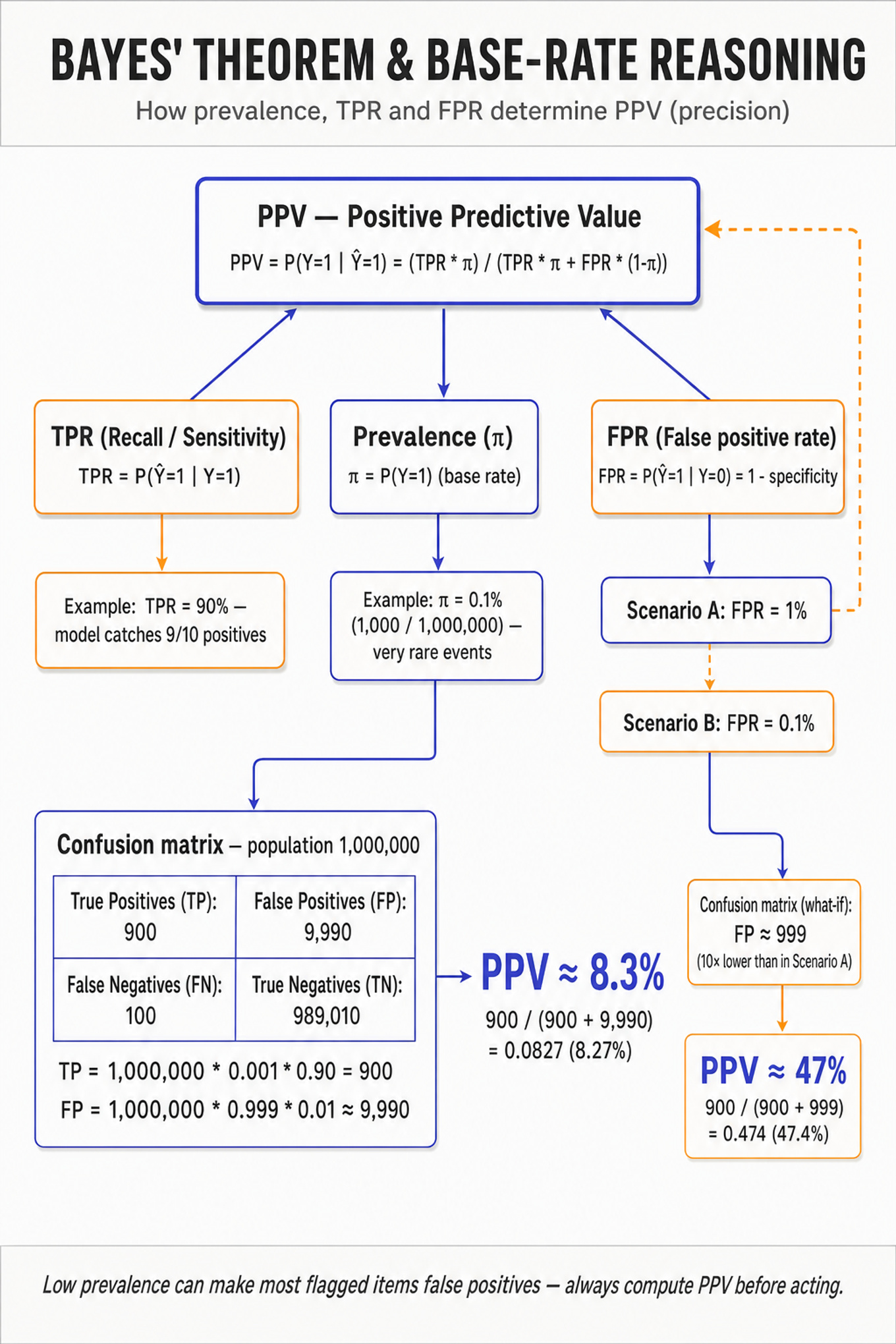
What's being tested
Interviewers are testing whether you can reason from classifier performance metrics and base rates to the probability that actually matters for a product decision: “given the signal fired, how likely is the case truly fraud/fake/positive?” For a Meta Data Scientist, this shows up in integrity systems, ads quality, account security, content moderation, ranking diagnostics, and model evaluation, where rare events make raw accuracy misleading. The interviewer is probing whether you can set up conditional probabilities cleanly, avoid base-rate neglect, and translate posterior probabilities into thresholding, review-load, or risk tradeoffs. They care less about memorizing Bayes’ theorem and more about whether you can interpret model outputs under real-world prevalence and decision costs.
Core knowledge
-
Bayes’ theorem converts from “how often a model catches positives” to “how likely a flagged item is truly positive”:
For classifiers, -
Base rate or prevalence is , often tiny in fraud, fake-account, or policy-violation settings. Even a highly accurate classifier can produce many false positives if the positive class is rare, because dominates the denominator.
-
Sensitivity, also called true positive rate or recall, is . Specificity is , so false positive rate is .
-
Positive predictive value is the posterior probability of being truly positive after a positive model result:
where . -
Negative predictive value is the analogous posterior after a negative result:
This matters when estimating residual risk among accounts or sessions the model clears. -
Accuracy can be useless for rare events. If fraud prevalence is 0.1%, a model predicting “not fraud” for everyone has 99.9%
accuracybut zero fraud detection. Preferprecision,recall,FPR,AUC-PR, and cost-weighted expected loss. -
Confusion-matrix counts make Bayesian reasoning concrete. For an imagined population of 1,000,000 users, compute expected true positives, false positives, true negatives, and false negatives. This often prevents denominator mistakes and gives an operational sense of human review volume.
-
Likelihood ratios are a compact alternative:
A positive signal has likelihood ratio . This is useful when combining multiple independent-ish signals. -
Independence assumptions are dangerous when combining flags. Two abuse classifiers trained on overlapping features, such as account age, device reputation, and graph connectivity, are correlated; multiplying likelihood ratios naively can overstate confidence. A DS should ask whether signals are conditionally independent or calibrated jointly.
-
Calibration differs from ranking quality. A model like
XGBoost, logistic regression, or a neural ranking model may separate positives well but output poorly calibrated probabilities. Use reliability curves,Brier score, isotonic regression, Platt scaling, and calibration by segment before interpreting scores as probabilities. -
Threshold choice should reflect costs. For integrity review, a higher threshold increases
precisionand reduces review load but misses more harmful cases; a lower threshold increasesrecallbut may create user harm through false enforcement. The posterior is an input to this decision, not the whole decision. -
Segment-level base rates matter. Prevalence may differ by geography, account age, surface, advertiser type, or traffic source. Applying a global posterior to a high-risk cohort or low-risk cohort can mislead; compute when segment sizes support it.
Worked example
For Calculate Posterior Fraud Probability Using Bayes' Theorem, a strong candidate would first clarify what the “positive” event means: model flags fraud, transaction is truly fraud, or a user/session is fraudulent. They would ask for or restate the prior fraud rate, the model’s true positive rate, and its false positive rate, then declare that they are assuming these metrics are measured on a representative population. The answer skeleton is: define events, write Bayes’ theorem, expand the denominator using the law of total probability, plug in classifier rates, then interpret the result as precision or posterior fraud probability.
They would explicitly say that the denominator is not just the true-positive path; it includes both true frauds flagged and legitimate cases incorrectly flagged. A good framing might use expected counts in a hypothetical population, because Meta-scale systems often care about review queues, enforcement errors, and aggregate user impact. The key tradeoff to flag is that a high TPR can still yield a low posterior if fraud is rare and FPR is not extremely small. They should avoid jumping from “the model is 99% accurate” to “a flagged item is 99% fraud,” because those are different conditional probabilities. They could close by saying, “If I had more time, I’d check calibration, estimate this by segment, and compare the posterior to the cost threshold for manual review or automatic action.”
A second angle
For Compute fraud probabilities with Bayes and Binomial, the same reasoning applies, but there is an added layer: repeated events across sessions. Instead of only asking for , the candidate may need to model the probability of observing suspicious events out of sessions using a Binomial distribution: The Bayesian part then updates the probability a user is fraudulent after seeing a pattern of session-level outcomes. The key constraint is whether sessions are independent and identically distributed; in real Meta abuse contexts, sessions from the same account are often correlated because device, network, and behavioral features persist. A strong DS answer would state the simplifying independence assumption, compute under that assumption, and then explain how correlation would affect confidence.
Common pitfalls
Pitfall: Confusing with .
This is the classic analytical mistake: treating recall as the probability that a flagged case is truly positive. A better answer names the two directions, writes Bayes’ theorem, and shows that the posterior depends on prevalence and the false positive rate.
Pitfall: Saying “the model is 99% accurate, so the flag is reliable” without discussing prevalence.
This communication mistake sounds confident but misses the main interview signal. In rare-event settings, accuracy can be dominated by true negatives; a stronger response says, “I’d want sensitivity, specificity, and the base rate, because precision may still be low.”
Pitfall: Stopping at the arithmetic and not interpreting the product decision.
A depth mistake is to compute the posterior but not connect it to action. For a DS role, add whether the result is high enough for auto-blocking, manual review, ranking demotion, or further evidence collection, and mention how different false-positive and false-negative costs change the threshold.
Connections
Interviewers may pivot from here to precision-recall tradeoffs, model calibration, threshold optimization, or expected loss under asymmetric business costs. They may also ask about A/B testing a new classifier threshold, cohort-level metric movement such as false_positive_rate by segment, or causal interpretation when enforcement changes the future observed prevalence.
Further reading
-
An Introduction to Statistical Learning — Clear treatment of classification metrics, probability estimates, and model evaluation.
-
[Pattern Recognition and Machine Learning, Christopher Bishop] — Deeper Bayesian framing for likelihoods, priors, posteriors, and classification.
-
[The Signal and the Noise, Nate Silver] — Accessible intuition for base rates, Bayesian updating, and probabilistic reasoning under uncertainty.
Practice questions
- Compute posterior fake probability using Bayes' ruleMeta · Data Scientist · Technical Screen · medium
- Quantify base-rate dilution in CTRMeta · Data Scientist · Technical Screen · easy
- Compute posterior for accurate-but-rare classifierMeta · Data Scientist · Onsite · medium
- Compute conditional occupancy across two roomsMeta · Data Scientist · Onsite · easy
- Compute posterior and event counts in fraud screenMeta · Data Scientist · Onsite · medium
- Determine Probability of Friend Request Being FakeMeta · Data Scientist · Onsite · easy
- Calculate Posterior Probability of Flagged User Being Bad ActorMeta · Data Scientist · Onsite · easy